
Key Takeaways
- A website that looks polished can still fail commercially if its information architecture, CTA placement, and page hierarchy were not planned before a single design element was created.
- The choice between a WordPress-based build and a fully custom build should be determined by content update frequency, third-party integration requirements, and the business’s internal capacity to maintain the site, not by which option sounds more impressive.
- Responsive design is a baseline technical requirement in 2025, not a value-added feature; agencies that present it as a differentiator are not operating from a current state of practice.
- Years in business only translate to better client outcomes when an agency has demonstrably adapted through major platform and algorithm shifts, not simply repeated the same process over time.
- Web design decisions made at the wireframe stage directly constrain what SEO and conversion optimization can achieve later, which means separating “build” from “marketing strategy” is a structural mistake.
A web design project fails before it goes live more often than after. The failure point is almost always the same: a business owner evaluated agencies on visual style and quoted scope, signed a contract, and only discovered the strategic gaps once the site was live and underperforming. This article gives Dayton-area business owners a concrete decision-making framework, covering how to distinguish genuine custom work from dressed-up templates, how design choices at the planning stage determine conversion outcomes, and what questions separate an agency that has grown through experience from one that has simply aged.
Why Most Dayton Websites Underperform Before Launch
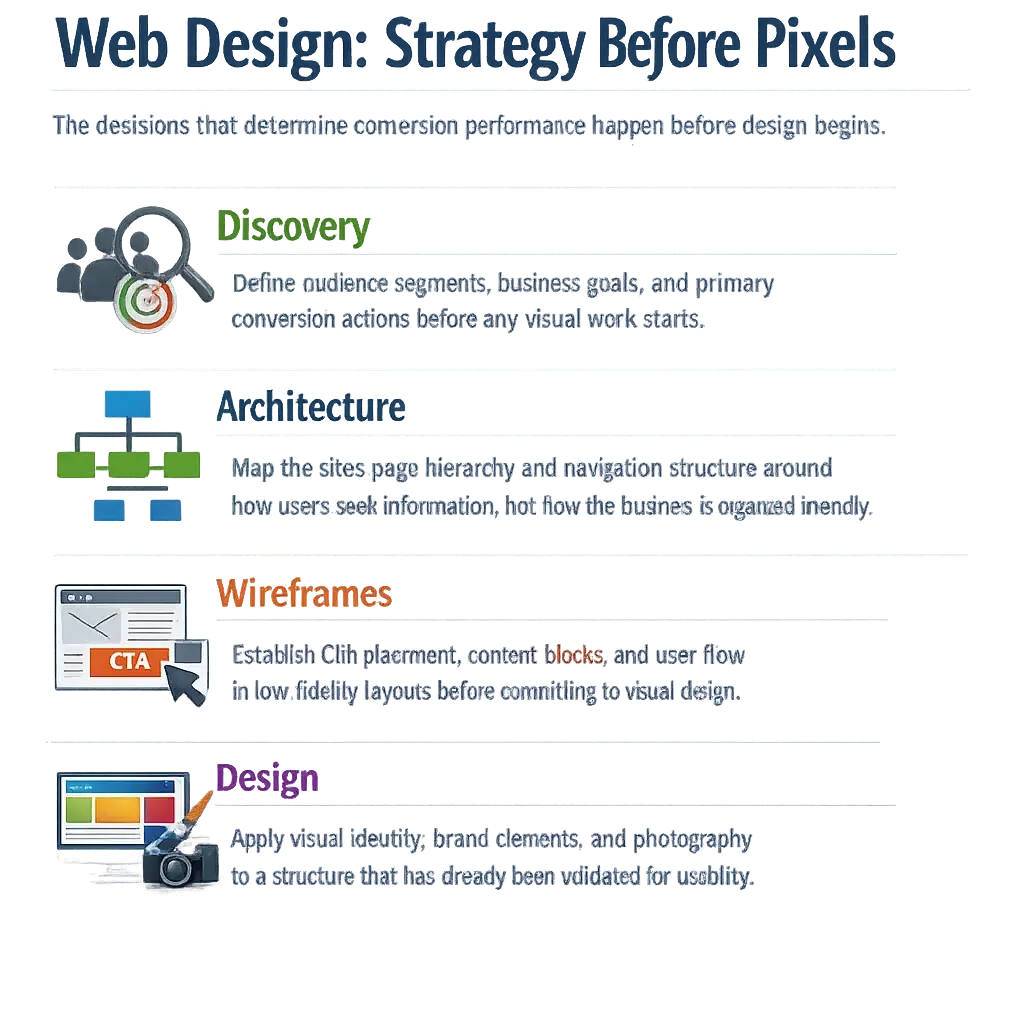
The single most expensive mistake in web design is treating it as a visual exercise. Design is the last step. Strategy is the first.
When an agency skips a formal discovery and strategy phase, the consequences show up as: navigation structures that bury the most-requested information, calls to action placed where users are not looking, and page hierarchies built around what the client wants to say rather than what the visitor needs to find. All of this is invisible on a design mockup and only measurable once real traffic hits the live site.
A business owner in Beavercreek or Centerville evaluating web design proposals should ask one direct question before anything else: “Walk me through your discovery process before the design phase begins.” An agency that has a structured answer, covering audience research, competitor analysis, conversion goal mapping, and sitemap architecture, is operating from a fundamentally different methodology than one that asks for your logo and existing copy and starts building pages. Understanding how to choose a web design agency for your small business before signing any contract can save months of remediation work after launch.
(https://web.dev/articles/a11y-tips-for-web-dev) baked in from the start.”; footer=”Mongoose Digital Marketing”]
The Template vs. Custom Build Decision: A Practical Framework
The debate between WordPress-based builds and fully custom development is often framed as a quality argument. It is not. It is a strategic fit argument, and the right answer depends on three specific factors.
Factor 1: Content Update Frequency
If the business owner or an internal team member needs to update content regularly, add blog posts, change service pages, or swap out seasonal promotions, a well-configured WordPress build with a clean page builder gives them that capability without a development ticket for every change. A fully custom-coded site without a content management layer creates dependency on the agency for tasks that should be routine. The article WordPress for Small Businesses: What Agencies Won’t Tell You covers this dependency dynamic in detail and is worth reviewing before committing to a platform.
Factor 2: Third-Party Integration Requirements
Businesses in Huber Heights or Miamisburg running eCommerce, appointment scheduling, CRM integrations, or patient portal connections may have requirements that exceed what a theme-based build handles cleanly. Custom development allows precise control over how data moves between systems. The integration requirements, not the aesthetic preference for “custom,” are what justify the additional complexity.
Factor 3: Internal Technical Capacity
Who will maintain the site in 12 months? If the answer is “our front desk manager,” that person needs a system they can operate without training. If the answer is “our in-house developer,” the build methodology can afford to be more technically demanding. The honest conversation about post-launch ownership is one that many agencies avoid because it sometimes argues against the more expensive build option.
Need a hand with this in Dayton, Kettering and the Triad? Call (937) 848-0086 or request a free estimate. Honest answers, no pressure.
How to Evaluate Whether an Agency’s Experience Is Generative or Static
Longevity in web design is only meaningful if the agency navigated platform transitions, algorithm changes, and shifting user behavior, and made deliberate strategic adjustments at each point. An agency that has built websites the same way since 2003 is not experienced; it is entrenched.
When evaluating an agency serving the Kettering or Springboro market, these questions separate adaptive experience from static repetition:
Questions that reveal generative experience:
- How did your approach to mobile design change between 2012 and 2018, and what drove those changes?
- When Google’s Core Web Vitals became a ranking signal, what specific technical changes did you make to existing client sites?
- Can you describe a project where you recommended against the client’s initial design direction based on conversion data? What was the outcome?
- What does your process look like for an industry where online conversion is difficult, such as professional services or B2B?
Portfolio evaluation criteria:
| What You See | What It Tells You | What to Ask Instead |
|---|---|---|
| Design thumbnails | Visual style only | What was the conversion goal for this site? |
| Client names and logos | Client roster breadth | What measurable outcome did this client achieve post-launch? |
| “Responsive design” callout | Baseline compliance | How do you address Core Web Vitals performance scores? |
| Years in business | Tenure, not competency | How has your methodology changed in the last three years? |
| “Custom design” claim | Marketing language | What specifically distinguishes your build from a premium template? |
The Design-to-SEO Dependency: Why Separating Them Costs You Twice
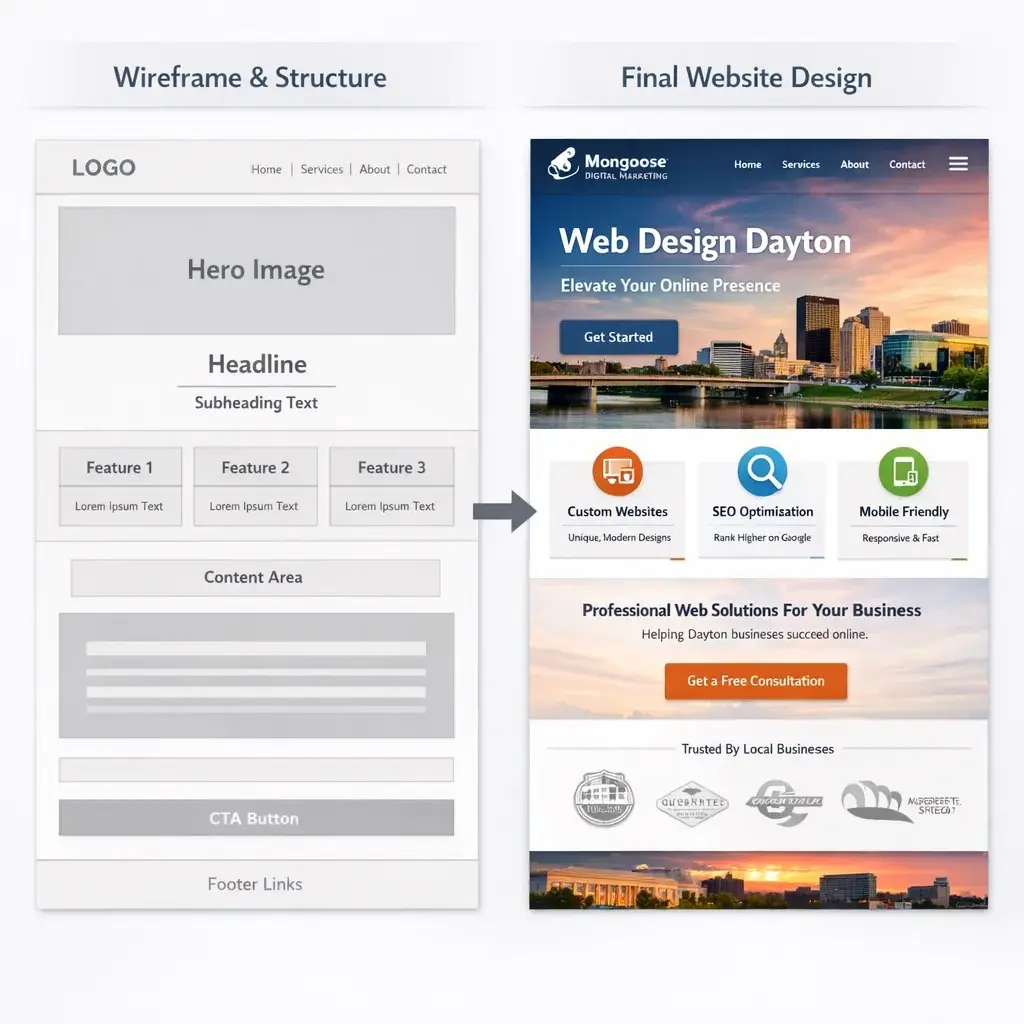
Web design and SEO are treated as separate services by most agencies. They are not separate disciplines. The decisions made during the design and development phase determine what SEO can accomplish after launch, and some of those decisions are expensive or impossible to reverse without a rebuild.
Specific design-phase decisions with direct SEO consequences include:
- URL structure and page hierarchy. A flat site architecture with logical parent-child page relationships supports crawlability. A site built without this structure requires significant restructuring to correct later.
- Heading tag usage. Decorative use of H1 and H2 tags for visual sizing rather than semantic meaning undermines on-page optimization. This is set in the CMS template configuration during development.
- Image handling. Sites built without lazy loading, next-gen image formats, or alt text standards baked into the template structure will consistently underperform on page speed and image search.
- Internal linking architecture. The navigation structure designed during wireframing determines how link equity flows through the site. A redesign that changes navigation later disrupts that flow.
- Schema markup. Structured data for local businesses, service pages, and reviews is implemented at the development stage. Sites built without it require developer access to add later.
For businesses in Dayton or the surrounding communities, working with an agency that treats web design and SEO services as interconnected from the first meeting means the site that launches is not one that needs immediate remediation. It means the build itself is a marketing asset from day one.
What Mongoose Digital Marketing Does Differently
Mongoose builds websites for Dayton-area businesses as integrated growth systems, not standalone design projects. The discovery phase establishes conversion goals before wireframes are drawn. The architecture is built around how target audiences navigate decisions in your specific industry. Development includes SEO technical requirements as standard, not as an add-on.
The result is a site that is faster to generate leads, easier to optimize over time, and aligned with the broader digital marketing strategy from the moment it goes live. Whether your business is based in Dayton, Kettering, Beavercreek, Centerville, Huber Heights, Miamisburg, or Springboro, the process starts with a free consultation focused on your growth goals, not a template pitch.
Reach out to Mongoose Digital Marketing to start that conversation. You can also review Google’s Core Web Vitals documentation and Search Central’s guidance on site structure to understand the technical standards your next site should be built to meet from the first line of code.
Frequently Asked Questions
How long does a professional web design project typically take for a Dayton-area business?
Most professional website projects for small to mid-sized businesses run between six and twelve weeks from the initial discovery meeting to launch. The timeline depends on the number of pages, the complexity of functionality required, how quickly feedback is provided during review stages, and whether custom photography or copywriting is included in the scope. Businesses that come to the project with clear goals and existing brand assets tend to move through the process faster.
What makes a website design effective for local search in Dayton?
Local search performance depends on decisions made before a single page is published. Site architecture, internal linking structure, page load speed, mobile responsiveness, and properly implemented schema markup for local businesses all contribute to how well a site performs in Dayton-area search results. A website that looks polished but was built without these technical foundations in place will struggle to rank against competitors whose sites were built with local SEO as part of the original plan. The article Web Design Best Practices for SEO in 2026 outlines the current technical benchmarks every Dayton business site should meet.
Should a Dayton business redesign an existing website or build a new one from scratch?
That depends on what the current site is doing well and where it is failing. If the existing site has strong domain authority, established backlinks, and content that ranks, a redesign preserving that equity is usually the better path. If the current site was built on a limiting platform, has significant technical debt, or never performed as a marketing tool, starting with a properly architected build is often the faster route to results. A good agency will audit the existing site before recommending either approach.
Does Mongoose Digital Marketing work with businesses outside of Dayton proper?
Yes. Mongoose Digital Marketing works with businesses throughout the greater Dayton region, including Kettering, Beavercreek, Centerville, Huber Heights, Miamisburg, and Springboro. The same integrated process, discovery, architecture, development, and SEO, applies regardless of which community a business is based in. The goal in every case is a site that functions as a growth asset for that specific business and its local market.
Conclusion
Businesses in Dayton and Beavercreek deserve a web design partner that understands both the local market and the technical standards that determine whether a site actually drives growth. Mongoose Digital Marketing builds websites as integrated systems, where design, development, and SEO strategy work together from the first conversation rather than being patched together after launch. To talk through what that looks like for your business, call (937) 848-0086 or Contact Mongoose Digital Marketing to start with a free consultation.