
Key Takeaways
- SEO tasks have hard dependencies, meaning backlinks pointing to a page with thin content or broken conversion paths do not compound into results the way most buyers expect.
- The most significant cost in SEO is rarely the monthly retainer; it is the time and budget spent replacing work that was executed in the wrong sequence.
- “Affordable” is a contextual label, not an absolute one; the right scope of SEO work is determined by your site’s current constraint, whether that is technical debt, weak authority, or poor conversion architecture.
- AI search engines (ChatGPT, Perplexity, Google’s AI Overviews) reward content that is structured, attributable, and direct, which requires different formatting decisions than traditional SERP optimization.
- Businesses in the Dayton metro area, including Kettering, Beavercreek, Centerville, Huber Heights, Miamisburg, and Springboro, compete in a market where local SEO precision and conversion-ready pages are often the highest-leverage starting point.
Getting real return from SEO investment comes down to one principle that most service providers sidestep: the right work done in the right order compounds, and the wrong work done first creates debt that has to be paid off before any subsequent investment can gain traction. That principle changes how you should evaluate what any SEO service is offering, regardless of where it sits on the price spectrum.
This article is a practical framework for business owners who want to buy SEO services with the same rigor they would apply to any capital decision. It covers how to read an SEO proposal, why the sequence of deliverables matters more than the volume of deliverables, and how the emergence of AI-driven search changes what “good SEO” actually requires from the ground up.
Why Affordable SEO Is a Contextual Judgment, Not a Price Tag
The word “affordable” is doing almost no analytical work in most SEO conversations. Buyers encounter it as a positioning term, and it functions as one. What it rarely communicates is the actual variable that determines whether a given scope of SEO work represents sound investment: the relationship between the cost of the engagement and the constraint that is actually limiting your organic growth.
A new domain with zero backlinks has a different binding constraint than a four-year-old website with 300 indexed pages, a confusing URL structure, and five service pages that each accidentally target the same keyword. In the first case, authority-building and foundational content are the leverage point. In the second, the constraint may be crawl inefficiency or keyword cannibalization, and buying more backlinks before resolving those issues will produce results that are frustratingly slow to materialize.
Affordable SEO, properly understood, means: the scope of work that addresses your site’s actual binding constraint at a price that makes sense relative to the revenue opportunity those rankings represent. That definition requires knowing your constraint before committing to a scope of services.
The Site Maturity Variable Nobody Talks About
Every site exists at a stage of organic development that determines which SEO activities have the most leverage. There are three broad stages worth understanding:
New sites (zero to twelve months of organic history): The primary constraints are authority and crawlability. Search engines have limited data about the site’s topical relevance. The highest-leverage activities are technical foundation (crawlable architecture, canonical structure, mobile performance), foundational keyword targeting on core service pages, and early-stage authority signals through legitimate link acquisition.
Established sites with organic history: These sites have accumulated data. The constraints shift. Common problems include keyword cannibalization across multiple pages targeting the same terms, thin content on pages that rank but do not convert, and internal linking structures that fail to pass authority to the pages that matter most commercially.
Sites with penalty history or significant technical debt: For these sites, the constraint is not content or authority. It is remediation. Buying content or link-building services before resolving manual actions or crawl budget problems is equivalent to adding fuel to a vehicle with a broken engine. The remediation work comes first, and any provider who leads with content volume or link packages before auditing the technical health of your site is not sequencing work to serve your growth.
The Dependency Map: Why Sequence Determines ROI
SEO deliverables are not interchangeable. Each layer of optimization depends on the stability of the layer beneath it. When that dependency structure is ignored, each subsequent investment produces diminishing returns at best and contradictory signals at worst.
Here is how the dependency chain works in practice:
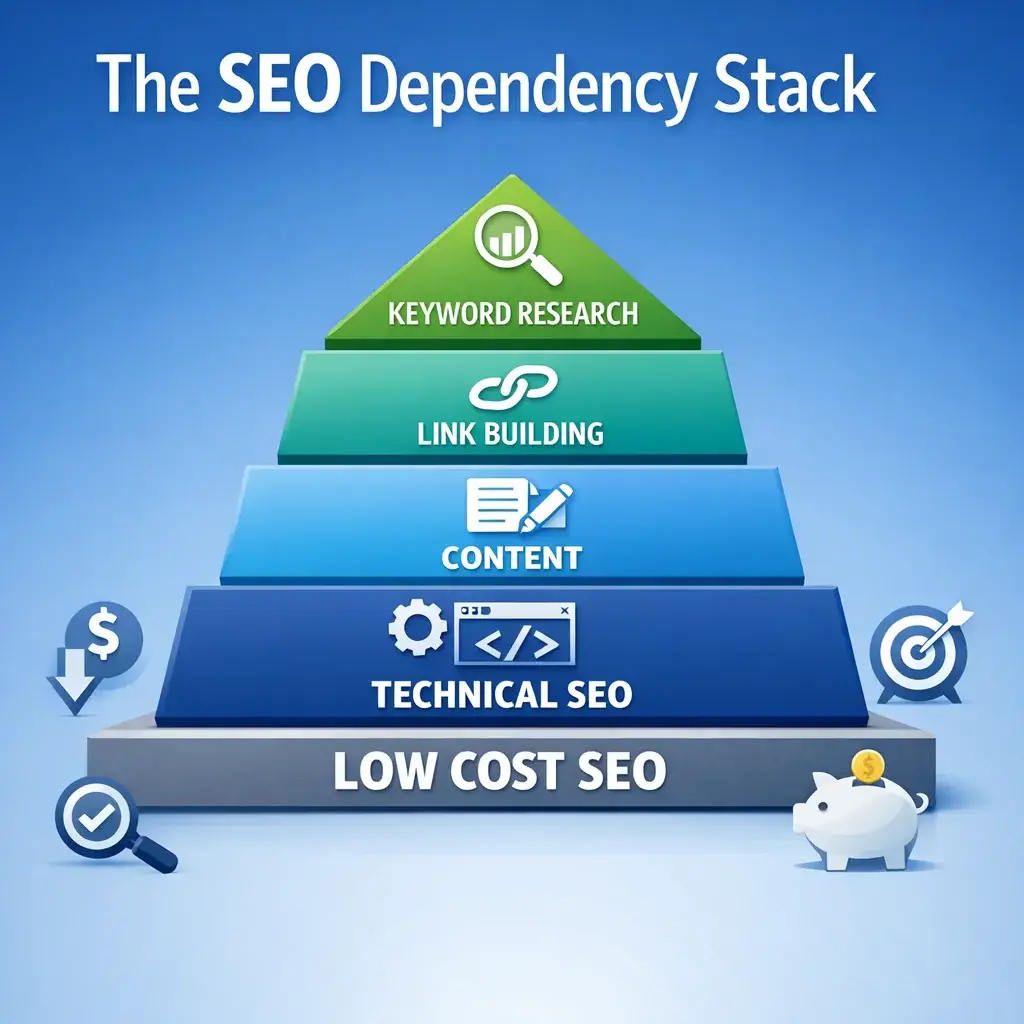
The failure mode at each skipped layer is specific:
- Backlinks before technical foundation: Links pointing to a page that loads slowly, has duplicate content issues, or exists in a crawl trap do not accumulate domain authority effectively. The authority signal is diluted or misdirected.
- Content volume before conversion architecture: Publishing fifteen blog posts before your core service pages have a clear call to action, a working contact form, and basic conversion tracking produces traffic data that misleads future keyword decisions. You see visits and conclude the content is working. The leads data tells a different story.
- Authority campaigns before keyword cannibalization is resolved: When multiple pages target the same keyword, search engines distribute ranking signals across all of them rather than concentrating them on one. Running a link-building campaign into a cannibalized site structure means you are building signals that cancel each other.
This is not a theoretical concern. It is the primary reason well-intentioned SEO budgets produce underwhelming results. The intervention was real, but it was applied to the wrong layer at the wrong time.
Need a hand with this in Dayton, Kettering and the Triad? Call (937) 848-0086 or request a free estimate. Honest answers, no pressure.
Reading an SEO Proposal: The Decision Rubric
When you receive a list of SEO deliverables, the natural instinct is to evaluate it by volume. More items feels like more value. That instinct is exactly what low-quality providers exploit.
The correct evaluation framework is sequence and justification, not volume.
Questions That Separate Sequenced Strategy from Activity Lists
Apply these questions to any SEO proposal before signing:
| Evaluation Question | What a Strong Answer Looks Like | What a Weak Answer Looks Like |
|---|---|---|
| What is the primary constraint limiting our organic growth right now? | Specific identification based on audit: “Your crawl coverage is poor; 40% of your URLs are either redirected or return errors, which is limiting indexation of your service pages.” | Generic: “You need better SEO across the board.” |
| Why is this deliverable sequenced before that one? | Causal logic: “We are fixing technical architecture before building content because new content on a poorly crawled site will not be indexed reliably.” | Activity-first answer: “We do these together in Month 1.” |
| How does each activity connect to a business outcome? | Specific: “Improved service page rankings for [keyword category] are expected to increase qualified contact form submissions.” | Vague: “Better rankings lead to more traffic and more business.” |
| What does the conversion path look like for traffic we generate? | Acknowledges and audits form function, call tracking, page CTA structure before campaign begins. | Not mentioned; treated as the client’s concern. |
| How will we know if this work is succeeding before the ranking moves? | Intermediate signals: crawl coverage improvement, indexed page count, click-through rate from existing impressions. | “Rankings take 3-6 months, so we will check then.” |
| How does this scope account for our competitive landscape? | References specific competitors and their authority profiles to justify scope. | Fixed package with no mention of competitive context. |
The answers to these questions tell you whether an agency is sequencing work to address your site’s actual constraint or packaging their easiest-to-deliver services as a standardized offer. If you are working through this evaluation process for the first time, the article on how to choose a local SEO company that actually works provides additional criteria worth applying before you commit to any engagement.
The Conversion Path Problem: When Rankings Are Not the Bottleneck
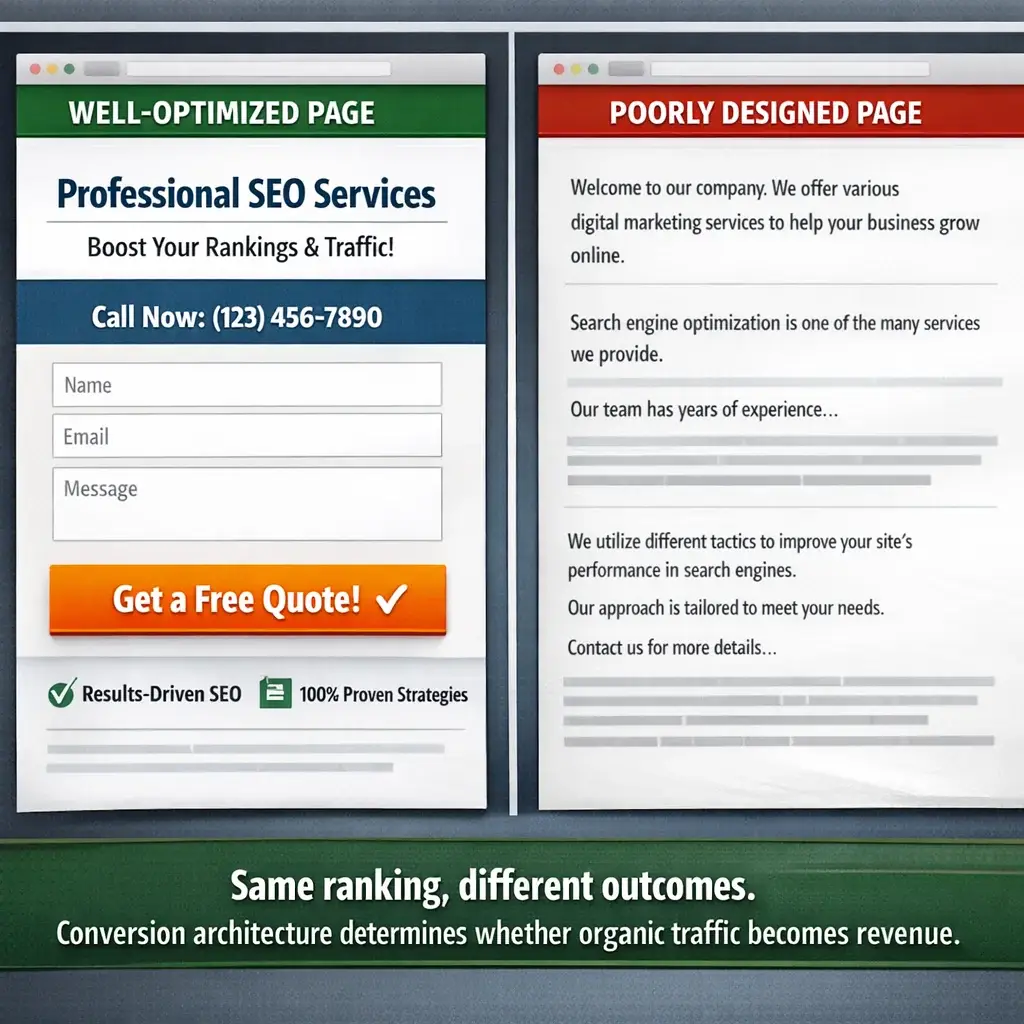
One of the most consistently overlooked dimensions of SEO value is the downstream infrastructure that captures the traffic SEO generates. A page that ranks on page one for a high-intent keyword and sends visitors to a form that does not submit on mobile, a phone number that goes to a voicemail that is never checked, or a page layout that buries the call to action below thousands of words of supporting content is not underperforming because of SEO. It is underperforming because the conversion path is broken.
This matters to the cost-effectiveness calculation because the same improvement in organic traffic produces dramatically different revenue outcomes depending on conversion infrastructure. A site with solid technical SEO, good rankings, and a 1% lead conversion rate and a site with identical rankings and a 4% conversion rate are not comparable investments. The SEO spend is the same; the return is not.
Any SEO engagement worth the investment should begin with an honest assessment of conversion readiness: are the forms working, is the phone number tracked, does the page layout guide visitors toward a clear next action? This is not a web design upsell. It is a prerequisite for knowing whether SEO results are actually translating into business outcomes.
AI Search and What It Changes About Core SEO Decisions
AI-generated search surfaces, including Google’s AI Overviews, ChatGPT’s web-browsing responses, and Perplexity’s answer engine, are not simply a new channel layered on top of traditional SEO. They represent a different optimization target that requires different decisions at the content structure level.
Traditional SEO optimizes for a crawler that indexes pages, evaluates relevance signals, and ranks them in a list. The content that performs well in that environment tends to be comprehensive, internally linked, and structured around keyword density and topical authority signals.
AI search optimizes for a language model that synthesizes answers from multiple sources and surfaces content that is quotable, attributable, and structured enough to extract as a direct answer. A page that performs well in AI surfaces tends to feature:
- Clear, direct answers to specific questions positioned near the top of the page
- Structured content using headers that align with question syntax
- Schema markup that communicates entity relationships to automated systems
- FAQ sections with concise, complete answers rather than answers that require reading the surrounding context
- Author and source attribution signals that help AI systems assess credibility
The important strategic implication is that these are not add-on services to be retrofitted once a site is ranking. They are formatting and architecture decisions that affect how core content is written and organized from the beginning. A service page written and structured for AI readiness and traditional ranking simultaneously requires intentional decisions about content length, header syntax, and answer completeness that are different from a page written purely for keyword density.
For businesses in the Dayton metro, including those serving Kettering, Beavercreek, Centerville, Huber Heights, Miamisburg, and Springboro, this has a practical implication: local service queries are increasingly being answered directly in AI surfaces with attribution to specific businesses. Optimizing for that surface means structured, direct, and credible content is not optional infrastructure. It is the baseline.
What Good SEO Oversight Looks Like as a Business Owner
Buying SEO services without a framework for evaluating ongoing performance is one of the most common ways SEO engagements stall. Providers can stay busy with activity that does not move the metrics that matter.
The performance signals worth tracking are layered. In the early months, before ranking improvements are visible, the meaningful signals are technical: indexed page count improving, crawl errors decreasing, page speed scores moving. These are leading indicators that the foundational work is functioning. Mid-engagement signals shift toward search impressions and click-through rates from Google Search Console, which show whether targeted pages are appearing for the right queries before they reach the first page. Revenue-stage signals are qualified leads and conversion rate on organic traffic, tracked separately from paid traffic.
A provider who cannot tell you what the intermediate signals should look like during the first 90 days of an engagement is either not sequencing work with your constraint in mind or is not measuring the right things. Either way, it is a signal worth acting on before the engagement runs long without results.
The businesses that get the most out of SEO investment are the ones that treat it as a growth system with measurable stages, not a monthly subscription to hope. That requires a partner who can explain the logic of the work being done, not just report the activity.
Mongoose Digital Marketing works with businesses across Dayton, Kettering, Beavercreek, Centerville, Huber Heights, Miamisburg, and Springboro to build that kind of system, starting with the constraint that is actually limiting your growth. If you want to understand what that looks like for your specific site, a free consultation is the right starting point.
Frequently Asked Questions
How long does it take to see results from affordable SEO services?
Most businesses begin to see meaningful technical improvements within the first 30 to 60 days, such as better indexing and fewer crawl errors. Ranking and traffic improvements typically become visible between three and six months, depending on the competitiveness of your market and the current condition of your site. SEO compounds over time, so the earlier the foundational work is done correctly, the faster later stages produce visible returns.
What is the difference between cheap SEO and affordable SEO?
Cheap SEO usually means outsourced link schemes, templated content, and activity reports that substitute for actual results. Affordable SEO means right-sized strategy matched to your actual constraints, with work sequenced to produce measurable progress at each stage. The distinction matters because cheap SEO can create technical problems that cost more to fix than the original service saved.
Can small or local businesses compete with larger companies in search results?
Yes, and local search is one of the clearest opportunities for smaller businesses to outperform larger competitors. National brands rarely optimize at the neighborhood or city level the way a focused local provider can. Targeted local content, accurate business listings, and strong on-page signals for specific service areas consistently allow smaller businesses to rank above larger ones for the searches that drive actual local customers.
How do I know if my current SEO provider is doing the right work?
The clearest sign is whether your provider can explain what intermediate signals to expect at each stage of the engagement, not just show activity logs. Indexed page growth, crawl error reduction, and search impression data from Google Search Console are all trackable early indicators. If your provider cannot connect the work being done to specific measurable outcomes at each phase, that is worth addressing directly before the engagement continues without a clear direction.
Conclusion
Businesses in Dayton and Centerville that want SEO to function as a real growth system rather than a recurring expense deserve a partner who can explain the logic behind every phase of the work and measure what actually matters. Mongoose Digital Marketing brings that clarity to clients across the Miami Valley, building SEO strategies grounded in your specific market, your site’s current condition, and the growth stage you are actually in. Call us at (937) 848-0086 or Contact Mongoose Digital Marketing to start with a free consultation and find out exactly what is holding your organic traffic back.