
Key Takeaways
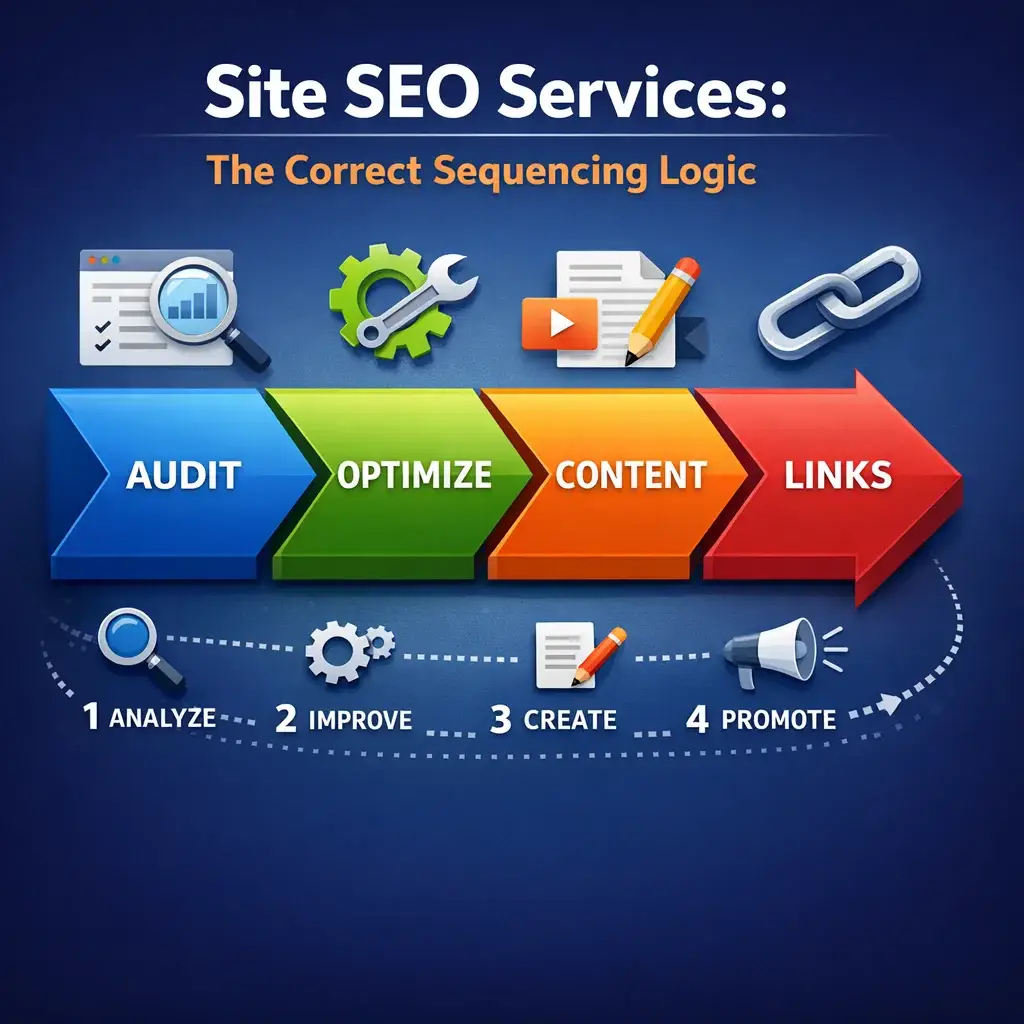
- Site SEO services encompass technical optimization, content strategy, and authority building, and the sequence in which these pillars are addressed directly determines how fast and how durably a site gains organic visibility.
- A website cannot benefit meaningfully from AI search optimization or content scaling until it clears measurable technical thresholds, including a crawlability rate above 95%, an indexation ratio above 80%, and Core Web Vitals scores in the “Good” range across all three metrics.
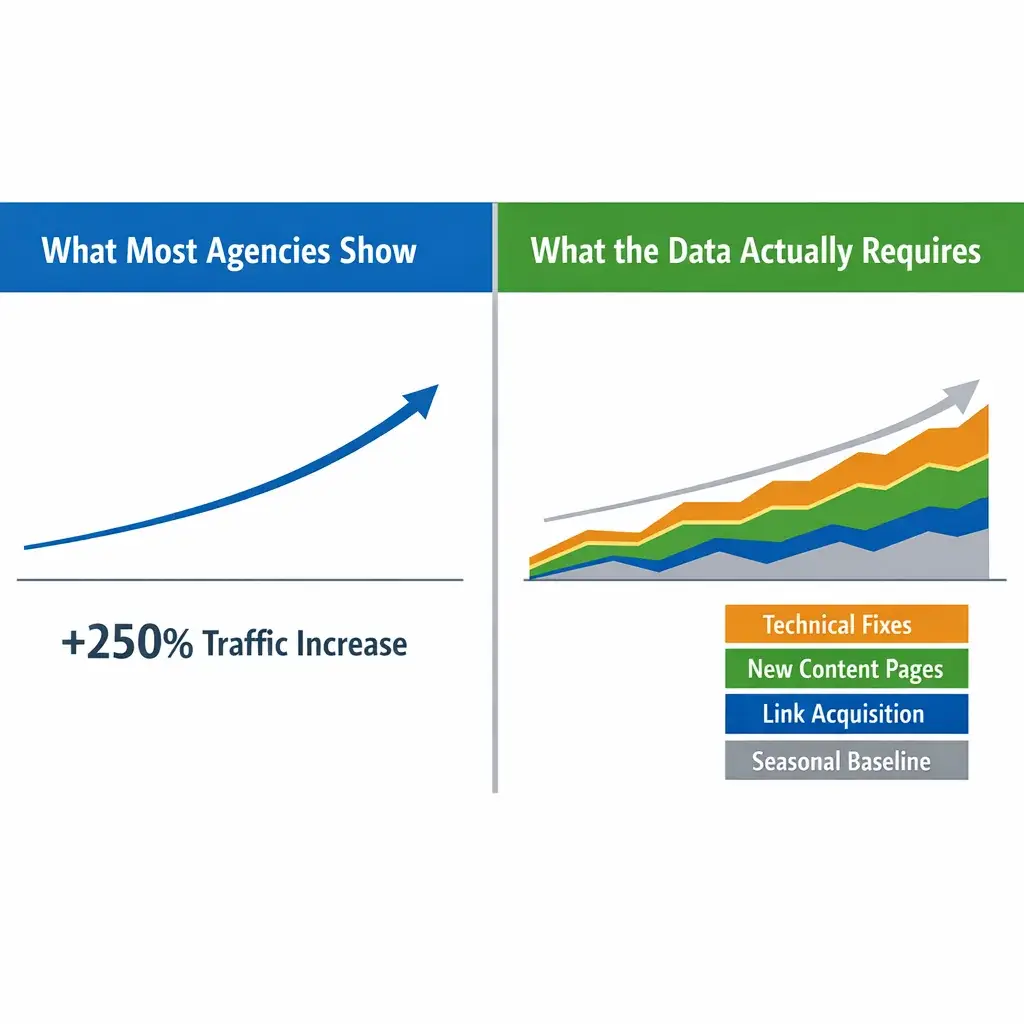
- Case study results from SEO agencies should always be evaluated by which specific intervention drove which specific metric, because bundled campaigns that combine site rebuilds, link acquisition, and content production cannot attribute a single outcome to a single tactic.
- The strategic tension between high-volume informational keywords and lower-volume transactional keywords is the most consequential prioritization decision in any SEO engagement, and it directly controls how quickly investment translates to revenue.
- Businesses in the Dayton metro area, including Kettering, Beavercreek, Centerville, Huber Heights, Miamisburg, and Springboro, compete in a regional search landscape where precise geographic targeting and domain authority together determine whether local or national competitors occupy the top positions.
Site SEO services are the structured, ongoing process of making a website more visible, more trusted, and more valuable to both search engines and the people those engines serve. When done with discipline, SEO produces compounding returns: rankings that hold, traffic that converts, and a digital presence that gets harder for competitors to displace over time. When done without a coherent framework, it produces impressive-sounding activity with results that either plateau quickly or evaporate after the next algorithm update.
The difference between those two outcomes comes down to sequencing, prioritization, and honest attribution. Most discussions of SEO services describe what agencies do. This article explains the decision logic behind why those actions happen in a specific order, which choices matter most under constrained resources, and how to evaluate whether the results an agency claims are actually connected to the work it performed.
The Three Pillars of Site SEO Services and Why Sequence Matters
Every credible SEO engagement operates across three distinct pillars: technical optimization, content development, and authority building. These are not interchangeable phases that can be run in parallel from day one. They have a dependency relationship, and ignoring that relationship is the most common reason SEO campaigns produce underwhelming results in the first six to twelve months.
Technical SEO: The Threshold That Must Be Cleared First
Technical SEO is the process of ensuring a site can be found, read, and understood by search engine crawlers before any content or link-building efforts begin. This is not a procedural preference. It is a functional prerequisite.
If Googlebot cannot crawl a page, that page will not be indexed. If a page is not indexed, no amount of keyword optimization or backlink acquisition will move it in search results. Technical work creates the conditions under which all other SEO investment becomes productive.
The specific thresholds that define “foundation-ready” are measurable and should be explicitly tracked. For a deeper breakdown of how these issues are diagnosed and resolved, the article on Technical SEO Services Dayton covers the most common ranking obstacles and how to fix them:
| Technical Signal | Minimum Threshold Before Scaling Content | How to Measure |
|---|---|---|
| Crawlability Rate | Above 95% of submitted URLs successfully crawled | Google Search Console Coverage Report |
| Indexation Ratio | Above 80% of crawlable pages indexed and active | Search Console Index Coverage vs. sitemap |
| Core Web Vitals: LCP | Under 2.5 seconds (Good range) | PageSpeed Insights / CrWX data |
| Core Web Vitals: CLS | Under 0.1 (Good range) | PageSpeed Insights / field data |
| Core Web Vitals: INP | Under 200 milliseconds (Good range) | Chrome UX Report |
| Crawl Depth | Key conversion pages within 3 clicks of homepage | Site crawl tools (Screaming Frog, Sitebulb) |
| Internal Orphan Pages | Zero pages with no internal links pointing to them | Site crawl audit |
| Canonical Coverage | 100% of duplicate or near-duplicate pages canonicalized | Manual audit + crawl tool |
A site that cannot meet these benchmarks is not ready to have AI search optimization, large-scale content production, or link acquisition layered on top of it. Those tactics require a functioning distribution system. Technical SEO builds that system.
Content SEO: The Prioritization Decision That Drives Revenue Timing
Once a site clears the technical threshold, content development becomes the primary lever for growth. But content SEO contains a strategic decision that most agency presentations skip entirely: the tension between informational keywords and transactional keywords.
Informational keywords, such as “what is commercial HVAC maintenance” or “how to choose an SEO agency,” carry high search volumes but attract users who are researching, not buying. Transactional keywords, such as “commercial HVAC service Dayton OH” or “site SEO services Kettering,” carry lower volumes but attract users with clear purchase intent.
The mistake is treating these as equally valuable in the early months of a campaign. They are not. The sequencing logic works like this:
- Transactional keywords should be prioritized first because they generate revenue-connected traffic. Even at lower volumes, a user searching for “site SEO services Beavercreek” is closer to a conversion than a user reading a blog post about SEO fundamentals.
- Informational keywords build topical authority over time, which eventually boosts rankings for transactional terms. But the authority signal takes months to accumulate.
- When resources are constrained, the correct allocation is to establish transactional page quality first, then layer informational content outward from that core.
This sequencing means that a business in Centerville or Miamisburg with a limited content budget should expect the early months of an SEO campaign to focus on service pages and location pages that target purchase-ready queries, not blog content designed to build awareness among audiences that may never convert.
Authority Building: The Third Pillar That Amplifies, Not Substitutes
Backlinks remain a primary ranking signal because they represent a third-party endorsement of a site’s credibility. But authority building is the third pillar for a reason. Links pointing to a technically broken site or to content that does not satisfy search intent are largely wasted. The amplification effect of a high-quality backlink is only realized when it flows to a page that Google already considers crawlable, indexed, and topically relevant.
The internal linking structure of a site controls how that link equity distributes once it arrives. A homepage that earns a backlink from a regional business publication passes authority to other pages through internal links. If service pages for specific areas like Huber Heights or Springboro are buried three or four clicks from the homepage with no internal links from high-authority pages, they receive almost none of that equity. Site architecture determines equity flow, and equity flow determines which pages have the ranking potential to compete.
The AI Search Question: Additive Layer or Strategic Shift
The search landscape is evolving. AI-generated answer surfaces like Google’s AI Overviews are now appearing for a significant share of queries, and platforms outside traditional search are increasingly surfacing content in response to user questions. How a business and its SEO agency should respond to this depends on a strategic posture question that has no single correct answer: is AI search a replacement for traditional SEO, an enhancement layer on top of it, or simply a new visibility channel alongside it?
Here is the honest answer: the correct posture depends on your query category and audience behavior.
- For informational and navigational queries, AI-generated answers are already displacing traditional blue-link results. A user asking “how does technical SEO work” is increasingly receiving a synthesized answer rather than clicking through to a website.
- For transactional and local queries, traditional search results still dominate. Someone searching for “site SEO services near Dayton” or “SEO agency Kettering OH” is still primarily engaging with traditional organic and map-pack results, not AI-generated summaries.
This means that the claim made by some agencies that traditional SEO is urgently losing relevance is not accurate for most local and regional businesses. The evidence does not support wholesale budget reallocation away from traditional organic SEO at this point for businesses competing in local markets across the Dayton metro. AI optimization becomes relevant as an additional layer once traditional signals are strong, not as a substitute for the foundational work.
The one meaningful change AI search does create is an elevated premium on topical authority and clear, citable prose. AI platforms draw citations from content that demonstrates expertise, names specific claims, and is structured in ways that make discrete facts easy to extract. This is not different in kind from good E-E-A-T content strategy. It is the same discipline applied with additional precision.
Need a hand with this in Dayton, Kettering and the Triad? Call (937) 848-0086 or request a free estimate. Honest answers, no pressure.
How to Evaluate SEO Case Study Results Without Being Misled
The results presented in SEO case studies are often real. The attribution logic behind them is almost always incomplete.
When an agency reports a 300% increase in organic traffic or a dramatic rise in lead volume, the relevant question is not whether the number is accurate. It is: which specific intervention produced which specific component of that result?
Consider a scenario where an agency simultaneously rebuilds a client’s website, produces 20 new service pages, earns 15 backlinks from regional publications, and launches a Google Business Profile optimization campaign. Twelve months later, organic traffic has tripled. Which tactic drove the growth?
Without a controlled attribution methodology, this is unanswerable. The traffic increase is real. The causal chain is unknown. A sophisticated buyer should ask the following questions before accepting case study results as evidence of a specific service’s effectiveness:
- Was the measurement period long enough to isolate SEO effects from seasonality or concurrent advertising activity?
- Were any of the results achieved through paid channels that are being presented alongside organic results?
- Was the site also redesigned during the same period? A redesign can independently affect organic performance by improving user engagement metrics, and this effect would appear in the same traffic report as any SEO work.
- Which specific pages drove the traffic growth, and which content type do those pages represent?
- Did conversion improvements come from increased traffic, from improved page conversion rates, or from changes to the sales process that happened independently?
None of these questions are hostile. They are the questions a genuine expert asks because they determine whether a case study is evidence of a repeatable capability or evidence that a lot of things happened at the same time.
What Ongoing SEO Reporting Should Actually Drive
Reporting is often described as a deliverable, a monthly document that proves work was completed. That framing undervalues what reporting should actually do: trigger specific decisions.
A properly structured SEO reporting cadence answers three questions every review period:
Which pages gained or lost ranking position, and why? Ranking movement without a causal explanation is noise. An expert report connects position changes to specific actions taken, algorithm updates that occurred, or competitive changes that shifted the landscape.
Where is the gap between crawl coverage and indexed performance? If a site has 200 pages submitted in its sitemap but only 140 are indexed, that gap represents lost ranking potential. A good report tracks this ratio over time and documents what was done to close it.
Which transactional pages are converting and at what rate? Organic traffic that does not convert is a content-targeting problem, not a success. Reporting that celebrates traffic growth without connecting it to lead or revenue data is incomplete.
When a report answers these questions, it becomes a decision tool. It tells a business owner in Dayton or Centerville whether the current strategy is working, which adjustments are warranted, and where the next month’s effort should concentrate. Reporting that does not drive decisions is activity documentation, not partnership. Understanding what a well-structured SEO strategy looks like beyond surface-level tactics helps set the right expectations for what reporting should ultimately inform.
Mongoose Digital Marketing and Site SEO Services Across the Dayton Region
Mongoose Digital Marketing works with businesses across Dayton, Kettering, Beavercreek, Centerville, Huber Heights, Miamisburg, and Springboro to build SEO strategies that are sequenced correctly, prioritized for revenue impact, and reported transparently. The approach is not a service menu. It is a framework that begins with an honest assessment of where a site currently stands against the technical thresholds that determine readiness, then builds outward from that foundation with content and authority strategies designed for the specific competitive landscape each client operates in.
If your site has been receiving SEO services without a clear explanation of what threshold you are working toward, which keywords are being prioritized and why, or how the results being reported connect to specific actions taken, those are the conversations worth having. For a free consultation, contact Mongoose Digital Marketing directly.
To understand Google’s own documentation on what constitutes quality content and technical site health, the Google Search Central documentation is the authoritative primary source. For independent research on AI search behavior and traditional search result changes, the Search Engine Land research section tracks algorithm updates and their documented effects on search result composition.
Frequently Asked Questions
What does site SEO services actually include, and how is it different from just publishing blog posts?
Site SEO services cover the full technical and content foundation a site needs to compete in search results. That includes crawlability, page speed, mobile usability, internal linking structure, keyword targeting, on-page content optimization, and authority building through external links. Publishing blog posts is one component of a content strategy, but without the underlying technical health and proper keyword prioritization in place first, additional content often produces minimal results. The sequencing matters as much as the individual tactics.
How long does it typically take to see results from SEO work?
For most sites in competitive local markets like Dayton or Beavercreek, meaningful ranking movement on targeted keywords generally appears within three to six months of consistent, correctly sequenced work. Sites with significant technical issues may require more foundational time before content and authority efforts produce visible gains. The specific timeline depends on how competitive the target keywords are, the current condition of the site, and how consistently the strategy is executed month over month.
How can I tell whether my current SEO provider is doing work that actually matters?
The clearest indicators are transparency and connection to outcomes. A provider should be able to explain which specific keywords are being targeted and why those terms were chosen over alternatives, what technical thresholds the site is working toward, and how reported traffic or ranking changes tie back to specific actions taken in the previous period. If reports show activity without explaining the reasoning behind it or connecting results to lead or revenue data, that is a sign the reporting is documentation rather than a decision-making tool.
Does local SEO require a different approach than general SEO, and does my location within the Dayton area matter?
Local SEO and broader SEO share the same technical foundation, but local work requires additional layers that address proximity signals, Google Business Profile optimization, location-specific keyword targeting, and local citation consistency. Your specific location within the Dayton region does matter because search results are increasingly localized, meaning a business in Centerville and a business in Huber Heights may face different competitive landscapes for similar services. A strategy built for your specific market and geography will outperform a generic approach applied uniformly across regions.
Conclusion
Businesses across Dayton, Kettering, Beavercreek, and Centerville deserve SEO work that is honest about sequencing, clear about priorities, and connected to real outcomes rather than vanity metrics. Mongoose Digital Marketing builds site SEO strategies around the specific competitive landscape each client operates in, starting with the technical foundation that determines whether any other effort will hold. If you are ready to understand where your site actually stands and what it would take to move it forward, reach out directly at (937) 848-0086 or Contact Mongoose Digital Marketing for a free consultation.