Key Takeaways
- Voice assistants select spoken answers from pages that are already indexed and eligible to show a snippet in standard search results, meaning SEO fundamentals must be in place before any voice-specific work produces results.
- Meeting Google’s eligibility floor gets your page into the candidate pool, but schema markup and conversational answer structure are the selection signals that determine which eligible page actually gets read aloud.
- An answer written for voice must pass a formatting dependency test: if the meaning collapses when bullets and tables are stripped away, the answer will be garbled or skipped by a voice assistant reading continuous audio.
- Each AI platform uses a distinct crawler, so a Dayton business that blocks OAI-SearchBot is invisible to ChatGPT voice even if it ranks well on Google, and those permissions are configured independently in robots.txt.
- Local voice queries follow a conversational structure that differs from typed searches, and pages built to answer spoken questions about Dayton-area services capture that intent more precisely than pages optimized only for short keyword phrases.
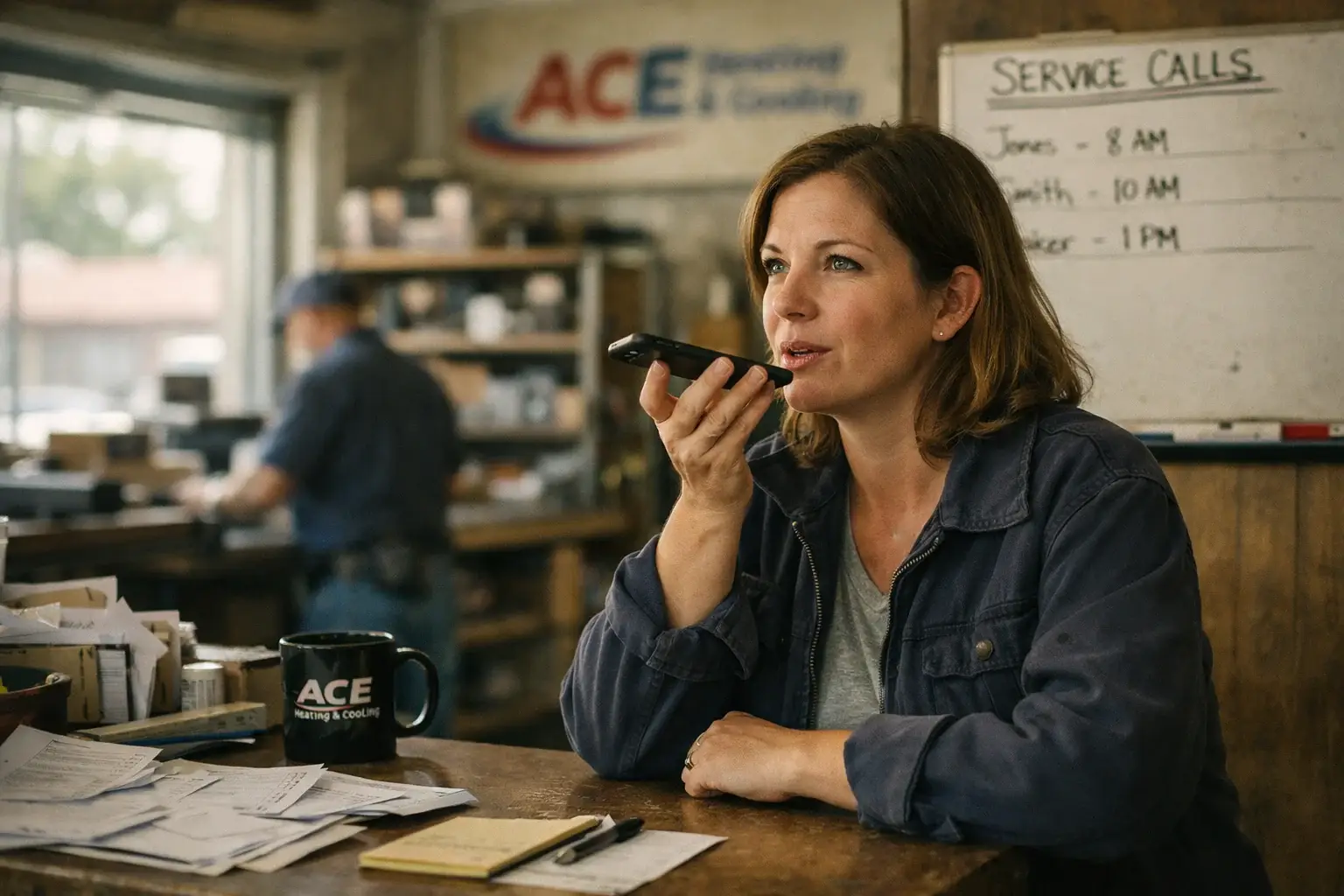
Someone in Kettering asks their phone, “Hey Google, who does HVAC repair near me?” Google Assistant speaks one answer aloud. Not a list of ten blue links. One answer, from one page, read in roughly two sentences. If your business is not the source of that answer, you do not exist for that query.
That is the operating reality of voice search in Dayton’s service market today. And the gap between businesses that capture those spoken answers and businesses that miss them entirely comes down to a set of technical and editorial decisions that most local sites have not made yet.
Mongoose Digital Marketing works with businesses across the Miami Valley, including Dayton, Beavercreek, Centerville, Huber Heights, Miamisburg, and Springboro, to close that gap systematically.
Why Voice Search Is Not a Separate Discipline
The first thing to understand about voice search optimization is that it does not exist in isolation from standard SEO. As documented by both 4 Eyes Creative and Coulter Creative, Google’s own guidance states that its AI features, including the voice surfaces powered by Google Assistant, are rooted in its core Search ranking and quality systems. (4eyescreative.com, coulter-creative.com)
What that means in practice: a page that cannot rank in traditional search cannot be selected as a voice answer. Voice optimization is an answer-selection layer built on top of a working SEO foundation. If your Dayton business website has technical crawl issues, thin content, or inconsistent local citations, voice optimization work applied on top of those problems will not move the needle.
The sequence matters:
- Fix foundational SEO: crawlability, indexing, title and header structure, mobile performance, internal linking.
- Build answer-first content that addresses the specific questions your customers ask aloud.
- Apply structured data and listing signals that help machines select your page over competing candidates.
- Confirm crawler access for every AI platform individually.
Skipping step one and jumping to step three is a common and expensive mistake. Our technical SEO services in Dayton address exactly the foundational layer that voice optimization depends on.
Have a question about voice search optimization services dayton? Send a message with the situation you are working through and the decision you need help with. Ask for a written explanation of possible next steps.
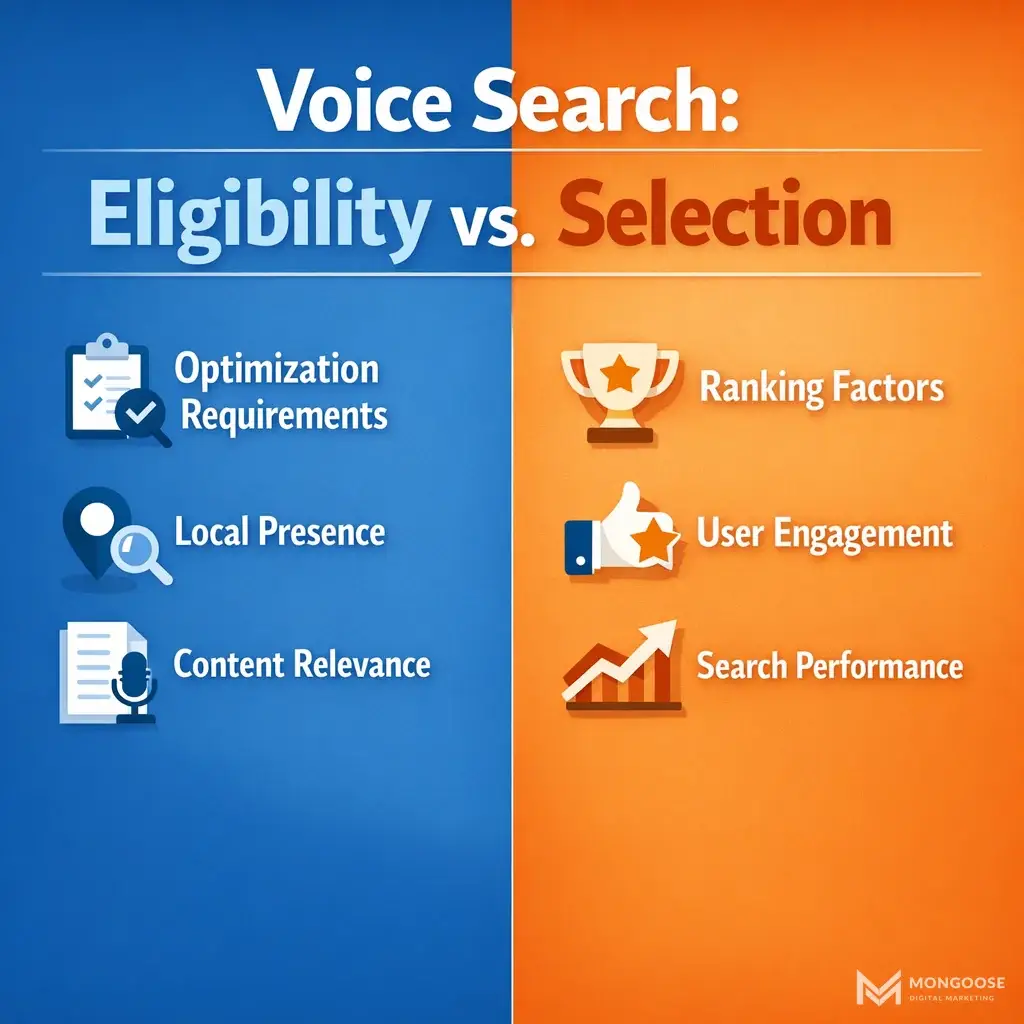
The Two-Tier Model: Eligibility vs. Selection
Here is a distinction that most content on this topic leaves unresolved, and it directly affects how you prioritize your work.
Google states that a page needs no special markup and no extra requirements to appear in AI Overviews or voice surfaces. It must be indexed and eligible to show with a snippet. That is the eligibility floor. (4eyescreative.com)
At the same time, schema markup, answer-first writing structure, and consistent business listing data are consistently recommended as best practices. These are not admission requirements. They are selection signals.
The distinction matters because the pool of eligible pages for any local service query in a mid-sized market like Dayton contains dozens of competing pages. Getting indexed gets you into the pool. Schema and conversational structure are what get you selected from the pool.
| Layer | What It Does | What Happens Without It |
|---|---|---|
| Eligibility (indexed + snippet-eligible) | Admits your page as a candidate for voice output | Your page cannot be selected regardless of quality |
| Crawl access (Googlebot, OAI-SearchBot, PerplexityBot, Bingbot) | Allows each AI platform’s bot to read your content | Invisible to any platform whose bot is blocked |
| Answer-first content structure | Positions your answer at the top of a question-headed section | Machine skips to a competitor’s page with a clearer answer |
| Schema markup | Helps machines accurately read and contextualize your page | Competitor pages with schema gain a selection advantage |
| Consistent NAP in listings | Provides accurate data for Siri, Maps, and listing-dependent voice surfaces | Voice assistants may read outdated or incorrect business information |
Illustration, not a photograph of a completed client project.
The Formatting Dependency Test: Why “Sounds Natural When Read Aloud” Is a Technical Standard
Voice assistants read a single continuous text block. They cannot parse a table with merged cells, a bulleted list with sub-items, or a parenthetical that only makes sense alongside the visual element it references. When content depends on formatting to convey its meaning, that meaning is lost the moment the content is converted to audio.
This produces a concrete editorial rule: before any answer candidate is published, strip the formatting mentally. Read the remaining plain text aloud. If the meaning holds, the answer is voice-ready. If it falls apart, the answer needs to be rewritten as continuous prose before any structural elements are added back for desktop readers.
4 Eyes Creative describes the standard as “short answers that sound natural when read aloud” and specifies “one or two sentences under each question heading, written so it still makes sense when it’s pulled out on its own.” (4eyescreative.com) The underlying reason is exactly the formatting dependency problem. The answer has to survive extraction intact.
For a Dayton HVAC company, this means the answer to “What does emergency furnace repair cost in Dayton?” should not begin with a bullet list of variables. It should begin with a sentence that answers the question in plain English and stands alone when spoken. The supporting detail can follow, but the extractable answer must come first.
Per-Platform Crawler Access: The Configuration Problem Most Dayton Sites Have Not Solved
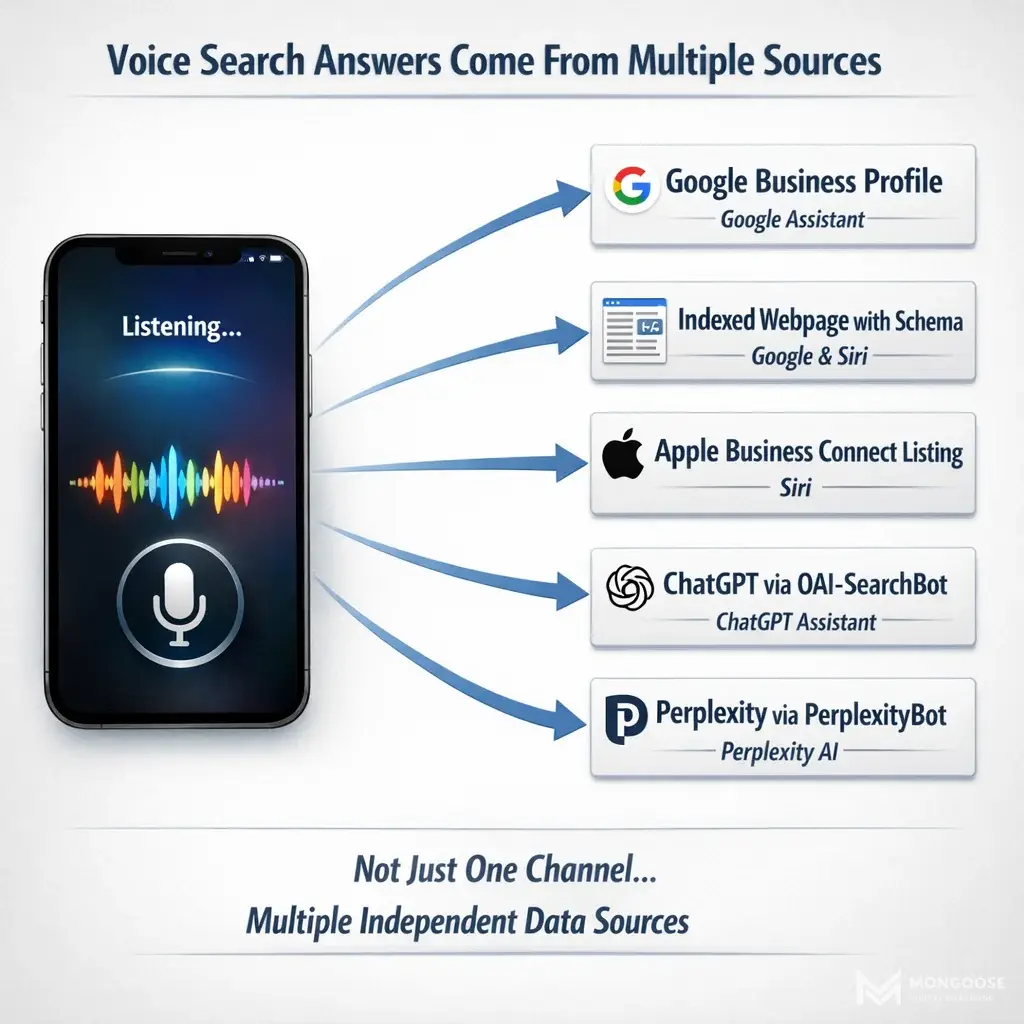
Voice search now reaches users through multiple AI platforms operating independently. Google Assistant, Siri via Apple Business and ChatGPT voice, Perplexity, and Microsoft Copilot each operate on a distinct index built by a distinct crawler.
As documented by 4 Eyes Creative, the relevant bots include Googlebot, Bingbot, OAI-SearchBot for ChatGPT, and PerplexityBot. Each platform documents its own requirements, and each bot must be individually permitted. (4eyescreative.com)
The operational consequence: a business can be fully visible to Google while being entirely invisible to ChatGPT voice, based solely on robots.txt settings that most site owners configured once and never revisited. This is not a theoretical risk. It is a gap that exists on the majority of small business websites that have not been audited against the current AI crawler landscape.
Additionally, 4 Eyes Creative flags a specific crawl eligibility issue that is easy to introduce accidentally: “stray nosnippet or tight max-snippet settings” that prevent a page from showing a snippet even when it is indexed. A page blocked from showing snippets is blocked from voice selection. (4eyescreative.com)
Local Voice Queries: How Conversational Intent Changes the Content Target
A person typing into Google might search “Dayton plumber.” The same person using voice asks “Who is the best plumber near me in Dayton?” or “Is there a plumber open right now in Kettering?” Those are structurally different queries, and they require structurally different answers.
Local voice queries tend to be longer, phrased as full questions, and focused on immediacy, proximity, or category judgment. The page that answers “Who are the top-rated roofers in Beavercreek?” must actually contain a sentence that approximates that answer in plain prose, not just a page title that includes the words “roofer” and “Beavercreek.”
The content work this requires includes:
- Identifying the specific spoken questions your customers use, pulled from tools like People Also Ask, Google autocomplete, and your own sales call patterns.
- Writing question-headed sections with direct prose answers that name your service area explicitly.
- Building FAQ sections that use the conversational phrasing of spoken queries rather than keyword-compressed heading text.
- Ensuring your Google Business Profile is complete, with accurate service areas covering Dayton, Kettering, Centerville, Huber Heights, Miamisburg, and Springboro, since listing data is a primary source for Siri and Maps-based voice responses.
Apple documents that a business’s place card in Apple Business appears across Apple apps from Maps to Siri. (4eyescreative.com) That means incomplete or inconsistent listing data does not just affect Google. It affects the spoken output of every device running iOS in the Miami Valley. Understanding how local SEO in Dayton works is essential context for building the listing and content signals that voice assistants draw from.
Illustration, not a photograph of a completed client project.
What Voice Search Optimization Services in Dayton Actually Include
Effective voice search optimization for a Dayton-area business is not a single deliverable. It is a coordinated set of ongoing technical and editorial actions. Based on the publicly documented frameworks from multiple Dayton-area agencies, the work typically covers:
- Question research: Identifying the spoken queries your customers use for your specific services and towns, not generic national query patterns.
- Answer audits: Establishing a baseline for which pages currently hold featured snippets, People Also Ask positions, and AI Overview links for your target queries.
- Answer-first rewrites: Restructuring key pages so the direct answer appears in the first one or two sentences beneath each question heading, in prose that passes the formatting dependency test.
- Crawl and snippet eligibility review: Confirming that Googlebot, OAI-SearchBot, PerplexityBot, and Bingbot can all reach your site and that no unintended nosnippet tags are blocking selection.
- Listing synchronization: Ensuring Google Business Profile, Apple Business, and Bing Places are complete and identical, since listing inconsistency produces different voice outputs across platforms.
- Schema deployment: Adding structured data through schema markup that accurately describes your business, services, and content to give machines a reliable reading of your pages.
- Monthly answer tracking: Rechecking the same target questions across Google and major AI assistants each month and logging which page holds the answer.
No agency, including Mongoose, can guarantee placement in a voice answer. Google states that its systems decide whether a page makes a good snippet result, and that placement cannot be manually triggered. (4eyescreative.com) What the work does is make your pages the strongest available candidate for every query in your target set.
If your Dayton-area business needs a voice search audit or a full answer-readiness assessment, contact Mongoose Digital Marketing to schedule a free consultation.
Frequently Asked Questions
Does my Dayton business need to rank on page one before voice search optimization is worth doing?
Not page one specifically, but your page does need to be indexed and eligible to show a snippet in standard search results before it can be selected as a voice answer. Voice assistants choose from the same candidate pool that standard search builds. If your pages have crawl issues, thin content, or other foundational SEO problems, those need to be addressed first. Voice-specific work applied to a broken SEO foundation produces no meaningful result.
Will adding schema markup guarantee that Google Assistant reads my page as the answer?
No. Schema markup is a selection signal, not an admission requirement, and no one can guarantee placement in a voice answer. Google states that its systems decide whether a page makes a good snippet result, and that decision cannot be manually triggered. What schema does is give machines a more accurate reading of your page, which improves your standing as a candidate relative to competing pages that lack it. The goal of optimization is to make your page the strongest available candidate, not to override the selection process.
How do I know if ChatGPT voice can even find my business’s website?
ChatGPT voice uses OAI-SearchBot to crawl the web during voice conversations. If your robots.txt file blocks OAI-SearchBot, your site is invisible to ChatGPT voice regardless of how well it performs in Google. The same principle applies to PerplexityBot for Perplexity and Bingbot for Microsoft Copilot. Each platform uses a distinct crawler, and each must be individually permitted. A robots.txt audit that checks permissions against the current list of AI crawlers is the starting point for answering this question accurately for your specific site.
My Google Business Profile is already set up. Is that enough to cover voice search for Siri and Maps-based queries?
A complete and accurate Google Business Profile is essential but covers only part of the voice search landscape. Apple documents that a business’s place card in Apple Business appears across Apple apps from Maps to Siri, which means a business that has not claimed and completed its Apple Business Connect listing may be missing or showing inaccurate information on every iOS device in the Miami Valley. Bing Places feeds Microsoft Copilot through a separate index. For consistent voice output across all major platforms, Google Business Profile, Apple Business Connect, and Bing Places need to be complete, accurate, and identical to each other.
Conclusion
Voice search in the Dayton market is not a future consideration. It is the channel through which a customer in Kettering, Beavercreek, or Miamisburg right now receives a single spoken answer to a service question your business could be answering. The gap between businesses that capture those moments and businesses that are simply absent comes down to decisions that are largely technical and editorial: whether your pages are indexed and snippet-eligible, whether the right crawlers can reach your site, whether your answers are written to survive extraction as continuous spoken prose, and whether your listings tell the same story across every platform a voice assistant consults.
None of that work is automatic, and none of it is permanent. The AI platform landscape changes, crawler requirements shift, and competitors continuously improve their own answer-readiness. Closing the gap requires an initial audit and ongoing monthly tracking against the same target questions your customers are actually asking aloud.
Mongoose Digital Marketing works with businesses across the Miami Valley to build and maintain that answer-readiness systematically, from the foundational SEO layer through per-platform crawler configuration, structured data, and listing synchronization. If you are ready to understand where your Dayton-area business currently stands in voice and AI search, the starting point is a conversation.