

Key Takeaways
- Schema markup is structured data code that tells search engines exactly what your business does, where you operate, and who you serve, giving Google the context it needs to display your listings as rich results.
- The schema type you implement should be driven by your buyer’s search behavior, not just your business category: a Dayton defense contractor needs different markup than a Kettering HVAC company.
- Deploying schema on top of an inconsistent Google Business Profile creates competing signals that reduce authority rather than build it; the correct sequence is to audit and reconcile your GBP first, then implement schema.
- Multi-typing a service page as both
ServiceandProductin JSON-LD can make that page eligible for Product rich results, including price range display and availability signals, before a user ever clicks your listing. areaServedshould be declared as a structured array naming each suburb you serve, not a single generic geographic reference, to give Google precise service-area signals across Dayton, Kettering, Beavercreek, Centerville, Huber Heights, Miamisburg, and Springboro.
Schema markup services in Dayton give local businesses a direct mechanism for communicating business identity, service scope, and geographic coverage to Google in machine-readable language. This article covers how to choose the right schema types for your specific buyer, how to avoid the GBP-schema conflict that undermines most local implementations, and how to structure your markup for both traditional search and AI-driven discovery.
Why Schema Type Selection Is a Business Decision, Not a Technical Default
Most implementations default to [LocalBusiness](https://schema.org/LocalBusiness) schema for any business with a physical address. That default is wrong for a significant portion of Dayton’s business landscape.
LocalBusiness schema is optimized for proximity-based queries: “HVAC company near me,” “plumber in Centerville,” “roofing contractor Beavercreek.” It signals to Google that your primary value is geographic availability. For home services companies in the Miami Valley operating in that fast-decision, high-intent environment, that signal is exactly right.
It is not right for a precision manufacturer in the Dayton region supplying components to defense and aerospace programs centered around Wright-Patterson. That buyer is not searching “defense contractor near me.” They are searching company names, capability terms, and certification identifiers. When they find a supplier, they are conducting structured due diligence, not making a proximity decision. Applying LocalBusiness schema to that business tells Google a story that does not match how that buyer actually searches, which means the schema provides minimal ranking signal for the queries that actually drive revenue.
Matching Schema Type to Buyer Intent
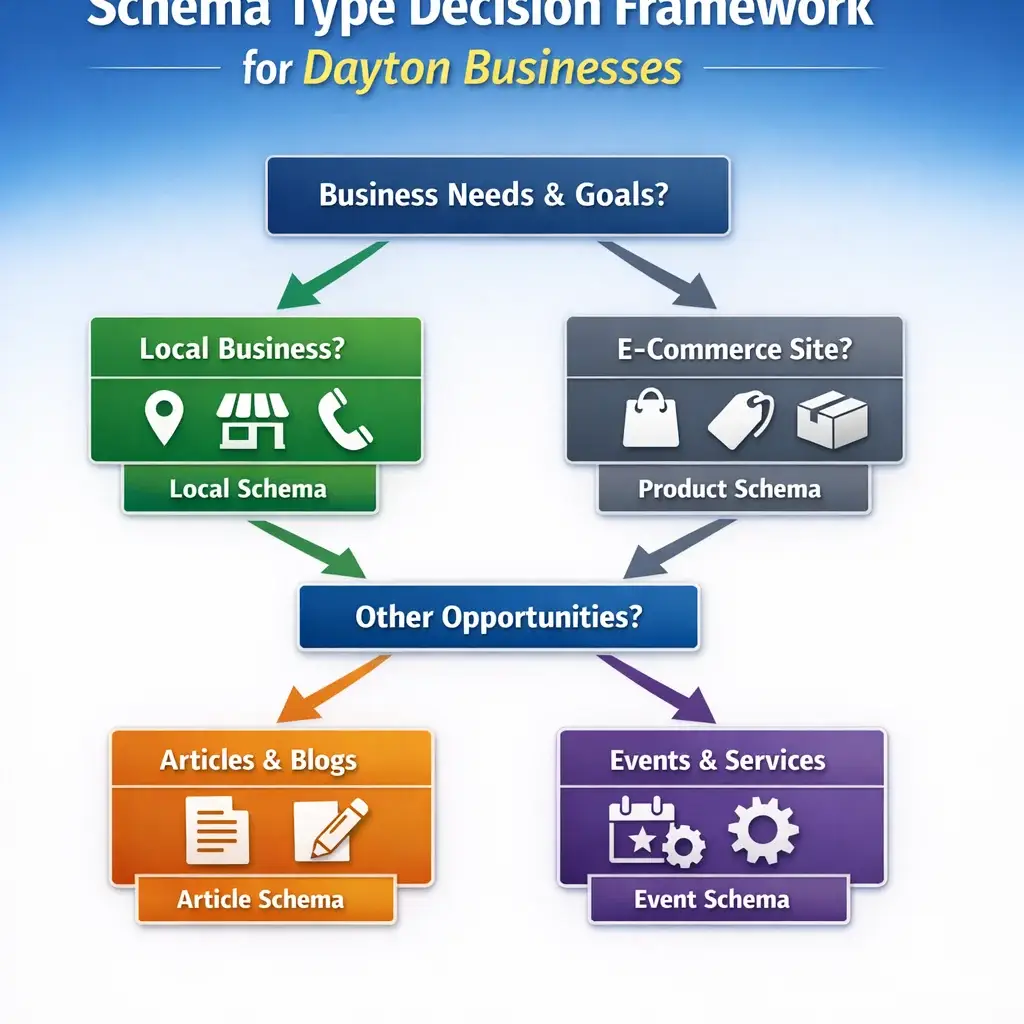
The decision tree looks like this:
- Proximity-based buyer (searches by location, speed of decision matters):
LocalBusinessschema is the correct anchor type. Layer inareaServed,openingHoursSpecification, andpotentialActionfor click-to-call or quote requests. - Capability-evaluation buyer (searches by service type or certification, evaluates over time):
Serviceschema with explicitserviceOutput,providerlinked to anOrganizationentity, andhasCredentialorcertificationproperties. The buyer needs to understand what you produce and for whom. - Product-adjacent service buyer (seeks a defined deliverable with a known scope): Multi-type
Service+Productwith anoffersproperty. This unlocks Product rich result eligibility at the SERP level.
The GBP-Schema Conflict: The Most Common Implementation Error in the Dayton Market
Google Business Profile and schema markup are two separate sources of structured information about your business. When they agree, they reinforce each other. When they conflict, Google receives competing signals and the result is reduced confidence in both sources, not a blended version of the truth.
This conflict is more common than most business owners realize, especially for businesses that have had a GBP listing for several years and are adding schema markup for the first time. The categories of conflict include:
| Conflict Type | Example | Google’s Likely Response |
|---|---|---|
| Business name variation | GBP: “Mongoose Digital” / Schema: “Mongoose Digital Marketing LLC” | Ambiguity in entity recognition; may suppress brand SERP features |
| Address formatting difference | GBP: “123 Main St” / Schema: “123 Main Street” | Minor, but contributes to NAP inconsistency signals across the web |
| Service area mismatch | GBP lists 5 counties / Schema areaServed names 2 cities | Schema underrepresents coverage; Local Pack eligibility may narrow |
| Business category conflict | GBP: “Marketing Agency” / Schema: LocalBusiness without additionalType | Generic classification; competitor specificity may outrank |
| Hours discrepancy | GBP shows seasonal hours / Schema has static hours | Potential for rich result suppression or incorrect display |
The Correct Implementation Sequence
The standard approach of implementing schema and hoping it aligns with GBP is backwards. The sequence that produces clean results:
- Audit your existing GBP listing for accuracy: business name, address, phone number, categories, service areas, and hours.
- Reconcile any discrepancies between GBP data and your website’s contact page, footer, and citation profiles.
- Then implement or update schema markup to mirror GBP data exactly, including identical formatting for address fields.
- Validate using Google’s Rich Results Test and monitor for errors and warnings in Google Search Console’s Rich Results report.
For Dayton businesses that have been operating with a GBP for three or more years, step one routinely surfaces address changes, phone number updates, or category shifts that were applied in GBP but never propagated to on-site schema. Those gaps actively work against the trust signals schema is meant to build. Understanding how local SEO in Dayton works and how Google rankings are determined provides useful context for why that reconciliation step is non-negotiable before any structured data is deployed.
Need a hand with this in Dayton, Kettering and the Triad? Call (937) 848-0086 or request a free estimate. Honest answers, no pressure.
Structuring areaServed for Multi-Suburb Coverage
A single areaServed entry pointing to a Wikipedia page for “Dayton, Ohio” is insufficient for a business that actively serves Kettering, Beavercreek, Centerville, Huber Heights, Miamisburg, and Springboro. It tells Google you serve the city; it does not tell Google you serve the suburbs where a significant portion of your customers live and search.
The correct structure uses an array of City schema entities, each with its own name and sameAs property linking to the corresponding Wikipedia or Wikidata page. This approach produces granular geographic signals that support Local Pack eligibility in suburb-specific queries rather than only city-level queries.
"areaServed": [
  {
    "@type": "City",
    "name": "Dayton",
    "sameAs": "https://en.wikipedia.org/wiki/Dayton,_Ohio"
  },
  {
    "@type": "City",
    "name": "Kettering",
    "sameAs": "https://en.wikipedia.org/wiki/Kettering,_Ohio"
  },
  {
    "@type": "City",
    "name": "Beavercreek",
    "sameAs": "https://en.wikipedia.org/wiki/Beavercreek,_Ohio"
  },
  {
    "@type": "City",
    "name": "Centerville",
    "sameAs": "https://en.wikipedia.org/wiki/Centerville,_Ohio"
  },
  {
    "@type": "City",
    "name": "Huber Heights",
    "sameAs": "https://en.wikipedia.org/wiki/Huber_Heights,_Ohio"
  },
  {
    "@type": "City",
    "name": "Miamisburg",
    "sameAs": "https://en.wikipedia.org/wiki/Miamisburg,_Ohio"
  },
  {
    "@type": "City",
    "name": "Springboro",
    "sameAs": "https://en.wikipedia.org/wiki/Springboro,_Ohio"
  }
]
This is a JSON-LD implementation detail that most schema markup checklists skip entirely because it adds complexity. It is also one of the higher-impact configurations for businesses whose revenue depends on suburb-level searches rather than city-center visibility.
Schema Properties That Feed AI and LLM Discovery
Google’s traditional crawlers read schema for rich result eligibility. AI systems and large language models, including the retrieval layers behind tools like ChatGPT search and Perplexity, read schema for entity understanding. The properties that matter most to each are not identical.
For AI discovery, the properties with the highest signal value are:
description: A precise, factual description of what your business does. Not a marketing headline. A machine-readable summary of your service scope, delivery model, and geographic coverage.serviceOutput: Specific toServiceschema. Describes what the service produces. “ISO 9001-certified precision machined components for aerospace applications” communicates more to an AI retrieval system than “quality manufacturing.”additionalTypewith a Wikidata or Wikipedia link: Connects your business to a recognized knowledge graph entity. An HVAC company linking to the Wikipedia entry for “heating, ventilation, and air conditioning” gives AI systems a verified conceptual anchor.knowsAbouton anOrganizationentity: Lists topical areas of expertise. Underused by most local businesses, and directly relevant to how AI systems build their internal model of what your business knows and does.
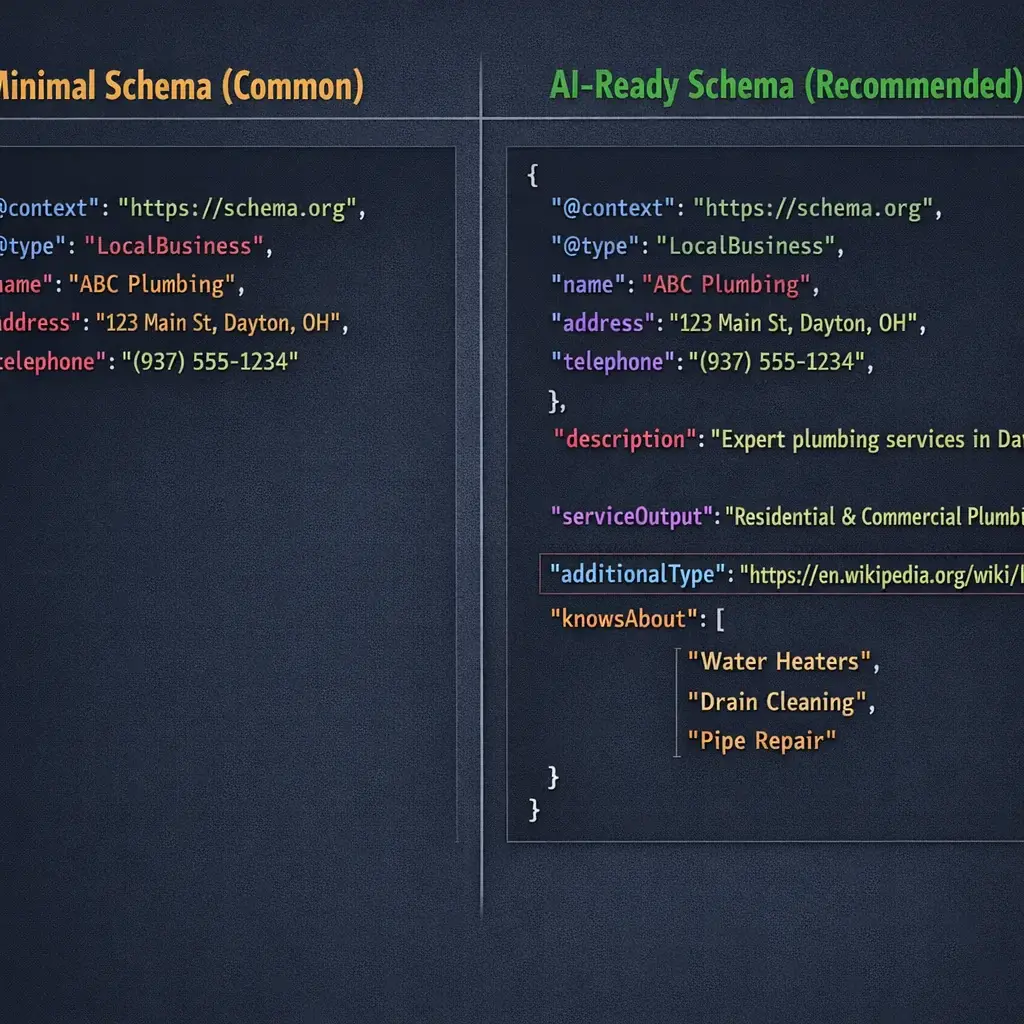
The practical implication: schema markup that was implemented two or three years ago for rich result eligibility may be missing the properties that now determine whether your business appears in AI-generated responses to local service queries. An audit against current best practices for both traditional search and AI visibility is not a one-time event; it is a periodic maintenance requirement as both Google’s and AI platforms’ consumption of structured data continues to evolve.
For businesses in Dayton evaluating schema markup services, the standard to hold providers to is not just implementation but validation, GBP reconciliation, and a markup architecture that reflects how your specific buyer searches, not a generic local business template applied uniformly across every client. That distinction is what separates schema that moves performance metrics from schema that simply passes a validation test. The broader picture of how technical SEO services in Dayton address the underlying issues that suppress rankings shows why structured data sits within a larger ecosystem of signals that all need to align.
Learn more about schema.org’s full specification for Service and LocalBusiness types to understand the complete range of available properties before any implementation begins.
Frequently Asked Questions
What does a schema markup service actually do for a Dayton business?
A schema markup service translates the information already on your website, your business name, service areas, hours, reviews, and expertise, into a structured data format that search engines and AI platforms can read without ambiguity. Rather than leaving Google to interpret your content through text analysis alone, schema provides explicit labels that confirm what your business is, where it operates, and what problems it solves. For Dayton businesses competing in local search, this reduces the risk of misclassification and improves the consistency of how your business appears across search results, map packs, and AI-generated responses.
How is schema markup different from standard SEO work?
Most traditional SEO focuses on the content and authority signals that humans read, page copy, backlinks, and site structure. Schema markup operates in the background as machine-readable code that never appears visibly on the page. The two disciplines are complementary rather than interchangeable. A well-optimized page without schema still leaves search engines doing interpretive work; schema reduces that guesswork by explicitly confirming details that support your visibility in structured results like rich snippets and local knowledge panels.
How often does schema markup need to be updated or audited?
Schema is not a one-time implementation. Google’s guidelines for structured data evolve, new property types gain relevance as AI-driven search expands, and your own business details, services offered, service areas, hours, staff, change over time. Schema that was correctly implemented two years ago may now be missing properties relevant to how AI systems surface local business information. A periodic audit, typically aligned with any significant change to your services or website, keeps your structured data accurate and competitive.
Does schema markup directly improve search rankings?
Schema markup is not a direct ranking factor in the traditional sense, but it influences several signals that affect how prominently your business appears in search results. Correct implementation supports rich result eligibility, which improves click-through rates. Consistency between your schema, your Google Business Profile, and your on-page content strengthens the trust signals that local search algorithms weigh. And as AI-powered search features increasingly draw on structured data to populate answers to local service queries, businesses with well-architected schema are better positioned to appear in those responses than businesses without it.
Mongoose Digital Marketing proudly serves businesses across Dayton, Kettering, Beavercreek, and Centerville with schema markup services built around the specific way local buyers search, not generic templates applied without context. Whether you are a service business in Beavercreek looking to strengthen your local search presence or an established operation in Kettering that has never had your structured data audited, the process starts with an honest look at what is actually in place and what is missing. Reach out directly at (937) 848-0086 or Contact Mongoose Digital Marketing to start that conversation.