

Key Takeaways
- Local SEO and organic SEO are distinct disciplines with different ranking factors; Dayton businesses that treat them as interchangeable typically underperform in both the Map Pack and standard search results.
- Google’s local ranking system weights relevance, distance, and prominence, and prominence is the factor most determined by off-site authority signals that require ongoing, sustained effort to build.
- B2B businesses serving aerospace, defense, and manufacturing buyers in the Dayton area need deeper content and more technically specific keyword targeting than consumer-facing businesses, because thin content actively signals low credibility to technically literate decision-makers.
- Search intent matching, meaning aligning the type of page you create with the reason someone is searching, separates SEO campaigns that generate rankings from campaigns that generate revenue.
SEO marketing in Dayton, OH sits at an interesting intersection. The region’s economy blends consumer service businesses, healthcare providers, and a substantial B2B industrial base with ties to aerospace, defense, and manufacturing. That mix means there is no single SEO playbook that works for every Dayton business. A medical spa in Centerville competes in a very different search landscape than a precision machining supplier in Miamisburg. Getting results from SEO here means understanding which version of search optimization your business actually needs, and executing it with enough depth to outperform competitors who are still running on surface-level tactics.
This guide explains the mechanics behind SEO marketing in a way that gives you a real decision framework, not just a list of services.
Local SEO vs. Organic SEO: Two Systems, One Goal
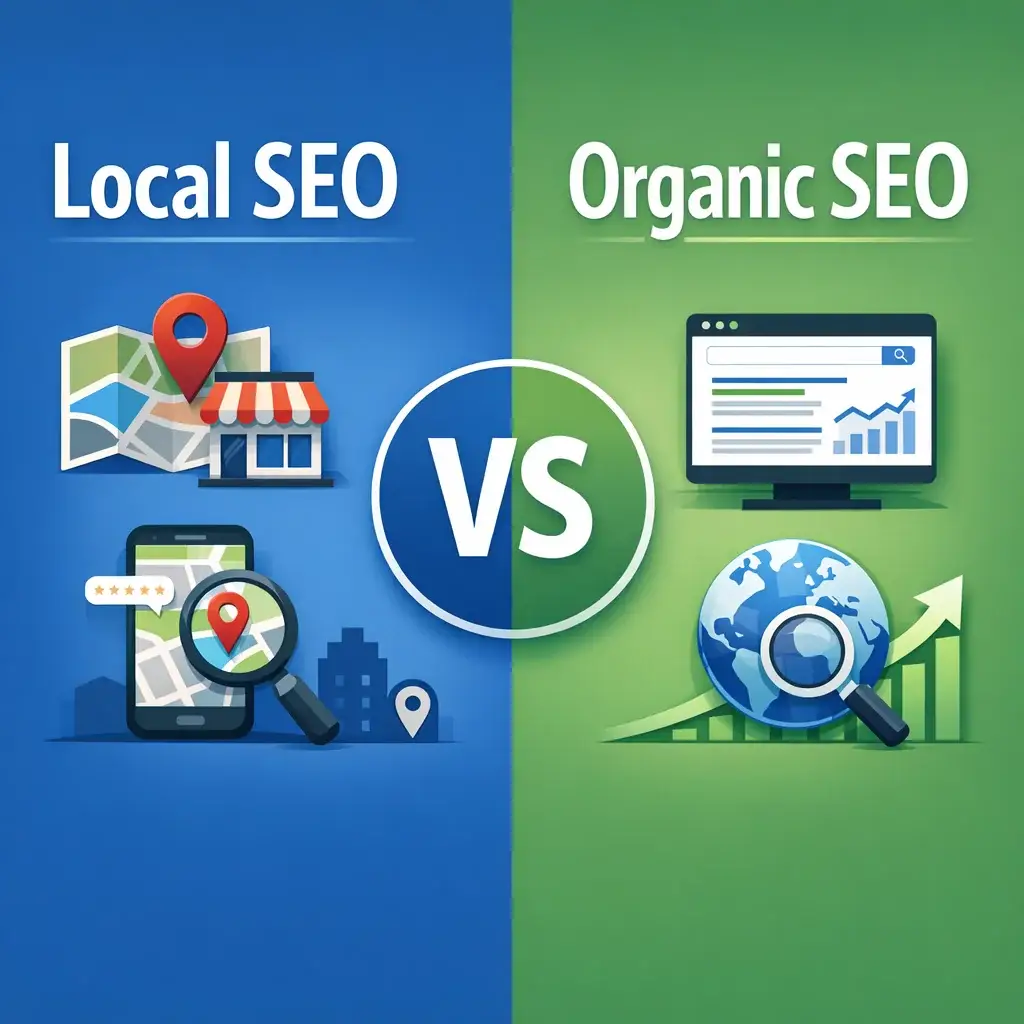
The most common strategic mistake Dayton businesses make is treating local SEO and organic SEO as the same thing with different names. They are not. They are distinct systems with different ranking factors, different content requirements, and different payoff timelines.
Local SEO targets the Map Pack, the block of three business listings that appears above standard search results for queries with local intent. Google determines Map Pack rankings using three primary signals: relevance, distance, and prominence. Relevance measures how well your Google Business Profile and website content match what someone searched. Distance measures your physical proximity to the searcher or the location they specified. Prominence measures how well-known and authoritative your business appears across the web, based on reviews, citations, backlinks, and brand mentions.
Organic SEO targets the standard blue-link results that appear below the Map Pack. These rankings are driven by page-level authority, content depth, technical site health, and the overall domain authority you accumulate over time. A business can rank in the Map Pack without appearing prominently in organic results, and vice versa.
For most consumer service businesses in Kettering, Beavercreek, Huber Heights, and surrounding Dayton suburbs, the Map Pack is where the majority of purchase-ready traffic originates. For B2B businesses targeting procurement managers at regional manufacturers or defense contractors, organic rankings for specific, longer-tail technical queries often carry more conversion weight.
The strategic question is not “should I do SEO?” It is “which version of SEO should I prioritize first, and why?” For a deeper look at how these rankings actually function in the local context, the article on local SEO in Dayton: how Google rankings work breaks down the mechanics in detail.
Why Prominence Is Where the Real Work Lives
Of Google’s three local ranking factors, prominence is the one that generates the most confusion and the most wasted effort. Relevance and distance are relatively controllable. You optimize your Google Business Profile with accurate categories and service descriptions. Your physical address determines your distance signal. Done.
Prominence is different. It is largely determined by what happens off your own website. Specifically, prominence reflects the volume and quality of your reviews across Google and other platforms, the consistency and quantity of your business citations across directories, the number and quality of backlinks pointing to your site, and the overall brand presence you have built across the web.
This is why prominence requires ongoing effort rather than a one-time setup. A competitor who has been accumulating reviews and citations for three years has a prominence advantage that cannot be closed in a week. A link from a respected regional business association, a local chamber of commerce membership listed on their website, or consistent five-star reviews from verified clients all contribute to prominence in ways that reinforce each other over time.
For Dayton businesses, this has a practical implication. If your Map Pack rankings are underperforming relative to competitors who appear less polished on paper, the most common explanation is a prominence deficit rather than a relevance or distance problem. The diagnostic starts off-site, not on your own homepage.
Need a hand with this in Dayton, Kettering and the Triad? Call (937) 848-0086 or request a free estimate. Honest answers, no pressure.
SEO Strategy When Your Buyer Is an Engineer
Dayton’s B2B industrial sector creates a keyword and content challenge that most SEO guides skip entirely. When the person evaluating your business is an engineer, an operations director, or a procurement lead at a defense-adjacent supplier, the behavior pattern driving their search is fundamentally different from a homeowner looking for a local plumber.
Technically literate buyers search with specificity. They use industry terminology. They evaluate claims critically. They are skeptical of vague superlatives and marketing language that substitutes adjectives for evidence. When they land on a thin page full of generic positioning statements, they do not stay long, and they do not convert.
This creates a direct strategic implication for SEO: content depth is not just a ranking mechanism, it is a trust mechanism. A 400-word service page that ranks for “aerospace component manufacturing Dayton OH” may attract the click, but it will not survive the scrutiny of someone who actually knows the space.
The table below outlines how SEO strategy shifts based on buyer profile.
| Strategic Variable | Consumer Service Buyer | B2B Industrial / Technical Buyer |
|---|---|---|
| Keyword specificity | Broad and geo-modified (“HVAC repair Centerville OH”) | Technical and application-specific (“tight tolerance CNC Dayton OH”) |
| Content depth required | 600-900 words, clear benefits | 1,200+ words, specifications and process detail |
| Trust signals that convert | Reviews, photos, fast load time | Case studies, certifications, technical documentation |
| Primary search intent | Immediate service need | Vendor evaluation over multiple sessions |
| Map Pack vs. Organic priority | Map Pack dominant | Organic rankings for long-tail queries dominant |
| Conversion timeline | Same session | Multiple touchpoints over days or weeks |
Ignoring this distinction is one of the most common reasons B2B industrial businesses in the Dayton area see traffic gains from SEO campaigns that do not translate into qualified leads.
Technical SEO and Intent Matching: The Overlooked Foundations
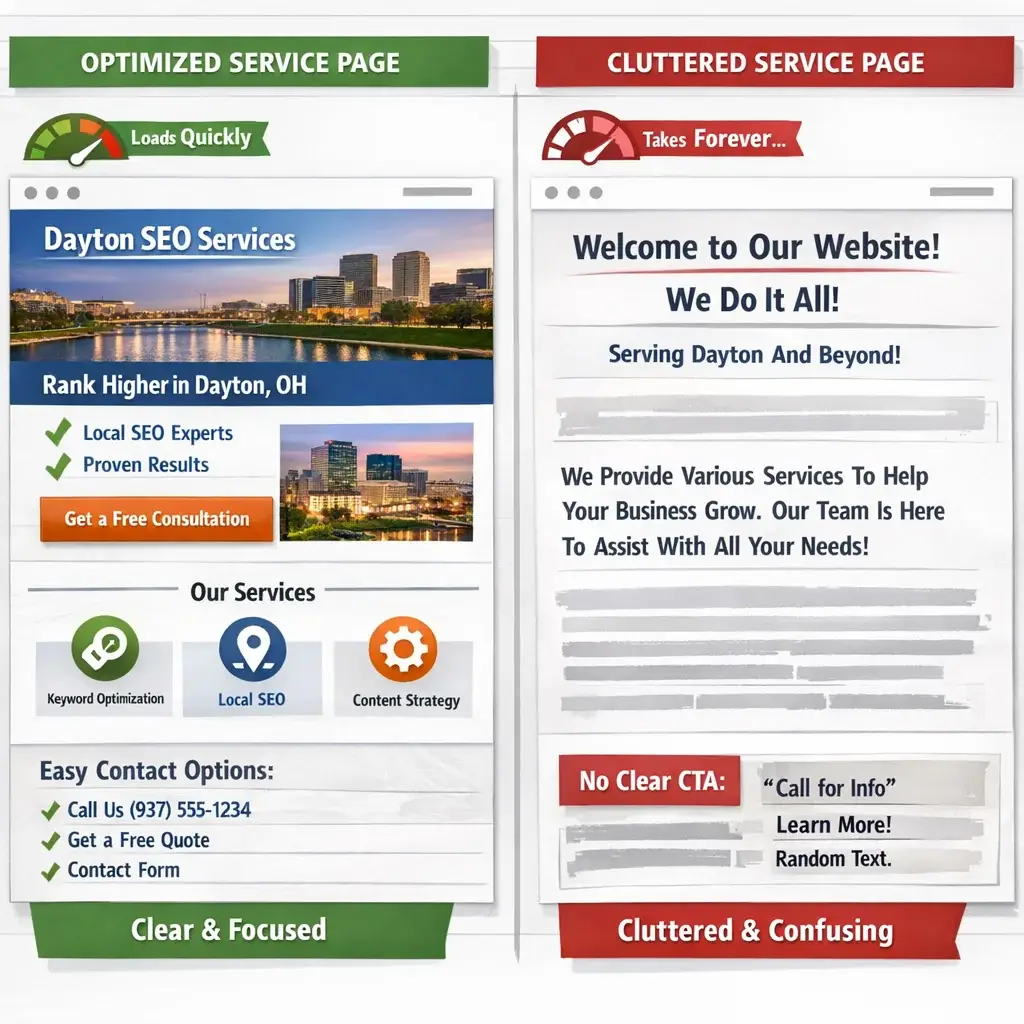
Technical SEO refers to the infrastructure-level factors that determine whether search engines can efficiently crawl, index, and rank your site. Common technical problems that block rankings include slow page load speeds, broken internal links, duplicate content across service pages, missing or malformed structured data, and pages that are indexed but do not carry enough authority to compete.
These issues are not hypothetical. They are routine findings across Dayton business websites, particularly those built on older platforms or assembled with page-builder tools without SEO review. A site with solid content that loads slowly or sends conflicting signals through duplicate title tags will consistently underperform a technically cleaner competitor even when the content quality is comparable. The article on technical SEO services for Dayton businesses covers the most common site-level issues in more detail.
Intent matching is a related but distinct concept. Search intent describes the reason behind a query. Is the searcher looking for information, comparing options, or ready to contact a provider? Creating a page optimized for a keyword without matching the intent behind that keyword produces rankings that generate impressions but not traffic or conversions.
For example, a Dayton roofing company ranking for “how long does a roof last” is capturing informational intent. That traffic has research value and brand exposure value, but it will not convert at the same rate as traffic from “roof replacement estimate Springboro OH,” which signals transactional intent. Both have a place in a complete SEO strategy, but only if the pages created for each match what the searcher is actually looking for at that moment.
Combining technical site health with intent-matched content is the execution layer where most campaigns either succeed or stall.
How Mongoose Digital Marketing Approaches SEO in Dayton
Mongoose Digital Marketing builds SEO campaigns for Dayton area businesses across Kettering, Beavercreek, Centerville, Huber Heights, Miamisburg, and Springboro by starting with an honest assessment of which ranking system matters most for your specific business model, buyer profile, and competitive landscape.
That means distinguishing between local and organic SEO before writing a single piece of content. It means diagnosing prominence deficits with off-site audits rather than just optimizing page titles. It means building content with the depth required to earn credibility with a technically sophisticated B2B audience, when that is who your buyers actually are. And it means aligning every page to the search intent of the queries you are targeting, so rankings turn into traffic and traffic turns into revenue.
If you want a clear picture of where your Dayton business stands in search today and what it would take to move the needle, contact Mongoose Digital Marketing for a free consultation. There are no obligations, and the assessment gives you something actionable regardless of what you decide to do next.
For further reading on how Google evaluates local business relevance, the Google Business Profile Help Center provides direct documentation on the ranking factors discussed in this article.
Frequently Asked Questions
What is the difference between local SEO and organic SEO for a Dayton business?
Local SEO focuses on ranking within Google’s map-based results, which appear when someone searches for a nearby service with geographic intent. It depends heavily on your Google Business Profile, proximity to the searcher, and the consistency of your business information across directories. Organic SEO targets the traditional blue-link results below the map pack and is driven by content depth, backlink authority, and technical site health. Most Dayton businesses need both, but the priority between them depends on whether your buyers are searching for an immediate local provider or researching solutions before they are ready to contact anyone.
How long does SEO typically take to produce results for a Dayton area business?
SEO is a compounding process rather than an immediate switch. Most businesses begin to see measurable movement in rankings and organic traffic within three to six months of consistent, well-executed work. Competitive markets within the Dayton metro, including areas like Beavercreek or Centerville, may require more time to displace established competitors. The timeline also depends on how much technical groundwork needs to be addressed before content and authority-building efforts can gain traction.
Does my business need SEO if it already runs paid search ads?
Paid search and SEO serve different roles in your overall visibility strategy. Ads stop generating traffic the moment your budget runs out, while organic rankings continue working without a per-click cost. Many Dayton businesses that rely exclusively on paid traffic find themselves vulnerable to rising competition and increasing costs over time. SEO builds an asset that grows in value, and for businesses with longer sales cycles or research-driven buyers, organic content often reaches prospects at moments when paid ads are not even in the picture.
What makes SEO for Dayton businesses different from general SEO advice found online?
Most general SEO content addresses national or highly competitive markets and does not account for the specific competitive dynamics, buyer behavior, or geographic nuance of a mid-sized metro like Dayton. Suburb-level targeting across communities such as Kettering, Huber Heights, and Miamisburg requires a different approach than broad city targeting. The industrial and B2B presence in the Dayton region also means that content strategies often need to match a more technically sophisticated audience than you would encounter in primarily consumer-facing markets.
Conclusion
Dayton businesses competing for visibility in search deserve a strategy built around how their specific buyers actually search, not a template borrowed from a larger market. Mongoose Digital Marketing works with businesses across Dayton and Kettering to develop SEO campaigns grounded in honest diagnosis, intent-matched content, and the technical foundation that turns rankings into real revenue. To talk through where your business stands today and what it would take to move forward, call (937) 848-0086 or Contact Mongoose Digital Marketing.