

Key Takeaways
- Google’s December 2021 proximity update made physical address location a dominant Map Pack ranking signal, meaning a business in Centerville can be functionally invisible in northern Dayton searches regardless of how well its Google Business Profile is optimized.
- High-intent emergency searches and lower-intent research searches require structurally different on-page architectures; optimizing both pages the same way actively reduces conversion rates on at least one of them.
- Google Business Profile rankings are influenced by review velocity, keyword presence in review text, and post frequency cadence, not just profile completeness.
- When client keyword preferences conflict with actual search data, conversion proximity, how close a searcher is to making a hiring decision, should determine which keywords anchor the strategy.
- For local service businesses with multiple service-area pages, index bloat is a more common and damaging technical problem than page speed, yet it goes unaddressed by most SEO providers.
A Dayton business owner searches their own company name plus “HVAC Dayton OH” and finds themselves on page three. A competitor based in Kettering appears in the Map Pack for searches in Beavercreek, Huber Heights, and Miamisburg. The business owner hires an SEO agency, receives a 40-page audit report, and six months later the rankings have barely moved. The report told them what was wrong. Nobody told them which problems to fix first, or why the strategy needed to be built differently based on where their office sits relative to where their customers search.
That gap, between describing what SEO involves and actually explaining how ranking decisions get made, is where most search ranking services in Dayton OH fall short. This article explains the decision logic that competent SEO work is built on, so you can evaluate any provider, ask the right questions, and understand what a real strategy looks like for businesses serving the Dayton metro area.
The Location Signal Problem Nobody Solves for You
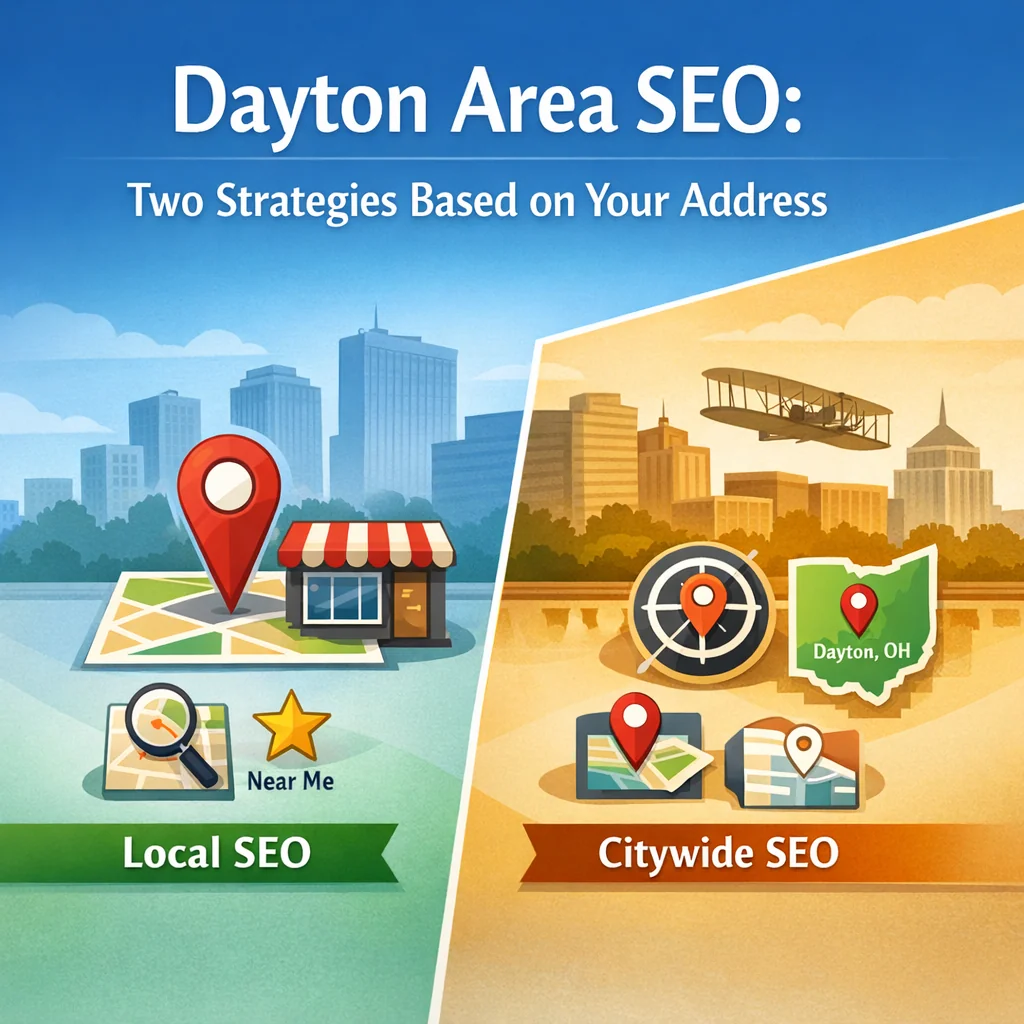
Every credible SEO provider serving Dayton will mention Google Business Profile optimization. Most will list it as a service alongside on-page SEO, link building, and technical audits. Almost none will explain the strategic fork that your physical address creates before any of that work begins.
After Google’s December 2021 core update, proximity became the dominant signal for Map Pack rankings. This is not a minor nuance. It means a well-optimized business physically located in Centerville can be essentially invisible in Map Pack results for searches originating in northern Dayton, even with a complete GBP profile, strong reviews, and consistent posting activity.
This creates a genuine decision point that every Dayton-area business faces before any SEO campaign launches. Our article on local SEO in Dayton and how Google rankings work covers the mechanics of these proximity signals in detail.
The Two Paths, and How They Differ
Path A: Your physical address falls within the zip codes you most want to rank in.
Here, your GBP strategy and your organic strategy can reinforce each other. You can legitimately compete in the Map Pack for nearby searches, and organic content can capture longer-tail queries across a broader geographic footprint. The campaign runs on two parallel tracks that amplify each other.
Path B: Your physical address is outside your primary target service area.
No volume of GBP posts, photos, or review accumulation will close the proximity gap for Map Pack rankings in areas well outside your address. This is not a criticism of GBP management as a service. It is a fundamental characteristic of how Google’s local ranking algorithm works. When this is your situation, the strategy has to shift in specific ways:
- Organic rankings become the primary capture mechanism for target-area searches
- Geo-targeted landing pages for Beavercreek, Huber Heights, Springboro, or Miamisburg need to carry genuine location-specific content, not thin templates with the city name swapped in
- Citation clustering in the target zones (local directory listings, local press mentions, Chamber of Commerce citations) builds geographic relevance signals that partially compensate for address distance
- GBP efforts shift toward review volume and keyword-rich review content rather than proximity-dependent Map Pack domination
The audit question that opens a real SEO engagement is not just “what keywords should you rank for.” It is “does your physical location allow Map Pack competition in your target areas, or does the strategy need to bypass the Map Pack and win on organic?” These are fundamentally different campaigns with different budgets, timelines, and success metrics. An SEO provider who does not ask this question in the first conversation is describing a service, not building a strategy.
Why the Audit Is Not the Strategy
Every SEO provider you talk to in Dayton will offer an audit. An audit is a starting point, not a plan. What separates competent search ranking services from generic ones is what happens after the audit findings come back, specifically which findings trigger which actions, and in what order.
Here is what a real audit-to-action framework looks like for a Dayton-area service business.
Technical Issues: What to Prioritize First
| Finding | Priority Level | Action | Why It Matters for Local Rankings |
|---|---|---|---|
| Index bloat (low-value pages competing for same local terms) | Critical | Consolidate or noindex thin pages | Dilutes topical authority; confuses Google about which page to rank |
| Missing or broken local schema markup | High | Implement LocalBusiness schema on all service pages | Schema helps Google parse NAP data and service categories accurately |
| Core Web Vitals failures on mobile | High | Address LCP and CLS on key service pages first | Mobile page experience is a ranking signal; most local searches are mobile |
| Orphaned service-area pages (no internal links) | High | Build internal linking structure around service geography | Orphaned pages receive no PageRank flow and rarely rank |
| Duplicate city-page templates | Critical | Rewrite with unique location-specific content | Template duplication triggers thin-content filtering |
| NAP inconsistency across citations | Medium-High | Audit and correct all directory listings | Inconsistent NAP data undermines GBP authority signals |
| Page speed issues (non-mobile) | Medium | Address after critical issues resolved | Less impactful for local than technical and content issues |
The item most local SEO providers do not discuss is index bloat. For a service business that has built out pages for every city in the Dayton metro area using slight variations on the same template, those pages frequently compete against each other for the same search queries. Google has to pick one, often picks none, and the domain’s topical authority gets diluted across dozens of underperforming pages instead of concentrated in a few that rank well.
Fixing index bloat, whether by consolidating pages, rewriting them with genuine differentiated content, or removing them entirely, typically produces faster ranking movement than any other single technical intervention. For a deeper look at the full range of issues that suppress local rankings, our technical SEO services for Dayton businesses walk through the most common structural problems and how they get resolved.
The GBP Activity Model: Not a Checklist, a Competitive Signal
Google Business Profile optimization is not a one-time setup task. It is an ongoing competitive signal environment where inactivity causes decay and consistent activity compounds over time.
Three GBP signals that matter more than profile completeness:
Review velocity. The rate at which new reviews arrive matters more than total review count for ranking. A business with 80 reviews that received 15 in the last 90 days typically outranks a business with 200 reviews that received two in the last 90 days. Building a systematic review request process into every job completion is a ranking activity, not just a reputation activity.
Keyword presence in review text. When customers naturally include service and location terms in review text (“they fixed our furnace quickly and the team was great for Dayton emergency service”), those terms function as relevance signals. Prompting customers with specific language in review request messages, where allowed, directly influences this signal.
Post cadence. Regular GBP posts, service updates, offers, and photo additions signal active business operation. Inconsistent or absent posting is not neutral. It is a signal of reduced engagement that GBP’s ranking factors register as lower priority relative to active competitors.
Need a hand with this in Dayton, Kettering and the Triad? Call (937) 848-0086 or request a free estimate. Honest answers, no pressure.
Intent Architecture: Why One Page Cannot Do Two Jobs
Hexxen, an SEO provider focused on home services, correctly identifies that Dayton-area home services customers are often searching because they need help immediately, not because they are browsing options. That is a meaningful behavioral insight. What it should change about how pages are built is rarely explained.
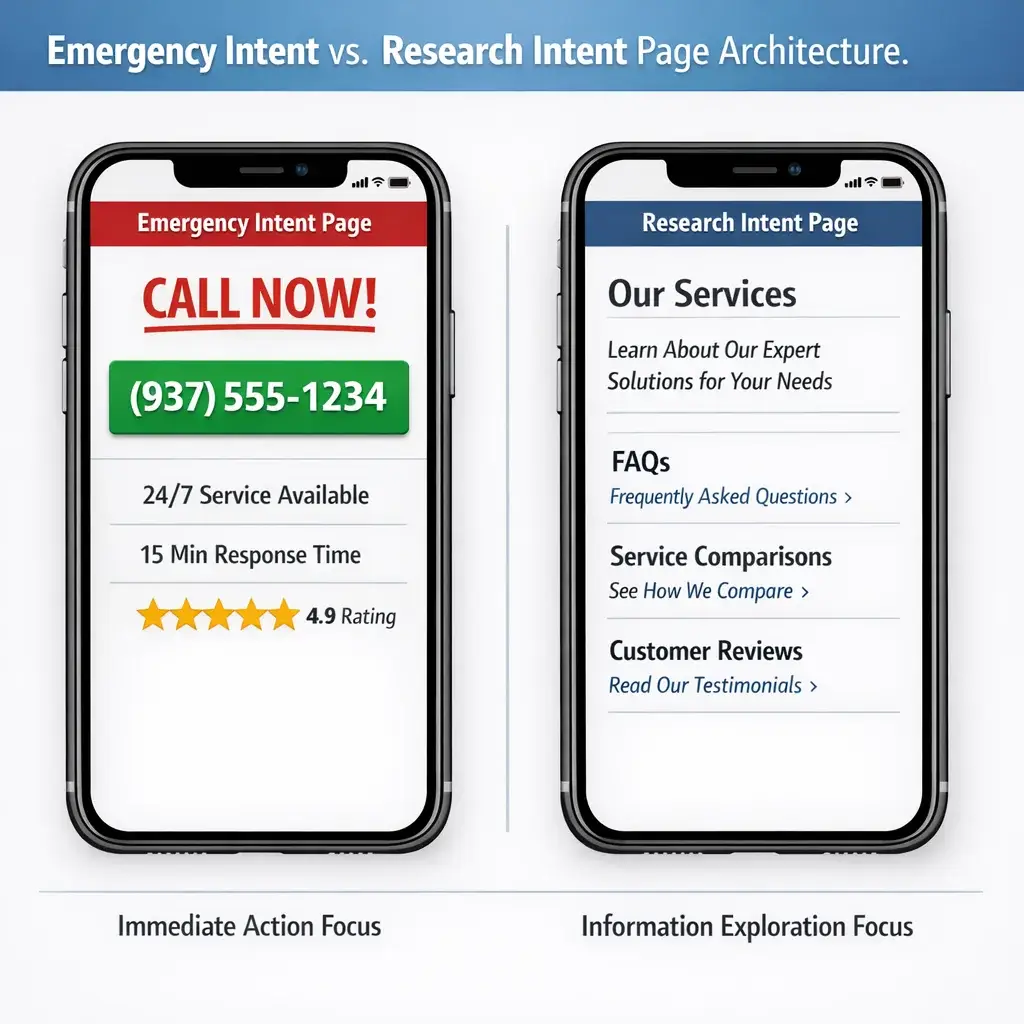
High-intent emergency searches and lower-intent research searches require structurally different page designs. Treating them the same way produces a page that performs poorly for both.
Emergency Intent Pages
A search like “emergency plumber Dayton OH” or “furnace not working Beavercreek” arrives from someone who has already made the decision to hire. They are not comparing options. They are looking for confirmation that you can help them right now.
Above-the-fold elements for emergency intent pages must include:
- Phone number in large format, click-to-call on mobile
- Availability statement (“Available now” or specific hours)
- Response time indication
- One or two trust signals (years in business, number of jobs completed, review score)
The page should reach a call-to-action within the first screen view. Long-form content below that point is acceptable and can serve organic ranking purposes, but the conversion architecture cannot require scrolling.
Research Intent Pages
A search like “best HVAC company Dayton” or “Miamisburg plumbing services reviews” arrives from someone still evaluating. They will scroll. They will read. They will compare.
These pages can and should include:
- Detailed service descriptions
- FAQ sections that address common questions in the evaluation process
- Before-and-after scenarios or case study formats
- Comparison information that positions your services against alternatives
- CTAs placed at natural decision points throughout the content, not only at the top
The decision of which intent profile a page is built around has to precede any on-page SEO work. If the keyword research phase does not classify queries by intent before content is assigned to pages, the resulting pages will be optimized for rankings but not for the actual behavior of the people who arrive on them.
Keyword Strategy: Resolving the Conflict Between What You Want and What Converts
Most Dayton-area business owners come into an SEO engagement with a list of keywords they want to rank for. Those keywords are usually competitive head terms: “Dayton HVAC company,” “Dayton plumbing services,” “electrician Dayton OH.” They are not wrong to want those rankings. But when the search data comes back from actual analytics and keyword tools, the picture is usually different.
The majority of converting traffic, meaning searchers who actually call, book, or fill out a contact form, arrives from long-tail, intent-specific queries. “Furnace not turning on Dayton OH fix.” “Same-day AC repair Kettering.” “Water heater replacement Springboro OH.”
These terms have lower search volumes. They are less prestigious. They are also significantly closer to a hiring decision.
The decision rule: When client keyword preferences and search data conflict, the keyword strategy should be built around conversion proximity. This means prioritizing terms where the searcher is close to taking action, even when those terms carry lower volume and less prestige than the head terms a business owner instinctively wants.
This does not mean abandoning head terms. It means sequencing the campaign correctly. Long-tail, high-conversion-proximity terms generate near-term revenue while the campaign builds the domain authority required to compete for broader head terms over a longer timeline. An agency that builds the entire strategy around high-competition head terms from day one is optimizing for rankings that will take 12 to 18 months to appear, while leaving near-term revenue opportunities unaddressed.
What Legitimate Link Building Looks Like for Dayton Businesses
Link building is one of the most consistently misrepresented services in local SEO. The distinction that rarely gets explained is the difference between topically relevant local links and generic high-authority links.
For a Dayton-area service business, topically relevant local links carry more ranking weight for local and Map Pack rankings than generic high-domain-authority links from unrelated industries. The links that move local rankings are:
- Dayton Area Chamber of Commerce membership listings
- Local news citations (Dayton Daily News, local neighborhood publications)
- Industry association directories with local chapters
- Local business cross-referral links (a plumber linked from a local general contractor’s preferred vendors page)
- Sponsorship citations from Dayton-area nonprofits or events
A provider who describes their link building service as “establishing authority for SERPs” without specifying local relevance as a criterion is likely building links that improve domain authority metrics without materially moving local rankings. These are not the same outcome.
Choosing a Search Ranking Service in the Dayton Area
Evaluating SEO providers in Dayton becomes more productive when you know what questions expose genuine strategic thinking versus service description.
Ask any provider you are considering:
- Given my physical address, am I a viable Map Pack competitor in my target service areas, or does the strategy need to prioritize organic?
- Which specific audit findings will trigger which specific actions, and in what sequence?
- How do you classify search intent before assigning content to pages?
- When my keyword preferences and the search data conflict, how do you make that call?
- What does your link building specifically look like for a local service business in the Dayton market?
A provider with real expertise will answer each of these without hesitation. A provider who has been describing a standardized service package will revert to listing deliverables.
Mongoose Digital Marketing works with businesses across Dayton, Kettering, Beavercreek, Centerville, Huber Heights, Miamisburg, and Springboro. Every engagement starts with the location signal question, because the answer determines which campaign you actually need. If you want a direct assessment of where your rankings stand and what is actually driving the gap, contact us for a free consultation.
For additional context on how Google’s local ranking systems work, Google’s own documentation on how local results are ranked explains the three core factors Google uses: relevance, distance, and prominence.
Frequently Asked Questions
What is the difference between local SEO and general SEO for a Dayton business?
General SEO focuses on improving a website’s visibility in organic search results across a broad audience. Local SEO is specifically concerned with how a business appears when someone searches with geographic intent, including the Map Pack results that appear above traditional organic listings. For a business serving customers in Dayton or surrounding communities like Beavercreek or Centerville, local SEO addresses proximity signals, Google Business Profile optimization, and locally relevant citations that general SEO work does not prioritize.
How long does it typically take to see movement in local search rankings?
The timeline varies based on how competitive the target search terms are, the current condition of the website, and whether foundational issues like inconsistent business listings or thin page content need to be corrected first. In less competitive categories, directional movement can appear within a few months. In more saturated local markets, building enough authority to shift rankings meaningfully is a longer process. Any provider offering a specific guarantee tied to a short fixed timeline is describing an outcome they cannot reliably control.
Why does my business show up in some Dayton-area searches but not others?
Google’s local ranking system weighs distance heavily, which means your visibility often shifts based on where the person searching is physically located relative to your business address. A search run from Kettering and the same search run from Huber Heights can return different Map Pack results even when the search terms are identical. Beyond proximity, relevance signals on your website and the overall prominence Google assigns your business profile both influence which queries trigger your listing and which do not.
Do online reviews actually affect search rankings for Dayton businesses?
Yes, review signals are a recognized factor in local search prominence. This includes the volume of reviews, the overall rating, how recently reviews were posted, and whether the business responds to them. Reviews that mention specific services or locations can also reinforce relevance signals. This does not mean that accumulating reviews alone will move rankings, but a business with a thin or stale review profile is working against itself in a category where competitors are actively maintaining theirs.
Conclusion
Businesses in Dayton and Kettering that have watched competitors consistently appear above them in local search results are usually dealing with a strategy problem, not just a visibility problem, and closing that gap requires a provider who understands how Google’s local systems actually treat businesses in this specific market. Mongoose Digital Marketing works with service businesses across the Dayton area to build search campaigns grounded in real location signal analysis and locally relevant authority, not generic optimization checklists. Call us at (937) 848-0086 or Contact Mongoose Digital Marketing to get a direct assessment of where your rankings stand and what is actually driving the gap.