
Key Takeaways
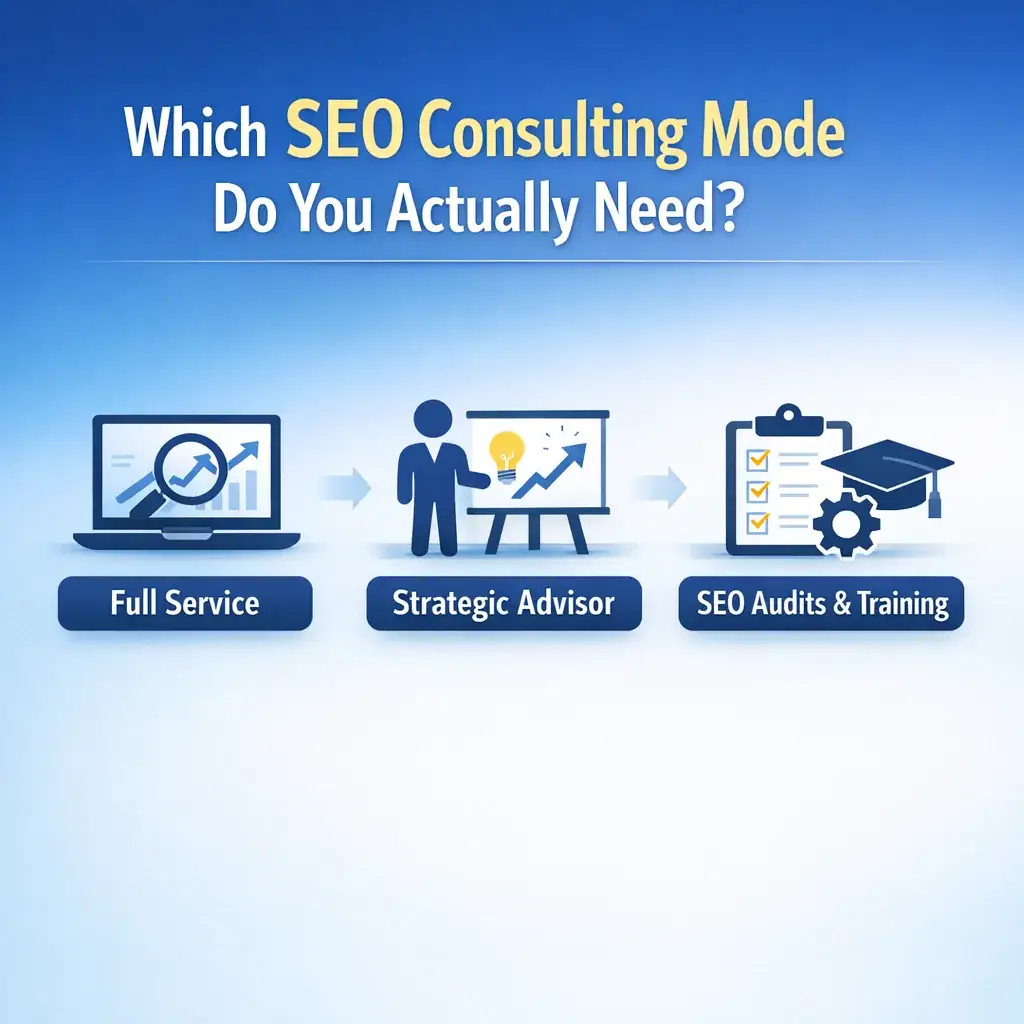
- SEO consulting services divide into two fundamentally different modes, strategic advisory and tactical execution, and hiring the wrong mode for your actual bottleneck produces poor ROI even when the work is done correctly.
- The 87% lower customer acquisition cost often cited for SEO applies after the strategy compounds, typically beyond month six, not during the early ramp period when paid search still outperforms on speed.
- AI search visibility (Google AI Overviews, ChatGPT, Perplexity) is driven by entity authority, topical depth, and structured data signals that differ meaningfully from the signals that produce traditional blue-link rankings.
- A high-quality SEO audit separates into two distinct products: a technical health audit that identifies compliance failures, and a strategic opportunity audit that maps the gap between current organic performance and addressable market demand.
- Businesses in the Dayton metro area, including Kettering, Beavercreek, Centerville, Huber Heights, Miamisburg, and Springboro, compete in local and regional search environments where competitor keyword density and local entity signals vary significantly by industry vertical.
Hiring an SEO consultant without first diagnosing your actual bottleneck is one of the most common and expensive mistakes a growing business can make. The work gets completed, the invoices get paid, and the rankings fail to move, not because the consultant was incompetent, but because the engagement was solving the wrong problem. This article walks through the decision logic that most engagements skip: how to identify which mode of SEO consulting your business actually needs, what separates a high-leverage audit from a compliance checklist, how AI search visibility works as a distinct discipline, and what accountability structures indicate a serious consulting partner versus a vendor simply executing tasks.
The Strategic vs. Tactical Distinction That Determines Your ROI
Every reputable source on SEO consulting acknowledges that the service exists on a spectrum from pure strategy to hands-on execution. What almost none of them explain is how to identify where your business sits on that spectrum before signing an engagement.
The distinction matters because the failure modes are completely different.
A business with a broken keyword universe, meaning it is targeting terms that do not match its actual buyers’ intent, will not benefit from flawless technical execution. Crawl budgets can be optimized, page speed can be improved, and schema markup can be perfect, and organic leads will still fail to convert because the traffic arriving is the wrong traffic. That is a strategy failure, and it requires a consultant who operates at the diagnostic level before touching a single page.
Conversely, a business with sound strategy but significant technical debt, think duplicate content, crawl errors, slow Core Web Vitals, or a disorganized site architecture, will see a qualified content strategy stall because the search engine cannot efficiently process and index the content being produced. That is an execution failure, and it requires a consultant with hands-on technical depth, not another market positioning workshop. For a closer look at the specific issues that fall into this category, the article on Technical SEO Services Dayton | Fix What’s Killing Rankings breaks down the most common culprits in detail.
How to Identify Your Bottleneck Before Engaging Anyone
Ask three questions about your current organic performance:
1. Do you rank for anything relevant at all?
If the answer is no across the board, the problem is likely foundational: wrong keyword targets, technical barriers to indexing, or insufficient domain authority. This is primarily a strategy and technical execution problem, and you need a consultant who can operate in both modes.
2. Do you rank but fail to convert?
If organic traffic arrives but produces minimal leads or revenue, the keyword strategy may be misaligned with buyer intent. You are attracting the wrong audience or ranking for informational queries when you need transactional ones. This is a strategy problem layered on what appears to be a performance success.
3. Do you rank for some terms but have obvious content gaps?
If competitors consistently outrank you in your core service areas despite your site having comparable authority signals, the problem is likely topical depth and content architecture. This is an execution problem with a clear strategic map already in place.
The consulting profile, engagement model, and success metrics you need differ across all three scenarios. A vendor who applies the same onboarding process regardless of which scenario you are in is running a template, not a diagnosis.
What a High-Value SEO Audit Actually Looks Like
The SEO audit is the entry point for nearly every consulting engagement, and it is almost universally described as a commodity starting point. It is not. There are two distinct audit types, and conflating them is how businesses end up paying for analysis that does not inform decisions.
Technical Health Audit
This is what most agencies mean when they say “SEO audit.” It evaluates:
- Crawlability and indexation status
- Core Web Vitals performance across device types
- Duplicate content, canonical tag errors, and redirect chains
- Structured data implementation and validation
- Internal linking architecture and crawl depth
- Mobile usability and page experience signals
A technical health audit answers the question: is your site technically capable of ranking? It is a compliance check against known ranking prerequisites. It is necessary but not sufficient for a growth strategy.
Strategic Opportunity Audit
This is the audit that drives revenue decisions. It maps the gap between your current organic performance and the total addressable demand in your market. It includes:
- Share-of-voice analysis across your target keyword universe
- Competitor content gap identification by topic cluster
- Search intent classification across your full keyword set
- Entity coverage analysis relative to AI search citation patterns
- Local search visibility scoring for each geographic service area
For businesses operating across the Dayton metro, including Kettering, Beavercreek, Centerville, Huber Heights, Miamisburg, and Springboro, this audit needs to account for local keyword competition by individual market, not just the city of Dayton as a whole. A Centerville-based service business and a Huber Heights-based service business may face entirely different competitive landscapes for the same service category. The article on SEO Services Dayton: Local Strategies That Actually Work explores how those suburb-level dynamics play out across key industry verticals.
A strategic opportunity audit answers the question: where is organic growth actually available, and what is the effort-to-return ratio for capturing it? That is the output that justifies an SEO investment at the executive level.
Need a hand with this in Dayton, Kettering and the Triad? Call (937) 848-0086 or request a free estimate. Honest answers, no pressure.
The Cost-Efficiency Argument, Applied Correctly
The widely cited statistic that SEO produces customer acquisition costs 87% lower than paid search is accurate in context and misleading without it. The operative phrase is “a good SEO strategy” applied over sufficient time.
Here is the temporal reality of how the cost curves actually compare:
| Time Period | SEO Consulting | Paid Search |
|---|---|---|
| Month 1 to 3 | High investment, near-zero organic return while strategy builds | Immediate traffic and leads from day one |
| Month 4 to 6 | First ranking movements appear, some qualified traffic begins | Consistent return, but cost-per-lead remains fixed or rises |
| Month 7 to 12 | Compounding return as content and authority build | Return plateaus relative to budget; requires continued spend |
| Month 13 to 24 | Organic leads arrive at substantially lower cost-per-acquisition | Every lead still requires active ad spend to generate |
| Month 24 and beyond | Content and authority assets produce return without proportional new spend | Full budget dependency; traffic stops when spend stops |
The business case for SEO consulting is strongest when you are planning for a 12 to 24 month growth horizon and have the capacity to sustain revenue through the ramp period. If your business needs leads within 60 days, paid search is the correct immediate tool, and SEO should run in parallel as the long-term compounding engine. For businesses evaluating both options simultaneously, the article on PPC Advertising Management Services That Deliver ROI lays out how a managed paid search strategy can bridge that gap during the organic ramp period.
A consulting partner worth working with will tell you this directly. One who positions SEO as an immediate replacement for paid lead generation is misrepresenting the timeline.
AI Search Visibility: What It Is and How It Differs From Traditional SEO
The emergence of Google AI Overviews, ChatGPT search, Perplexity, and Microsoft Copilot as visible answer surfaces has created a legitimate new discipline that some consultants market aggressively and few explain with any precision.
Here is what is actually mechanically different about AI search visibility compared to traditional ranking signals.
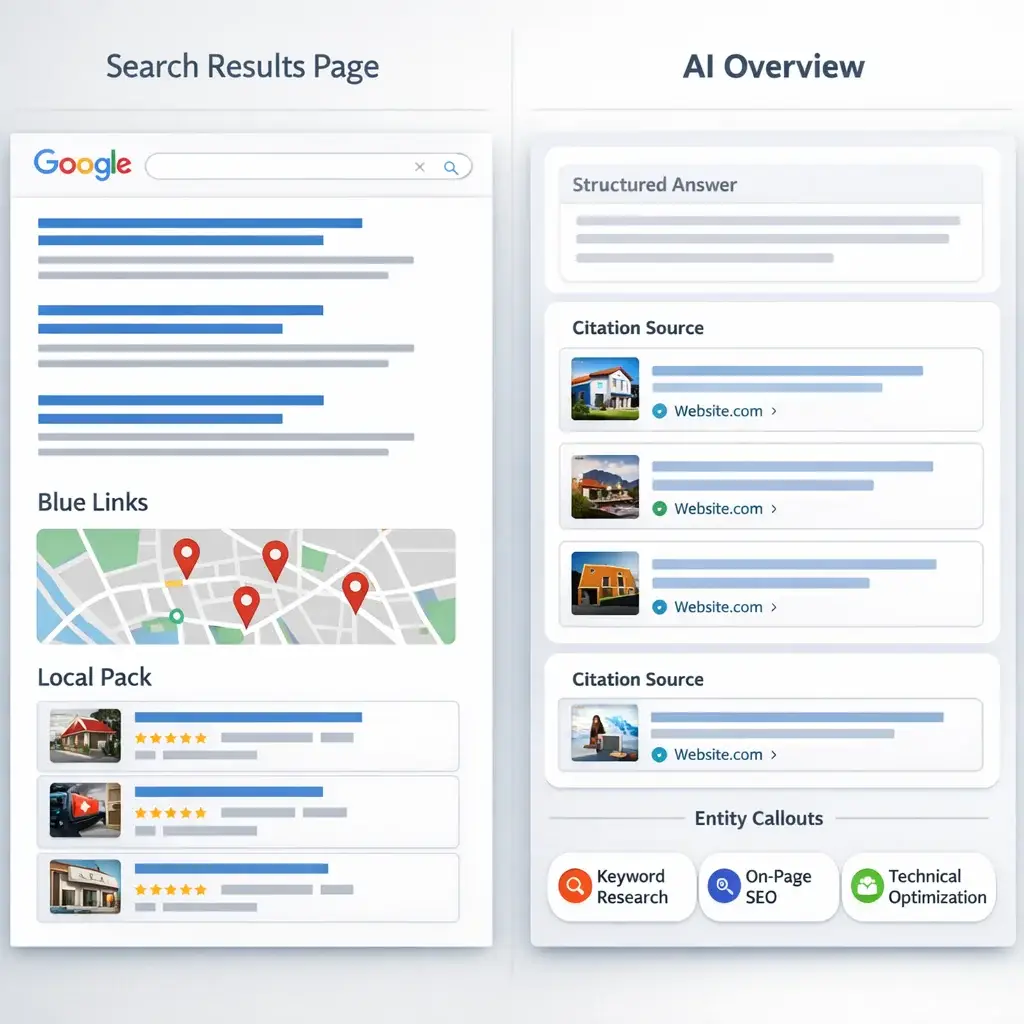
Traditional Ranking Signals (Blue-Link SEO)
- Backlink authority and relevance
- On-page keyword density and semantic coverage
- Click-through rate and engagement signals
- Page experience and Core Web Vitals
- Internal linking and site architecture
AI Overview and LLM Citation Signals
- Entity authority: Is your brand, product, or person recognized as an entity within Google’s Knowledge Graph? LLMs cite sources they have indexed as authoritative entities, not just pages with high backlink counts.
- Topical completeness: AI systems synthesize answers from sources that comprehensively address a topic. Thin content that ranks for a keyword may not be cited in an AI overview for the same query.
- Structured data and schema: FAQ schema, HowTo schema, and Article schema help AI systems extract and attribute information accurately.
- Third-party validation: Citations in AI overviews skew toward sources that are themselves cited by other authoritative sources, which overlaps with but is not identical to traditional link building.
- Concise, citable answer formatting: AI systems extract specific answer passages. Content structured to provide a direct, quotable answer to a defined question performs better as a citation source.
The conflict worth acknowledging is this: long-form comprehensive content, which is a traditional ranking signal for competitive informational queries, can actually underperform as an AI citation source if it buries the direct answer. A consultant optimizing for both surfaces simultaneously needs to resolve that tension at the content architecture level, not just add schema markup to existing pages.
For businesses in the Dayton area, AI search visibility is particularly relevant for service queries with strong local intent. A user asking an AI assistant “who are the best marketing consultants near Dayton” is engaging in a behavior that rewards entity authority and local business profile completeness, signals that differ from the page-level optimization driving traditional local SEO rankings.
What Accountability Looks Like in a Serious Consulting Engagement
Social proof through case studies and testimonials is the industry standard for signaling credibility. It is also the easiest signal to present without substance. A case study showing 960 organic sessions growing to 17,000+ is compelling. It tells you nothing about the timeline, the competitive context, the starting authority level, the content investment required, or whether those sessions converted to revenue.
The accountability structures that distinguish a high-quality SEO consulting engagement are contractual and operational, not just promotional.
Look for these concrete accountability signals when evaluating a consulting partner:
- Defined success metrics at engagement start: Not “we will improve your rankings,” but specific KPIs tied to traffic, lead volume, and revenue attribution that are agreed upon before work begins.
- Reporting cadence with causal explanation: Monthly or quarterly reports that explain what actions were taken, what signals changed, and why specific outcomes occurred, not just a dashboard screenshot.
- Separation of audit deliverables from strategy deliverables: An audit that produces a prioritized action list with effort and impact estimates per item, not a list of issues without relative weighting.
- Honest ramp period communication: Any consultant who does not explicitly set expectations about the 3 to 6 month period before compounding begins is either inexperienced or managing your expectations in their favor.
- Clear scope for strategy versus execution work: If the engagement includes both advisory and implementation services, the deliverables for each should be defined separately so you can evaluate performance in both modes independently.
Choosing an SEO Consulting Partner in the Dayton Region
Businesses across Dayton, Kettering, Beavercreek, Centerville, Huber Heights, Miamisburg, and Springboro are competing in a local search environment where national agencies frequently apply templated strategies that do not reflect the actual competitive dynamics of specific Ohio markets. Regional market context, including which competitors are dominant in which service categories, what local search volumes actually look like for your industry, and how local entity signals perform across individual suburbs, is the difference between a strategy built for your market and a strategy built for a generic market.
At Mongoose Digital Marketing, we operate as a full-service partner covering SEO, web design, PPC, and social media, which means the SEO strategy we build does not exist in isolation from your site architecture, paid search behavior, or content ecosystem. That integration is not a sales point. It is a functional advantage: organic and paid strategies that are built in coordination compound faster than strategies built in separate silos.
The starting point is a free consultation where we diagnose which mode of consulting your business actually needs before recommending an engagement structure. If the answer is that you need paid search more urgently than organic SEO, we will tell you that. The goal is your growth, not a signed contract for a service that solves the wrong problem.
Ready to identify your actual growth bottleneck? Contact Mongoose Digital Marketing for a free consultation and find out exactly what it will take to grow your organic visibility in the Dayton metro market.
Frequently Asked Questions
What is the difference between an SEO consultant and an SEO agency?
An SEO consultant typically works in an advisory capacity, diagnosing problems, building strategy, and guiding your internal team or existing vendors on execution. An SEO agency generally handles both the strategy and the hands-on implementation work. Some engagements blend both models, where a consultant or consulting firm also executes the recommendations they develop. The right fit depends on whether you have internal capacity to act on recommendations or whether you need a partner to carry the work through to completion.
How long does it take to see results from SEO consulting?
The timeline depends on the condition of your site, how competitive your target keywords are, and how quickly recommendations are implemented. Technical fixes that remove crawl or indexing problems can produce measurable changes within weeks. Content and authority-building strategies typically require several months before ranking improvements become significant. A consulting engagement should establish realistic milestones early so you have a clear framework for evaluating progress rather than waiting indefinitely for results.
Can SEO consulting help a local business compete against larger national companies?
Yes, and local markets are often where targeted SEO strategy creates the most leverage. National brands frequently rely on broad, templated approaches that do not account for the specific competitive dynamics of individual metro areas or suburbs. A well-executed local SEO strategy that addresses entity signals, location-specific content, and regional search behavior can outperform much larger competitors within a defined geographic market.
How do I know if my business needs SEO consulting or a different digital marketing service first?
The honest answer is that SEO is not always the highest-priority investment depending on where a business is in its growth stage. If your website has significant technical problems, your paid search is unmanaged, or your conversion rate is low, addressing those issues first may produce faster returns than building organic visibility. A legitimate consulting engagement starts with that diagnostic conversation rather than assuming SEO is the right solution before understanding the full picture.
Conclusion
Businesses in Dayton, Kettering, Beavercreek, and Centerville deserve an SEO partner who understands the local competitive landscape rather than applying a national template to a regional market. Mongoose Digital Marketing combines SEO consulting with integrated web design and local search strategy, so the plan we build for your business reflects where your customers actually are and what it actually takes to reach them in the Dayton metro. To find out what your organic growth opportunity looks like, Contact Mongoose Digital Marketing or call us directly at (937) 848-0086.