

Key Takeaways
- Small businesses in Dayton, Kettering, Beavercreek, and the surrounding Miami Valley area need SEO strategies built around local search intent, not generic national ranking tactics, because their customers search with geography and immediacy in mind.
- The scoring methodologies used by agency comparison sites contradict each other directly, meaning the “best” agency on one list may rank near the bottom on another, and understanding why this happens is more useful than trusting any single ranking.
- SEO that generates phone calls and form submissions for a local service business operates differently from SEO that generates rankings, and confusing the two leads to campaigns that look successful on paper but produce no growth.
- Before signing with any SEO agency, asking who will handle your account day-to-day and what their direct experience level is reveals more about likely results than any published case study or review score.
- Switching SEO agencies mid-campaign carries real operational risk, including loss of strategic momentum and institutional knowledge about your site, that most agency comparison guides never address.
Small businesses make a predictable mistake when searching for SEO help: they evaluate agencies the same way they would evaluate a product on Amazon, looking for the highest-rated option on a ranked list and signing with whoever appears at the top. The problem is that those lists are almost always published by agencies that ranked themselves first, scored using methodologies that contradict each other, and built around a definition of “small business” that is vague enough to be meaningless. A two-person plumbing operation in Miamisburg and a forty-person regional law firm in Beavercreek are both technically small businesses, but they share almost no SEO priorities, competitive dynamics, or realistic timelines.
This article gives Dayton-area business owners a framework for evaluating SEO companies on their own terms, using questions and criteria that the published comparison sites consistently skip. The goal is not to hand you another ranked list. The goal is to help you make a decision that produces actual leads, actual calls, and actual revenue growth.
Why Most SEO Comparison Guides Fail Small Businesses
The ranked-list format that dominates search results for “SEO companies for small business” has a structural problem baked in. The agencies publishing those guides have a financial incentive to rank themselves at the top, and the methodology each one uses to justify that ranking is chosen after the conclusion, not before it.
Consider how differently three prominent comparison sites weight the same evaluation criteria. One site gives review scores nearly a quarter of the total weight. Another weights AI search visibility at sixty percent of the total score, treating a contested and inconsistently defined metric as the dominant factor in agency quality. A third splits weight equally across five criteria regardless of how relevant each one is to any specific business situation. The same agencies appear across all three lists in completely different rank positions, and none of the guides explain to the reader why the methodology differences exist or which weighting makes sense for a given business type.
This matters practically. A methodology that heavily weights AI search visibility will systematically favor agencies that have invested in appearing in AI-generated answers, which is a new and genuinely uncertain discipline. That weighting may be appropriate for a B2B technology company whose prospects research solutions through AI tools. It is much less clearly appropriate for a Centerville HVAC company whose customers search Google Maps when their furnace stops working at 10 PM.
The Self-Ranking Problem Is a Due Diligence Test, Not Just a Disclaimer
Several of the most prominent comparison sites openly acknowledge ranking themselves first on their own lists. Some include a single-sentence disclaimer and move on. Others do not disclose the conflict at all despite being guilty of the same thing.
The disclosure, or lack of it, is itself a signal worth paying attention to. An agency that ranks itself first without acknowledging the conflict is demonstrating in public, before you have even spoken with them, a tolerance for misleading presentation. That is a preview of how they may present your campaign results six months in.
A direct test you can apply: ask any agency you are evaluating whether they publish a best-agencies-in-the-industry list, and whether they ranked themselves on it. Their willingness to answer plainly, and how they frame the answer, tells you something about their reporting culture. Agencies that deflect that question or justify the practice without acknowledging the obvious conflict warrant additional scrutiny. For a deeper look at the patterns local SEO companies often obscure, the article What Local SEO Companies Won’t Tell You About Rankings covers the most common gaps in agency transparency.
Defining “Small Business” Before You Search for Help
The single most common gap in SEO agency comparison content is that “small business” is never actually defined, yet it is used as if it describes a single type of client with a single set of needs.
For the purposes of choosing an SEO partner, the relevant distinction is not company size. It is the nature of how your customers find and choose you.
Local service businesses operate within a defined geographic area. Their customers search with location signals, often on mobile, often with immediate intent. Think of the search “furnace repair near me” or “plumber Huber Heights.” These businesses need SEO that is rooted in Google Business Profile optimization, local citation consistency, proximity-based ranking signals, and content that directly answers the questions their community is searching for. Results are measured in calls and appointment requests, not abstract ranking positions.
Product and eCommerce businesses compete on broader keyword sets, often nationally, and measure success through transaction volume and average order value. SEO strategy for these businesses centers on product page optimization, category architecture, and review volume across multiple platforms.
Professional services firms operate somewhere between these two models. A Springboro accounting firm serves a local geographic market but may compete for informational keywords that attract clients well before they are ready to call. Their SEO needs content that builds authority over time and converts at a slower, more researched decision pace.
If an agency pitches you a strategy without first asking which of these models describes your business, that is a meaningful warning sign. The tactics that generate leads for one model can be actively counterproductive for another.
Need a hand with this in Dayton, Kettering and the Triad? Call (937) 848-0086 or request a free estimate. Honest answers, no pressure.
Rankings vs. Leads: The Distinction That Determines Whether SEO Works for You
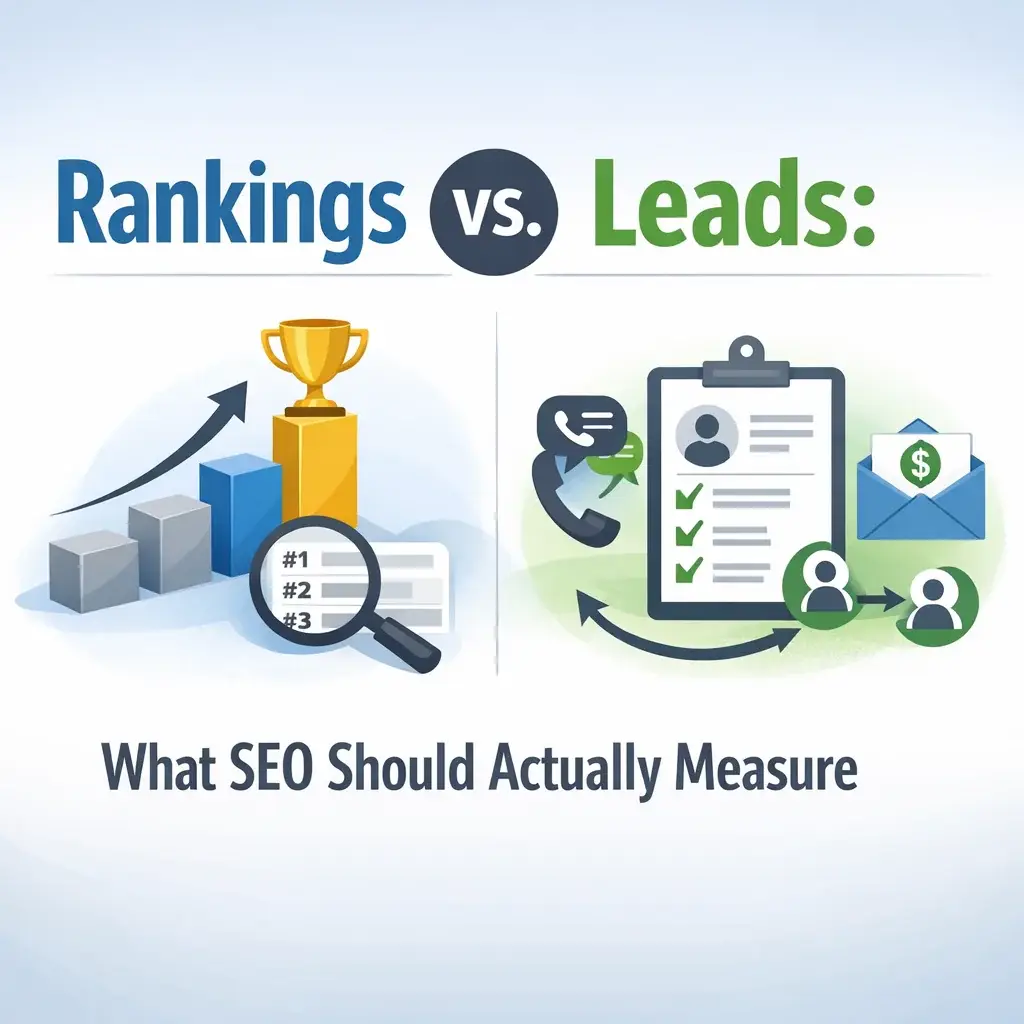
One of the most important operational distinctions that almost no comparison guide explains is the difference between SEO that generates rankings and SEO that generates leads.
It is entirely possible to rank on the first page of Google for keywords that your actual customers never search. It is equally possible to improve rankings for competitive keywords while your call volume and form submissions stay flat because the search intent behind those keywords does not match what you offer.
Lead-generating SEO is built backward from the customer’s decision process. It starts by identifying the specific searches that occur immediately before someone contacts a business like yours, then builds ranking authority for those searches specifically. For a small business in Kettering or Miamisburg, that means prioritizing searches with clear local intent and commercial urgency over high-volume keywords that attract researchers, competitors, or people at the very beginning of an awareness journey.
How to Tell Which Type of SEO an Agency Is Selling You
Ask any prospective agency to walk you through how they will measure success for your specific campaign. If the answer centers on keyword rankings and organic traffic volume, follow up by asking how they connect those metrics to leads and revenue. Agencies that have genuinely built lead-generating SEO programs for local businesses will have a clear answer. They will reference conversion tracking, call tracking, form submission attribution, and revenue tied to organic channel. Agencies that pause or pivot to explaining why rankings matter first are likely to deliver the reporting that looks good rather than the results that grow your business.
The Questions That Reveal an Agency’s True Capability
Evaluation criteria published on comparison sites, whether labeled “content quality,” “technical SEO depth,” or “pricing fairness,” are presented as conclusions. They are scores assigned by the site’s editorial team, and you have no way to verify or replicate them. What you can do is ask questions directly that surface the same underlying quality signals.
Who Will Actually Work on Your Account?
The single most predictive question in any agency evaluation is: who will be my day-to-day contact, and what is their direct experience level? This matters disproportionately for small businesses because the gap between the senior strategist who wins the account and the junior coordinator who services it is often where results fall apart.
Some comparison guides use “founder-led” as a positive quality signal, and there is logic behind it. In founder-led agencies, the chain between the person who diagnosed your problem and the person executing the solution tends to be shorter. But founder-led status is a proxy for the real question. Ask it directly: Will a strategist with verifiable experience in local SEO be actively working on my account each month, or will they set the initial direction and hand it to a coordinator?
Any agency that cannot answer this question clearly, or that answers with vague language about “team-based servicing,” deserves follow-up.
Can You Show Me a Local Campaign That Matches My Situation?
Ask for examples of SEO campaigns they have run for businesses that are similar to yours in three specific ways: same general business type, similar geographic market size, and comparable starting point in terms of existing domain authority and online presence. Case studies that show results for national brands or enterprise clients tell you very little about how the agency will perform for a local service business in Dayton’s competitive market.
If they share a case study, ask what specifically drove the result. If the answer is vague, that is meaningful. Genuine SEO expertise produces an explanation that references specific technical decisions, content choices, or local citation strategies. Marketing language about “holistic optimization” and “full-funnel approaches” that is not connected to specific decisions is not an answer. The article How to Find the Right SEO Agency (Real Guide) walks through additional due diligence questions worth adding to your evaluation process.
What Happens When You Switch Agencies
Agency comparison guides focus almost entirely on how to find the right agency. They say very little about the operational reality of agency transitions, which is a significant gap for small businesses with limited runway.
When you switch SEO agencies, several things happen simultaneously. The new agency needs time to audit your existing site, understand what the previous agency built or did not build, and form their own judgment about what is working. That audit period is often a month or more. Campaign momentum, particularly the compounding authority built through consistent content and link acquisition over months, does not transfer instantly. If the previous agency built that authority using tactics the new agency considers problematic, there may be corrective work required before forward progress resumes.
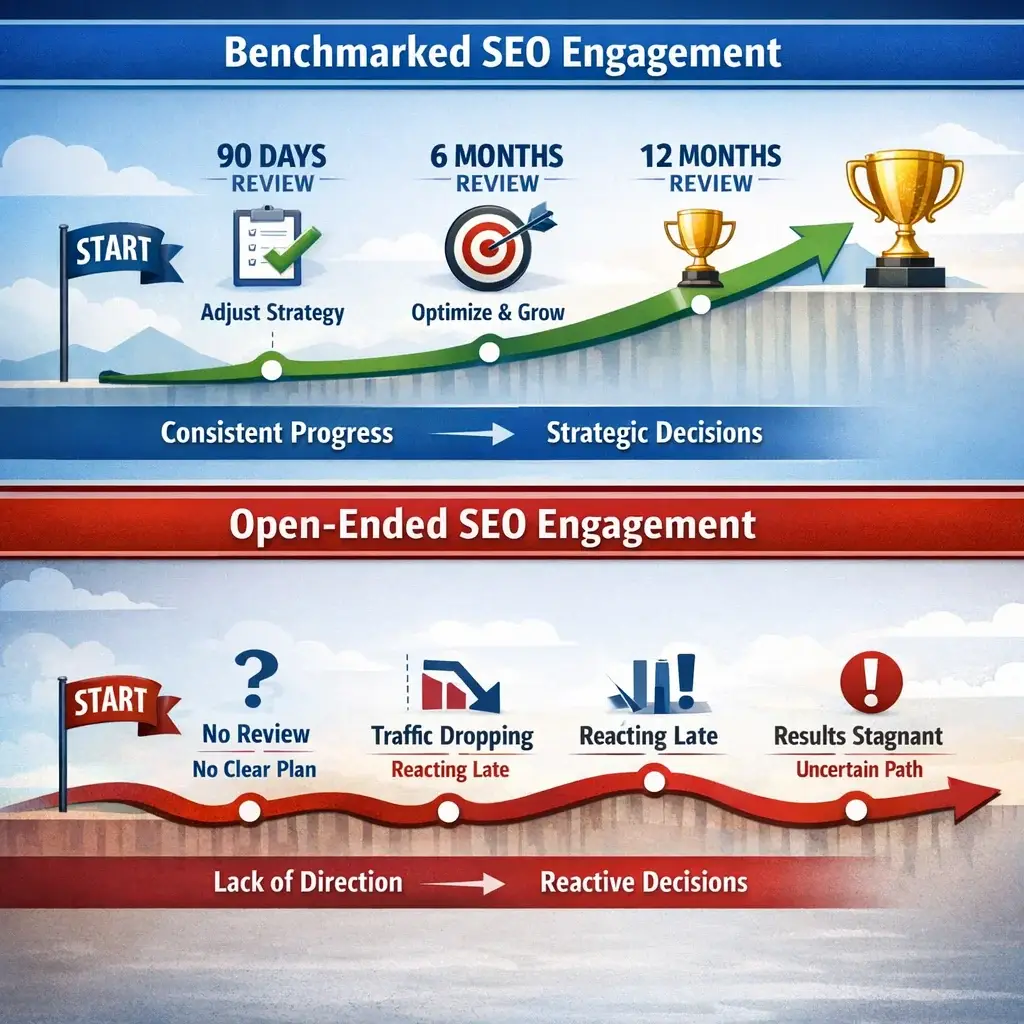
This does not mean you should stay with an agency that is not delivering. It means you should enter any agency relationship with clear benchmarks agreed in writing, reviewed at defined intervals, so that you can make a transition decision before you have spent a year of budget without results. Setting those benchmarks upfront is not adversarial. Any agency confident in their process will welcome the specificity.
How to Evaluate Agencies Serving the Dayton Market
For businesses serving Dayton, Kettering, Beavercreek, Centerville, Huber Heights, Miamisburg, and Springboro, the competitive landscape in local search is specific to this region. That specificity means the most relevant evaluation question is whether an agency understands how local search actually functions in mid-sized Midwestern markets, not whether they have impressive case studies from coastal metros with very different competitive dynamics.
When speaking with any agency, ask specifically about their experience with Google Business Profile optimization and local pack ranking in similar markets. Ask how they approach citation building and whether they have worked with the directories and local platforms relevant to your industry in Ohio. Ask whether they have run campaigns for businesses competing in markets where physical proximity to a search is a significant ranking factor, because that describes most of the Miami Valley service business landscape.
The table below summarizes the key evaluation criteria that matter specifically for small businesses pursuing local SEO, and the verification question you should ask to move each criterion from a label to a real data point.
| Evaluation Criterion | What It Actually Means | The Question to Ask |
|---|---|---|
| Local SEO capability | Documented ability to improve rankings in local map packs, not just organic results | “Show me a Google Business Profile you manage that has improved in local pack visibility. What did you change?” |
| Account experience level | The person doing the work has run local campaigns before, not just managed reports | “What is the job title and tenure of the person who will handle my account week to week?” |
| Lead attribution | The agency can connect SEO activity to business outcomes, not just traffic | “How do you track calls and form submissions that come from organic search?” |
| Content approach | Content is built around local search intent, not generic keyword volume | “How do you decide what to write about for a local service business?” |
| Reporting transparency | Reports show progress toward business goals, not just ranking tables | “Can I see an example of a monthly report you send to a local service client?” |
| Transition risk awareness | The agency understands what they inherit and what it takes to maintain momentum | “If I came to you from another agency, how would you approach the first 90 days?” |
Choosing the Right Partner for Where You Are in Your Growth
The right SEO agency for a Dayton-area small business is not the one with the most impressive website, the longest client list, or the highest position on a self-published ranking. It is the one that can clearly articulate what they will do for your specific situation, connect that work to the outcomes your business actually needs, and demonstrate that the person making those decisions will be actively engaged in your account.
Mongoose Digital Marketing works with small businesses across Dayton, Kettering, Beavercreek, Centerville, Huber Heights, Miamisburg, and Springboro because we understand that local growth requires local thinking. We do not apply national playbooks to regional markets. We build strategies around where your customers are, what they are searching for, and what it takes to earn their contact in a competitive market.
If you want a direct conversation about what SEO can realistically do for your business and what it will take to get there, start with a free consultation. We will tell you what we see, what we would do, and why, without the vague language that makes most agency pitches feel identical.
For additional context on how Google’s local search ranking systems work, Google’s own Search Central documentation provides the foundational framework that legitimate SEO strategies are built on.
Frequently Asked Questions
How long does it typically take to see results from SEO for a small business?
Most small businesses begin to see measurable movement in local search visibility within three to six months of consistent, well-executed SEO work. The timeline depends on factors like how competitive your market is, how your website is currently performing, and how long your business has been established online. Newer businesses or those with significant technical issues may take longer to gain traction, while businesses with an existing foundation often see faster progress. Any agency promising dramatic results within the first thirty days is likely oversimplifying what genuine SEO requires.
What is the difference between local SEO and general SEO, and which does a small business need?
General SEO focuses on improving a website’s visibility in broader, often national or industry-wide search results. Local SEO is specifically aimed at connecting a business with people searching in a defined geographic area, which is the priority for most small businesses that serve customers in a specific city or region. For a plumber in Kettering or a dentist in Centerville, ranking well in the Dayton metro area matters far more than ranking for broad national terms. Most small businesses benefit primarily from a local SEO approach, though the two strategies often overlap and reinforce each other.
What should a small business owner actually look for in an SEO agency contract or agreement?
Look for clear language around what work will be performed each month, how results will be reported, and what happens to your website assets if you end the relationship. Ownership of your Google Business Profile, website content, and any accounts created on your behalf should remain with your business, not the agency. Be cautious of long lock-in terms with no performance accountability built in, and make sure the reporting you receive connects to business outcomes like leads and calls rather than only tracking keyword positions in isolation.
Can a small business do SEO without hiring an agency?
Yes, and for some businesses it makes sense to handle foundational tasks internally, particularly keeping the Google Business Profile accurate and generating genuine customer reviews. However, the technical and strategic depth required to compete in a contested local market, including site architecture, content development, link building, and ongoing performance analysis, typically requires dedicated expertise and time that most small business owners cannot realistically maintain alongside running their operations. The question is not whether an owner can learn SEO, but whether the time investment produces a better return than focusing on core business activities while a qualified agency handles search strategy.
Small businesses in Dayton and Beavercreek deserve straightforward answers and an SEO partner who understands the local market well enough to build strategy around it, not just apply a generic template and send a monthly ranking report. Mongoose Digital Marketing works directly with small business owners across the Miami Valley to develop search strategies grounded in how real customers in this region actually find and choose local services. If you are ready to have an honest conversation about what SEO can do for your business, call us at (937) 848-0086 or Contact Mongoose Digital Marketing to get started.