
The Business Owner’s Real Guide to Finding the Right SEO Agency
Most articles about finding the right SEO agency give you the same recycled advice: set a budget, check Google reviews, ask for case studies, look out for “black hat” tactics. It’s a checklist dressed up as expertise, and it leaves the most important questions completely unanswered.
The problem is not that this advice is wrong. It’s that it’s incomplete in ways that cost businesses real money and real time. Choosing the wrong SEO partner doesn’t just mean slow growth — it can mean months of work that has to be undone, a content library you don’t actually own, and traffic gains that look impressive in a monthly report but never translate into a single qualified lead.
This guide operates at a different level. It covers the questions most agencies hope you won’t ask, the red flags that don’t show up on a review platform, and the strategic frameworks that separate agencies genuinely capable of driving business growth from those that are simply proficient at moving a keyword ranking needle.
If you’re a business owner or marketing decision-maker preparing to evaluate SEO partners, this is the framework that will actually protect you — and help you find an agency worth committing to.
Why the Standard Vetting Process Fails Most Businesses
The conventional approach to agency selection treats SEO like a commodity purchase. You define a scope, collect proposals, compare line items, and pick a winner. But SEO is not a commodity — it’s a compounding strategic function that intersects with your content, your sales cycle, your technical infrastructure, and your brand positioning.
The gap between a competent agency and an exceptional one rarely shows up in a proposal document. It shows up six months into the engagement, when one agency has built measurable pipeline and the other is still reporting on keyword position improvements that your sales team has never felt.
Here’s what the standard checklist misses entirely.
The Build vs. Hire vs. Partner Decision Comes First
Before you evaluate a single agency, you owe it to your business to answer a more fundamental question: is an external SEO agency actually the right structural answer for where you are right now?
There are four real options on the table:
- Full-service agency: End-to-end strategy and execution handled externally. Best for businesses without existing in-house SEO capacity who want integrated support across content, technical, and link acquisition.
- Specialist boutique agency: Narrow focus — technical SEO, local SEO, or a specific vertical. High expertise, lower capacity breadth. Best when you have a targeted problem and internal marketing bandwidth to manage the relationship.
- Fractional in-house SEO: A senior SEO strategist embedded part-time in your team. Best for businesses that want institutional knowledge to stay internal but can’t yet justify a full-time hire.
- Hybrid model: In-house strategist setting direction, agency executing content production and link building. Best for scaling businesses with enough internal clarity to direct external effort effectively.
Each of these has distinct cost structures, risk profiles, and performance timelines. The agency selection conversation only makes sense once you’ve consciously chosen which model fits your stage of growth.
How to Actually Evaluate an SEO Agency’s Track Record
Let’s talk about case studies — because every guide tells you to ask for them, and almost no guide tells you what to actually do with them.
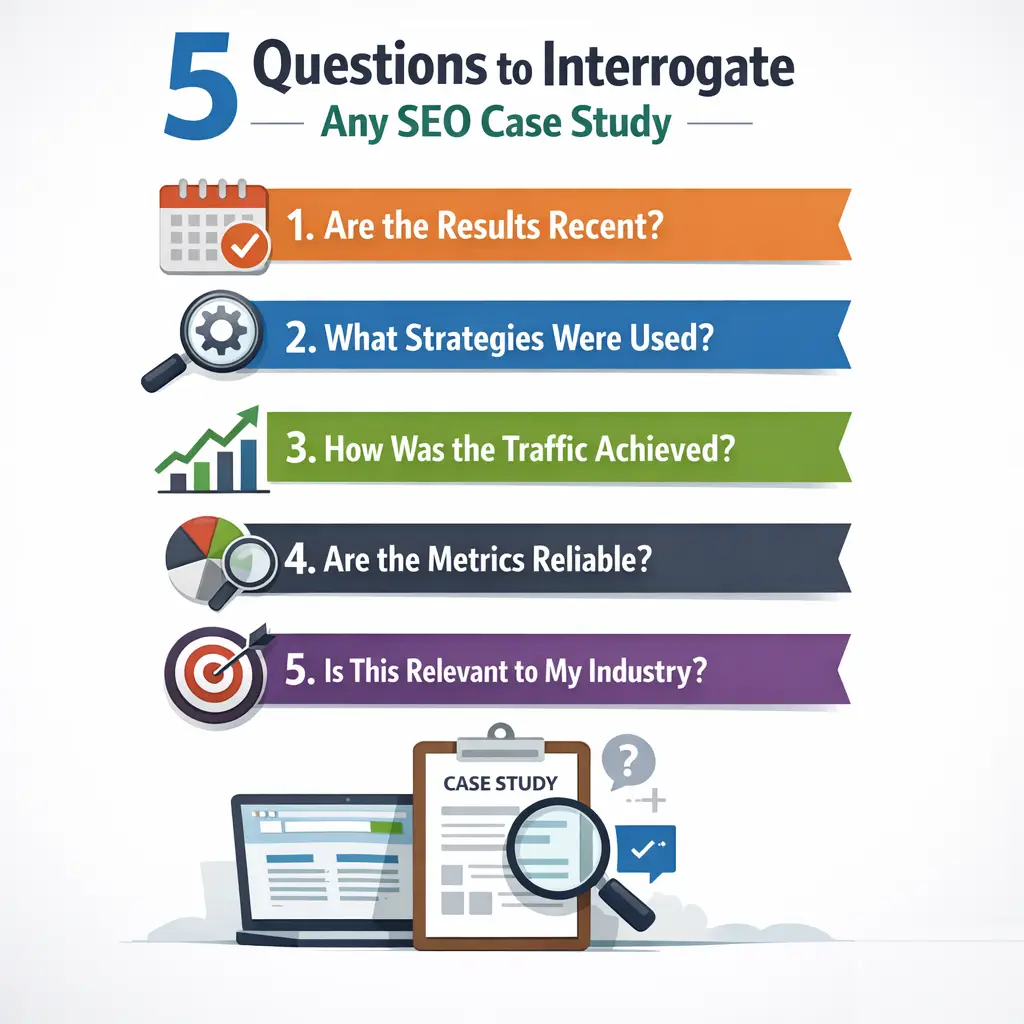
Case studies are marketing materials. They are curated, framed, and published by the agency for the purpose of winning new business. That does not make them dishonest, but it does mean they require interrogation.
The Attribution Audit: Reading Between the Lines
When an agency presents a case study showing 140% organic traffic growth over 18 months, the sophisticated question is not “how did you do it?” — it’s “how do you know it was you?”
Traffic growth has many parents: algorithm tailwinds, a PR campaign running concurrently, a surge in branded search following an offline advertising push, seasonal demand shifts, or a competitor going offline. A strong agency can isolate its contribution from all of these. A weak agency cannot — and won’t mention it.
When reviewing case study evidence, ask the agency directly:
- What other marketing activity was running during this period, and how did you control for its influence?
- What portion of the traffic growth was branded vs. non-branded keyword capture?
- Can you walk me through how you separate your SEO contribution from organic demand trends in the client’s industry?
If they can answer these questions with specificity — referencing GA4 channel attribution, Search Console segment analysis, or controlled content testing — that’s genuine expertise. If they pivot to enthusiasm about the headline numbers, you’re looking at a marketing narrative, not a performance proof point.
As a further step, you can request that an agency share read-only access to anonymized Google Search Console or GA4 data from a past client who has consented to its use. This is not an unreasonable ask. An agency confident in its work will accommodate it. One with something to obscure won’t.
Algorithm Performance as a Credibility Signal
Here’s a vetting angle almost no one uses: ask the agency how its client portfolio performed across the last two or three major Google core updates.
Google’s algorithm update history is public. The Helpful Content System rollouts, the March and August 2024 core updates — these were seismic events that caused massive swings across the SEO landscape. An agency whose clients collectively held or grew through those updates is one that builds to Google’s quality guidelines, not around them. An agency that can’t speak to this, or deflects with a generic statement about “always following best practices,” hasn’t done the analysis.
This question is particularly important now, as AI-generated content at scale has drawn intensified algorithmic scrutiny. How an agency thinks about content quality signals — not just content volume — is one of the clearest windows into its strategic caliber.
The “Who’s Actually Working on Your Account” Problem
This is one of the most consequential issues in agency selection, and it receives almost no coverage in standard advice.
Many mid-to-large SEO agencies operate with a two-track system: senior strategists and experienced practitioners handle the sales process and onboarding conversations, and then accounts transition to more junior coordinators or outsourced execution teams within the first 60 days of the contract. The people who impressed you in the pitch room are not necessarily the people who will be doing the work.
This is not a complaint about agency structure per se — delegation and specialization are legitimate operational choices. The problem is when clients don’t know it’s happening, and when the transition creates a gap in strategic continuity.
Questions That Expose Account Ownership Dynamics
Before signing, ask these questions directly and expect specific, named answers:
- Who specifically will be assigned as the day-to-day strategist on my account? Ask for their name, their LinkedIn profile, and examples of their individual work.
- What is the average tenure of account managers at your agency? High turnover is one of the strongest predictors of campaign discontinuity you can observe from the outside.
- If my account manager leaves, what is your transition protocol? How is institutional knowledge documented and transferred?
- Will any of my work be executed by offshore teams or subcontractors, and if so, how is quality controlled?
These questions feel blunt, but they are entirely reasonable due diligence. A transparent agency will answer them without friction. An agency that becomes defensive is telling you something important.
The reason account manager continuity matters so much in SEO specifically is that this discipline rewards accumulated knowledge. A strategist who understands your site’s penalty history, your past content experiments, your competitors’ link acquisition patterns, and your audience’s specific search behavior is materially more effective than one starting from scratch. Every account transition partially resets that knowledge base — and in SEO, that reset costs you time you can’t buy back.
Strategic Fit vs. Tactical Fit: The Distinction That Determines Long-Term ROI
Most businesses evaluate SEO agencies on whether they offer the right services. That’s tactical fit — can they do keyword research, build links, optimize page speed, and produce content? The more consequential evaluation is strategic fit: does this agency’s philosophy and experience actually align with how your customers buy?
This distinction matters enormously across business models.
A Comparison of SEO Needs by Business Type
| Business Model | Primary SEO Priority | Content Format Focus | Key Conversion Signal | What to Look for in an Agency |
|---|---|---|---|---|
| Local service business | Google Business Profile & local pack visibility | Service pages, FAQ content, review integration | Phone calls, form fills | Proven local SEO track record; familiarity with map-pack ranking factors |
| B2B / considered purchase | Buyer journey content; middle-funnel trust building | Long-form guides, comparison content, case studies | Demo requests, qualified lead submissions | Understanding of long sales cycles; content mapped to stages, not just volume |
| eCommerce | Category and product page optimization; faceted navigation | Product descriptions, collection pages, schema markup | Add-to-cart, purchase conversion | Technical SEO depth; experience with crawl budget and structured data |
| SaaS / subscription | Programmatic content at scale; feature and use-case targeting | Landing pages, integration pages, alternative pages | Free trial signups, MQL volume | Experience with template-driven SEO at scale; understanding of SaaS funnel metrics |
| Professional services | Authority and expertise signaling; YMYL compliance | Thought leadership, author-attributed content | Consultation requests, contact form | E-E-A-T expertise; understanding of trust signals in regulated categories |
An eCommerce-optimized agency running a B2B account will chase keyword volume metrics because that’s what its workflow is built around. In a B2B context — where a single converted account may be worth more than thousands of low-intent visitors — that approach actively damages your marketing efficiency. The agency looks productive; your pipeline stays flat.
When evaluating agencies, push them on this directly.
The Buyer Journey Mapping Test
Ask any agency you’re seriously considering: “Walk me through how you would map keyword clusters to specific stages of our buyer’s journey, and explain how that mapping would change your recommended content format and calls to action at each stage.”
A capable agency will sketch out a framework that connects awareness-stage informational queries to educational content with soft conversion points, middle-funnel comparison queries to content designed to build trust and preference, and decision-stage queries to content with direct conversion pathways.
An agency that responds with a keyword volume spreadsheet and a content calendar has answered a different question than the one you asked. That tells you what you need to know.
Recognizing Structural Red Flags Beyond the Obvious Ones
The generic red flags are well documented: avoid agencies that promise specific ranking positions, avoid link schemes that violate Google’s quality guidelines, avoid contracts with no performance benchmarks. These are correct, but they’re the floor — not the ceiling — of risk awareness.
The subtler structural red flags are the ones that cost businesses the most, precisely because they’re harder to see from the outside.
Red Flags That Rarely Appear on Checklists
Templated content at scale as the primary deliverable
Some agencies have built their production model around high-volume content generation using standardized templates and AI-assisted drafting with minimal editorial investment. Volume is high; differentiation is low. In a post-Helpful Content landscape, this approach creates real algorithmic risk. Ask to see content produced for clients in industries similar to yours — not as portfolio pieces, but actual published URLs you can review and assess against the quality of what’s currently ranking.
Reporting that conflates activity with outcomes
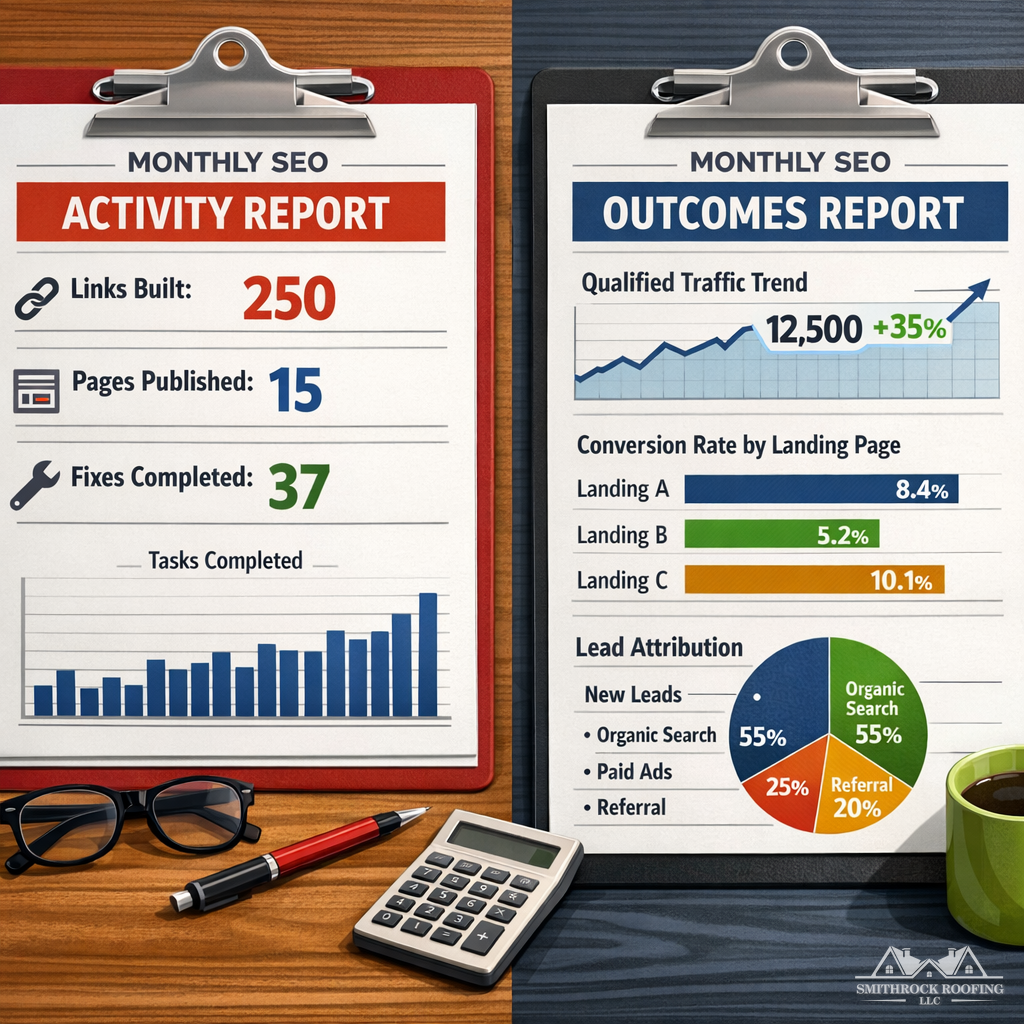
A common pattern in underperforming agency relationships is monthly reports that document activity (pages published, links acquired, technical fixes completed) without connecting that activity to business outcomes. Healthy reporting connects inputs to leading indicators, and leading indicators to revenue-relevant metrics. If an agency’s sample report is three pages of tasks completed, that is the agency’s performance management philosophy expressed in document form.
Keyword volume as the sole targeting framework
The most consequential strategic divide between strong and weak SEO agencies is how they define targeting success. An agency that leads strategy with “high-volume keywords” as the primary selection criterion is optimizing for a metric that correlates poorly with revenue in most markets. Search volume tells you how many people search a phrase. It tells you very little about whether those people are buyers, researchers, or students writing papers. Intent analysis — behavioral, contextual, and competitive — is the more meaningful input, and an agency that can’t articulate how it weights intent against volume should not be building your keyword strategy. Our article on SEO for lead generation goes deeper on how intent-driven targeting connects organic traffic to actual pipeline.
Absence of AI search readiness in their forward-looking strategy
The search landscape is shifting in ways that are not speculative — they’re already measurable. AI-powered search features, answer engine visibility, and structured data optimization are not future considerations; they’re current performance factors. An agency that cannot speak specifically to how it approaches structured data markup, how it thinks about appearing in AI-generated search summaries, and how it monitors brand visibility in large language model outputs is an agency operating on a two-year-old playbook.
Understanding Your Contract Before You Sign It
Contract review advice in most agency selection guides amounts to: “make sure KPIs are defined.” That is necessary but insufficient. There are several specific provisions in SEO contracts that carry significant business risk and rarely get flagged.
Contract Clauses That Protect You
Content ownership and IP rights
Any content created by the agency during your engagement — blog articles, landing pages, technical documentation — should explicitly transfer to your ownership. Some agency contracts retain licensing rights to templated elements or content frameworks, which can create complications if you leave. Confirm in plain language: all content produced for your account becomes your sole property upon delivery or payment.
Data access and portability
Your Google Search Console property, your GA4 account, your Google Business Profile — these should be set up in your own accounts with the agency granted access, not the reverse. If an agency controls the master account, you may lose access to historical data and link profiles if the relationship ends. This is not a hypothetical risk; it happens regularly and the data loss is permanent.
Performance benchmark definitions
A contract that references “improved organic performance” as a success metric is unenforceable in any meaningful sense. Performance benchmarks should define specific leading indicators with timelines: indexation coverage targets, organic click-through rate benchmarks by content category, and conversion event targets connected to actual business outcomes. Ambiguous benchmarks protect the agency, not you.
Minimum notice and exit terms
SEO has a real performance lag — three to six months before most strategic interventions produce measurable movement. Evaluate minimum contract terms with this in mind. A 12-month minimum commitment is standard and reasonable for comprehensive SEO work. What matters more is whether there is a genuine off-ramp if performance benchmarks are clearly not being met after a reasonable review period.
Leading Indicators: Evaluating Performance Before Results Are Visible
Every standard guide implies you’ll be able to judge an SEO agency’s performance relatively quickly. The reality is more complicated, and businesses that don’t understand the measurement lag end up making reactive decisions that interrupt strategies that were actually working.
Organic SEO operates on a three-to-six month minimum feedback loop for most interventions. A content strategy launched in month one will not produce statistically meaningful traffic data until month four or five. This creates a legitimate evaluation problem: how do you know if early work is on track before the results are visible?
The answer is leading indicators — early-stage metrics that predict downstream performance before it materializes.
Leading Indicators to Track in Months One Through Three
- Crawl coverage improvement: Is Google crawling and indexing a higher percentage of your target pages? Expanding indexed coverage is the foundation everything else builds on.
- Core Web Vitals and technical health scores: Are technical performance issues being resolved at a measurable rate? Track the number of flagged issues in Search Console and the trajectory of resolution. A technical SEO audit for small business can establish a clear baseline for measuring this progress from day one.
- Click-through rate by intent cluster: Even before rankings improve significantly, a well-structured content and title tag strategy should produce improving CTR trends for existing impressions. Flat or declining CTR in month two suggests the content strategy isn’t resonating.
- New keyword surface area: The number of distinct queries for which your site appears in Search Console data — even at low positions — should expand as new content is indexed. Flat query coverage after 60 days of content publication is a signal worth investigating.
- Backlink acquisition quality: Not volume — quality. Review the referring domains being acquired against authority, topical relevance, and traffic signals. Three genuinely relevant editorial links outperform thirty directory submissions by a considerable margin.
An agency that cannot orient your reporting around these leading indicators, or that pushes back on the premise of early-stage measurement, is an agency that isn’t confident in the quality of its process — only in its eventual ability to point at a positive number.
Finding an Agency That Builds With You, Not For You
The most durable agency relationships are the ones where knowledge flows in both directions. The agency understands your business deeply — your customers’ language, your competitive dynamics, your seasonal patterns, your sales team’s feedback on lead quality. Your team understands enough about SEO to be an informed partner, not a passive recipient of monthly PDF reports.
This is the difference between an agency that creates dependency and an agency that creates capability. The former is valuable only as long as you keep paying. The latter compounds your competitive advantage regardless of what happens to the relationship.
When you’re in final conversations with an agency, ask one last question: “How do you build SEO knowledge into our internal team over the course of an engagement, and what does our understanding of our own SEO program look like 12 months from now compared to today?”
The answer will tell you more about the agency’s values than any proposal document will.
At Mongoose Digital Marketing, we take the questions on this page seriously — because we get asked them, and we think businesses that ask them are the right businesses to work with. If you’re in the process of evaluating SEO partners and want a straightforward conversation about what real results look like and how we’d approach your specific situation, we offer a free consultation with no obligation and no sales pressure — just an honest assessment of what’s possible and what it takes to get there.
Strategic Recommendations for 2026
The SEO landscape continues to shift in ways that reward businesses who treat search as a strategic asset rather than a marketing line item. As you finalize your agency search and plan for the year ahead, three moves in particular will separate businesses that compound their organic growth from those that tread water.
1. Prioritize Agencies With Demonstrated AI-Era Content Experience
Generative search features — including Google’s AI Overviews and the growing prevalence of zero-click results — are changing which pages earn visits and which earn only impressions. In 2026, the agencies worth working with are those who have already adapted their content strategies to this environment: building topical authority across structured content clusters, optimizing for cited sources rather than ranked links, and helping clients understand the difference. Ask prospective agencies directly how they are adjusting content strategy in response to AI-generated search results, and evaluate their answer for specificity.
2. Invest in First-Party Data Infrastructure Alongside SEO
SEO drives traffic, but traffic that can be captured, segmented, and nurtured through your own systems is exponentially more valuable than anonymous visits. In 2026, the most productive agency relationships will integrate SEO with CRM data, email capture strategy, and audience segmentation — so that organic growth feeds a compounding asset you own, rather than a vanity metric you rent. Look for agencies that ask about your existing data infrastructure early in discovery, not as an afterthought.
3. Build a Quarterly SEO Review Process Before You Start, Not After
One of the most common failure modes in agency relationships is the absence of a structured review cadence that connects SEO activity to business outcomes. Before your engagement begins, agree on a quarterly review format that covers leading indicators, content performance, technical health, and pipeline contribution. Agencies that are willing to design this structure with you before the contract is signed are agencies that expect to be held accountable — and that accountability is precisely what protects your investment.
Frequently Asked Questions
How long does it typically take to see results from an SEO campaign?
Meaningful SEO results generally begin to emerge between three and six months into a well-executed campaign, with more significant organic growth often visible between six and twelve months. The timeline depends on factors like your website’s existing authority, the competitiveness of your target keywords, the quality and frequency of content production, and how efficiently technical issues are resolved. Agencies that promise faster timelines without qualifying these variables should be questioned carefully — sustainable SEO is not a rapid-return channel, but its compounding nature makes it one of the highest-value long-term investments in your marketing mix.
What should I look for when comparing SEO agencies?
Look for agencies that ask more questions than they answer in early conversations. The right agency will want to understand your business model, your customers’ language, your competitive landscape, and your existing content before recommending anything. Beyond that, prioritize transparency in reporting — agencies should be able to connect their activity directly to leading indicators like rankings, crawl health, and qualified traffic growth, and ultimately to business outcomes like leads and revenue. Avoid agencies that lead with guarantees, rely heavily on volume-based tactics, or are reluctant to explain their methodology in plain language. Our guide on how to select a local SEO company covers additional vetting criteria worth reviewing before you finalize your decision.
What is the difference between local SEO and general organic SEO?
Local SEO focuses specifically on improving your visibility in geographically targeted searches — the kind a potential customer makes when looking for a service or business near them. It involves optimizing your Google Business Profile, building consistent local citations, earning reviews, and ensuring your website clearly signals the geographic areas you serve. General organic SEO covers a broader scope: building authority on topics relevant to your industry, creating content that answers the questions your customers are asking regardless of location, and earning links that signal your site’s credibility to search engines. Many businesses benefit from both working in tandem, and the strongest agencies integrate local and organic strategies rather than treating them as separate programs.
How do I know if an SEO agency’s reporting is meaningful or just surface-level metrics?
Meaningful reporting connects SEO activity to business outcomes. Surface-level reporting celebrates traffic growth, keyword ranking movement, and domain authority scores in isolation — without demonstrating what those numbers mean for leads, revenue, or qualified pipeline. A trustworthy agency will contextualize metrics: explaining why a particular ranking matters, what kind of visitor a specific page is attracting, and whether organic traffic is converting at a rate that justifies the investment. If a monthly report leaves you feeling informed but unable to make a decision, it is surface-level. If it leaves you with a clear sense of where momentum is building and where adjustments are needed, it is doing its job.
Conclusion
Choosing the right SEO partner is one of the more consequential decisions a growing business can make — and it deserves the same careful evaluation you would apply to any strategic hire. At Mongoose Digital Marketing, our approach to local SEO and content strategy is built on the same principles this article has outlined: honest timelines, transparent reporting, and a genuine commitment to building your team’s understanding alongside your search presence. If you’re ready to have a straightforward conversation about what organic growth could look like for your business, Contact Mongoose Digital Marketing — no pressure, just a clear-eyed look at what’s possible.