

Key Takeaways
- A website redesign is a high-risk, high-disruption intervention — not a default solution — and businesses that lack defined conversion goals, resolved content strategy, and stakeholder alignment before starting are statistically more likely to see the project fail or underperform.
- Organic search rankings routinely drop during the 60-to-180-day window after a redesign launches, a predictable pattern caused by re-crawling delays, redirect chain equity dilution, and Core Web Vitals regressions that most agencies never disclose upfront.
- The most common reason a redesigned website fails to improve conversions is not poor visual design — it is new design wrapped around the same unconvincing, poorly structured content that caused the original site to underperform.
- Translation loss between design files and built code — including degraded microinteractions, component drift, and unoptimized asset pipelines — silently destroys the performance gains a redesign was intended to create, often triggering a costly second redesign within 18 months.
- Businesses in the Dayton metro area, including Kettering, Beavercreek, Centerville, and Miamisburg, operate in competitive local markets where a technically sound, conversion-optimized website is a direct revenue asset, not a cosmetic exercise.
Your website is losing you business right now. That is not a scare tactic — it is a measurable reality that applies to most businesses operating on a site that was built more than three years ago without systematic performance reviews. In the Dayton, Ohio market, where regional competition across sectors like healthcare, home services, manufacturing, professional services, and retail has accelerated dramatically, a website that fails to convert qualified traffic into leads is not a neutral asset. It is an active liability.
But here is where most conversations about website redesign services go wrong immediately: the word “redesign” gets treated as a universal prescription. A business owner notices declining leads or hears a competitor has a sharper-looking site, and the instinct is to rebuild from scratch. Sometimes that instinct is exactly right. Often, it is not — and the difference between a redesign that generates real revenue lift and one that drains budget while producing marginal results comes down to diagnostic clarity before a single wireframe is drawn.
This guide is written for business owners in Dayton, Kettering, Beavercreek, Centerville, Huber Heights, Miamisburg, and Springboro who are seriously evaluating whether a website redesign is the right move, what that process actually involves at an operational level, and what the most common failure modes are — including the ones most agencies prefer not to discuss.
Is a Redesign Actually What Your Business Needs?
The most credible thing a competent web strategist can say to a prospect is: you may not need a full redesign yet. This diagnostic honesty is also, consistently, the most useful starting point for any engagement.
A full website redesign is appropriate when one or more of the following conditions are true:
- The existing site’s architecture is fundamentally incompatible with current conversion goals — meaning navigation, page hierarchy, and user flows are structurally broken, not just cosmetically dated
- The technology stack is obsolete to the point where performance, security, or integrations cannot be meaningfully improved without rebuilding
- Brand identity has undergone a significant strategic shift and the visual system needs to reflect that consistently across all touchpoints
- The content strategy has been overhauled and the new information architecture cannot be mapped onto the existing site structure without structural work
A full redesign is likely not the right first move when:
- Traffic is arriving but not converting — this is a CRO (conversion rate optimization) problem, often solvable through targeted landing page testing, copy revision, and form optimization
- Core Web Vitals scores are poor due to image optimization, caching configuration, or plugin bloat — these are technical remediation tasks
- The site looks dated but the underlying structure and content architecture are sound — a visual refresh, typography update, and updated imagery can close the perception gap at a fraction of the cost and risk
- Internal stakeholders cannot currently agree on what the site’s primary conversion goal actually is
That last point deserves emphasis. Stakeholder misalignment is the number one cause of redesign project failure — not technical execution, not design quality, not development capacity. When a business enters a redesign without internal consensus on what success looks like, the project becomes a negotiation between competing internal preferences rather than a disciplined build toward measurable outcomes. The result is a site that pleases everyone internally and converts no one externally.
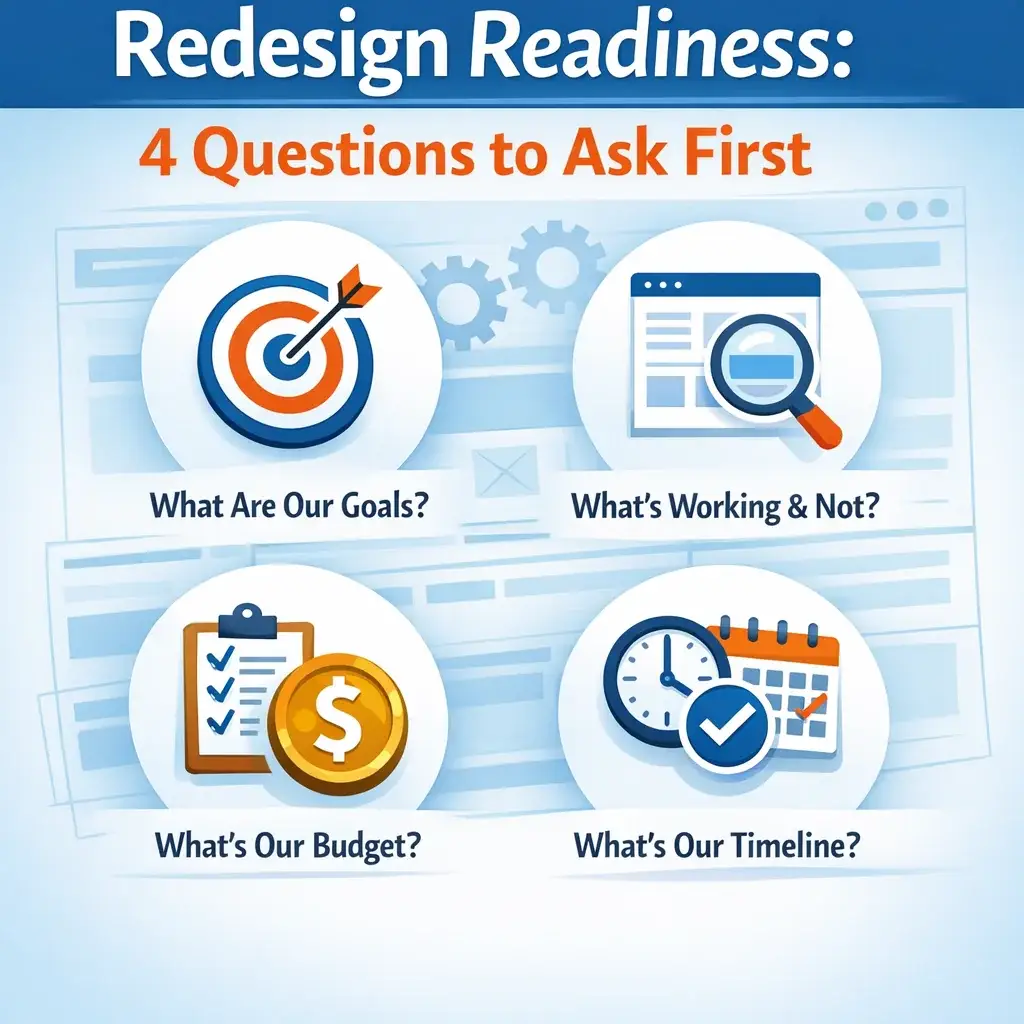
The Redesign Readiness Audit: Four Questions to Answer First
Before committing to a full website redesign engagement, every Dayton-area business should be able to answer these four questions with specificity:
1. What is your primary conversion event, and do you have baseline data on its current rate?
Not “we want more leads.” Specifically: is the conversion event a form submission, a phone call, a booking, an email sign-up, or an ecommerce transaction? And do you know your current conversion rate from organic traffic, from paid traffic, and from direct traffic separately? Without this baseline, you cannot measure whether a redesign improved anything.
2. Is your content strategy resolved?
A redesign built around unresolved content is the single most reliable path to a site that looks modern and still fails to convert. Content strategy means knowing what each page needs to communicate, to whom, at what stage of the buying decision, and in what order. If you cannot answer those questions now, solving them before design begins — not after — is the highest-leverage investment available to you.
3. Do key decision-makers agree on the site’s goals and the authority to approve design decisions?
Identify now whether your redesign approval process will involve one decision-maker or seven. Projects with clear, single-point approval authority move faster, cost less, and produce better outcomes. Projects where design decisions must cycle through a committee of stakeholders with competing aesthetic preferences routinely expand in scope, timeline, and budget while shrinking in strategic clarity.
4. Is your analytics infrastructure solid enough to measure improvement?
Google Analytics 4, Search Console integration, call tracking if phone leads are a primary conversion event, and event tracking for key interactions — these need to be in place and accurately configured before launch. If your current analytics are broken, misconfigured, or absent, you are building on a foundation that cannot support any meaningful performance evaluation.
The SEO Mortality Window: What No One Tells You About Rankings After Launch
Of all the risks associated with a website redesign, organic search ranking disruption is the most consistently understated — and the most genuinely damaging when handled without a disciplined mitigation strategy.
Every agency will tell you they “preserve SEO equity” during a redesign. Very few will explain what that phrase actually means operationally, or what happens in the 60-to-180-day period after a new site goes live. This window — which we call the SEO Mortality Window — is a predictable, documented phenomenon that every business considering a redesign needs to understand before committing.
What Happens During the SEO Mortality Window
When a new site launches, Google must re-crawl and re-evaluate the entire site from scratch. Even on a well-maintained site with a clean redirect map, this process introduces a sequence of organic visibility risks:
Redirect Chain Equity Dilution
301 redirects pass the majority of link equity from old URLs to new ones — but not all of it, and not instantly. During the recrawl period, pages that previously ranked on the strength of accumulated backlinks and internal link signals may temporarily drop while Google reassigns that equity through the new URL structure. Complex redirect chains (old URL → interim URL → new URL) dilute equity further with each additional hop.
Semantic HTML Structure Changes
New page templates often alter heading hierarchy, schema markup, and the semantic relationship between on-page elements. A page that previously signaled topical authority through a specific H1/H2 structure may temporarily lose keyword association clarity if those relationships are changed during the rebuild — even when the content itself is preserved.
Core Web Vitals Regression
This is one of the most common and least anticipated post-launch problems. A newly deployed site frequently performs worse on Core Web Vitals initially than the site it replaced. Reasons include unoptimized image formats (WebP not yet implemented), JavaScript-heavy animation libraries that block rendering, larger CSS bundles from new design systems, and third-party script load order issues. Google’s page experience signals factor directly into rankings, and a new site that ships with poor LCP (Largest Contentful Paint) or CLS (Cumulative Layout Shift) scores will feel the impact within weeks. Our guide on website speed optimization for small business covers the specific remediation steps that address these regressions most effectively.
Indexation Gaps
If the XML sitemap is not updated at launch, if robots.txt is misconfigured during development and not corrected before go-live, or if canonical tags are set incorrectly on new page templates, portions of the site can go unindexed for weeks — removing pages from ranking contention entirely during a period when visibility is already under pressure.
Hard Cutover vs. Staged Migration: The Strategic Choice
Most redesigns launch via a hard cutover: the old site goes down, the new site goes live, and the team monitors anxiously for the next several weeks. This approach is high-risk for any business where organic search drives a meaningful percentage of lead volume.
The alternative is a staged migration strategy, which involves:
- Launching non-critical sections of the new site first (blog, about, resource pages) while maintaining existing service and conversion pages on the current site
- Running parallel indexing monitoring via Search Console to confirm new URLs are being crawled and ranked before fully retiring old ones
- Completing a full pre-launch SEO audit that documents every existing ranking URL, its current position, its backlink profile, and its redirect destination in the new architecture
- Building a dedicated SEO stabilization sprint into the project timeline — typically two to four weeks post-launch focused exclusively on crawl error remediation, Core Web Vitals optimization, and ranking recovery monitoring
For established businesses in Dayton with existing organic traffic — particularly those in sectors like legal, medical, home services, or professional services where organic search intent is high — the staged migration approach is not optional. It is standard professional practice.
| Risk Factor | Hard Cutover | Staged Migration |
|---|---|---|
| Redirect chain errors discovered | Post-launch (traffic loss already occurring) | Pre-launch during phased monitoring |
| Core Web Vitals regression | Full site affected at launch | Isolated to new sections, easier to remediate |
| Indexation gaps | Affects entire new site simultaneously | Contained to incremental sections |
| Ranking recovery timeline | 90–180 days, full site | 30–60 days per section, with overlap |
| Organic lead disruption | High, often significant | Low to moderate, manageable |
| Appropriate for | Brochure sites with no organic traffic dependency | Any business with established organic rankings |
Where Redesign Projects Actually Fail: Translation Loss
The agency process diagram that appears on virtually every web design company’s website looks roughly like this: Discovery → Strategy → Wireframes → Design → Development → Launch → Support. It is clean, it is logical, and it describes a project trajectory that rarely survives contact with reality without significant turbulence.
The phase that receives the least honest attention in any agency’s marketing is the handoff between design and development. This is where a disproportionate share of redesign projects quietly fail — not in a visible, dramatic way, but through the gradual accumulation of compromises that collectively erode the performance the redesign was intended to create.
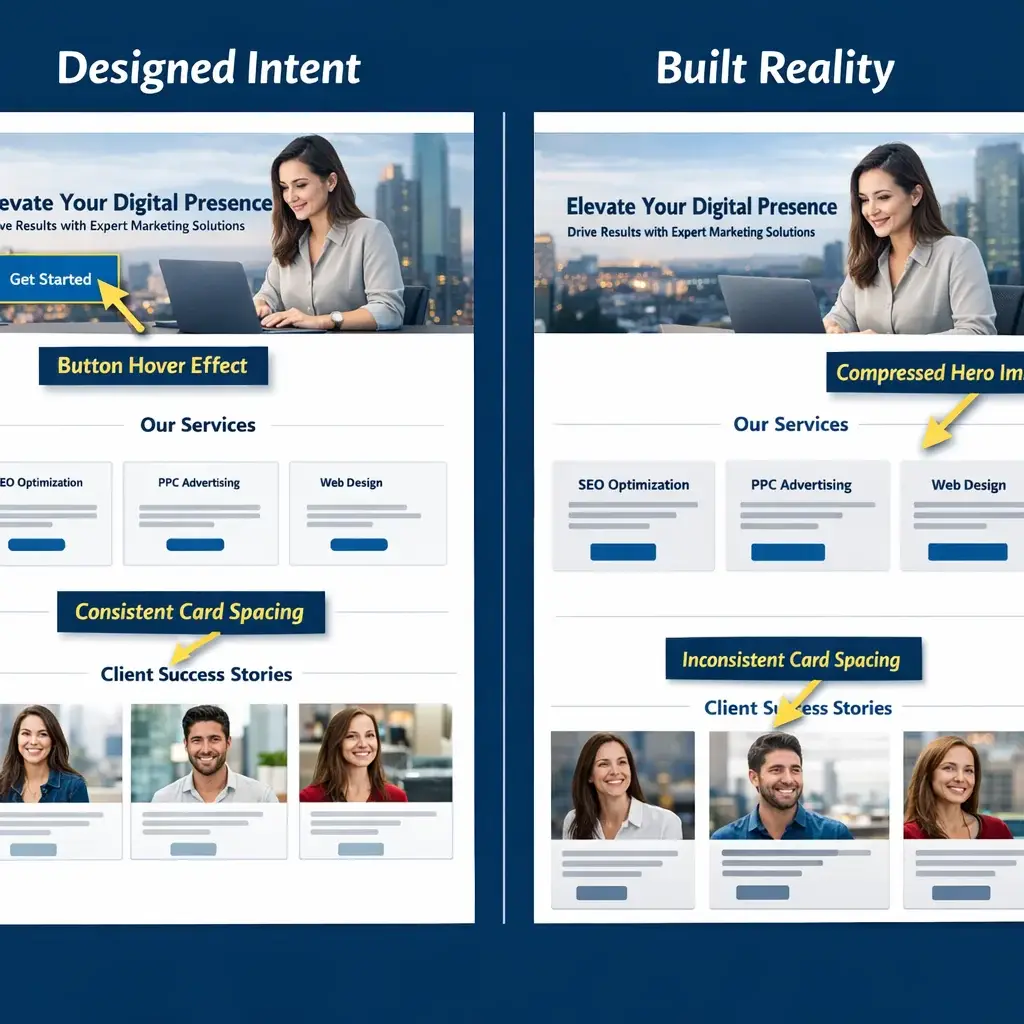
This degradation has a name: Translation Loss.
What Translation Loss Looks Like in Practice
Interaction Fidelity Degradation
During user testing and design review, microinteractions — button hover states, scroll-triggered animations, form field focus behavior, progress indicators — generate measurable improvements in engagement and task completion rates. These elements are often the specific design decisions that drove conversion lift in prototype testing. Under development time pressure, they are frequently the first things cut or simplified. The built site ships with interactions that are functional but stripped of the precision that made them effective.
Component Drift
In a well-structured design system, every button, card, form, and typographic element has defined specifications: exact spacing, color values, font weights, border radius, and shadow properties. When those specifications are interpreted rather than precisely implemented — because design tokens were not formally documented, or because developer time pressure led to eyeballing rather than measuring — visual inconsistency accumulates across pages. This inconsistency is subtle enough that most stakeholders don’t consciously notice it, but it erodes the sense of quality and brand coherence that new design was meant to establish.
Performance Regression Through Design Complexity
Modern design systems, particularly those incorporating layered visual effects, large background imagery, custom typefaces, and scroll-based animations, carry real performance costs if not implemented with asset optimization protocols in place. Sites that look exceptional in Figma can ship with Largest Contentful Paint scores above four seconds, JavaScript bundle sizes that cripple mobile load performance, and CSS animation implementations that trigger layout recalculation — all of which damage both user experience and search rankings.
The Second Redesign Trap
Sites that suffer significant translation loss typically show a recognizable performance pattern: strong initial metrics driven by novelty and any genuine structural improvements, followed by gradual decay over 12 to 18 months as the gap between designed intent and built reality becomes apparent in user behavior data. By month 18, the business has lost confidence in the process, the agency relationship has deteriorated, and the conversation about another redesign begins — often before the first one has been fully paid for.
How to Prevent Translation Loss Before It Starts
The solution is not to find developers who execute perfectly. The solution is to make perfect execution the documented standard before development begins.
Design-Development Contract Specifications are the operational tool that prevents translation loss. These are agreed-upon written standards covering:
- Animation timing curves and duration ranges for all interactive elements
- Asset optimization thresholds: maximum file sizes for images, video, and custom fonts
- Component naming conventions that ensure design and development reference the same elements consistently
- Interactive state libraries: documented hover, focus, active, and disabled states for every reusable component
- Performance budget: agreed maximum page weight and Core Web Vitals targets that development is contractually responsible for meeting at launch
For Dayton-area businesses evaluating website redesign services, asking a prospective agency whether they work from documented design-development specifications is one of the highest-signal qualification questions available. An agency that produces these specifications as standard practice has built projects with enough failure-mode experience to know why they are necessary. An agency that does not will likely learn that lesson on your project.
The Content Problem That Design Cannot Solve
There is a version of a website redesign that businesses invest in heavily and that delivers genuine visual improvement, faster load times, and cleaner mobile experience — and still fails to move the conversion needle meaningfully. This outcome is more common than any agency’s case study section will suggest, and its cause is consistent: new design applied to old messaging.
Content strategy is the load-bearing structural element of any website. Visual design is the surface that makes that structure accessible and persuasive to the eye. When the structural element is compromised — when page copy is vague, value propositions are generic, calls to action are ambiguous, and the information architecture reflects how the business thinks about itself rather than how its customers think about their problems — no amount of visual refinement will compensate.
The Mechanism of Content-Driven Conversion Failure
Consider a service business in the Centerville or Springboro market — a wealth management firm, a physical therapy practice, or a commercial HVAC contractor. The existing site underperforms. A redesign is commissioned. The new site looks authoritative, loads quickly, and presents well on mobile. Traffic does not meaningfully improve, and conversion rates move only marginally.
The post-mortem almost always reveals the same pattern: the service pages describe what the company does rather than what the client receives. The homepage headline names the company’s category rather than the client’s outcome. The call-to-action says “Contact Us” rather than “Get Your Free Assessment” or “See If You Qualify.” The FAQ section answers questions the business thinks customers ask rather than the questions customers actually type into Google.
These are not design problems. They are message problems. And they require content strategy and professional copywriting to resolve — not a new color palette. The article on conversion optimization: beyond the basic CRO playbook goes deeper on how message hierarchy and copy structure directly affect conversion outcomes at the page level.
Resolving Content Before Design Begins
The sequencing of a well-executed redesign places content strategy ahead of visual design, not parallel to it or after it. This means:
- Audience research and keyword intent mapping complete before page templates are designed, so template structure reflects the actual information hierarchy that converts target audiences
- Page-level content briefs written for every primary service or product page, documenting the conversion goal, the target audience segment, the primary keyword theme, and the key message hierarchy before a designer builds the layout
- Copy drafted and approved before development begins, so no page goes live with placeholder content or lightly edited versions of the old site’s copy
For businesses across the Dayton metro area operating in competitive local verticals, content quality is also directly tied to local SEO performance. Pages that specifically address the audiences in Kettering, Huber Heights, Beavercreek, or Miamisburg — through relevant local context, specific service area references, and content that reflects the actual decision-making concerns of those markets — consistently outperform generic regional pages in localized search results.
What a Technically Sound Redesign Actually Delivers
When a website redesign is approached with diagnostic rigor — starting from readiness assessment, building content strategy before design, managing the SEO Mortality Window with a staged migration plan, and preventing translation loss through documented specifications — the outcomes are measurable and significant.
The specific gains that a well-executed redesign produces include:
- Qualified lead volume increase from organic search, driven by improved content architecture, resolved technical SEO issues, and better alignment between search intent and page content
- Conversion rate improvement at specific funnel stages — not a blanket “more conversions,” but measurable lift at the stage where the redesign addressed a specific friction point, whether that is form completion, phone call initiation, or product page-to-cart progression
- Reduced cost-per-lead from paid channels — a landing page optimized through the redesign process typically improves Quality Scores in Google Ads, reducing cost-per-click and improving ad spend efficiency
- Brand perception lift in competitive markets — for businesses in the Dayton area competing against regional and national players, a site that projects precision, authority, and competence creates a tangible first-impression advantage that influences consideration even before a prospect contacts you
- Reduced bounce rate from mobile traffic — for businesses where mobile traffic represents a significant share of sessions, a genuine mobile-first rebuild (not a responsive afterthought) consistently reduces bounce rates and improves session depth among mobile users
These outcomes are achievable. They are also conditional — on the quality of the strategic groundwork, the rigor of the execution, and the discipline of post-launch performance monitoring.
A website redesign is not a one-time event with a launch date as the finish line. It is the beginning of a performance optimization cycle — one where the baseline established at launch becomes the benchmark against which every subsequent improvement is measured.
Choosing a Website Redesign Partner in the Dayton Area
For businesses in Dayton, Kettering, Beavercreek, Centerville, Huber Heights, Miamisburg, and Springboro evaluating website redesign services, the qualification process matters as much as the final selection. The questions below are designed to surface the difference between agencies with genuine project depth and those selling a process template.
Questions That Reveal Actual Expertise
On SEO risk management:
“How do you manage organic ranking risk during the transition from old site to new site? What does your post-launch SEO monitoring protocol look like, and how long does it run?”
An agency with real experience will describe a specific redirect mapping process, pre-launch crawl auditing, Search Console monitoring cadence, and a defined stabilization period. An agency without it will say some version of “we take care of all the SEO stuff.”
On content strategy:
“At what point in your process does content strategy get resolved? Who produces the copy — us, you, or a subcontractor — and at what stage relative to design?”
The correct answer involves content strategy preceding or running parallel to design, not following it.
On design-to-development handoff:
“Do you work from documented design-development specifications? Can you show me an example of the performance budgets and component specifications your development team works from?”
On measurement:
“What analytics infrastructure do you put in place before launch, and what does your post-launch reporting look like for the first 90 days?”
On honest scope assessment:
“Based on what we’ve discussed, is a full redesign the right first move, or are there targeted optimizations that should be prioritized first?”
An agency that answers that last question with an honest “actually, you might not need a full redesign yet” is demonstrating the kind of diagnostic honesty that correlates strongly with good project outcomes. It means they are optimizing for your result, not their invoice. If you want to understand how to evaluate agency options with rigor, the article on how to find the right SEO agency applies the same qualification logic to the broader agency selection process.
Mongoose Digital Marketing works with businesses across the Dayton metro area to make that diagnostic call accurately — and when a full redesign is the right investment, to execute it with the strategic discipline, SEO rigor, and conversion focus that turns a website into a genuine revenue driver.
Strategic Recommendations for 2026
The website landscape is shifting fast enough that the decisions you make heading into 2026 will carry more consequence than they would have a few years ago. Three areas deserve deliberate attention before your next redesign cycle begins.
1. Conduct a Core Web Vitals Audit Before Scoping Anything
Google’s performance signals have matured into a genuine ranking factor, and most websites — even recently redesigned ones — carry measurable technical debt in loading performance and layout stability. Before committing to a full redesign scope, use Google Search Console’s Core Web Vitals report alongside PageSpeed Insights to identify whether your current site’s underperformance is structural or addressable through targeted optimization. This audit shapes whether a full redesign is the right first move or whether a phased technical improvement delivers faster ROI.
2. Implement Session Recording and Heatmap Analysis Before Redesigning
Tools like Microsoft Clarity (free) or Hotjar provide behavioral data that no analytics dashboard can replicate — actual recordings of how real users move through your current site, where they hesitate, and where they abandon. Running three to six months of this data before briefing a redesign agency means your new information architecture is informed by documented behavior, not assumptions. It transforms the discovery phase from a conversation about preferences into a conversation about evidence.
3. Establish a Content Inventory and Gap Analysis as a Standalone Step
One of the most consistent failure points in redesign projects is treating content as a production task rather than a strategic one. Before design begins, audit every page of your current site against your current customer journey: what pages serve which stage of the funnel, which pages are underperforming despite traffic, and which topics are absent entirely. Pair this with a competitive content gap analysis using tools like Ahrefs or Semrush to identify ranking opportunities your new site should be built to capture from day one.
Frequently Asked Questions
How long does a professional website redesign typically take from kickoff to launch?
Timeline varies based on site complexity, content volume, and how quickly a business can participate in key decision points, but most professionally managed redesigns for small to mid-sized businesses run between eight and sixteen weeks. Larger sites with custom functionality, complex integrations, or substantial content migration requirements often extend beyond that range. The single most common cause of project delays is content — specifically, copy and imagery that hasn’t been prepared before the design phase begins. Agencies that build content strategy into the early phases of their process consistently deliver closer to initial timeline estimates than those that treat content as a late-stage task.
Will a website redesign hurt my current Google rankings?
It carries real risk if not managed correctly, and that risk is frequently underestimated. When URLs change, when page structures are altered, or when content is removed or consolidated, search engines treat the new site as a different entity until the relationships between old and new are clearly mapped. A properly executed redesign includes a comprehensive redirect map that preserves link equity, pre-launch technical SEO auditing, and a structured monitoring period after launch using Google Search Console to catch any ranking volatility early. Businesses that skip this process sometimes see significant and long-lasting organic traffic loss — which is why asking prospective agencies specifically about their SEO transition protocol is one of the most important questions in the selection process.
What’s the difference between a website redesign and a website refresh?
A redesign is a structural rethinking of a website — its information architecture, user experience flow, visual design system, and often its technical foundation. It typically involves strategic discovery, new design work from the ground up, and development that rebuilds rather than modifies. A refresh is more surgical: updating visual elements like typography, color, and imagery within an existing structure, improving specific page performance, or modernizing certain components without rebuilding the whole. Neither is inherently better — the right approach depends on whether your site’s problems are cosmetic or structural. This is exactly the kind of diagnostic call that separates agencies focused on your outcome from those defaulting to the most comprehensive (and most billable) scope.
How do I measure whether a website redesign was actually successful?
Success metrics should be defined before the project begins, not after launch. Vanity metrics like total sessions or bounce rate tell an incomplete story — the meaningful measurements are those tied to business outcomes: conversion rate on key landing pages, qualified lead volume, revenue-attributed traffic by channel, and goal completion rates for the specific actions the site is designed to drive. A well-run redesign project establishes analytics infrastructure before launch, including properly configured conversion tracking, so that post-launch reporting reflects real performance rather than estimated improvement. The first 90 days after launch are the most information-dense period — traffic patterns stabilize, user behavior data accumulates, and SEO signals begin to register — making structured post-launch monitoring as important as the build itself.
The Right Partner Makes the Difference
A website redesign is one of the most consequential investments a business makes in its digital presence, and the outcome depends less on the platform chosen than on the strategic rigor brought to the process. Mongoose Digital Marketing works with businesses throughout Dayton, Kettering, Beavercreek, and Centerville to deliver redesigns built on honest diagnosis, conversion-focused design, and the kind of SEO discipline that protects and builds organic visibility — not just on launch day, but over the long term. If you’re ready to find out whether a redesign is the right move for your business, Contact Mongoose Digital Marketing and get a clear-eyed assessment from a local team that’s invested in your results.
See also: Website Design for Companies That Actually Converts
See also: SEO Services Dayton: Local Strategies That Actually Work