
Key Takeaways
- Website optimization is not a menu of independent services; technical SEO, page speed, and on-page content form a dependency chain where infrastructure problems must be resolved before content work produces reliable ranking gains.
- Slow server response time affects Google rankings, bounce rate, and lead form conversion rate through a single causal mechanism: a high Time to First Byte delays Largest Contentful Paint, which triggers both a page experience ranking penalty and user abandonment before any conversion opportunity occurs.
- For Dayton businesses targeting high-intent local searchers who are ready to call or book, the optimization priority hierarchy shifts toward mobile call path speed and click-to-call functionality ahead of content volume.
- Google Business Profile optimization and technical site performance are not parallel tracks; page experience signals feed into local pack ranking systems, meaning a GBP investment can underperform if the underlying site has unresolved technical issues.
- An effective website optimization sequence follows a fixed triage order: resolve technical infrastructure first, then address on-page elements, then build content, because each layer depends on the one beneath it functioning correctly.
Businesses across Dayton, Kettering, Beavercreek, and the broader Miami Valley region lose leads every day not because their services are inferior, but because their websites fail silently. Pages load too slowly on mobile. Google Business Profile listings earn clicks that go nowhere because the landing page experience is broken. Content gets created before the technical foundation is stable enough to support it. The result is wasted effort and stalled rankings.
This article explains how the components of website optimization actually connect to each other, in what order they should be addressed, and why treating them as separate service buckets produces incomplete results. If you are evaluating website optimization services in Dayton or trying to understand what a competent agency should actually be doing for your business, this is the framework you need.
Why the Sequence of Optimization Work Matters More Than the Service List
Every agency in this space presents website optimization as a list: keyword research, on-page SEO, link building, technical SEO, local SEO, content creation. The list is accurate. The problem is that presenting these as equivalent items with no dependency order is like listing foundation work, framing, and roofing as interchangeable steps in a construction project.
Technical SEO is the foundation. If your server response time is slow, if render-blocking scripts are preventing the browser from painting your page, or if your Core Web Vitals scores are failing, then any content you create on top of that infrastructure is competing at a structural disadvantage. Google’s crawlers are evaluating page experience signals alongside relevance signals. A well-optimized page title on a slow-loading page is a well-dressed candidate showing up late to the interview.
The correct triage sequence for a Dayton business starting or restarting an optimization effort looks like this:
- Technical audit first. Identify server response time (Time to First Byte), render-blocking resources, image optimization status, mobile usability, and Core Web Vitals scores before touching any content.
- Resolve infrastructure issues. Fix what is slowing the site down at the server and code level before creating new pages or building links to them.
- On-page optimization. Once the technical foundation is stable, optimize existing page structure, metadata, header hierarchy, and internal linking.
- Content development. Build or improve content on a technically sound site that Google can crawl, render, and score accurately.
- Local SEO and GBP alignment. Optimize your Google Business Profile with the confidence that the pages it links to will perform when clicked.
- Link building and authority development. Earn or build links to pages that are already technically clean and content-complete.
Skipping step one and proceeding to step four is a common and expensive mistake. It is also one that most agencies do not explain, because explaining the dependency chain requires acknowledging that some of the work they are selling has an ordering requirement that affects when it delivers returns.
Have a question about website optimization services dayton? Send a message with the situation you are working through and the decision you need help with. Ask for a written explanation of possible next steps.
The Speed-Ranking-Conversion Connection Is One Mechanism, Not Three Services
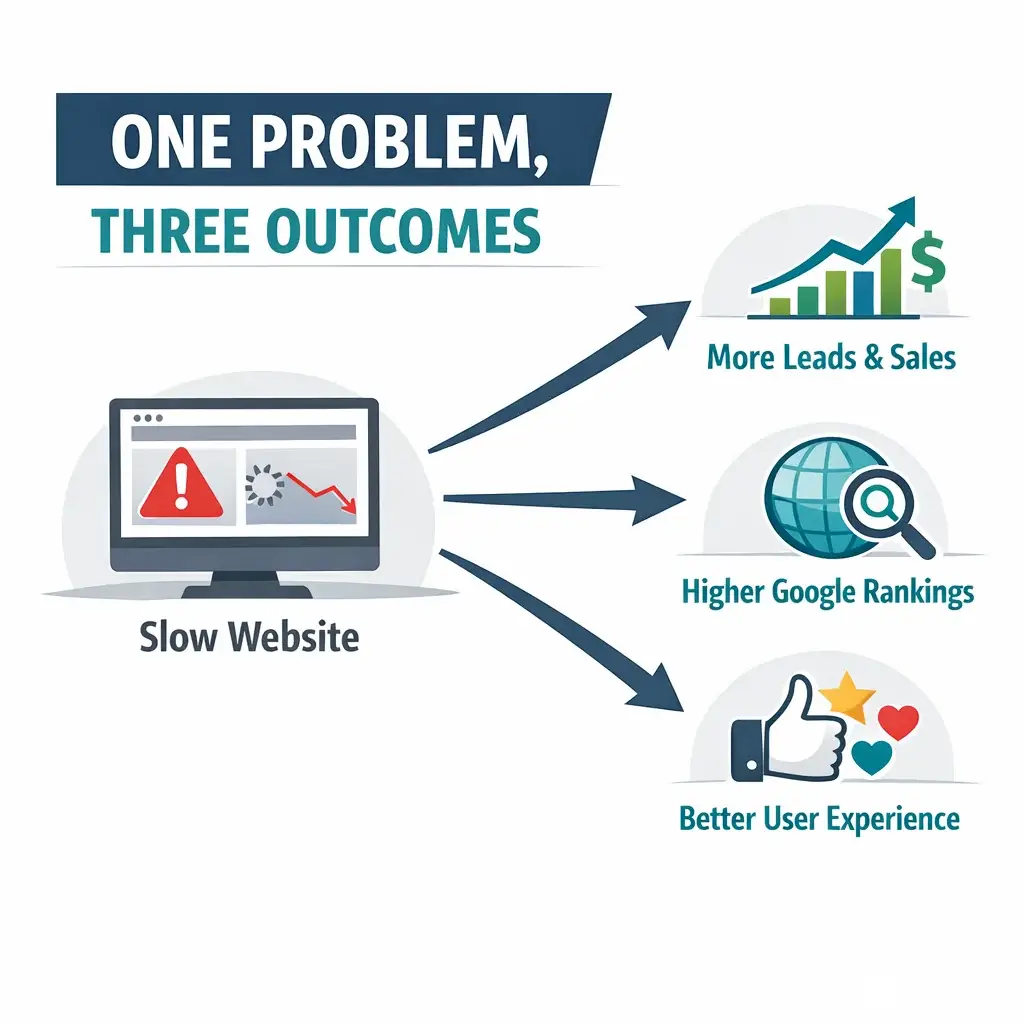
Page speed is frequently described as affecting rankings, user experience, and conversions. What is rarely explained is that these three outcomes share a single root cause, which means a single infrastructure decision can break all three simultaneously, and fixing it correctly improves all three at once.
Here is the causal chain:
A slow server response produces a high Time to First Byte (TTFB). High TTFB delays the browser’s ability to begin rendering the page. That delay extends the time before the page’s main content becomes visible, which is what Google’s Largest Contentful Paint (LCP) metric measures. A poor LCP score contributes to a failing Core Web Vitals assessment. Google uses Core Web Vitals as a ranking signal, so a poor LCP directly affects where your page appears in search results.
Simultaneously, the same slow load time that produced the poor LCP score causes real users to abandon the page before it finishes loading. That abandonment registers as a high bounce rate. And because the user left before the page rendered completely, they never reached your contact form, your phone number, or your service inquiry button. The conversion never had a chance to happen.
This is why website speed optimization is one of the highest-leverage interventions available. It is not three separate improvements. It is one fix with three measurable outcomes: better rankings, lower bounce rate, and higher conversion rate. The gains compound across every page on the site, and they compound with every visit.
Illustration, not a photograph of a completed client project.
LCP and CLS Are Different Problems That Require Different Fixes
Core Web Vitals is the umbrella term. Within it, Largest Contentful Paint (LCP) and Cumulative Layout Shift (CLS) are distinct metrics with distinct root causes. Treating them as interchangeable symptoms of the same problem leads to wasted diagnostic effort.
LCP measures how long it takes for the largest visible content element, typically a hero image or a headline block, to fully render. LCP failures are almost always caused by one of four issues: slow server response time, render-blocking JavaScript or CSS that holds up the browser, unoptimized images that take too long to download, or a content delivery configuration that does not serve assets from a location close to the user.
CLS measures how much the page layout shifts unexpectedly while loading. If a button moves right before a user taps it, or a block of text jumps down the page as an ad loads in above it, that is a CLS event. CLS failures are typically caused by images or embeds without declared dimensions, dynamically injected content loading above existing content, or web fonts loading late and causing text reflow.
The fix for a high LCP score involves server infrastructure, image compression, and resource loading strategy. The fix for a high CLS score involves HTML and CSS structure, dimension declarations, and font loading behavior. A Dayton business that receives a report saying “your Core Web Vitals are failing” needs to know which metric is failing and why before any remediation work is scoped, because the two problems require different skills and different interventions. Our technical SEO services in Dayton are built specifically to diagnose these distinctions and address each one at the root cause level.
| Metric | What It Measures | Common Root Causes | Primary Fix Category |
|---|---|---|---|
| Largest Contentful Paint (LCP) | Time for main content to visually render | Slow TTFB, render-blocking resources, unoptimized images | Server config, image optimization, CDN |
| Cumulative Layout Shift (CLS) | Unexpected visual movement during load | Missing image dimensions, late-loading fonts, injected content | HTML/CSS structure, font strategy |
| Interaction to Next Paint (INP) | Responsiveness to user input | Heavy JavaScript execution, long tasks blocking main thread | JS audit, code splitting, task scheduling |
Local SEO and Technical SEO Are Not Parallel Tracks
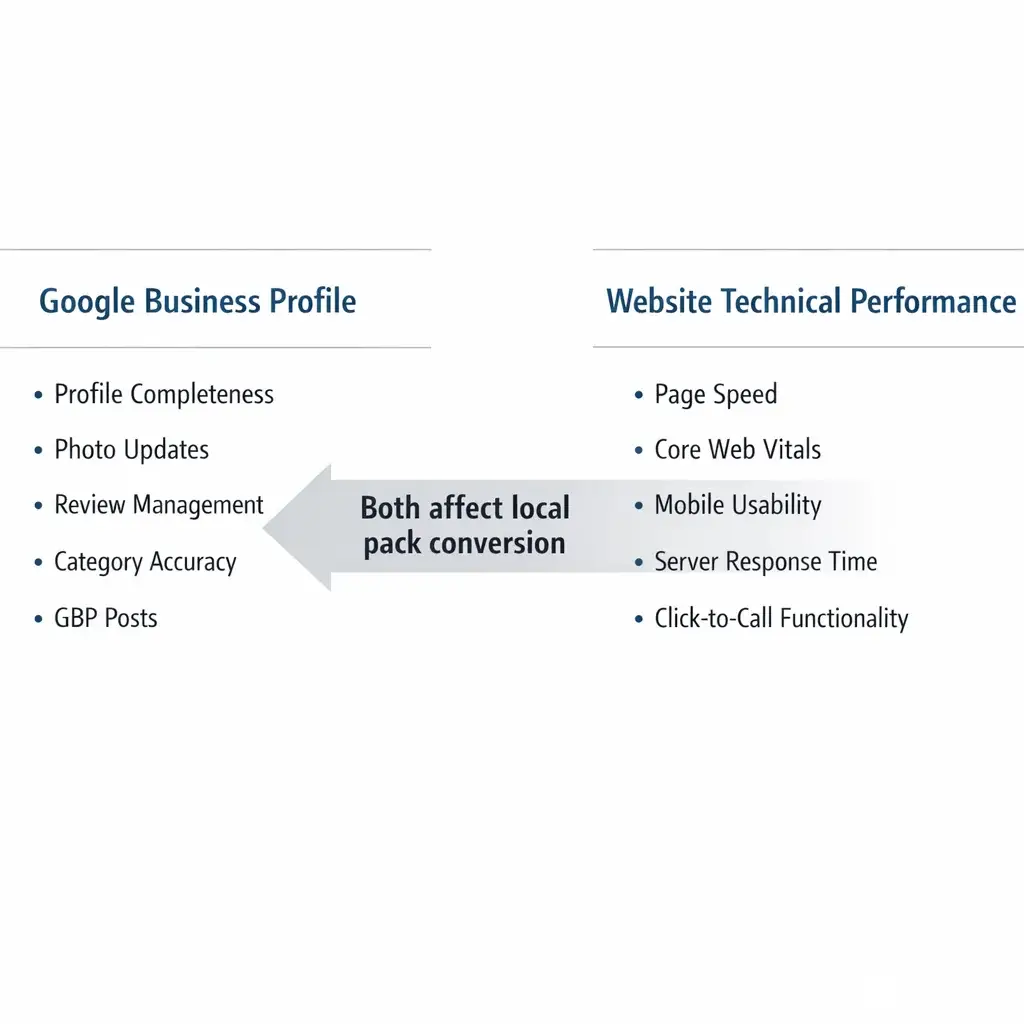
The standard agency presentation separates Google Business Profile management from technical SEO, treating them as two independent service lines. This separation creates a gap that can cost Dayton businesses their local pack placement.
Here is what that gap looks like in practice. A business invests in GBP optimization: the profile is fully filled out, photos are updated, review responses are active, and the business is accurately categorized. The GBP listing earns impressions in the local pack. A potential customer in Centerville or Springboro clicks through to the website. The website loads slowly on mobile, the layout shifts as content loads in, and the user bounces within seconds.
That behavioral signal, the click from the local pack followed by an immediate departure, is not invisible to Google. Page experience signals, including the Core Web Vitals data that Google collects from real users via Chrome, feed into how Google evaluates the quality of the destination behind a local listing. A GBP listing that consistently sends users to a poor page experience is not performing at its ceiling.
This means the two tracks are actually one track. GBP optimization determines whether users find you in the local pack. Technical site performance determines whether that listing converts clicks into calls, form submissions, and booked appointments. Optimizing one without the other is an incomplete investment. For a deeper look at how these systems interact, the article on local SEO in Dayton and how Google rankings work covers the ranking mechanisms in detail.
Illustration, not a photograph of a completed client project.
High-Intent Local Search Changes the Optimization Priority Hierarchy
Users searching for service providers in a specific city or metro area are not in a browsing mindset. They have a problem. They need a solution. They are comparing the first credible options they find, and they will call the one that is easiest to reach. Research on local search behavior consistently shows that the intent behind these searches is transactional, not informational, users are ready to call, book, and hire.
This behavioral reality changes the optimization priority hierarchy for businesses in Dayton, Kettering, Huber Heights, Miamisburg, and surrounding communities. When the user arriving at your site is ready to hire, the most important optimization is not content depth. It is conversion path speed.
Specific priorities for high-intent local audiences:
- Click-to-call functionality on mobile. A phone number that requires copy-pasting is a friction point that costs calls. The number needs to be tap-to-call, visible above the fold on mobile, and present on every page.
- Page load time on mobile connections. High-intent users are frequently searching from their phones, often while actively in a situation that created the need. A three-second load time is a barrier to conversion, not a minor inconvenience.
- Form load time and form field count. Contact forms with more than three to four fields see meaningful drop-off. A form that loads slowly or errors on submission loses leads permanently.
- Clear, specific calls to action. “Contact Us” is weaker than “Request a Free Consultation” or “Call Our Dayton Team.” Specificity reduces hesitation.
- NAP consistency. Your Name, Address, and Phone number must be identical across your website, your GBP listing, and every directory where your business is listed. Inconsistencies undermine local ranking signals.
Content volume and depth matter for informational queries. For high-intent local searches, what matters most is that the path from search result to phone call is fast, clear, and frictionless.
What a Thorough Website Optimization Engagement Actually Involves
Understanding the dependency chain and the priority hierarchy gives you a basis for evaluating what an agency is actually proposing. A thorough engagement for a Dayton business should cover the following components in a logical sequence:
Technical Foundation
- Performance audit with documented before metrics: TTFB, LCP, CLS, INP, and mobile usability score
- Image compression and conversion to modern formats (WebP)
- Render-blocking script identification and deferral
- Caching strategy and resource loading configuration
- Server response time assessment and remediation
- Mobile usability review across primary service pages
On-Page and Local Alignment
- Metadata optimization across service and location pages
- Header structure and keyword alignment review
- Internal linking strategy connecting service pages to location pages
- NAP consistency audit across website, GBP, and third-party directories
- GBP profile completeness and ongoing management
- Location page creation for served communities including Kettering, Beavercreek, Centerville, Huber Heights, Miamisburg, and Springboro
Conversion Infrastructure
- Click-to-call implementation and testing on mobile
- Contact form load time and field count review
- CTA placement and specificity on high-traffic pages
- Call tracking setup to connect inbound calls to specific pages and campaigns
Ongoing Measurement
- Core Web Vitals monitoring with real-user data, not just lab scores
- Ranking tracking for target keywords in the Dayton metro area
- Conversion rate tracking tied to specific optimization changes
- Monthly reporting that connects technical improvements to business outcomes: calls, form submissions, and lead volume
Working With Mongoose Digital Marketing on Website Optimization in Dayton
Mongoose Digital Marketing serves businesses across Dayton, Kettering, Beavercreek, Centerville, Huber Heights, Miamisburg, Springboro, and the surrounding Miami Valley area. Our approach to website optimization follows the dependency chain outlined in this article: technical infrastructure first, on-page and local alignment second, content and authority development third. Every engagement is built around the specific competitive landscape and audience behavior relevant to your market, not a templated checklist applied uniformly across industries.
If your website is underperforming in local search, losing clicks from your GBP listing, or failing to convert traffic into calls and inquiries, the starting point is an honest technical assessment. We offer a free consultation to review where your site currently stands and what the highest-priority interventions are for your business.
Contact Mongoose Digital Marketing to schedule your free consultation.
Frequently Asked Questions
How do I know whether my Dayton business website has a technical SEO problem before I contact an agency?
Start with two free tools: Google Search Console and Google PageSpeed Insights. Search Console will flag mobile usability errors, crawl issues, and Core Web Vitals failures based on real user data collected from Chrome. PageSpeed Insights will give you lab-based scores for LCP, CLS, and INP along with specific diagnostics. If your LCP score is above 2.5 seconds or your CLS score is above 0.1, you have documented technical issues that need to be resolved before additional content or link building work will reach its full potential. These scores are a starting point for a conversation with an agency, not a complete diagnosis, but they tell you whether infrastructure problems exist before any proposal is signed.
Why would my Google Business Profile be getting impressions but not generating calls or form submissions?
The most common explanation is a mismatch between GBP performance and website performance. Your GBP listing can earn placement in the local pack based on proximity, relevance, and profile completeness, but when a user clicks through to your website and encounters a slow-loading page, a layout that shifts on mobile, or a phone number that cannot be tapped to call, they leave before converting. The GBP impression was earned. The conversion was lost at the website level. Resolving this requires treating the GBP listing and the destination page as a connected system, not two separate concerns managed independently.
Does website optimization work the same way for a business in Kettering or Beavercreek as it does for a business located in downtown Dayton?
The underlying technical principles are identical, but the local SEO layer requires location-specific targeting. A business serving Beavercreek or Kettering needs location pages that explicitly address those communities, NAP data consistent with the specific service area, and GBP category and service configuration that reflects where the business actually operates. Google’s local ranking systems use proximity as one signal, but relevance and prominence signals, including content specificity and behavioral data from local searchers, mean that a well-optimized location page targeting Kettering can outperform a generic page that only references the broader Dayton metro area.
What should a monthly website optimization report actually show me?
A useful monthly report connects technical metrics to business outcomes. It should show before-and-after Core Web Vitals scores so you can see whether infrastructure improvements held or regressed. It should show keyword ranking movement for the specific search terms relevant to your services and geography. It should show conversion events, meaning tracked calls, form submissions, and any other defined lead actions, tied to the pages where optimization work occurred. A report that shows only traffic volume or keyword impressions without connecting those numbers to actual leads or calls is measuring activity rather than results. The question every monthly report should answer is: did the work done last month produce more contacts from qualified local searchers?
Conclusion
Website optimization for Dayton businesses is not a service you purchase once and set aside. It is a layered system where infrastructure integrity determines whether every other investment produces returns. The technical foundation has to be stable before on-page work is meaningful. On-page work has to be complete before content builds authority. And both have to be functioning correctly before a Google Business Profile investment converts local pack clicks into actual calls.
For businesses across Dayton, Kettering, Beavercreek, Centerville, Huber Heights, Miamisburg, Springboro, and the broader Miami Valley region, the competitive reality is that high-intent local searchers make decisions quickly. They tap the first credible, fast-loading option they find. The businesses that capture those searchers consistently are not necessarily the ones with the most content or the most links. They are the ones whose technical foundation does not get in the way of a motivated buyer completing the simplest possible action: making a call.
If the framework in this article has clarified what your website currently lacks or helped you identify where a previous optimization effort stalled, that clarity is the right starting point for whatever comes next.