

Key Takeaways
- Professional blog services in Dayton, Ohio go far beyond writing posts; they establish content architecture, audience segmentation, and editorial governance before a single word is published.
- Geographic specificity in blog content builds measurable local search authority that generic national content cannot replicate for Dayton-area businesses.
- The most common failure in business blogging is publishing volume without a topical authority strategy, which dilutes SEO signal rather than building it.
- Choosing between a pillar-cluster content model and a multi-audience hub structure is a site architecture decision, not a publishing preference, and it must be made before content scales.
- Blog performance should connect directly to business outcomes such as lead volume, organic traffic growth, and conversion rate, not just page views or post count.
A Dayton business owner signs a contract with a content agency, receives twelve blog posts over three months, and sees no movement in search rankings, no uptick in contact form submissions, and no identifiable change in site traffic. The posts are well-written. They are published consistently. They cover relevant topics. And they produce nothing.
This situation is more common than most agencies admit, and the reason is almost always the same: the blog was treated as a publishing channel rather than a strategic asset. If you are evaluating Dayton Ohio blog services for your business, understanding what separates productive blog strategy from expensive content production is the most important decision you will make before spending a dollar.
What Blog Services Actually Do (and What Most Don’t)
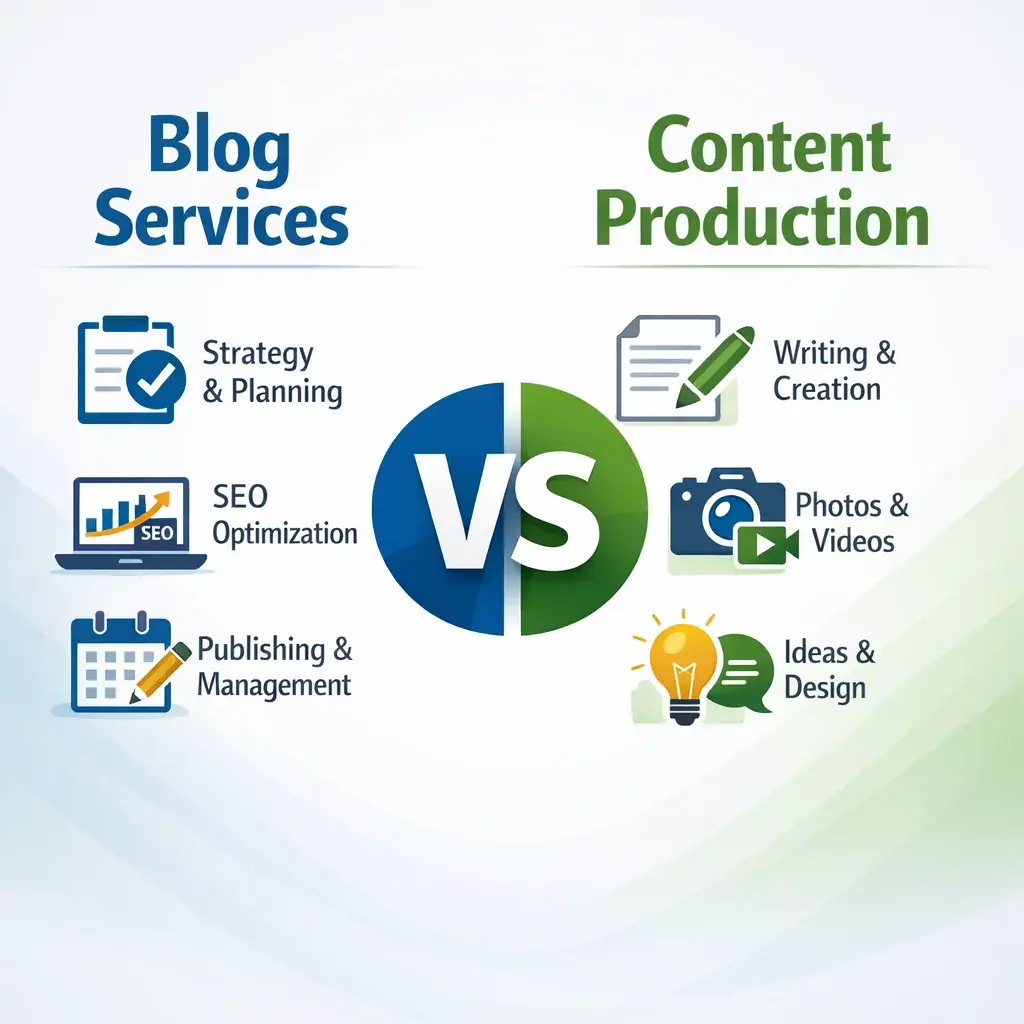
The term “blog services” covers a wide range of deliverables, and the difference between a low-value provider and a high-value partner is found in what happens before writing begins.
A content production service writes posts. A blog service builds a content system. That system includes:
- Keyword and intent research tied to specific stages of your buyer’s journey
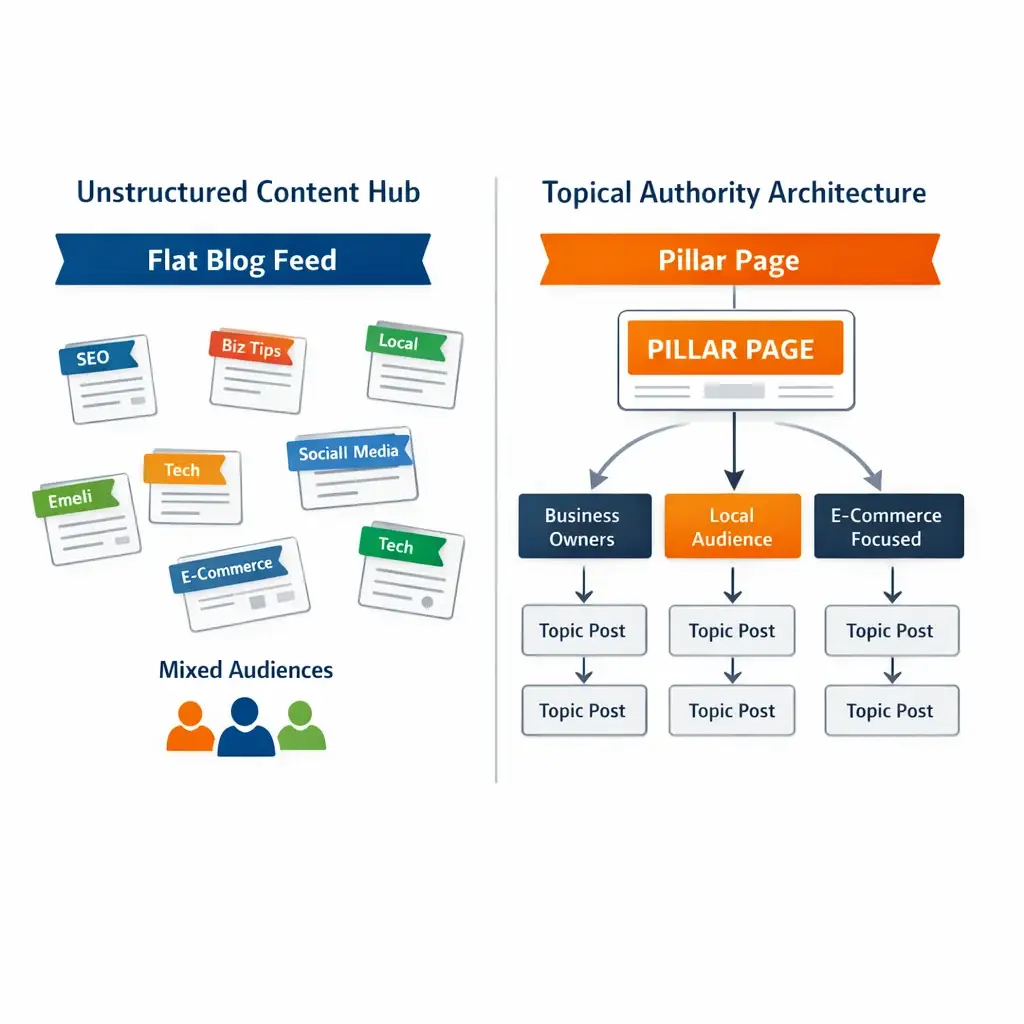
- Topic cluster architecture that groups related content around pillar pages to concentrate topical authority
- Audience segmentation to determine whether your blog serves one reader profile or multiple, and how structure should reflect that
- Editorial governance including a controlled category and tag vocabulary, a publishing calendar, and a content brief workflow
- Performance measurement connecting blog activity to leads, rankings, and revenue
Skipping any of these components does not make blogging cheaper. It makes it slower, messier, and far less likely to produce results that connect to your actual business goals. To understand exactly what a high-performing blog system looks like in practice, the Blog Writing Services: What You’re Missing article outlines the gaps most businesses never realize exist.
The Local Authority Argument Competitors Never Make
Every business blog that ranks well in Dayton does so for one of two reasons: institutional domain authority built over decades, or genuine geographic specificity that creates trust signals no national content farm can replicate.
The University of Dayton ranks for content because udayton.edu carries accumulated authority from years of institutional credibility. A locally-owned service business in Kettering, Beavercreek, or Centerville cannot replicate that model. What a local business can build, and what institutions cannot easily replicate, is granular neighborhood-level expertise that signals genuine local knowledge to both readers and search engines.
A plumber in Huber Heights writing about common pipe issues in post-war residential construction in that area demonstrates expertise no national content mill can fake. A financial advisor in Springboro referencing Miamisburg’s specific business community creates relevance a boilerplate template cannot produce. This is the core value proposition of local blog content, and it is the argument almost no blog service makes explicitly.
For Dayton-area businesses, local content specificity serves three measurable functions:
- Local SEO reinforcement by associating your domain with specific geographic terms, neighborhoods, and regional business context
- Trust acceleration because readers recognize authentic local knowledge and stay on-page longer, which sends positive engagement signals
- Community authority building that positions your business as a subject matter resource within the Dayton metro area, not just a vendor listing
Need a hand with this in Dayton, Kettering and the Triad? Call (937) 848-0086 or request a free estimate. Honest answers, no pressure.
Why Content Architecture Matters More Than Post Volume
One of the most instructive patterns visible across Dayton-area blogs is what happens when content scales without structure. Organizations accumulate dozens of topic tags, create near-duplicate categories, and publish multiple posts in the same week targeting entirely different audiences. The result is a content library that search engines cannot interpret clearly, and readers cannot navigate efficiently.
Tag and category architecture is not a publishing decision. It is a site structure decision with direct consequences for how search engines distribute topical authority across your domain. When a blog maintains separate tags for what are effectively the same concept, that fragmentation tells search engines that your site lacks clear expertise in any single area. When content targeting three different reader personas lives on one undifferentiated blog URL, the signals those posts generate compete with each other rather than compound.
Before any Dayton business scales blog output, two foundational questions must be answered:
Question one: Are you building topical authority for a single audience or multiple distinct audiences? If the answer is multiple, the structural decision of whether to use one blog, multiple blogs, or a pillar-cluster architecture must be resolved first. The answer determines internal linking logic, call-to-action alignment, and which pages earn ranking authority over time.
Question two: What is the controlled vocabulary for your categories and tags? This vocabulary should be defined at the start and governed editorially throughout. Every new tag added without governance is a dilution of the signal you have already built.
These structural decisions also have direct implications for your broader SEO strategy services in Dayton, since topical authority built through a blog feeds directly into how your entire domain is evaluated by search engines.
Evaluating Blog Services in the Dayton Market
When comparing blog service providers in Dayton and the surrounding communities of Kettering, Centerville, Miamisburg, and Beavercreek, the evaluation criteria should center on strategic capability, not deliverable count.
| Evaluation Criteria | What a Strong Provider Demonstrates | What a Weak Provider Does Instead |
|---|---|---|
| Content architecture | Proposes cluster structure before writing begins | Delivers a list of post topics without structural logic |
| Audience segmentation | Identifies distinct reader personas and maps content to each | Writes to a general “target audience” without differentiation |
| Editorial governance | Establishes category taxonomy and tag vocabulary upfront | Allows tags and categories to accumulate organically |
| Local SEO integration | Connects blog strategy to geographic keyword targets | Treats blog and SEO as separate workstreams |
| Performance reporting | Reports on traffic, leads, rankings, and conversions | Reports on post count and word volume |
| Measurement cadence | Reviews performance monthly and adjusts strategy | Publishes on schedule regardless of what data shows |
The businesses that get genuine return from blog investment in Dayton are not necessarily the ones publishing the most content. They are the ones whose blog content is organized to build authority in specific topic areas, targeted to specific reader intents, and measured against specific business outcomes.
How Publishing Cadence Should Be Set
Publishing frequency is one of the most misunderstood variables in blog strategy. Many Dayton businesses are sold on a fixed monthly post count without any rationale for why that number was chosen.
Cadence should be determined by three factors: your current domain authority, the competitive density of your target keywords, and the crawl rate Google has established for your site. A newer domain with lower authority often benefits more from publishing fewer, longer, more thoroughly researched pieces than from frequent short posts. An established domain competing in a saturated local category may need a higher volume of tightly clustered content to move rankings.
What matters is that publishing decisions are made in response to data, not in response to a contract line item. A blog service worth hiring in the Dayton market will review performance metrics monthly, identify which content is earning traffic and which is not, and adjust topic selection and frequency accordingly. Understanding how those decisions connect to overall local search performance is covered in depth in the SEO Dayton Ohio: Local Strategies That Actually Work article.
For Dayton-area businesses ready to build blog content that connects to measurable growth, Mongoose Digital Marketing offers blog strategy and content services grounded in SEO architecture, audience segmentation, and outcome tracking. You can also review how Google approaches content quality and expertise signals in their Search Quality Evaluator Guidelines to understand what a high-performing blog must demonstrate to earn sustained rankings.
Frequently Asked Questions
How do I know if a Dayton blog service is actually improving my search rankings?
Look for a service that provides monthly reporting tied to specific metrics: organic traffic growth by page, keyword ranking movement for targeted terms, and changes in time-on-page or bounce rate. If your blog service cannot show you which posts are driving traffic and how that traffic is behaving once it arrives, you are not getting the visibility you need to evaluate whether the investment is working.
Does publishing more blog posts always lead to better results?
Not necessarily. Publishing frequency should be matched to your domain authority, your competitive landscape in the Dayton market, and how Google is currently crawling your site. A smaller number of deeply researched, well-structured posts often outperforms a high volume of thin content. The goal is topical authority built strategically, not a post count built to satisfy a contract.
What makes a local Dayton blog different from general content marketing?
A Dayton-focused blog integrates local context into content that also satisfies broader search intent. That means referencing specific neighborhoods, industries, and community patterns that Dayton-area readers recognize, while still targeting keywords with measurable search volume. Content that feels generically national rarely earns the trust of local readers or the ranking signals that come from genuine engagement.
How long does it typically take to see results from a business blog?
Organic search results from blog content generally take three to six months to become visible in a meaningful way, depending on domain age, the competitiveness of your target keywords, and the consistency of your publishing strategy. Businesses that treat blogging as a long-term asset rather than a short-term traffic tactic are the ones that see compounding growth over time.
Conclusion
For businesses in Dayton, Kettering, Beavercreek, and Centerville that want blog content built around real SEO architecture and local audience insight, Mongoose Digital Marketing brings the strategy, content development, and performance tracking that turn a blog from a routine obligation into a genuine growth channel. Whether you need a full content strategy built from the ground up or consistent monthly blog services aligned to your business goals, the team at Mongoose is proud to serve the communities that make up the greater Dayton area. Call (937) 848-0086 or Contact Mongoose Digital Marketing to start a conversation about what the right blog strategy could do for your business.