
Key Takeaways
- Roofing SEO cost is determined by a combination of your market’s competitive intensity, your website’s current authority, the geographic footprint you want to dominate, and the specific mix of work your SEO provider prioritizes each month.
- Not all SEO hours deliver equal compounding value: a contextually relevant backlink from a roofing trade publication builds authority that lasts for years, while a citation submission delivers a one-time signal.
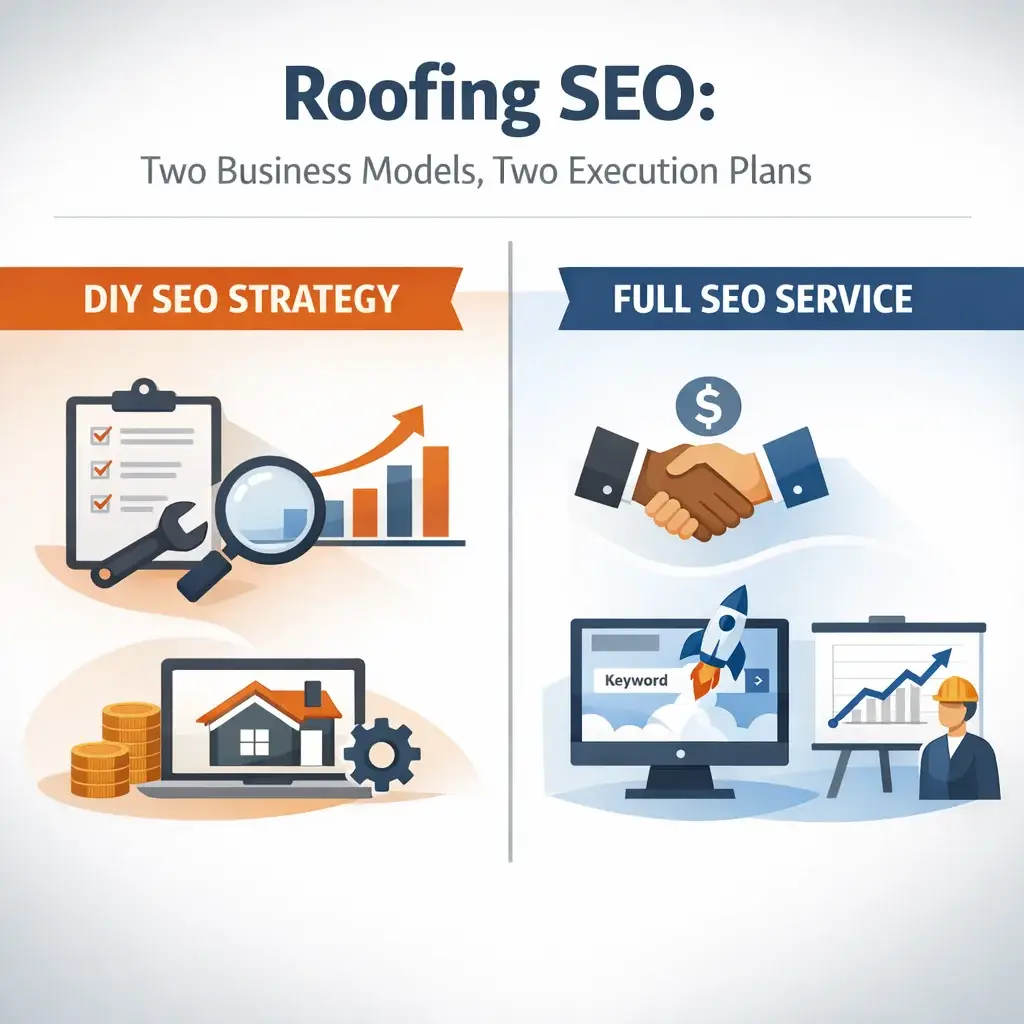
- Storm-restoration roofers and retail-replacement roofers have fundamentally different lead lifecycles, which changes the deliverables that should appear in month one of any SEO campaign.
- Asset ownership, including your website, Google Business Profile, and call tracking numbers, is a hidden cost multiplier: losing these assets at contract exit means rebuilding from zero, not from where you left off.
- The local SEO signals that improve your Google Maps ranking, such as structured data, citation consistency, and E-E-A-T content, are the same signals that feed AI-generated search results, so you are not buying two separate things.
Roofing SEO cost is shaped by a layered set of variables, and understanding those variables is what separates a contractor who allocates a marketing budget confidently from one who picks a number and hopes for the best. This article breaks down the factors that drive investment levels, explains the reasoning behind them, and surfaces several distinctions that most SEO conversations in the roofing space never reach.
What Actually Drives Roofing SEO Cost
Every proposal you receive from an SEO provider is, at its core, a translation of your current situation into a workload estimate. The factors below are the inputs to that estimate. When you understand them, you can evaluate proposals critically rather than comparing line items on a spreadsheet.
Your Website’s Current Authority
Domain authority is not a vanity metric. It is a practical indicator of how hard your site has to work to compete for a given keyword. A roofing website with a thin backlink profile, no indexed blog content, and a domain age under two years is starting from a structural disadvantage compared to a competitor who has been earning local links and publishing location-specific content for five years.
The practical implication: a lower-authority site requires more foundational work in the early months of a campaign. That work includes technical remediation, content architecture, and early link acquisition before you can expect meaningful ranking movement. Providers who quote you the same scope regardless of where your website sits today are not doing the analysis. The starting point changes the workload.
Competitor Link Profiles Are Live, Not Fixed
Market competitiveness is listed as a pricing factor in virtually every roofing SEO article. What those articles rarely explain is that your competitors’ SEO investments are not static. A well-funded competitor entering the Dayton market six months into your campaign changes your required investment, not just your timeline.
When Mongoose evaluates a roofing market, we look at the link velocity and content output of the top three organic results, not just their current authority scores. A competitor who is actively building links at volume is a moving target. Your campaign budget should reflect the competitive environment as it is evolving, not as it was when you signed the contract.
Geographic Footprint and Location Page Quality
Serving Dayton, Kettering, Beavercreek, Centerville, Huber Heights, Miamisburg, and Springboro means competing for visibility across multiple distinct local markets, each with its own search behavior and its own set of ranking competitors. More target cities means more location-specific content, more internal linking architecture, and more citation consistency work across those geographic signals.
Here is where the work-type distinction becomes important. A proposal that includes “location pages” as a deliverable is not automatically delivering value. There is a meaningful difference between thin, templated location pages that Google’s quality filters will eventually discount and locally differentiated content that builds genuine topical authority for each service area. When evaluating a proposal, ask specifically what differentiates each location page from the others. If the answer is “we swap the city name,” that is a red flag with compounding consequences.
The Business Model Split: Retail Replacement vs. Storm Restoration
This is the most operationally significant factor in roofing SEO, and it is consistently underexplained in the industry.
Retail-replacement roofers operate on a longer lead lifecycle. A homeowner notices granule loss, requests three estimates, and makes a decision over days or weeks. SEO’s compounding timeline aligns well with this model. Review velocity, location page authority, and Google Business Profile optimization all feed directly into the consideration-stage research that this customer does before calling anyone.
Storm-restoration roofers operate inside a compressed demand window. A significant weather event creates a concentrated surge of homeowner intent, typically within 72 to 96 hours, before competing crews saturate the affected area. Organic SEO’s six-to-twelve-month compounding curve is structurally mismatched with this pattern.
This means a storm-focused contractor asking “how much should I spend on SEO?” is actually asking the wrong prior question. The right question is: “Does my revenue mix allow SEO’s compounding timeline to align with how my jobs arrive?” If the answer is no, the budget decision, the deliverable structure, and the channel mix all change. A storm-forward operation may need SEO primarily for brand credibility and long-tail content rather than as a primary lead driver, which changes what month-one deliverables should look like entirely. For a deeper breakdown of how local SEO for roofing companies translates into real job volume, the distinctions between business models become even more pronounced.
The Work-Type Hierarchy: What Fills Those Hours Matters More Than How Many You Get
A common argument against low-budget SEO proposals is that the monthly fee divided by an agency’s hourly rate produces too few hours to move any ranking needle. This argument is mathematically correct but strategically incomplete.
The hours question misses the more important question: what type of work fills those hours, and what is the compounding shelf life of each task?
Consider the difference between these three activities:
| SEO Task | Compounding Value | Shelf Life | Strategic Priority |
|---|---|---|---|
| Contextually relevant backlink from a roofing trade publication | High | Years | Highest |
| Original, location-specific service page content | Medium-High | Months to years | High |
| Google Business Profile post | Low | Days to weeks | Ongoing maintenance |
| Citation submission to a niche directory | Low | Permanent but commoditized | Foundational, not differentiating |
| Thin location page with swapped city name | Negative over time | Short, with risk | Avoid |
A contractor evaluating competing proposals should not lead with “how many hours do I receive?” They should ask: “What specific tasks will fill those hours in months one through three, and what is the compounding value of each?” A provider who cannot answer that question with specificity is not running a strategic campaign. They are running a task list.
This reframes the low-budget conversation from a quantity problem into a task-priority problem. A smaller budget spent entirely on high-compounding work will outperform a larger budget spent on commodity deliverables. The budget level sets a ceiling on what is possible, but the task hierarchy determines whether you reach it.
Need a hand with this in Dayton, Kettering and the Triad? Call (937) 848-0086 or request a free estimate. Honest answers, no pressure.
Asset Ownership: The Hidden Cost Multiplier
Most SEO discussions treat asset ownership as a contract nicety, a line in the fine print worth checking before you sign. It is more consequential than that framing suggests.
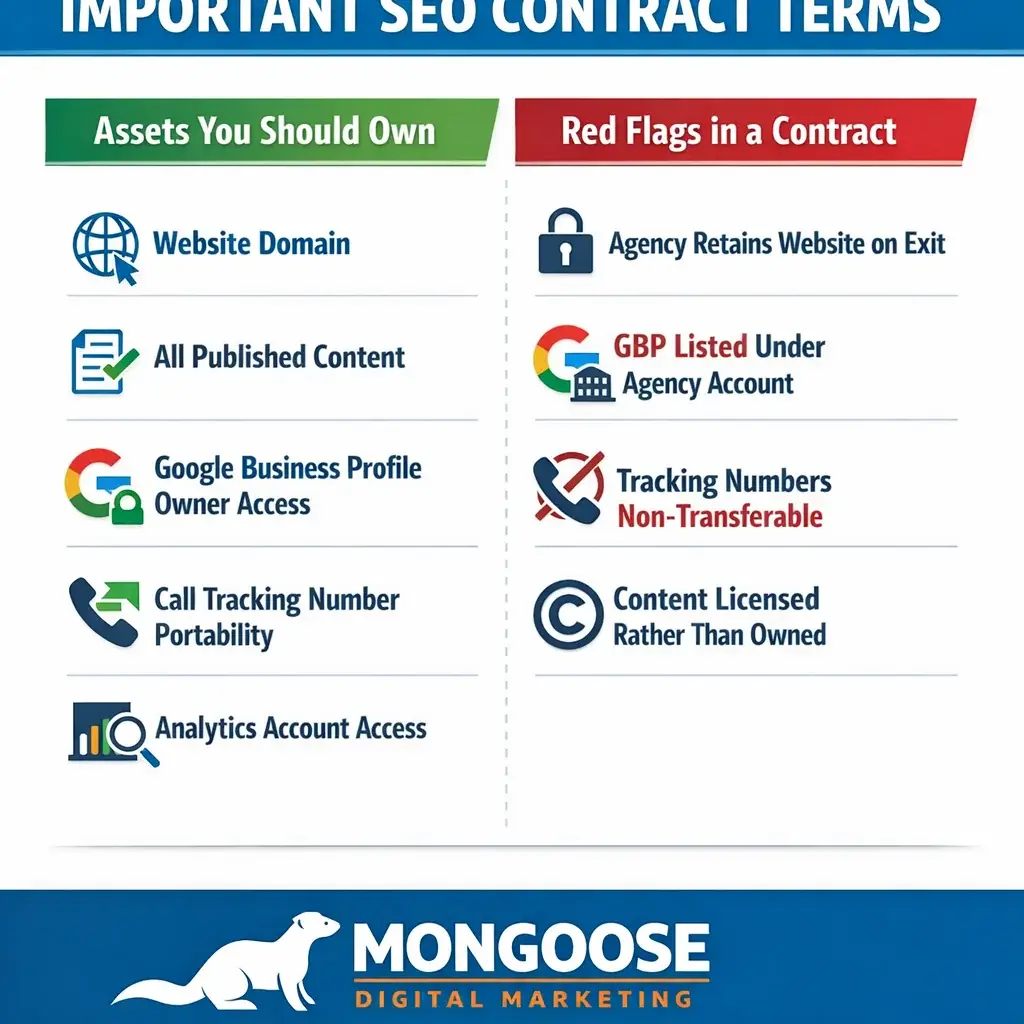
Here is the financial logic. If you cannot exit an agency relationship while retaining your website, your content, your Google Business Profile access, and your call tracking numbers, the effective cost of your SEO is not the monthly retainer. It is the monthly retainer plus the replacement cost of rebuilding those assets from zero.
Consider what 18 months of SEO investment produces: accumulated domain authority from earned backlinks, indexed location content that has built topical signals, a GBP with posting history and review momentum, and call tracking data that feeds your understanding of which keywords convert to booked jobs. If an agency controls those assets and you cannot transfer them on exit, you lose all of it. The next agency starts your clock from zero, not from month 19.
Before signing any roofing SEO agreement, confirm the following in writing:
- Website ownership: The domain and all files transfer to you at contract end, unconditionally.
- Content ownership: All published articles, location pages, and service content belong to you, not the agency.
- GBP access: You hold owner-level access to your Google Business Profile. The agency operates as a manager, not an owner.
- Call tracking numbers: Any tracking numbers used in your campaign can be ported to a new provider or to your own account.
- Review history continuity: Understand whether any GBP management approach creates dependency on the agency’s tools or logins.
This checklist is not about distrust. It is about recognizing that the accumulated digital assets from a well-run SEO campaign are worth significant replacement cost, and that cost belongs in any honest comparison of what different providers are actually offering. The article on what local SEO companies won’t tell you about rankings covers additional contractual and structural traps worth understanding before you commit to any agreement.
Local SEO Signals and AI Search: One Budget, Not Two
Several roofing marketing articles have begun treating AI search visibility as a separate initiative requiring a separate budget. This reflects a misunderstanding of how AI Overviews and AI-powered search assistants actually generate their responses.
Google’s AI Overview system draws from the same underlying signals that determine your local organic and map pack rankings: structured data markup, citation consistency across directories, content that demonstrates first-hand expertise and geographic specificity, and E-E-A-T signals embedded in how your website presents your credentials, reviews, and service documentation.
A roofing contractor in Dayton who invests in a technically sound GBP, consistent NAP citations across local directories, and location pages that demonstrate genuine knowledge of the areas they serve is building the same signal foundation that AI systems reference when generating answers to roofing queries. There is no separate AI SEO product. There is well-executed local SEO, and it increasingly feeds both traditional results and AI-generated ones.
The practical implication for budget decisions: you do not need to layer a new initiative on top of existing SEO spend to pursue AI visibility. You need to confirm that your existing SEO provider is building the right signal types, specifically structured data, authoritative content, and citation accuracy, rather than filling hours with commodity tasks that do not compound into either traditional rankings or AI citations.
What a Competent Proposal Should Tell You
When you receive an SEO proposal for your roofing business, the document should answer several questions that generic tier tables do not address.
Questions the Proposal Should Answer Explicitly
- What is the current domain authority of your site relative to the top three ranking competitors in your primary market?
- Which specific deliverables are prioritized in months one through three, and why?
- How does the provider distinguish between your location pages? What makes the Kettering page different from the Beavercreek page beyond the city name?
- Who specifically will work on your account, and what is that person’s familiarity with local roofing markets?
- What does the reporting cadence look like, and which metrics will be tracked against a baseline established in week one?
- What assets do you own at contract exit, confirmed in the agreement itself?
A proposal that cannot answer these questions is a pricing document, not a strategy. The difference matters because roofing SEO is not a commodity purchase. It is a compounding investment in a digital asset that should be worth significantly more after 24 months than it was on day one. That compounding only happens when the work-type hierarchy is correct from the start. Understanding how to find the right SEO agency before you receive any proposal puts you in a significantly stronger negotiating position.
Working With Mongoose Digital Marketing
Mongoose Digital Marketing serves roofing contractors across Dayton, Kettering, Beavercreek, Centerville, Huber Heights, Miamisburg, and Springboro. Our approach to roofing SEO starts with a competitive audit of your specific market before any scope is defined, because the market you are actually in determines the workload your campaign requires, not a generic tier table.
We build campaigns around high-compounding tasks, asset ownership by default, and reporting that connects ranking movement to booked jobs rather than vanity metrics. If you want to understand exactly where your site stands relative to your local competitors and what it would take to close that gap, contact us for a free consultation. We will tell you what we find, not what sounds good.
Frequently Asked Questions
How long does it take to see results from roofing SEO?
Most roofing contractors begin to see measurable ranking movement within three to six months, depending on how competitive their local market is and how much foundational work the site requires before optimization can compound. Markets like Dayton with multiple established competitors typically take longer than smaller surrounding communities. The timeline is also influenced by how consistently the work is executed month over month, which is why continuity matters more than any single deliverable.
What makes roofing SEO different from general SEO services?
Roofing is a high-ticket, low-frequency purchase driven by urgent local need. That combination means the search behavior, the keyword intent, and the competitive landscape are all distinct from industries where customers browse or compare over weeks. Effective roofing SEO accounts for storm seasonality, the difference between residential and commercial intent, and the way Google treats service-area businesses differently than storefronts. A provider without direct experience in the roofing vertical will spend your first several months learning what specialists already know.
Who owns the website, content, and rankings when the contract ends?
You should own all of it. Any agreement worth signing should confirm in writing that the domain, the content, the Google Business Profile, and any assets created during the engagement transfer to you completely at contract exit. If a provider structures their service so that rankings or content revert to them when you leave, that arrangement benefits the agency, not your business.
Is roofing SEO worth the investment compared to paid advertising?
Paid advertising stops producing leads the moment the budget stops. SEO builds a digital asset that continues generating visibility and inbound calls beyond any individual campaign period. For roofing contractors in competitive markets like Beavercreek or Centerville, a well-ranked organic presence and a strong Google Business Profile can produce consistent lead flow without the per-click cost that compounds with every storm season. The two channels are not mutually exclusive, but organic search is the only one that compounds in your favor over time.
Conclusion
Roofing contractors in Dayton and the surrounding communities deserve an SEO partner who understands the local competitive landscape before quoting a scope, not one applying a generic package to a market they have never studied. Mongoose Digital Marketing works specifically with roofers across Kettering, Beavercreek, Centerville, and the broader Miami Valley, which means the strategy built for your business reflects actual local conditions rather than assumptions. Call us at (937) 848-0086 or Contact Mongoose Digital Marketing to find out exactly where your site stands and what it will take to move it.