
Before You Choose a Single Channel: The Local Market Audit That Changes Everything
Most local businesses start their digital marketing plan the wrong way. They pick a channel — usually whatever a vendor just pitched them, or whatever a competitor appears to be doing — and they build backward from that choice. Six months later, they have activity but no traction, and they conclude that “digital marketing doesn’t work for us.”
The problem was never the channel. The problem was skipping the foundational work that determines which channel deserves your attention first, and why.
Building a digital marketing plan for a local business is a fundamentally different exercise than building one for a national brand or an e-commerce company. Local consumers behave differently. Local algorithms weigh different signals. Local markets have geographic constraints that change the entire logic of channel selection, content strategy, and investment sequencing. A plan that ignores those realities isn’t a local marketing plan — it’s a generic marketing checklist dressed up in local language.
This guide is built around how local customers actually make decisions, not around how agencies prefer to package their services. It introduces three practitioner-level frameworks — the Competitive Radius Audit, the Local Intent Stack, and the Trust Velocity model — that most published advice never touches. If you’ve tried the step-by-step checklists and found them unsatisfying, this is the reasoning behind the reasoning.
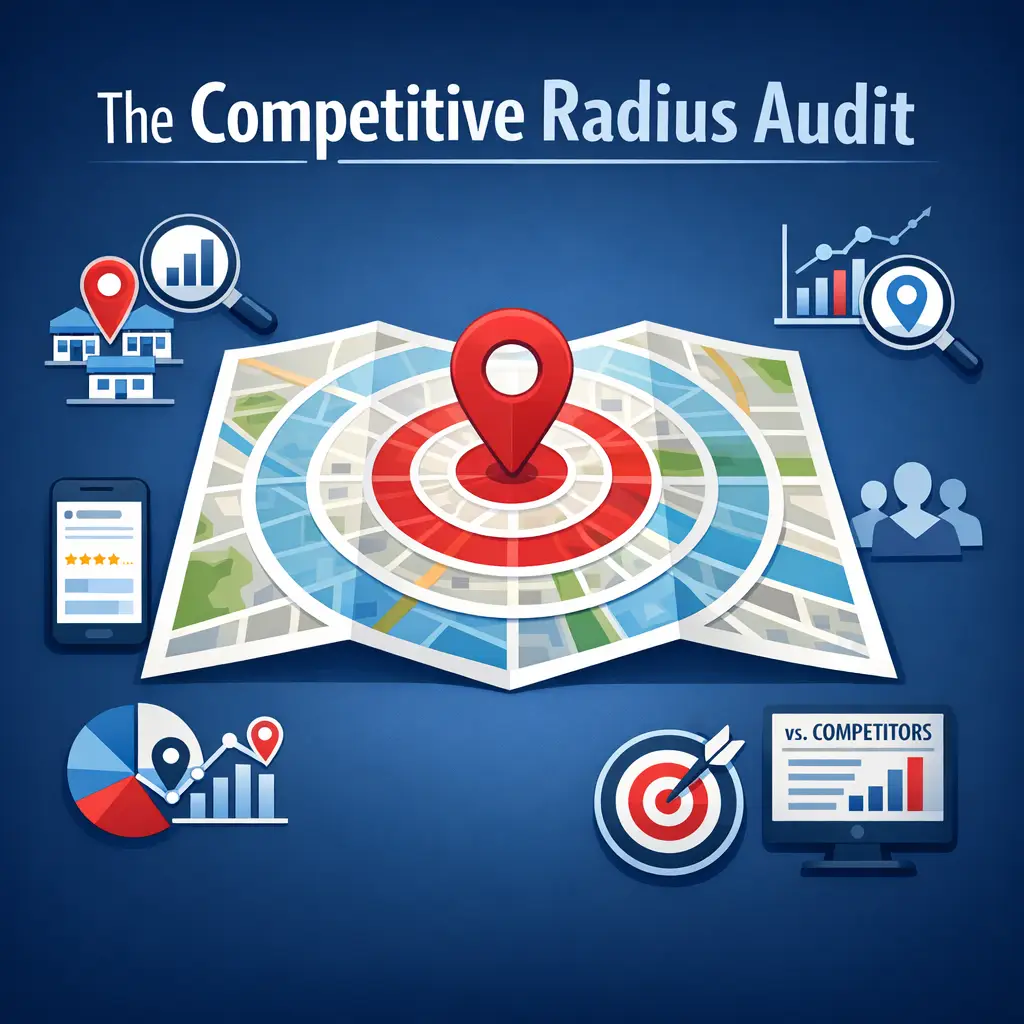
The Foundational Step Most Guides Skip: The Competitive Radius Audit
Before you write a single goal, choose a single platform, or publish a single piece of content, you need to answer one question that most digital marketing guides never ask: What is your actual competitive radius?
Your competitive radius is the geographic area within which a customer is realistically willing to travel or engage to do business with you, weighted against the density of alternatives available to them within that same area. It sounds simple. The implications are not.
A downtown coffee shop competes within roughly a half-mile to one-mile radius in an urban environment. A residential HVAC contractor in a mid-sized market may compete across a 25-mile radius. A boutique wedding venue might pull customers from across an entire state. These are not variations of the same marketing problem — they are structurally different problems that demand structurally different plans.
How to Define Your Competitive Radius
Start with three inputs:
1. Customer Travel Willingness
Look at your existing customers, if you have them, and map where they’re coming from. If you’re starting fresh, benchmark against your category. People choose a convenience store within a five-minute drive. People choose a specialized pediatric dentist within a 30-minute drive. Industry category is a reasonable proxy for initial radius estimation.
2. Local Search Behavior Data
Use Google Search Console (if your site has history) or Google Business Profile insights to see where searchers are physically located when they find you. This gives you a behavioral radius, not just an assumed one. Google’s Local Finder results also show you who ranks in your category across different distance thresholds — map that competitive field before you plan anything.
3. Competitor Footprint Analysis
Identify your three to five most direct local competitors. Where are they physically located? What service area do they claim? Where do they rank in local packs? The overlap zone between your location and theirs defines the contested territory your plan needs to address.
Once you have your competitive radius defined, everything downstream changes: the geographic targeting on paid campaigns, the hyperlocal content topics you need to own, the citation and review velocity targets that are realistic, and even the social platforms worth prioritizing.
The Local Intent Stack: Sequencing Channels by Purchase-Intent Proximity
Once your competitive radius is defined, the next mistake to avoid is treating all digital channels as equal options in a menu. They are not equal — not in cost, not in timing, and not in how they connect to actual purchase behavior.
The concept of the Local Intent Stack provides a sequencing logic grounded in consumer behavior, not in what’s easiest to sell or execute. The stack maps channels from highest purchase-intent proximity at the top to lowest at the bottom. For a local business working with finite resources, you build from the top down — not from the middle out.
The Local Intent Stack: Tier by Tier
Tier 1 — Capture (Highest Intent)
These are the channels a local consumer touches when they are already in the decision process. They know what they want. They are choosing who to give the business to.
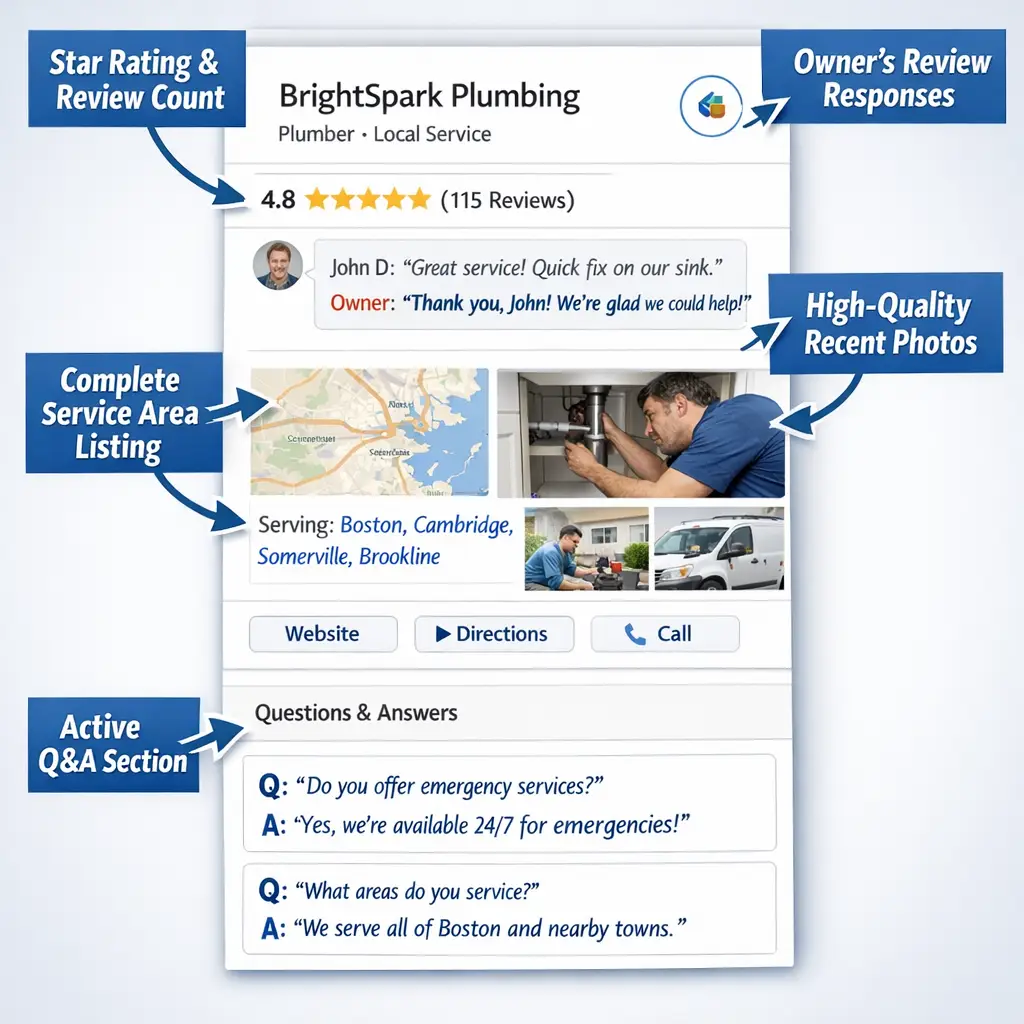
- Google Business Profile (GBP) — the single highest-leverage asset for most local businesses
- Local organic search (map pack + organic results for “near me” and location-modified queries)
- Direct website visits driven by brand-name search
Consumers in Tier 1 have already crossed the intent threshold. Your job here is not to persuade — it’s to not lose them. An incomplete GBP, a slow-loading website, or a thin review count kills conversions that are already within reach.
Tier 2 — Convert (Medium-High Intent)
These channels reach people who have already encountered your brand but have not yet made a decision.
- Retargeting campaigns (Google Display, Meta retargeting audiences)
- Email marketing to warm lists
- Landing pages tied to specific service searches
Tier 2 is where persuasion architecture matters. Review counts, trust signals, clear calls to action, and specific local proof points (neighborhood references, local testimonials) all do heavy lifting here.
Tier 3 — Build (Medium Intent)
These channels build relationship and familiarity with consumers who are aware of a need but not yet actively searching for a solution.
- Organic social media (Meta, Instagram, Nextdoor depending on category)
- Local content marketing and blog SEO
- Community partnerships and local press coverage
Tier 3 is a long-play investment. It rarely drives immediate leads, but it feeds Tiers 1 and 2 by expanding your brand’s known footprint within the competitive radius.
Tier 4 — Awareness (Lower Intent)
These are broad-reach channels where the consumer may not yet know they have a relevant need.
- Awareness-focused paid social
- YouTube pre-roll targeting local audiences
- Local display advertising
For most local businesses with constrained resources, Tier 4 is the last place to invest, not the first. Awareness without a functioning Tier 1 infrastructure is spending to fill a funnel with a hole in it.
| Channel | Intent Tier | Local-Specific Signals Required | Typical Time to Results |
|---|---|---|---|
| Google Business Profile | Tier 1 — Capture | Reviews, photos, Q&A, service areas, posts | Immediate to 30 days |
| Local SEO (Map Pack + Organic) | Tier 1 — Capture | Citations, NAP consistency, backlinks, local content | 60–180 days |
| Google Search Ads (Local) | Tier 1 — Capture | Location extensions, service-area targeting, call extensions | Immediate with spend |
| Retargeting (Google/Meta) | Tier 2 — Convert | Website pixel data, audience segmentation, trust-focused creative | 7–30 days |
| Email Marketing | Tier 2 — Convert | Segmented local list, hyperlocal content, personalization | 14–60 days |
| Organic Social Media | Tier 3 — Build | Community content, local tagging, UGC integration | 60–180+ days |
| Local Content / Blog SEO | Tier 3 — Build | Hyperlocal topics, event tie-ins, neighborhood coverage | 90–270 days |
| Awareness Paid Social | Tier 4 — Awareness | Local audience targeting, reach optimization | 30–90 days |
The table above gives you a sequencing logic and realistic time-to-results framing. If a local business is launching from zero and needs leads within 90 days, the answer is almost always: invest in GBP optimization, local SEO fundamentals, and a tightly targeted Google Search campaign before anything else. Everything else feeds from there.
Trust Velocity: Why Local Businesses Must Build Before They Broadcast
Here is the concept that most digital marketing guides treat as an afterthought, quietly tucked under “reputation management” as if it’s a separate workstream: for local businesses, trust is infrastructure, not decoration.
Trust velocity refers to the rate at which a local business accumulates verifiable social proof signals — reviews, citations, local media mentions, user-generated content — relative to the competitive set within its radius. It’s not just about having reviews. It’s about accumulating them faster, more consistently, and across more signal types than the competitors a consumer is simultaneously evaluating.
Why Trust Velocity Matters to Local Algorithms
Google’s local ranking algorithm is explicit about three ranking factors: relevance, distance, and prominence. Prominence is largely a trust and authority signal. It includes:
- Review count and average rating on GBP
- Citation consistency and volume across local directories
- Website authority and local link profile
- Local press and mention signals
A business with 12 reviews loses to a business with 87 reviews in most local pack contests, even when all other signals are roughly equal. That gap is a trust velocity problem, not a content problem or a keyword problem.
The Trust-Building Sprint Phase
A well-constructed local digital marketing plan includes a dedicated trust-building sprint in the first 60 to 90 days — before significant investment in paid awareness or top-of-funnel content. The sprint focuses on:
Reviews:
Build a systematic process for requesting reviews from satisfied customers at the moment of highest satisfaction — immediately after service completion, at point of delivery, or right after a successful outcome is confirmed. A review request strategy isn’t a nice-to-have; it’s a core operational process.
Citation Consistency:
Audit and standardize your Name, Address, Phone (NAP) data across every directory where your business appears. Google Maps, Apple Maps, Yelp, Bing Places, industry-specific directories, and local chamber listings all need to match perfectly. Inconsistent citations actively suppress local ranking performance.
Local Backlink Acquisition:
Identify five to ten local websites — news outlets, community organizations, business associations, complementary service providers — and pursue legitimate link placement. A single mention from a local news site carries more local ranking weight than dozens of generic directory links.
Social Proof on Asset Pages:
Every landing page, your GBP listing, and your primary social profiles should feature recent, specific, locally-grounded testimonials. Not generic praise — specific outcomes tied to recognizable local contexts.
Trust Velocity and Consumer Behavior: The Same-Day Decision Window
Local consumers frequently operate on compressed decision timelines that national marketers consistently underestimate. Research on local search behavior consistently shows that a significant portion of “near me” searches result in a business visit or contact within hours, not days. That same-day decision window means that when a consumer lands on your GBP listing or your website for the first time, they are often ready to decide right now.
In that moment, trust signals do the closing. An unanswered GBP review from three months ago, a “we’ll get back to you” contact form, or a website that loads slowly on mobile doesn’t just lose a lead — it loses a customer who was already yours to win. For a deeper look at how Google Business Profile optimization tips that actually work can close that gap, the tactical breakdown there maps directly to the trust signals covered in this section.
Mapping Your Plan to Local Seasonality and Demand Curves
A digital marketing plan is not a static document. For local businesses especially, demand is shaped by seasonal patterns, local events, and community calendars in ways that national marketing frameworks rarely account for.
Building a Local Demand Calendar
Before finalizing channel investment and content priorities, map out your local demand curve for the year:
Identify your peak demand periods. When do inbound inquiries naturally spike? This is when Tier 1 and Tier 2 channel performance is most valuable — and when you need full trust infrastructure in place to capitalize.
Identify your low-demand windows. These are your trust-building and infrastructure investment periods. Run review acquisition campaigns, build out content, refresh your website, and audit your citation profile when competition for attention is lower and leads are less immediately on the table.
Map local events and community calendar anchors. School year start, local festivals, sports seasons, weather shifts, holidays with local spending patterns — these are all demand inflection points. A local HVAC business needs a plan that front-loads paid search investment ahead of first heat waves and first cold snaps. A local restaurant needs a strategy that captures search volume around local events and holidays.
Build demand-trigger content. For each peak period, create specific content and campaign assets in advance. A local landscaping company publishing “spring lawn prep in [city name]” content in late winter captures early-stage research intent that converts into spring bookings.
The Feedback Loop Architecture
The most common failure mode in local digital marketing plans isn’t choosing the wrong channel. It’s building a plan with no mechanism for measuring whether any channel is working, and therefore no trigger for making changes.
A functioning local marketing plan includes defined measurement checkpoints:
- 30-day check: Are GBP views, clicks-to-call, and clicks-to-website trending upward since optimization began? Is review count increasing?
- 60-day check: Are local search rankings moving for target keywords? Is website traffic from organic local searches increasing?
- 90-day check: Are conversion events (calls, form fills, direction requests, bookings) increasing at a rate that justifies current channel investment? Which channels are producing the lowest cost-per-lead?
These checkpoints aren’t bureaucratic — they’re the mechanism that turns a static plan into a living strategy. Without them, you’re executing tactics, not running a plan.
Resource Triage: The Prioritization Framework for Constrained Local Businesses
Most local businesses cannot execute every channel simultaneously. Attempting to do so spreads attention and resources thin enough that nothing performs well. Expert-level planning means making explicit choices about what to do first, second, and later — based on current business stage, competitive radius density, and available operational capacity.
The Local Channel Triage Matrix
Stage 1 — Zero to Established (0–6 months)
Priority: Trust infrastructure and Tier 1 capture channels only.
- Fully optimize Google Business Profile
- Standardize all citations
- Build a systematic review acquisition process
- Launch a tightly targeted Google Search campaign for highest-intent keywords
- Ensure website is fast, mobile-optimized, and has clear conversion paths
If you cannot execute all five of these well simultaneously, execute them in that order. The article on website speed optimization for small business covers the technical side of that last point in detail — slow load times at Stage 1 are a conversion killer that undermines everything else in the stack.
Stage 2 — Established to Growing (6–18 months)
Priority: Expand organic visibility and build retargeting infrastructure.
- Begin local SEO content development targeting hyperlocal and category keywords
- Install pixel and begin building retargeting audiences
- Develop a structured email capture and nurture sequence
- Begin systematic local backlink acquisition
Stage 3 — Growing to Market Leadership (18 months+)
Priority: Awareness investment and category ownership.
- Expand paid social for brand awareness within competitive radius
- Invest in community content and local authority positioning
- Build referral and partnership channels
- Scale paid search into adjacent service and location keywords
This staged approach is not conservative — it’s efficient. It sequences investment to match the infrastructure needed to convert that investment into actual customers. Pouring awareness spend into a market where your trust signals are thin and your GBP is incomplete is a reliable way to generate impressions that never turn into leads.
Pulling the Plan Together: The Architecture of a Local Digital Marketing Strategy
A complete local digital marketing plan is not a channel list. It is a decision architecture with five components:
1. Competitive Radius Definition
Who you’re actually competing with, where, and within what geographic parameters.
2. Intent Stack Sequencing
Which channels get investment first, second, and later — based on purchase-intent proximity, not personal preference or vendor recommendation.
3. Trust Velocity Targets
Specific, measurable goals for review count, citation coverage, and local authority signals — tracked as core performance metrics alongside traffic and conversions.
4. Demand Curve Alignment
Channel investment and content production mapped to local seasonality and event-driven demand patterns, not a flat calendar.
5. Feedback Loop Checkpoints
Defined measurement milestones with explicit decision rules for scaling, adjusting, or cutting each tactic based on performance data.
Each component connects to the others. Your competitive radius shapes your intent stack priorities. Your trust velocity targets inform your budget sequencing. Your demand curve alignment tells you when to accelerate and when to build. And your feedback loops ensure the whole system adapts to real-world data rather than assumptions.
This is the structural difference between a digital marketing plan that produces measurable growth for a local business and a checklist that produces activity without outcomes.
If you’re ready to build a strategy with this kind of architecture behind it — built specifically for your market, your competitive radius, and your growth stage — Mongoose Digital Marketing works exclusively with local and regional businesses to develop data-driven digital plans that connect directly to leads, traffic, and revenue. Reach out for a free consultation and find out what a plan built around your specific market actually looks like.
Strategic Recommendations for 2026
As local search continues to evolve and consumer behavior becomes more fragmented across devices and platforms, the following three moves deserve serious consideration for any local business entering 2026 with growth on the agenda.
1. Prioritize AI-Assisted Local Content Production
Generative AI tools have matured to the point where local businesses can use them to scale neighborhood-specific content, FAQ pages, and service area landing pages without proportional increases in time or resources. The businesses that will win local search in 2026 are those using AI to increase content surface area while keeping human oversight on accuracy, tone, and local relevance. Tools like Jasper, Surfer SEO, or even a well-structured ChatGPT workflow paired with a local SEO optimization strategy can meaningfully expand your digital footprint across your competitive radius.
2. Invest in First-Party Data Infrastructure
Third-party tracking continues to erode. Email lists, SMS opt-ins, and CRM-integrated contact capture are no longer optional — they are the retention layer of a local digital marketing plan. Platforms like Klaviyo for email automation or a lightweight CRM such as HubSpot’s free tier give local businesses the infrastructure to own their audience relationships rather than rent access to them through paid channels indefinitely.
3. Activate Google Business Profile as a Publishing Channel
Most local businesses treat their Google Business Profile as a directory listing. In 2026, it should function as a weekly publishing touchpoint — posts, photo updates, offer announcements, and Q&A responses. Profiles with consistent, recent activity outperform dormant ones in the local pack, and the effort required is low relative to the visibility return. Make GBP management a standing item in your weekly marketing operations, not a quarterly cleanup task.
Frequently Asked Questions
What should a local business focus on first when building a digital marketing plan?
Start with the channels closest to purchase intent — your Google Business Profile, local SEO fundamentals, and review acquisition. These three areas capture demand that already exists in your market before it reaches a competitor. Paid search can accelerate results once your foundational presence is solid, but building intent-capture infrastructure first ensures every visitor has somewhere credible to land.
How long does it typically take to see results from a local SEO strategy?
Local SEO results are not instant, but they are compounding. Most local businesses begin to see measurable movement in local pack visibility and organic traffic within three to six months of consistent, well-structured effort. The timeline depends on your competitive radius, the current state of your citations and reviews, and how consistently new content and signals are being added. The businesses that treat local SEO as a long-term asset — not a short campaign — see the most durable returns.
How do online reviews actually affect local search rankings?
Reviews are a direct ranking signal in local search. Google’s algorithm weighs review quantity, recency, rating consistency, and the presence of keyword-relevant content within review text. Beyond rankings, reviews function as trust infrastructure — a business with a strong, recent review profile converts more visitors into contacts than one with few or outdated reviews, regardless of how much traffic the site receives. A disciplined review acquisition process is one of the highest-leverage activities a local business can maintain.
How do I know which digital marketing channels are worth investing in for my specific market?
The right channel mix depends on your competitive radius, your customer’s typical purchase journey, and the current gaps in your local digital presence. A business in a low-competition market with no Google Business Profile optimization needs different first steps than one competing in a dense urban area with strong existing local SEO. The most reliable way to answer this question for your specific situation is a structured competitive and intent-stack analysis — which is exactly the kind of work a dedicated local digital marketing strategist should lead before any channel investment is made.
Conclusion
Building a digital marketing plan that actually produces leads and revenue for a local business requires more than a list of tactics — it requires the kind of market-specific strategy that connects local SEO, reputation management, and demand-aligned content into a coherent system. Mongoose Digital Marketing works exclusively with local and regional businesses, which means every recommendation is grounded in how local search actually works, not generic best practices borrowed from enterprise playbooks. If you’re ready to build something that performs in your specific market, Contact Mongoose Digital Marketing to start the conversation.