

Key Takeaways
- Google’s local ranking algorithm operates on three core factors — Relevance, Distance, and Prominence — but these factors interact dynamically, meaning a highly prominent business can consistently rank for searches well outside its immediate physical proximity.
- Your Google Business Profile functions as a live editorial channel, not a one-time setup task; behavioral signals like click-to-call events, direction requests, and photo engagement feed directly into local pack ranking adjustments.
- Review velocity — the rate at which new reviews arrive — is a distinct ranking signal from total review count, meaning a business with fewer but more recent reviews will frequently outrank a competitor with a larger but stagnant review history.
- Local Pack rankings and traditional organic rankings are governed by separate algorithms, so a business can hold the top organic position for a keyword while being entirely absent from the Local Pack for the same query.
- Secondary Google Business Profile categories function as keyword expansion signals, allowing businesses to compete across multiple distinct search intent clusters simultaneously.
For Dayton-area businesses, local search is not an abstraction. When someone in Beavercreek searches “HVAC repair near me” at 9 PM on a January night, or when a Centerville homeowner types “best family dentist in Centerville OH,” there is a precise algorithmic process determining whose name appears in the next three seconds. Local SEO optimization is the discipline of making sure that process surfaces your business instead of a competitor’s.
The challenge is that most of what gets published about local SEO optimization is a decade-old checklist dressed up with a current date. Businesses following that guidance end up with a completed Google Business Profile, a handful of directory citations, and a flat ranking graph. The foundational work matters — but foundational work alone no longer separates you from the competition in markets like Dayton, Kettering, or Huber Heights, where established local businesses have already checked those same boxes.
This guide goes further. We’re covering the behavioral signal layer that most practitioners don’t discuss publicly, the category intelligence strategy that gives you a reverse-engineered keyword research method, the intent architecture problems that silently kill local landing page performance, and the temporal review dynamics that competitors rarely mention. If you’ve already read the standard local SEO explainers and found them thin, you’re in the right place.
How Google’s Local Algorithm Actually Works (Beyond the Three-Factor Oversimplification)
Every local SEO guide references Google’s three ranking factors: Relevance, Distance, and Prominence. That framing is accurate, but treating these three as equal, static, or fully transparent is where most strategy goes wrong.
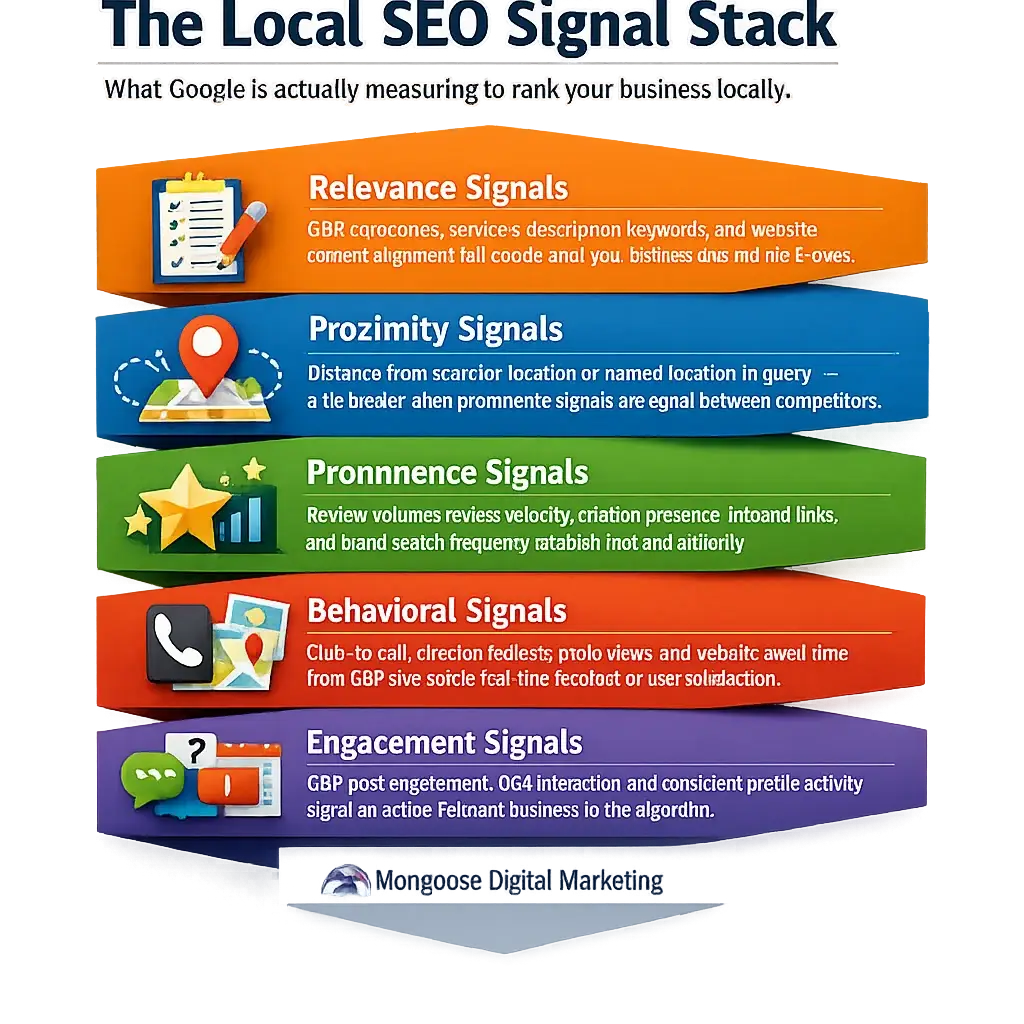
Relevance is how well your business profile matches what a searcher is looking for. It’s shaped by your GBP categories, services listed, keywords present in your business description and posts, and the semantic consistency between your profile and your website content.
Distance is proximity from the searcher’s location or the location named in the query. When someone in Miamisburg searches “auto body shop,” Google weights distance heavily. When someone searches “auto body shop Springboro,” the named location partially overrides the searcher’s physical position.
Prominence reflects how well-known and trusted your business is — online and offline. Review volume, review quality, inbound links, citation presence, and behavioral engagement signals all contribute to prominence.
Where the Interaction Between These Factors Gets Strategically Significant
The critical insight most guides miss: these factors trade off against each other. A highly prominent business — one with strong reviews, significant web authority, and high GBP engagement — can rank in local packs for searches occurring miles outside its physical location. In practical terms, a well-optimized Dayton business with strong prominence signals can appear in Kettering search results and vice versa.
This means that investing in prominence-building activities (review generation, behavioral engagement, local authority link acquisition) has geographic reach — it doesn’t just improve rankings directly in front of your front door.
Conversely, a business with perfect relevance and very close proximity to the searcher can still be outranked by a competitor with stronger prominence signals. Proximity is a tie-breaker when prominence is equal, not a guaranteed advantage.
The Behavioral Signal Layer: The Part Competitors Consistently Skip
Google’s local algorithm is not static between crawls. It incorporates real-time behavioral feedback — and this is the component that separates modern local SEO practitioners from those still operating on 2017 playbooks.
Specific behavioral inputs include:
- Click-through rate from local pack results — if your listing appears but users consistently choose a competitor, that pattern registers as a negative quality signal
- Click-to-call events — phone calls initiated directly from your GBP are a high-intent engagement signal
- Direction requests — users asking Google Maps to route them to your location signals genuine demand
- Website visit duration from GBP clicks — if users click through to your website and immediately leave, the behavioral feedback is negative
- Photo view volume — profiles with higher photo engagement correlate with stronger local pack positions
The strategic implication: a business can improve its local pack position without modifying its website at all, by engineering stronger GBP engagement. Publishing GBP posts that match active local search queries, maintaining a consistent photo update schedule, and proactively building out the Q&A section with keyword-aligned answers creates measurable improvements in these behavioral signals over time.
Businesses that understand this shift stop treating their GBP as a directory listing and start managing it as a live editorial property.
Google Business Profile Optimization: What ‘Complete Profile’ Actually Means in Practice
The standard advice — fill out your hours, add some photos, write a description — is the floor, not the ceiling. Here is where GBP optimization actually gets competitive.
Category Selection as Keyword Targeting
Your primary GBP category is the single most powerful keyword targeting lever available to you without requiring any name manipulation. Most businesses default to a broad primary category and stop there. The secondary categories are where significant competitive opportunity exists.
Secondary GBP categories function as keyword expansion signals. A Dayton landscaping company categorized as “Landscaping Company” in its primary category, and adding “Lawn Care Service,” “Sod Supplier,” and “Irrigation System Store” as secondary categories, is now semantically competing across four distinct keyword clusters simultaneously — each of which maps to different searcher intent.
The competitive intelligence angle: GBP categories are publicly visible. By reviewing the category selections of your direct competitors in the Dayton and surrounding markets, you have a reverse-engineered keyword map showing exactly which categorical keywords they’re targeting — something no keyword research tool can replicate with the same precision.
How to audit competitor GBP categories:
1. Open a competitor’s GBP listing in Google Maps
2. Scroll to the category field visible in the listing details
3. The primary category is always shown; secondary categories may appear in the “About” tab
4. Document all categories across your top five local competitors and identify gaps your profile isn’t covering
GBP Attributes: The Underutilized Relevance Signals
Attributes are business-specific flags available within GBP — things like accessibility features, payment methods accepted, outdoor seating, service options, and health and safety identifiers. These attributes do two things: they improve relevance matching for filtered searches, and they improve click-through rates by giving searchers confidence before they click.
For Dayton-area service businesses, specific attributes worth auditing include: “identifies as veteran-owned,” “offers online appointments,” “wheelchair accessible entrance,” and “LGBTQ+ friendly.” Each of these functions as a filter match signal in relevant searches.
GBP Q&A as a Keyword-Seeding Mechanism
The Q&A section on your GBP is publicly writable — any Google user can post a question, and any other user can answer. Most businesses ignore this section entirely. The practical opportunity: you can seed your own Q&A section with questions that mirror high-value search queries and provide keyword-rich answers.
For example, an HVAC company serving the Beavercreek and Fairborn area might seed questions like “Do you offer emergency furnace repair in Beavercreek?” with a detailed answer that includes service area, response times, and relevant service terminology. This content becomes indexable and functions as additional relevance signal without requiring website changes.
One caution: Google can remove Q&A content it identifies as spam, so questions should read as genuinely useful to prospective customers, not as obvious keyword stuffing. For a deeper breakdown of how to use every section of your profile strategically, see our article on Google Business Profile optimization tips that actually work.
Citation Building: Understanding Diminishing Returns and Topical Relevance
Citation consistency — your business Name, Address, and Phone number matching across all online directories — remains a foundational local SEO requirement. Inconsistencies here create relevance confusion for Google’s entity resolution process and should be resolved before investing in any other tactic.
But here is what the standard guides won’t tell you: citation building exhibits a strong diminishing returns curve.
The Diminishing Returns Reality
Getting your business listed accurately on Google, Bing Places, Apple Maps, Yelp, and the top 20-30 industry directories delivers significant foundational value. Adding your 31st, 50th, or 100th generic directory citation delivers progressively less incremental ranking benefit. At scale, generic citation volume without competitive differentiation is an expensive way to maintain existing positions rather than gain new ones.
The strategy implication for Dayton-area businesses competing in markets like Kettering or Huber Heights: once foundational citations are established and consistent, the next citation investment should be in topical relevance, not volume.
Topical Citation Relevance: Industry-Specific Over Generic
| Citation Type | Example Directories | Signal Value | Best For |
|---|---|---|---|
| Tier 1 Universal | Google Business Profile, Bing Places, Apple Maps, Yelp | Very High | All local businesses |
| Tier 2 Aggregators | Foursquare, Localeze, Data Axle | High | All local businesses |
| Tier 3 Industry-Specific | Houzz (home services), Healthgrades (healthcare), Avvo (legal), CarGurus (automotive) | High to Very High | Vertical-specific businesses |
| Tier 4 Regional/Local | Dayton Business Journal, local chamber directories, regional news site business listings | High | All Dayton-area businesses |
| Tier 5 Generic Aggregators | Dozens of low-authority directory sites | Low and diminishing | Minimal incremental value after foundational set |
The shift in strategy: for an established Centerville HVAC company, earning a citation on ACCA (Air Conditioning Contractors of America) or PHCC directory carries more topical relevance weight than adding a 40th generic directory listing. Google’s entity understanding increasingly rewards industry-specific associations as relevance confirmation signals.
Review Strategy: Velocity, Recency, and the Signals Most Businesses Ignore
Reviews are the component of local SEO where almost every business owner understands the surface-level importance but misses the signal architecture underneath.
Review Velocity vs. Review Volume
Total review count is a prominence signal, but it is a lagging indicator. What carries real-time weight in local rankings is review velocity — the rate at which new reviews are arriving.
A Springboro restaurant with 300 reviews accumulated over six years but no new reviews in the past four months will frequently be outranked in the Local Pack by a newer competitor with 60 reviews — if that competitor has received 20 of those reviews in the last 90 days. Google’s algorithm treats recent review activity as a signal of ongoing business health and current customer satisfaction.
The operational implication: review generation cannot be a campaign you run once. It requires a consistent, systematized process integrated into your regular customer interactions. For Dayton-area businesses, this means building review requests into post-service workflows, point-of-sale interactions, and follow-up email sequences — not as a one-time push.
Review Response as a Relevance Signal
Responding to reviews — both positive and negative — creates keyword-rich text adjacent to your listing. Responses allow you to naturally include service area references (“We’re glad we could help with your kitchen remodel here in Miamisburg”), service terminology, and business attributes in a format that reads as authentic customer dialogue rather than keyword insertion.
What to Do About Negative Reviews
Negative reviews handled well can be more valuable than positive reviews ignored. A professional, solution-oriented response to a negative review signals to both Google and prospective customers that the business is actively managed and accountable. Avoid defensive language; focus on resolution and demonstrate customer service investment.
Local Landing Page Architecture: The Intent Mismatch Problem
Location-specific landing pages are standard local SEO practice. The execution failure is pervasive, and it is silently destroying ranking performance for businesses across the Dayton metro area.
The Intent Mismatch Failure Mode
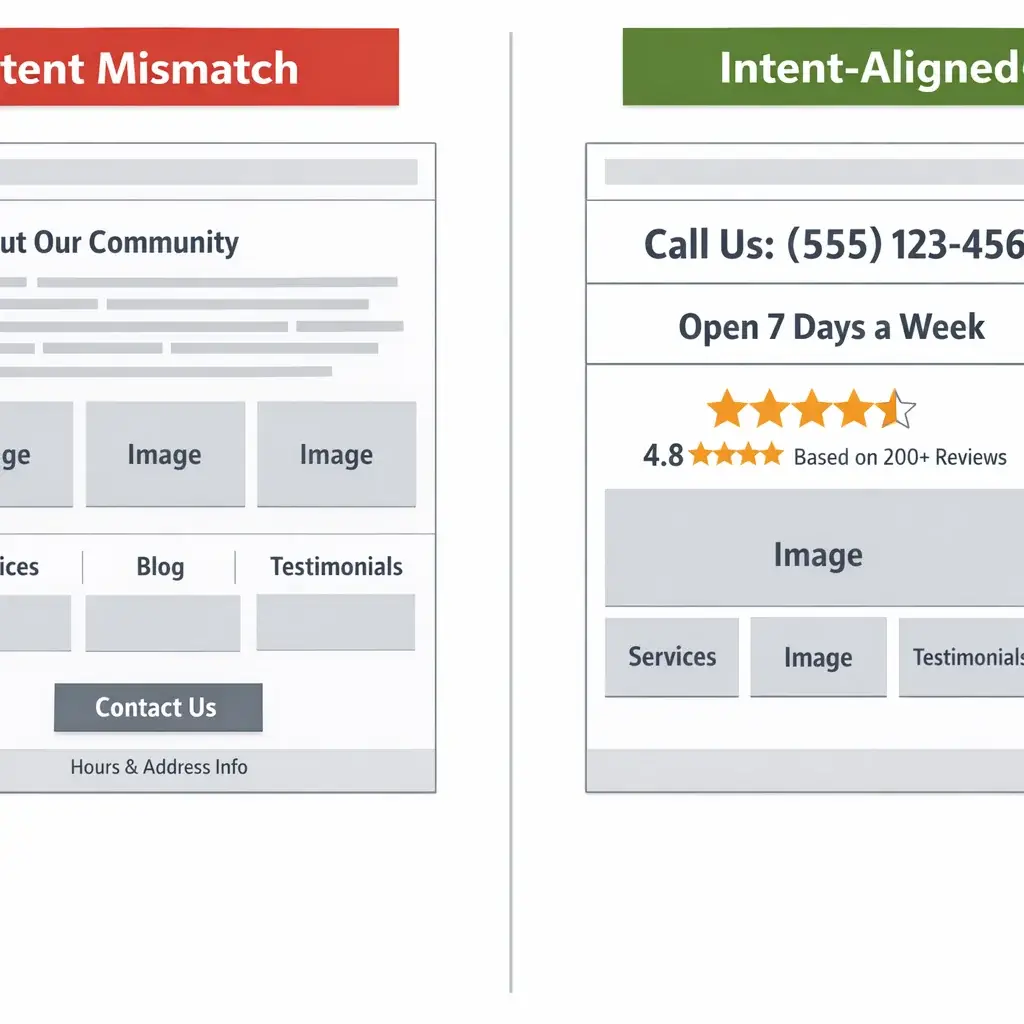
Here is the problem: most local landing pages are built for informational awareness intent (“Let us tell you about our Dayton location”) when the searcher arriving via the target keyword has transactional or navigational intent.
Consider a Dayton-area plumbing company targeting “emergency plumber Kettering OH.” A searcher using that query has acute transactional intent — they have a crisis, they need a phone number, and they need it within seconds. A landing page that opens with a paragraph about the company’s history serving the Kettering community, followed by service overviews and team bios, creates a severe intent mismatch. Google’s behavioral signals — high bounce rate, short dwell time, immediate back-navigation — register this mismatch and suppress the page.
A landing page correctly architected for transactional intent leads with the phone number, service availability (24/7 emergency response, for example), and an immediate action prompt. The community narrative and trust-building content exists further down the page, serving the minority of visitors who need that reassurance before calling.
Intent Segmentation Framework for Local Keywords
Not all local keywords carry the same intent, and each requires a different page architecture:
Transactional intent keywords (“emergency HVAC repair Dayton,” “same-day plumber Beavercreek”):
– Lead with contact information and availability
– Surface proof elements (reviews, response time guarantees, licensing) immediately
– Conversion action should be above the fold
– Narrative content secondary
Navigational intent keywords (“Mongoose Digital Marketing Dayton,” “[Business Name] Kettering location”):
– Lead with address, hours, and contact details
– Include Google Maps embed
– Clear identification of the specific location
– NAP consistency with GBP is critical
Informational intent keywords (“how to choose an HVAC company in Dayton,” “best neighborhoods in Centerville for families”):
– Lead with substantive answer to the implicit question
– Conversion elements present but not dominant
– Internal linking to service pages appropriate
– Longer-form content format
Mapping your target keywords to their dominant intent cluster before writing the landing page architecture is not optional — it is the difference between local pages that rank and convert and local pages that technically exist but underperform. If your pages are struggling to convert the traffic they do receive, the article on conversion optimization covers the broader CRO principles that apply directly to this problem.
The Local Pack vs. Organic Rankings: Two Separate Problems
This distinction is foundational, yet almost entirely absent from standard local SEO content. Knowing it changes how you allocate strategy effort.
The Local Pack (the map with three business listings that appears at the top of local search results) is governed primarily by Google’s local algorithm, which weighs GBP optimization, reviews, citations, proximity, and behavioral signals.
Traditional organic rankings (the standard blue-link results that appear below the Local Pack) are governed by Google’s core web search algorithm, which weighs on-page content quality, technical SEO, inbound link authority, E-E-A-T signals, and content depth.
These are separate systems. You can rank #1 in traditional organic results for a local keyword while being completely absent from the Local Pack for the same query. This happens frequently — and it happens because the business has invested heavily in content and technical SEO but has an underdeveloped GBP, thin review history, or weak behavioral signals.
The strategic implication: if your Dayton-area business is visible in organic but not appearing in the Local Pack, the solution is not more content or backlinks. It’s GBP engagement, review velocity, and citation quality. Conversely, if you’re in the Local Pack but not ranking in organic results, that’s a content and technical SEO problem, not a GBP problem.
Auditing which of these two positions you currently occupy — and what your specific gap is — is the correct starting point for any local SEO investment. Without that diagnosis, effort gets applied to the wrong channel. Our article on local SEO in Dayton and how Google rankings work goes deeper on how these two systems interact in practice for Miami Valley businesses.
Multi-Location Businesses: Managing Cannibalization Risk
For businesses with multiple locations across the Dayton metro — a dental group with offices in Kettering, Beavercreek, and Centerville, for example — there is a distinct risk that competitors’ guides never address: internal local SEO cannibalization.
Cannibalization occurs when two of your own business locations compete against each other for the same Local Pack position. In a three-result Local Pack, having two of your own locations appear means one of your locations is displacing a slot that could otherwise be captured by a competitor — but you’re also fighting yourself for click share, diluting the behavioral signal strength of both listings.
Managing multi-location local SEO requires:
- Distinct GBP profiles per location, each fully optimized with location-specific content
- Unique landing pages per location that are geographically differentiated in content, not just NAP-swapped templates
- Service area boundary definition within GBP to reduce geographic overlap between nearby locations
- Review generation strategies targeted at each specific location’s customer base, not consolidated to a single profile
Multi-location strategy is one of the more nuanced components of local SEO — and one that benefits significantly from structured audit work before expansion rather than after competing locations have already established conflicting signals.
Local SEO in the Age of AI Search: A Different Selection Mechanism
AI-generated search responses — whether through Google’s AI Overviews, ChatGPT, or other large language model interfaces — select local businesses through a fundamentally different mechanism than traditional ranked lists.
Traditional local SEO positions your business in ranked order. AI responses synthesize information and cite businesses based on their prominence across the broader web, the quality and depth of information available about them, and the semantic relevance of that information to the query.
For Dayton-area businesses, this means that being mentioned in local press coverage, regional industry publications, local business association sites, and community-relevant content carries disproportionate weight in AI citation decisions compared to traditional ranking factors. A business that is well-documented across authoritative web sources — not just well-optimized in GBP — is more likely to appear in AI-generated recommendations.
The practical strategy: earning genuine local mentions through community involvement, local PR, and industry association participation is not soft marketing. It is directly building the citation authority that AI systems use to determine which local businesses are worth recommending.
What Pulls Local SEO Together: A Prioritized Action Framework
Given the full signal stack described above, here is how to think about prioritization for Dayton-area businesses at different maturity levels:
Foundation Phase (Month 1-2):
– Claim and fully complete GBP with accurate NAP, primary and secondary categories, services, attributes, and description
– Establish Tier 1 and Tier 2 citations and audit for NAP consistency across existing listings
– Build location-specific landing pages with intent-aligned architecture
Engagement Phase (Month 2-4):
– Implement systematic review generation process targeting velocity, not just volume
– Begin GBP post publishing cadence (minimum twice monthly, ideally weekly)
– Seed Q&A section with keyword-aligned questions and answers
– Respond to all existing reviews with substantive, location-aware responses
Authority Phase (Month 4+):
– Pursue Tier 3 and Tier 4 topical citation opportunities in relevant industry and regional directories
– Build local content assets targeting informational intent keywords to capture mid-funnel local search traffic
– Develop local link acquisition strategy targeting regional publications, chamber directories, and community platforms
– Monitor behavioral signal performance through GBP Insights and adjust content strategy accordingly
Local SEO optimization, done at this level of specificity, is not a commodity service or a set-and-forget task. It’s an ongoing operational discipline that directly determines how often your Dayton-area business is the answer customers find when they’re ready to spend money. The businesses winning in Kettering, Centerville, and Huber Heights right now aren’t just running better ads — they’ve built a more deliberate local search presence, one behavioral signal at a time.
If you want to understand exactly where your current local search presence stands and what the highest-leverage improvements would be for your specific market and category, that’s the conversation we start with a free consultation.
Strategic Recommendations for 2026
As local search algorithms continue to evolve and AI-generated results reshape how Google surfaces businesses, the tactics that separate visible local brands from invisible ones are becoming more technical — and more behavioral. Here are three specific moves Dayton-area businesses should prioritize heading into 2026:
1. Invest in GBP Performance Monitoring with BrightLocal or Whitespark
Manual auditing of your Google Business Profile and citation ecosystem doesn’t scale, and gaps compound quietly over time. Tools like BrightLocal and Whitespark provide automated rank tracking at the zip-code level, citation auditing across hundreds of directories, and reputation monitoring across review platforms — giving you the signal clarity needed to make fast, informed decisions rather than reactive ones.
2. Integrate Conversational and AI Search Optimization into Your Local Content Strategy
With Google’s AI Overviews increasingly appearing above traditional local pack results, your location pages and blog content need to be structured to answer specific, intent-driven questions the way a knowledgeable local business owner would answer them. This means expanding FAQ-style content, using clear entity associations (neighborhood names, local landmarks, regional service context), and ensuring your GBP and website content are mutually reinforcing for the same core queries.
3. Build a First-Party Review Acquisition System — Not a One-Time Campaign
The businesses gaining ground in Centerville, Beavercreek, and Kettering aren’t generating reviews in bursts. They’ve built repeatable systems: post-service email or SMS sequences, in-person tablet-based prompts, and staff training that makes asking for reviews a standard part of the customer interaction — not an afterthought. In 2026, review velocity and sentiment diversity will matter more than raw star ratings alone.
Frequently Asked Questions
How long does it take to see results from local SEO in the Dayton area?
Most businesses begin seeing measurable movement in local pack rankings within 60 to 90 days of implementing foundational improvements — particularly GBP completion, citation consistency, and early review velocity. More competitive categories like legal, medical, or home services in markets like Beavercreek and Kettering may take four to six months before meaningful ranking shifts stabilize. Local SEO is cumulative, meaning the authority and signal consistency you build in the early months compounds over time rather than plateauing.
What is the most important factor in local SEO ranking for small businesses?
There is no single dominant factor, but Google Business Profile optimization consistently produces the fastest and most measurable lift for small businesses starting from a weak local search position. Accurate and complete NAP information, a fully built-out services section, consistent review generation, and active GBP posting all contribute to the proximity, relevance, and prominence signals Google uses to rank local results. For businesses in competitive Dayton suburbs, layering in citation authority and behavioral signals — like click-to-call rates and direction requests — is what separates good rankings from dominant ones.
Do I need a separate landing page for each city or suburb I serve?
Yes, if you want to rank organically in those specific markets. A single generic service page does not give Google the geographic and contextual signals it needs to associate your business with searches happening in Centerville, Huber Heights, or other Dayton-area communities you serve but don’t have a physical address in. Effective service-area landing pages are not thin duplicates — they include locally relevant content, specific service context for that area, and are built around the actual search intent of residents in that location.
Can I do local SEO myself, or do I need an agency?
Many foundational local SEO tasks — claiming your GBP, auditing citations, requesting reviews — are manageable independently, especially for single-location businesses with limited competition. However, the ongoing optimization work — monitoring behavioral signals, building a content strategy around local intent, acquiring local backlinks, and adapting to algorithm changes — requires consistent time, technical knowledge, and strategic prioritization that most business owners cannot sustain alongside running their operations. Partnering with a local agency that understands the Dayton market specifically means your strategy reflects what’s actually working in your category and geography, not generic best practices.
Conclusion
Mongoose Digital Marketing has spent years developing deep familiarity with how local search actually performs across Dayton, Kettering, Beavercreek, and the surrounding communities — not as a national agency applying a template, but as a local partner invested in the specific competitive dynamics of this market. If your business serves customers in Centerville or anywhere across the Miami Valley and you’re not consistently appearing when they search, there’s a fixable reason for it. Start with an honest assessment of where you stand: Get a Free Estimate.