

Key Takeaways
- Dayton’s economy operates as two distinct layers — a B2G/B2B defense and aerospace sector anchored by Wright-Patterson AFB and a consumer services market serving 800,000+ Miami Valley residents — and each requires a structurally different digital marketing approach.
- The historically lower cost-per-click environment in Dayton’s paid search auctions has been compressed by national franchise brands and private equity-backed regional players, making 2022-era PPC strategies increasingly ineffective for local independent businesses.
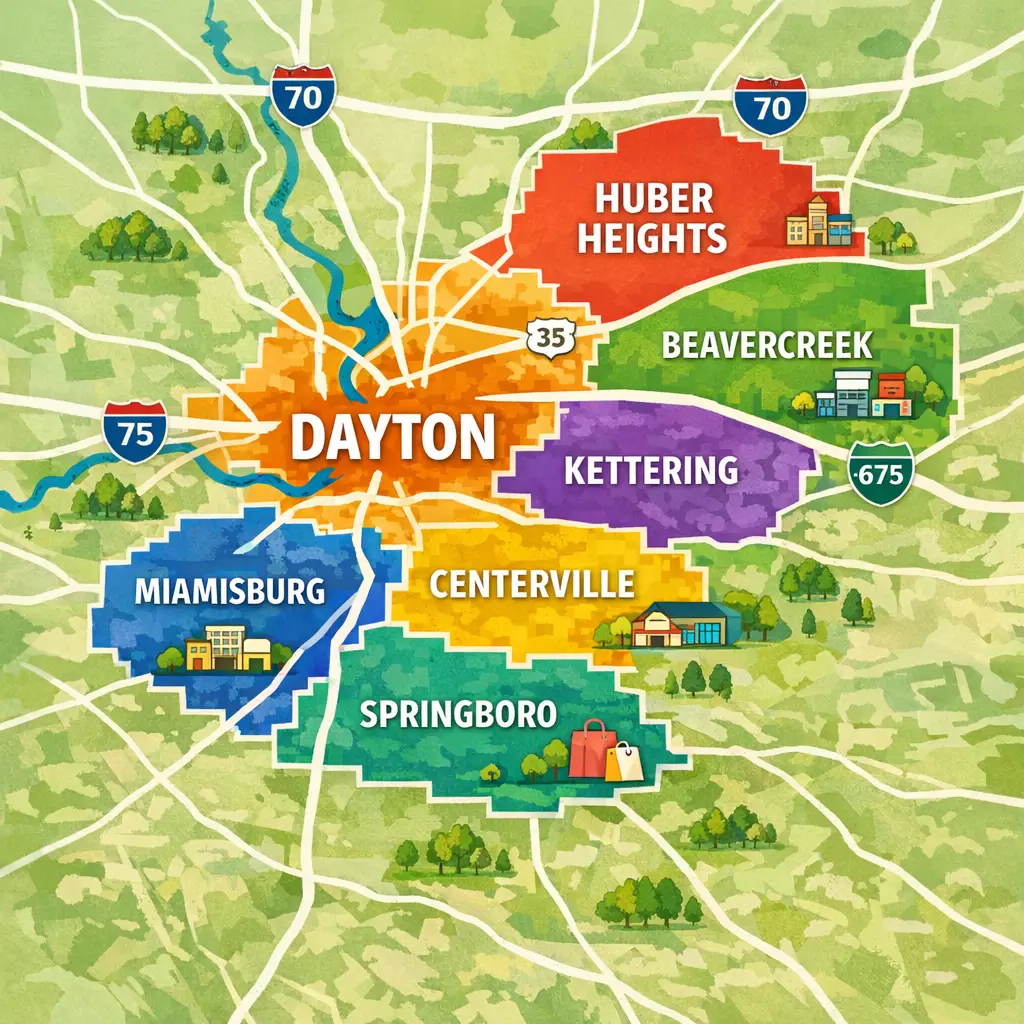
- Ranking for “Dayton” as a single geographic target is strategically incomplete; Google’s local algorithm increasingly rewards hyper-proximate authority, meaning suburb-level optimization across Kettering, Beavercreek, Centerville, Huber Heights, Miamisburg, and Springboro is now essential.
- Google’s AI Overviews are reshaping local search behavior for high-consideration service purchases, requiring Dayton businesses to invest in entity optimization and structured data — not just traditional keyword rankings.
- Multi-touch attribution, not lead volume alone, is the metric that separates businesses that scale digital marketing from those that stall — and most Dayton competitors are not tracking it correctly.
Most digital marketing content written for the Dayton, Ohio market makes the same fundamental mistake: it treats Dayton as a generic mid-sized Midwest city and applies an off-the-shelf playbook accordingly. List the services. Promise results. Mention “The Gem City” once for local flavor. Done.
That approach fails Dayton businesses — not because the tactics are wrong in theory, but because they’re being applied without any real understanding of how this market actually works. The Miami Valley’s economic structure, its geographic fragmentation across distinct suburban markets, and its competitive landscape by vertical are all factors that should be driving strategic decisions before a single ad is placed or a single page is optimized.
This guide was written to fill that gap. Whether you run a defense-adjacent engineering firm in Moraine, a medical practice in Beavercreek, a home services company in Centerville, or a B2B manufacturer in the Dayton metro, the strategic context here is specific to what’s actually happening in this market in 2025 — not what worked somewhere else three years ago.
Dayton’s Dual Economy: Why One Digital Strategy Can’t Serve Both Worlds
Before allocating a single dollar toward digital marketing, Dayton business owners need to understand something that no competitor in this space will tell you: Dayton is not one market. It’s two, operating simultaneously and requiring fundamentally different approaches.
The B2G and Defense Economy
Wright-Patterson Air Force Base is the largest single-site employer in Ohio, and its economic gravity extends far beyond the base perimeter. Engineering firms, IT integrators, defense subcontractors, staffing companies, and logistics providers throughout the Dayton metro are selling into a procurement-driven economy governed by acquisition cycles, NAICS codes, and contracting vehicles — not consumer impulse or seasonal demand.
For these businesses, the standard consumer digital marketing playbook is actively counterproductive. Facebook retargeting campaigns don’t influence a procurement officer. Weekly blog posts on general topics don’t establish the technical authority that defense primes and government contracting officers evaluate. A landing page optimized for emotional conversion copy is the wrong tool when your buyer is a program manager evaluating capability statements.
What these businesses actually need:
- LinkedIn authority content — Technical thought leadership targeting program managers, contracting officers, and engineering leads by job title and agency affiliation
- Long-cycle content strategy — White papers, capability briefs, and technical case studies that support a 6-to-18-month sales cycle
- GSA-aware positioning — Website content and credentialing that reflects contract vehicles and clearance-relevant language
- Search intent alignment — Targeting searches that reflect procurement research behavior, not consumer need-state language
The Consumer Services Economy
Layered on top of the defense and aerospace economy is a robust local consumer market serving the 800,000+ residents of the Miami Valley. Home services, healthcare, legal, restaurant, retail, and professional services businesses are competing for the attention of homeowners in Centerville, families in Huber Heights, patients in Beavercreek, and residents throughout the Dayton metro.
This economy runs on urgency, proximity, and trust signals. A homeowner with a broken furnace in Kettering isn’t evaluating capability statements — they’re scanning Google Local Pack results, checking star ratings, and clicking the first credible option they see. The buying cycle is hours, not months.
For consumer-facing Dayton businesses, the right digital infrastructure looks entirely different:
- Google Business Profile optimization with accurate service area definitions covering relevant suburbs
- Review velocity and recency — consistent acquisition of Google reviews from geographically proximate customers
- Local landing page architecture — individual suburb-specific pages for Kettering, Beavercreek, Centerville, Huber Heights, Miamisburg, and Springboro rather than a single generic Dayton page
- Google Local Services Ads and paid search calibrated to neighborhood-level intent signals
- Mobile-first conversion design — because most local service searches happen on a phone, often in an emergency context
Why This Distinction Changes Everything
The expert-level failure mode for Dayton businesses is applying the wrong strategy to the wrong economy. A defense subcontractor running Facebook lead generation campaigns is wasting budget chasing the wrong buyer. A plumbing company in Centerville investing in technical white papers and LinkedIn content is optimizing for a buying journey that doesn’t exist in their category.
Identifying which economy — or which combination of both — your business operates in is the mandatory first step. Everything downstream from that decision, including channel selection, content format, conversion architecture, and measurement framework, follows from getting that answer right.

The Dayton PPC Landscape in 2025: A Window That’s Closing
Dayton’s paid search environment has historically been kinder to local businesses than Ohio’s larger metros. Columbus, Cleveland, and Cincinnati have long attracted more aggressive bidding from national brands, regional chains, and well-funded competitors — which drove up cost-per-click across high-value verticals. Dayton, by contrast, offered local businesses a lower-competition window where modest budgets could generate meaningful lead volume.
That window is narrowing, and businesses operating on a pre-2023 PPC strategy are likely experiencing it firsthand without fully understanding why.
What Changed in Dayton’s PPC Auctions
National franchise brands and private equity-backed regional players have systematically entered Dayton’s paid search auctions over the past two years. This movement is most pronounced in three sectors:
- Home services — HVAC, roofing, plumbing, and electrical categories are now seeing aggressive bidding from regional rollup companies and national franchise operations with eight-figure marketing budgets
- Healthcare and medical — Telehealth platforms, regional health system expansions, and multi-location specialty practices are competing directly against independent Dayton providers
- Legal — Personal injury, family law, and criminal defense categories in Dayton were already competitive; they’ve now reached a level of auction aggression that rivals Columbus
The practical effect is straightforward: keywords that once generated leads at a manageable cost are now delivering the same leads at significantly higher expense, without a corresponding increase in close rate or customer lifetime value. For a local business that hasn’t recalibrated its bidding strategy, campaign structure, or quality score optimization in the past 18 months, the numbers are quietly degrading.
Where Asymmetric Opportunity Still Exists
The smart response to a compressed top-of-market isn’t to exit paid search — it’s to find the geographic and intent-based pockets where national competitors aren’t bidding effectively. And in Dayton, those pockets are real.
National franchise brands optimize for metro-level keyword terms. Their campaign structures rarely account for the granular geographic nuance of a market like Dayton, where a resident in Springboro and a resident in Huber Heights have meaningfully different commercial contexts despite being in the same metro area.
The opportunity for locally-rooted businesses lives in:
- Suburb-specific keyword targeting — “HVAC repair Kettering OH,” “emergency plumber Beavercreek,” “roofing company Centerville Ohio” often carry lower competition and higher conversion intent than generic Dayton-level terms
- Long-tail service queries — Highly specific searches combining service type, neighborhood, and urgency signal (“same-day water heater replacement Miamisburg”) attract buyers with high purchase intent and lower national advertiser presence
- Google Local Services Ads (LSA) — This format surfaces above traditional paid search results and rewards verified local businesses. National brands frequently underinvest in LSA optimization because it requires local verification infrastructure they can’t easily scale
For Dayton businesses navigating these shifts, understanding how PPC and SEO work together to grow your business is increasingly important — the businesses capturing the most leads aren’t relying on either channel in isolation.
Diagnosing a Stale PPC Strategy
The following table outlines the key indicators that a Dayton business’s paid search strategy needs a structural overhaul versus minor optimization:
| Indicator | Minor Optimization Needed | Structural Overhaul Required |
|---|---|---|
| Cost per lead trend | Stable or marginal increase | Consistent increase over 12+ months |
| Keyword targeting level | Mix of broad and specific terms | Primarily broad or city-level terms only |
| Geographic targeting | Suburb-level bid adjustments active | Single metro radius with flat bids |
| Ad group structure | Tightly themed, 5–15 keywords each | Broad match-heavy, 30+ keywords per group |
| Landing page alignment | Dedicated pages per campaign theme | All traffic to homepage or generic contact page |
| LSA presence | Active, verified, and optimized | Not running or unverified |
| Competitor monitoring | Regular auction insight review | No systematic competitor tracking |
| Conversion tracking | Call tracking + form + offline import | Form fills only or no tracking |
If your current campaigns sit consistently in the right column of this table, you’re not dealing with a bidding problem — you’re dealing with a structural problem that bid adjustments alone won’t fix.
Local SEO in Dayton: Why the Suburb Is the Real Battlefield
Ranking for “Dayton” as a geographic keyword is an incomplete goal. Not wrong — incomplete. And in 2025, that incompleteness is expensive.
Google’s local search algorithm has become increasingly aggressive about serving hyper-proximate results. When someone in Beavercreek searches for a service provider, Google’s systems weigh geographic proximity heavily in determining what appears in the Local Pack — the three-result map block that captures the majority of local service clicks. A business physically located in Miamisburg, regardless of its domain authority or review count, faces a structural disadvantage for searches originating from Huber Heights.
This isn’t a peripheral issue. For most local service businesses, the Local Pack is the primary source of inbound calls and website visits. Losing that real estate in key suburbs means losing revenue, regardless of how well the rest of the digital strategy performs.
The Geographic Structure That Makes Dayton Unique
The Dayton metro’s commercial geography is unusually fragmented for a market its size. Unlike Columbus, which radiates outward from a dense urban core, Dayton’s commercial activity is distributed across a constellation of semi-independent suburban nodes, each with its own commercial identity and search behavior:
- Kettering — Dense residential base with strong demand for home services, healthcare, and professional services; one of the highest-search-volume suburban markets in the metro
- Beavercreek — High-income demographic with significant Wright-Patterson proximity; strong demand for premium services and defense-adjacent professional services
- Centerville — Affluent residential market with active home improvement, legal, and medical search volume
- Huber Heights — Large working-class residential population with high demand for home services and automotive; often overlooked by digital strategies focused on southern suburbs
- Miamisburg — Growing commercial corridor with industrial and light manufacturing presence alongside consumer services demand
- Springboro — Rapidly growing suburb with above-average household income and active demand across home services, medical, and professional categories
A business serving all six of these markets with a single “Dayton, OH” Google Business Profile service area and one generic web page is functionally invisible in multiple of them, regardless of how strong its overall domain authority appears.
Building Suburb-Level Local Authority
Closing this gap requires a systematic approach across three areas:
Google Business Profile Architecture
Your GBP service area settings need to explicitly include each suburb you legitimately serve. Category selection matters: Google allows a primary category and multiple secondary categories, and the specificity of your selections directly influences which search queries trigger your listing. A roofing company that lists only “roofing contractor” as its category is missing the adjacent searches that drive volume in competitive suburbs.
Local Landing Page Strategy
Each primary suburb in your service area warrants its own dedicated landing page. Not a thin, template-filled page with the city name swapped in — a substantive page that reflects genuine local context: the neighborhoods you serve within that suburb, specific services relevant to that area’s housing stock or demographics, and local trust signals like associations, permits, or project examples in that community.
The Google Search Central documentation on local SEO makes clear that content relevance and geographic specificity are core signals in local ranking evaluation.
Review Acquisition Strategy by Geography
This is the element most businesses miss entirely. Google’s local algorithm weights the geographic proximity of reviewers to your business location as a signal of local relevance. A roofing company in Centerville with 200 reviews, most of which come from Centerville and Kettering customers, has stronger suburb-level authority in those markets than a competitor with 300 reviews distributed randomly across the metro.
This has direct implications for how you ask for reviews. A systematic review request process that targets customers in specific suburbs — and tracks geographic distribution of your review base — builds a more defensible local SEO position than generic review solicitation. The Google Business Profile optimization tips that actually work article covers the full mechanics of profile setup, category selection, and review strategy in detail.
AI Search, Google’s Overviews, and What Dayton Businesses Need to Know Now
The conversation about digital marketing in Dayton can’t stay anchored in 2022 strategy frameworks when the search environment has changed materially. Google’s AI Overviews — the AI-generated answer blocks that now appear at the top of results for a growing share of local service queries — are reshaping how clicks are distributed, and most local businesses aren’t prepared for it.
How AI Overviews Affect Local Search Behavior
AI Overviews synthesize information from multiple sources and present a summarized answer directly on the search results page. For informational queries, this has been the most disruptive development in search in years — high-ranking content that once captured clicks is now being summarized without the click ever happening.
For local service searches, the dynamic is more nuanced but still consequential. AI Overviews for queries like “best HVAC company in Kettering OH” or “how to find a contractor in Beavercreek” are pulling from sources that Google’s systems have determined to be authoritative, accurate, and well-structured. Businesses that appear as sources within these AI-generated responses gain brand exposure and implied third-party endorsement — even when the user doesn’t click through.
Businesses that don’t appear in AI Overview sources are structurally disadvantaged in a way that traditional rank tracking doesn’t capture, because traditional rank tracking doesn’t measure AI Overview presence at all.
What Influences AI Overview Inclusion
The Google AI Overview documentation confirms that AI-generated responses draw from sources Google considers highly relevant, trustworthy, and well-structured. For local Dayton businesses, the practical implications are:
Entity optimization — Your business needs to exist as a clearly defined, consistent entity across Google’s knowledge graph. This means NAP (name, address, phone) consistency across all directories, a fully completed and regularly updated Google Business Profile, and website content that explicitly identifies your business’s location, service area, categories, and specializations.
Structured data markup — Schema.org markup for local businesses, services, and reviews gives Google’s systems the structured signals they need to confidently include your business in AI-generated responses. A website without structured data is a harder source for AI systems to parse accurately.
Content authority by topic — AI Overviews favor sources that demonstrate genuine depth on a topic, not just keyword density. A roofing company that has substantive content about Dayton’s climate-specific roofing challenges (freeze-thaw cycles, ice dam formation in flat-roof commercial properties, hail event recovery) is a more credible source for AI synthesis than one with thin service pages.
Review signals across platforms — AI systems aggregate reputation signals. Consistent positive reviews across Google, Yelp, and industry-specific platforms reinforce your business’s credibility as a source Google can confidently cite.
Zero-Click Behavior and What Replaces It
As AI Overviews increase zero-click search rates for informational queries, the traffic that does reach your website is increasingly pre-qualified. Users who click through from an AI Overview or from results below it have already seen a summary of the topic — they’re not arriving cold, they’re arriving with intent that’s been shaped by the AI response.
This means conversion architecture matters more, not less. A website visitor arriving in 2025 has often already formed an initial impression of your business before they land on your page. The job of your website is to confirm that impression and convert, not to introduce your business from scratch.
For Dayton businesses, this reinforces a point that most competitor content completely ignores: what happens after the click is as strategically important as what earns the click in the first place. The local SEO for Ohio service businesses that actually works article goes deeper on building the kind of local authority that surfaces in both traditional results and AI-generated responses.
The Attribution Gap: Why Most Dayton Businesses Don’t Know What’s Actually Working
Digital marketing accountability has a consistent weak point, and it’s the same across Dayton’s competitive landscape: most businesses track activity metrics, not outcome metrics — and most can’t accurately trace which marketing touchpoints produced which customers.
This isn’t a minor operational detail. It’s the difference between scaling what works and continuously funding what doesn’t.
The Typical Dayton Service Business Buyer Journey
Consider a homeowner in Centerville looking for a roofing contractor after a spring hail event:
- They see a Facebook ad from a local roofing company three days after the storm
- They don’t click, but the brand name registers
- Two days later, they search “roof inspection Centerville OH” on Google
- They see three Local Pack results and click on the second one — a company they don’t recognize
- They visit the website, don’t fill out a form, but save the phone number
- A week later, they recall the Facebook ad brand, search for it by name, and call directly from the Google Business Profile listing
Which channel gets credit for this customer? Under most basic tracking setups, the answer is “direct” or “organic branded search” — and the Facebook ad that initiated brand awareness receives zero attribution. The roofing company continues underfunding Facebook because the data says it’s not working, when in reality it was the first touchpoint in a conversion that eventually closed.
This multi-touch reality is standard behavior for Dayton’s service businesses across home services, medical, legal, and professional service categories — anywhere the purchase involves any degree of consideration and trust evaluation before commitment.
Building a Measurement Framework That Reflects Reality
An attribution model that serves Dayton service businesses well combines several components that most competitors never discuss:
Call tracking with source attribution — Dynamic number insertion assigns unique phone numbers to different traffic sources, allowing you to trace which campaigns and which channels are generating inbound calls. For service businesses where the majority of conversions happen by phone, operating without call tracking is operating blind.
UTM parameter discipline — Consistent UTM tagging across all campaign traffic ensures that form fills and web conversions are attributed to the correct source, medium, and campaign in your analytics platform rather than pooling into the catch-all “direct” bucket.
CRM-to-campaign linkage — If your sales team is closing customers in a CRM, that closed-won data needs a path back to the originating marketing campaign. Without this linkage, you’re measuring leads — not customers — and the difference between lead volume and revenue is where most marketing decisions go wrong.
Offline conversion import — For businesses with in-person sales processes or phone-close models, importing offline conversion data into Google Ads and Meta’s ad platforms allows their algorithms to optimize toward customers, not just form completions.
Revenue by channel reporting — The terminal metric for any Dayton business investing in digital marketing isn’t traffic, impressions, or even leads. It’s revenue attributable to each channel, adjusted for customer acquisition cost and lifetime value. Building toward this metric takes time and infrastructure, but it’s the only measurement framework that produces confident, defensible budget decisions.
The businesses in Dayton that are scaling their digital marketing effectively aren’t the ones with the highest traffic numbers. They’re the ones that know, with reasonable confidence, which channels are producing customers at a return that justifies continued investment — and which channels are consuming budget without contributing to growth.
That knowledge doesn’t come from a dashboard. It comes from building the right measurement infrastructure before the campaigns launch.
Strategic Recommendations for 2026
The Dayton market is shifting fast enough that strategies built on last year’s assumptions will underperform before the year is out. Three specific moves are worth prioritizing as you head into 2026.
1. Invest in a Unified Local Data Layer
Tools like CallRail combined with a properly configured Google Analytics 4 property and a CRM connector — whether that’s HubSpot, Jobber, or ServiceTitan depending on your industry — give Dayton businesses the closed-loop measurement system described throughout this article. The configuration work is a one-time lift that pays compounding returns as campaign data accumulates. If your current stack can’t connect a closed customer back to the Google Ads keyword that started the journey, fixing that gap is the highest-leverage move you can make before increasing any channel spend.
2. Build a Dayton-Specific Content Authority Program
Google’s continued emphasis on helpful, locally relevant content means that businesses willing to produce genuinely useful material about their service area will outperform those relying on thin location pages. This means publishing content that answers the actual questions Dayton, Kettering, Beavercreek, and Centerville residents are asking — not generic industry content with a city name swapped in. Tools like Semrush or Ahrefs can surface the specific search queries your local audience is using so your content investment targets real demand rather than assumed demand.
3. Prioritize First-Party Data Capture
As third-party cookie deprecation continues and ad platforms reduce visibility into audience behavior, the businesses with proprietary first-party data — email lists, SMS subscribers, CRM-segmented customer profiles — will maintain targeting precision that competitors without that infrastructure will lose. Email marketing platforms like Klaviyo or ActiveCampaign, combined with intentional list-building through your website and paid campaigns, are the hedge against increasing platform dependency. For Dayton service businesses, a well-maintained customer email list is a durable asset that no algorithm change can take away.
Frequently Asked Questions
How long does it take for digital marketing to produce results in the Dayton market?
The timeline depends on the channel and your starting point. Paid search campaigns through Google Ads can generate qualified traffic and leads within days of launch, making them useful for businesses that need near-term results. SEO is a longer play — meaningful organic ranking improvements in competitive Dayton service categories typically take several months of consistent effort, though less competitive niches can see movement sooner. Social media advertising falls somewhere in between. Businesses that see the strongest long-term results are usually those running paid campaigns to generate immediate leads while simultaneously building organic visibility for sustained growth.
What makes digital marketing in Dayton different from national or generic campaigns?
Dayton has a distinct geography, a specific set of competing businesses, and a local audience with identifiable search behaviors. Generic campaigns built on national templates tend to miss the neighborhood-level specificity that local searchers respond to — things like service area callouts for Kettering, Beavercreek, or Centerville, references to local landmarks, and ad copy that speaks to the concerns of this particular market rather than a national average consumer. Campaigns built around Dayton’s actual search demand and competitive landscape consistently outperform campaigns that treat it as an interchangeable metro area.
Do small and mid-sized Dayton businesses really need a full digital marketing strategy, or is one channel enough?
For businesses with very narrow service offerings and limited competition, a single well-executed channel can be sufficient. But most Dayton businesses operate in categories with meaningful local competition, which means relying on a single channel creates fragility — if that channel’s performance dips due to algorithm changes, increased competition, or platform shifts, there’s nothing to absorb the impact. A multi-channel approach where paid search handles immediate demand, SEO builds long-term visibility, and email or social marketing supports retention gives businesses a more stable and predictable growth foundation.
How do I know if my current digital marketing is actually working?
The clearest signal is whether you can trace specific revenue — not just leads or traffic — back to specific channels and campaigns. If your current reporting stops at clicks, impressions, or even form fills without connecting those events to actual customers and closed revenue, you’re missing the measurement layer that makes confident budget decisions possible. A practical starting point is auditing whether your phone calls are tracked and attributed, whether your form submissions are tagged with source data, and whether your CRM records contain enough information to identify which marketing activity initiated each customer relationship.
Conclusion
Dayton businesses that are serious about growth deserve a digital marketing partner who understands this market at a street level — not a remote agency that swaps a city name into a templated playbook. Mongoose Digital Marketing proudly serves Dayton, Kettering, Beavercreek, and Centerville with SEO, paid advertising, and web strategy built around the specific competitive landscape and search behavior of this region. If you’re ready to build a measurement-driven digital marketing program that produces customers, not just traffic, Contact Mongoose Digital Marketing to start the conversation.
See also: SEO Services Dayton: Local Strategies That Actually Work
See also: Digital Marketing Beavercreek OH | Local Strategy That Works