
Why Your Social Media Content Isn’t Generating Leads (And What Actually Fixes It)
Most businesses running social media accounts are generating engagement. Likes, follows, comments, the occasional share — the numbers look reasonable enough to justify continuing. What they are not generating, in any reliable or scalable way, is a steady stream of qualified leads.
That gap between “active on social media” and “social media drives our pipeline” is where most strategies quietly fail. And the reason is almost never a content quality problem. It is an architecture problem.
This guide is built for business owners and marketing decision-makers who are done with vague advice about “posting consistently” and “knowing your audience.” Those things matter, but they are table stakes. What actually moves a stranger on social media into a conversation with your sales team is a deliberately engineered sequence of trust, intent recognition, and strategic conversion design — none of which happens by accident.
What follows is a practitioner-level breakdown of how to build a social media content strategy that generates real, qualified leads. Not vanity metrics. Not follower counts. Leads.
The Core Problem: Engagement and Lead Generation Are Not the Same Thing
Before building anything, it is worth being precise about the problem most social media strategies have.
Engagement metrics — likes, comments, shares, reach — measure attention. They tell you whether people noticed your content and whether it triggered a reaction. Attention is a prerequisite for lead generation, but it is not lead generation. A post can go viral and produce zero leads. A post with 12 likes can produce three qualified inquiries. These are entirely different outcomes, and they require entirely different content structures.
The strategic error most businesses make is designing content for the algorithm — optimizing for engagement signals because that is what the platforms measure and reward — while expecting that engagement will somehow convert into leads on its own. It will not. Not without a deliberate architecture that connects attention to action.
The second error is treating every lead as equivalent. A user who clicked a link because your headline was intriguing is not the same as a user who has visited your profile three times, saved two of your posts, and just sent you a DM asking a specific question about your service. Lead volume and lead quality require different content approaches, and conflating them produces a strategy that serves neither goal well.
Platform Intent Alignment: Choosing Channels Based on Psychological State, Not Demographics
Every competitor guide on social media strategy will tell you to choose platforms based on where your audience is. LinkedIn for B2B professionals, TikTok for younger audiences, Facebook for older demographics. That advice is not wrong — it is just incomplete in a way that costs you leads.
Demographics tell you who is on a platform. Intent state tells you what they are doing there mentally — and that distinction is what determines whether your lead-generation content will work.
Each major platform corresponds to a distinct psychological mode. Understanding that mode is what allows you to engineer content that produces action rather than passive scrolling.
Platform Intent States for Lead Generation
| Platform | User Intent State | Lead Gen Strength | Content Approach That Converts |
|---|---|---|---|
| Professional problem-awareness — actively receptive to business solutions | High (B2B) | Educational insight posts, case studies framed as business outcomes, direct CTA to consultation | |
| YouTube | Active research mode — pre-purchase investigation mindset | Very High (all) | Long-form how-to content, comparison content, service explainers with end-screen CTAs |
| Facebook Groups | Community belonging mode — peer trust is high | High (local/niche) | Authority positioning through helpfulness, not promotion; lead capture happens through relationship |
| Discovery and aspiration mode — emotionally open, cognitively passive | Medium | Trust-building sequences over time; direct CTAs convert poorly without prior relationship | |
| TikTok | Entertainment-first mode — attention is high, purchase intent is low | Low-to-Medium | Top-of-funnel brand awareness; lead gen requires a multi-platform nurture bridge |
| X (Twitter) | Real-time opinion mode — strong for thought leadership seeding | Low (direct) | Builds inbound reputation over time; weak for immediate lead capture |
The strategic takeaway here is not that some platforms are worth using and others are not. It is that your content on each platform needs to be calibrated to the intent state of the user who encounters it. A case study post that generates three consultation requests on LinkedIn may produce nothing on Instagram — not because of a demographic mismatch, but because the Instagram user was in discovery mode, not problem-solving mode. The content did not fit the context.
This is what we call platform intent alignment, and it is the single most common reason why businesses duplicate content across platforms and then wonder why results vary so dramatically.
The Trust Velocity Architecture: Engineering Content Sequences, Not Individual Posts
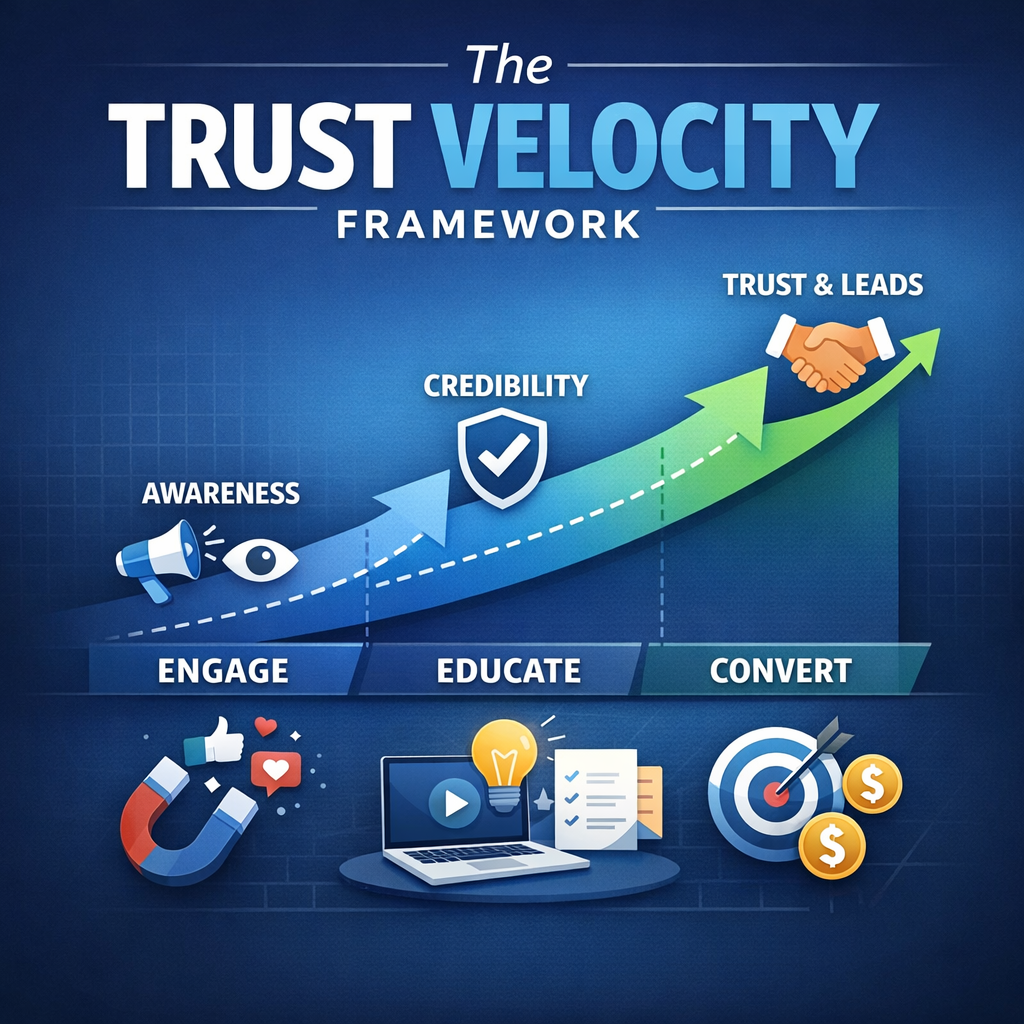
Here is the most important structural insight in this entire guide: leads are not generated by individual posts. They are generated by cumulative sequences of trust.
Most social media strategies treat every post as a standalone unit — a piece of content that either performs or does not. Expert practitioners design content in deliberate sequences that move a specific audience segment through five cognitive stages before any conversion attempt is made.
Those five stages are:
- Awareness — The user encounters your brand for the first time and registers that you exist and seem relevant to their world.
- Credibility — The user sees enough depth and expertise in your content to conclude that you know what you are talking about.
- Relatability — The user encounters content that speaks directly to a problem or situation they recognize as their own.
- Proof — The user sees evidence — case studies, testimonials, results — that your approach works for businesses like theirs.
- Permission — The user has accumulated enough trust to exchange contact information, respond to a CTA, or initiate a DM.
The reason most social media lead generation campaigns underperform is not a content quality issue. It is a trust deficit issue. Brands attempt to jump directly to stage five — launching a lead magnet, pushing a sign-up offer, or running a “book a free consultation” ad — before earning stages one through four. The user has no context, no credibility reference, and no social proof. They scroll past.
Mapping Your Content Calendar to the Trust Velocity Sequence
A content calendar is commonly presented as a scheduling tool. It is actually a strategic asset — if you build it deliberately.
Rather than filling calendar slots with content types (“Monday: tip post, Wednesday: testimonial, Friday: promotional”), build your calendar around trust-stage coverage for different audience segments.
At any given time, your active content should be delivering:
- Consistent awareness content for cold audiences who are encountering you for the first time
- Credibility-building content for users who have engaged once or twice but have not yet signaled intent
- Proof content timed to follow credibility content, not lead it
- Permission-stage content (CTAs, lead magnets, offers) targeted specifically at users who have already moved through the earlier stages
This is the architecture that turns a social media feed into a lead pipeline. It requires understanding not just what to post, but what stage of trust each piece of content is designed to build — and who it is designed to reach. For a deeper look at how to structure this kind of system for a local audience, the article on local business social media strategy that actually converts walks through platform-specific sequencing in detail.
Identifying High-Intent Signals Before the Form Fill
Standard analytics dashboards surface engagement metrics: reach, impressions, likes, comments, click-through rate. These measure attention. For lead generation, the metrics that matter are the ones that measure intent — and most platforms do not surface them prominently.
High-intent behavioral signals are the micro-actions that reveal purchase readiness before a user ever hits your lead capture page. Recognizing and acting on these signals is one of the most underutilized lead generation mechanisms available to businesses running active social media channels.
Behavioral Signals That Indicate Lead-Ready Intent
- Repeated profile visits (LinkedIn): A second or third profile view within a short window — particularly from the same account — is a strong buying signal. This person is conducting due diligence, not casual browsing.
- Content saves and bookmarks: A save indicates that the user found your content valuable enough to return to. Categorically, this is a stronger lead indicator than a like. Users who save content are in information-collection mode, which is characteristic of pre-purchase research behavior.
- Specific, contextualized comments: Generic comments (“Great post!” or “So helpful!”) indicate passive engagement. Comments that reference the user’s personal or business situation (“We ran into this exact problem last quarter and…”) indicate that the content resonated at a decision-relevant level. These users warrant direct, personalized engagement.
- Click + return patterns: Users who click your CTA link and then return to your social profile are exhibiting classic research-mode behavior. They want to know more about who is behind the content before committing to a form fill.
- DM-initiated conversations: Any user who sends a direct message — regardless of the nature of the question — has crossed a significant psychological threshold. They have moved from passive consumer to active communicator. These users should be treated as warm leads from the moment of first contact, regardless of what they asked.
The Pre-Capture Engagement Strategy
The practical application of intent signal recognition is a layer of engagement that happens before users reach your lead capture page. When you identify users exhibiting high-intent signals, proactive personal engagement — a thoughtful reply, a relevant follow-up question, a direct outreach — dramatically increases the probability of conversion because you are reaching them at peak interest.
This approach reframes social media not as a broadcast channel, but as an active prospecting environment. The content generates the signal; the engagement converts the signal into a lead. Understanding how to use direct messaging as part of this system is covered in depth in the social media chat lead generation guide.
The Attribution Problem: Proving Social Media’s Role in Your Pipeline
One of the most persistent challenges in social media lead generation is attribution — specifically, how to demonstrate that a particular piece of content, or the channel as a whole, contributed to a specific lead or client.
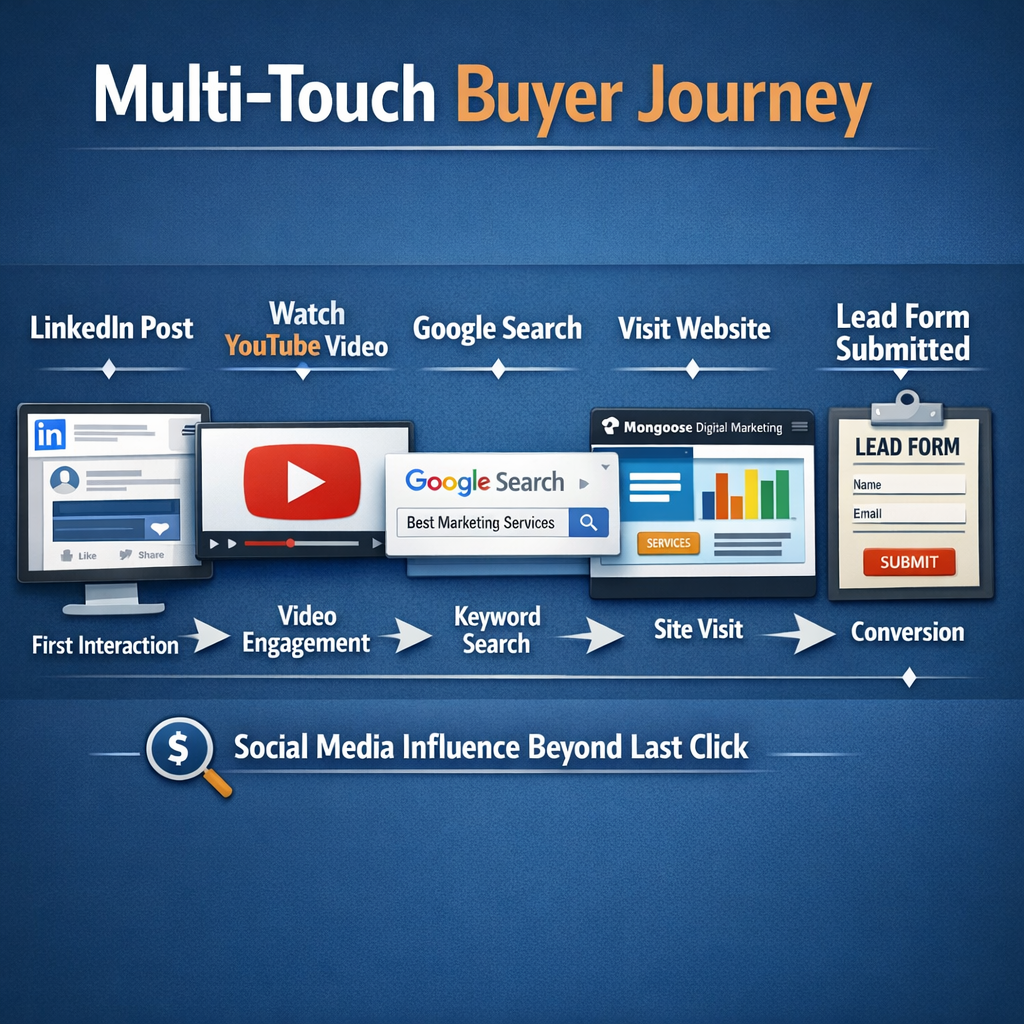
Last-click attribution — the default model in most analytics setups — assigns 100% of the credit for a conversion to the final touchpoint before the lead form was submitted. If someone found you through a Google search after seeing your social content three times, the search gets the credit. This systematically undervalues social media’s role in the buyer journey, which often spans multiple touchpoints across multiple weeks.
Building a Measurement Architecture That Captures Social’s True Impact
To accurately measure social media’s contribution to lead generation, a basic but effective measurement infrastructure requires:
- UTM parameter tagging on every link: Each social platform, campaign, and content type should have distinct UTM parameters so that traffic arriving at your website is identifiable by source. This allows your analytics platform to trace which social content drove website visits that later converted.
- CRM pipeline tagging: When leads are entered into your CRM, the source data from UTM parameters should follow them. This makes it possible to track not just which leads came from social media, but which specific campaigns or content types generated leads that actually closed.
- Multi-touch attribution modeling: Rather than assigning 100% of credit to the last click, a linear or position-based attribution model distributes credit across all touchpoints in the buyer journey. This produces a much more accurate picture of social media’s actual business contribution.
- Direct source questioning: At the lead capture stage, a simple “How did you first hear about us?” field adds qualitative data that supplements the quantitative tracking. This is particularly valuable for capturing what practitioners call “dark social” — traffic that arrives through untrackable channels like private DMs, WhatsApp links, and copied URLs.
Dark social is a real and significant measurement gap. When someone reads your LinkedIn post, screenshots it, and sends it to a colleague who then searches your company name and submits a lead form — that attribution chain is invisible to standard analytics. It registers as direct traffic or organic search. A robust strategy acknowledges this blind spot and builds qualitative data collection into the lead capture process to compensate for it.
Organic Content as a Testing Laboratory for Paid Lead Generation
Here is a strategic integration that most businesses completely miss: organic social media content and paid social media advertising should not operate as separate channels. Organic posts are a testing environment that produces validated signal for paid amplification.
The logic is straightforward. When you publish organic content, the platform’s algorithm distributes it to a subset of your existing audience. Posts that generate disproportionately high engagement — high saves, shares, comments, click-through — are proving something valuable: that a particular message, angle, or format resonates with people who already know your brand.
That validated signal can then be amplified to a cold lookalike audience through paid promotion. Instead of spending on creative that has never been tested, you are spending on content that has already demonstrated its ability to capture attention and generate engagement among a relevant audience. The result is consistently higher return on ad spend compared to promoting content that has no organic performance baseline.
The practical workflow:
- Publish organic content across your active channels consistently
- Identify top performers by engagement rate, saves, and link clicks — not just raw reach
- Promote the top-performing 10–20% of posts to cold audiences using lookalike targeting
- Use those promoted posts to drive traffic to a specific lead capture asset (consultation page, lead magnet, high-intent landing page)
- Feed conversion data back into your organic content strategy to inform what angles and formats to create next
This integration loop between organic signal and paid scale is one of the most capital-efficient lead generation mechanisms available on social platforms, and it is available to businesses at virtually any advertising scale.
The Algorithm-Strategy Tension Every Practitioner Navigates
There is a conflict at the center of social media lead generation that deserves direct acknowledgment: the behaviors that algorithms reward are not the same behaviors that build purchase-ready trust.
Algorithms on most platforms are optimized to maximize time-on-platform. They reward content that triggers strong emotional responses, generates rapid engagement, and keeps users scrolling. Entertainment, controversy, and novelty perform well algorithmically. Detailed educational content, nuanced case studies, and substantive proof posts — the content types that actually build the kind of trust that converts — tend to perform more modestly in pure reach terms.
This creates a genuine tension that every working social media strategist navigates. Optimizing purely for the algorithm produces engagement numbers but dilutes the brand positioning needed for lead generation. Optimizing purely for trust-building produces stronger leads but reduced organic reach.
The resolution is not to choose one over the other. It is to design a content mix that deliberately serves both purposes — using higher-entertainment content to generate reach and platform favor, while using deeper, more substantive content to build the trust architecture that converts reached audiences into leads. Engagement content fills the top of the funnel. Trust content does the conversion work.
Understanding this tension — and designing around it intentionally rather than defaulting to whatever generates the most likes — is what separates a social media strategy that drives leads from one that simply drives activity.
Final Strategic Recommendations for 2026
The social media lead generation landscape continues to shift, but the practitioners who will perform best in 2026 share a common orientation: they treat social media as an integrated business system rather than a content publishing function. Three specific moves will separate those who generate consistent leads from those who generate consistent activity.
1. Commit to a Unified Social CRM Workflow
Tools like HubSpot’s social integration layer, Sprout Social’s lead attribution features, or even a disciplined manual tagging system inside a CRM of your choice will become essential as platform attribution grows more fragmented. The goal is to close the loop between social engagement and pipeline movement — knowing not just that a lead came from social, but which content type, which topic cluster, and which platform interaction preceded the conversion. Without this infrastructure, you are optimizing in the dark.
2. Invest in Short-Form Video as a Trust Vehicle, Not Just a Reach Vehicle
Most brands still treat short-form video (Reels, TikTok, YouTube Shorts) as a top-of-funnel awareness tool. In 2026, the competitive advantage belongs to brands that have figured out how to pack substantive proof, authority signals, and soft conversion cues into that format without sacrificing the watchability that earns reach. Study the creators in your space who are doing this well. Build a repeatable production workflow that lets you publish at the volume the format demands without gutting the quality the trust-building requires.
3. Treat LinkedIn as a Primary Lead Generation Channel Regardless of Industry
The B2B case for LinkedIn has always been clear, but the platform’s targeting capabilities, thought leadership infrastructure, and increasingly active decision-maker user base have made it relevant well beyond traditional B2B contexts. Whether you sell professional services, home improvement, healthcare, or specialty retail, the adults making purchase decisions in your category are on LinkedIn. A consistent, authority-focused LinkedIn presence — built around genuine expertise rather than promotional content — is one of the highest-return organic investments available heading into 2026.
Frequently Asked Questions
How much content do I actually need to publish to generate leads from social media?
Volume matters less than consistency and strategic intent. Brands that publish a smaller number of well-constructed, trust-building posts on a reliable schedule reliably outperform brands that publish frequently with no clear conversion architecture behind the content. A practical starting point is three to five posts per week on your primary platform, with each piece of content serving a defined role — reach, trust-building, or direct conversion — rather than simply filling a calendar slot.
Which social media platform generates the best leads for small businesses?
There is no universal answer, and any recommendation that skips over your specific audience is doing you a disservice. The honest framework is this: the best platform is the one where your highest-intent potential customers are already spending time, and where your content format strengths align with what that platform rewards. For most service businesses, Facebook and Instagram remain high-volume options with strong local targeting capabilities. LinkedIn is consistently underused by small businesses and often delivers higher-quality leads even at lower reach volumes.
What is the difference between engagement and lead generation on social media?
Engagement — likes, comments, shares, saves — measures how your content performs within the platform ecosystem. Lead generation measures whether social activity is producing people who enter your sales process. These two metrics are related but not interchangeable, and optimizing purely for engagement can actually work against lead generation by shifting your content mix toward entertaining or provocative material that attracts attention but does not build the purchase-ready trust that converts. A lead generation strategy tracks both, but treats pipeline movement as the primary success metric.
How long does it take to see leads from an organic social media strategy?
Organic social lead generation is a compounding system, which means the timeline is longer than most brands expect and the returns grow faster than most brands anticipate. Most businesses that commit to a consistent, strategically designed organic social presence begin seeing measurable lead attribution between three and six months in. The underlying authority and trust infrastructure built during that period also accelerates results from any paid social investment layered on top, making the early organic work valuable well beyond its direct lead output.
Conclusion
A social media strategy that actually drives leads requires the kind of deliberate architecture — the right content mix, the right platform prioritization, the right integration between organic signal and paid distribution — that takes expertise and consistency to build and maintain. At Mongoose Digital Marketing, our social media management and digital marketing strategy services are built specifically around lead generation outcomes, not vanity metrics. If you’re ready to turn your social presence into a reliable part of your business development pipeline, we’d love to talk through what that looks like for your specific situation. Get a Free Estimate