
Why “Affordable PPC Management” Is More Complex Than Most Agencies Let On
Every small business owner searching for affordable PPC management is really asking the same underlying question: Can I make paid search work without burning through my operating budget? The honest answer is yes — but only under specific conditions that most agencies have a financial incentive never to explain clearly.
This article cuts through the surface-level advice that dominates most PPC content. You won’t find a rehash of Quality Score definitions or a list of “top tips” for writing ad copy. Instead, this is a practitioner-level breakdown of what actually determines whether PPC management delivers a real return for a small business — and what quietly kills campaigns that looked promising on paper.
If you’re evaluating whether to invest in managed PPC, considering bringing it in-house, or trying to understand why a previous campaign underperformed, this is the framework you need.
The Affordability Myth: When PPC Actually Works for Small Businesses
The industry’s standard pitch is that PPC is affordable because you control the budget. That’s technically true and practically misleading. Budget control is not the same as cost efficiency, and conflating the two causes small businesses to enter campaigns with unrealistic expectations.
Affordable PPC management isn’t a function of how little you spend. It’s a function of whether your cost-per-acquisition is lower than your customer lifetime value — and that equation is shaped by factors most competitors never discuss upfront.
Industries Where the Math Is Structurally Difficult
Certain industries carry click costs that make it nearly impossible for a small, independent operation to achieve positive ROI through search advertising alone. Highly competitive service verticals — personal injury law, insurance, home services in major metros — have click costs driven up by national brands and aggregators with structurally different economics than a local business.
This isn’t a management problem. It’s an auction dynamics problem. No amount of optimization closes the gap when a national competitor can absorb a breakeven cost-per-acquisition because they’re monetizing lifetime customer value across multiple products, and a local operator cannot.
Before committing to any PPC campaign, the foundational question is whether the keyword landscape in your specific vertical and geography allows for a viable cost-per-acquisition at realistic conversion rates. That analysis should happen before a single ad goes live.
The Learning Waste Period Nobody Accounts For
Every new PPC campaign goes through an optimization ramp-up period. During this window, the campaign is generating data, adjusting to auction dynamics, and building conversion history. This period is unavoidable, and it costs real money.
Conservative practitioners estimate that the first 60 to 90 days of a new campaign involve meaningful budget allocated to learning — clicks that generate data rather than conversions. This isn’t mismanagement. It’s the cost of building a functional machine from scratch.
The problem is that most small business PPC conversations never model this ramp-up cost honestly. When someone evaluates whether PPC management is financially viable, they need to account for the full cost of getting a campaign to steady-state performance — not just the ongoing monthly spend once it’s optimized.
The Account Age Penalty: A Structural Disadvantage Competitors Don’t Disclose
This is one of the most consequential and least-discussed dynamics in small business PPC. Google’s auction algorithm rewards account history. An established competitor in your keyword space has years of conversion data, strong historical click-through rates, and Quality Scores built through sustained performance. You’re starting at zero.
This creates a structural CPC disadvantage in the early months of a new account. You are competing in the same auction but paying more per click for equivalent ad positions — not because your ads are worse, but because your account hasn’t earned the algorithmic trust that incumbent accounts carry.
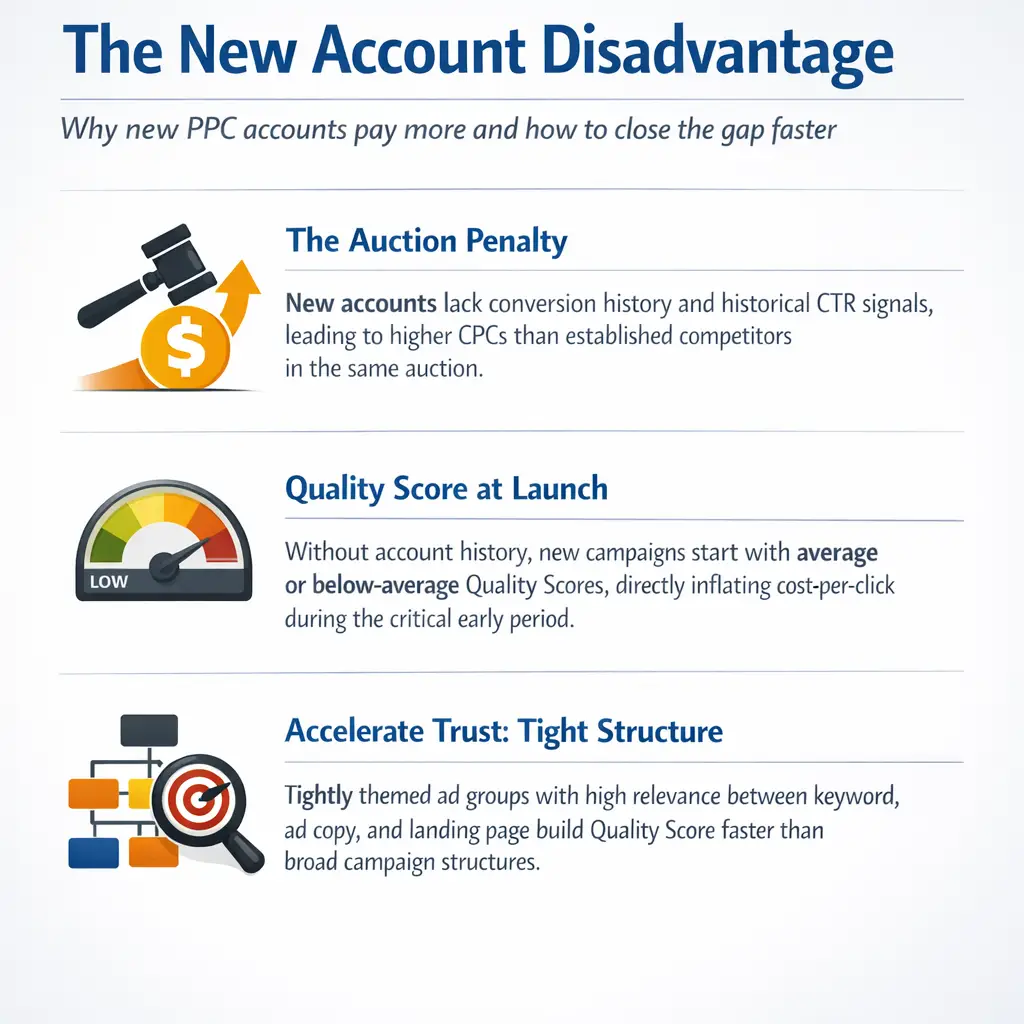
(https://support.google.com)”; item4_body=”Automated bidding strategies require a minimum conversion data threshold to function effectively. Deploying them too early wastes budget on uninformed machine learning.”; item5_title=”Accelerate Trust: Micro-Targeting”; item5_body=”Launching in lower-competition dayparts or tight geographic zones builds conversion data faster and establishes account authority before scaling spend.”; footer=”Mongoose Digital Marketing”]
How to Mitigate the Account Age Penalty
The account age penalty isn’t permanent, but it requires deliberate structural decisions at the campaign build stage to minimize its impact.
Tightly themed ad groups. The relevance signal between your keyword, ad copy, and landing page is one of the fastest levers for improving Quality Score early. Loosely organized ad groups — broad themes, generic copy — slow Quality Score accumulation. The more precisely each ad group mirrors a specific search intent, the faster the account builds the relevance signals that reduce CPC.
Earned entry into Smart Bidding. Google’s automated bid strategies — particularly Target CPA and Target ROAS — are powerful tools, but they require conversion data to function correctly. Deploying Smart Bidding on a new account with minimal conversion history is not a shortcut. It is the machine learning algorithm making decisions with insufficient data, which produces erratic and expensive results. The practical threshold for Target CPA to function reliably is in the range of 30 to 50 conversions per month at the campaign level. Before that threshold, manual or enhanced CPC bidding with disciplined human oversight typically outperforms automation.
Geographic and daypart micro-targeting. Rather than launching a campaign at full geographic and temporal scale, concentrating initial spend in lower-competition windows and geographies allows the account to accumulate conversion data faster. This accelerates the account’s trust signals and creates a stronger foundation for scaling.
The Management Fee Ratio Problem
There are two budgets in every managed PPC engagement: the management fee paid to the agency and the ad spend deployed in the auction. Most small businesses understand this intellectually, but few work through the economic implications at their actual budget levels.
At modest ad spend levels, the management fee can represent a disproportionately large share of total outlay. When that ratio is unfavorable, the effective cost-per-acquisition — accounting for both ad spend and management overhead — can be significantly higher than industry benchmarks suggest. A campaign that looks viable based on industry average metrics may not be viable once the full cost structure is modeled honestly.
This is not an argument against professional PPC management. It is an argument for running the actual numbers before committing. There are budget thresholds below which full ongoing management genuinely doesn’t pencil out — and operating below those thresholds while paying for full management is a structural economic problem that no amount of campaign optimization resolves.
Choosing the Right PPC Campaign Type for Your Business
“PPC management” is not a monolithic service. Search, Display, Shopping, Performance Max, and Local Services Ads have entirely different management demands, risk profiles, and suitability for small businesses. Treating them as interchangeable is one of the most common sources of wasted spend.
| Campaign Type | Management Complexity | Conversion Intent Level | Best Fit | Key Risk for Small Businesses |
|---|---|---|---|---|
| Search (Exact/Phrase) | Moderate | High | Service businesses, local offers, high-intent queries | Match type drift without disciplined negative keyword management |
| Display | High | Low–Medium | Brand awareness, retargeting only | Wasted spend on low-intent placements without aggressive exclusion lists |
| Shopping | High | High | E-commerce, product-based businesses | Feed quality issues that suppress performance and require ongoing maintenance |
| Performance Max | Very High | Variable | Accounts with strong conversion data history | Black-box optimization; unsuitable for new accounts with limited conversion data |
| Local Services Ads | Low | Very High | Home services, legal, medical, local trades | Limited control; lead quality varies significantly by category |
Search Campaigns: The Right Starting Point for Most Small Businesses
For the majority of small businesses entering paid search for the first time, tightly managed search campaigns — built around exact and phrase match keywords with robust negative keyword architecture — represent the most controllable and data-rich starting point.
The post-2021 shift in Google’s match type behavior is not optional knowledge for anyone managing PPC today. Broad match now captures search queries that bear limited resemblance to the original keyword. Without disciplined negative keyword lists built and maintained from day one, broad match campaigns burn budget on irrelevant traffic that looks like performance in the dashboard but doesn’t convert.
This is a specific, structural problem that requires active management — not a set-it-and-forget-it configuration. Any affordable PPC management engagement that doesn’t include ongoing negative keyword maintenance is leaving budget on the table systematically.
Performance Max: Powerful but Not for New Accounts
Performance Max has become Google’s default recommendation for most advertisers, and it can deliver strong results in the right conditions. Those conditions are: established accounts with meaningful conversion history, reliable conversion tracking infrastructure, and sufficient creative assets to feed the automation.
For a new small business account, Performance Max is frequently the wrong choice. The campaign type relies on machine learning optimization, and without the historical data to inform that optimization, it makes expensive, unfocused decisions. Small businesses are often steered toward Performance Max prematurely — it’s worth understanding what conditions actually make it viable before committing budget. For a deeper look at how paid search fits into a broader channel strategy, the article How PPC and SEO Work Together to Grow Your Business provides useful context on aligning these investments.
The Three-Way Decision Framework: Agency, Hybrid, or Owner-Managed
The industry presents PPC management as a binary choice: hire an agency or do it yourself with software tools. There is a third model that is often the most economically rational choice for budget-constrained small businesses — and the industry has a financial incentive to leave it out of the conversation.
The three genuine options are:
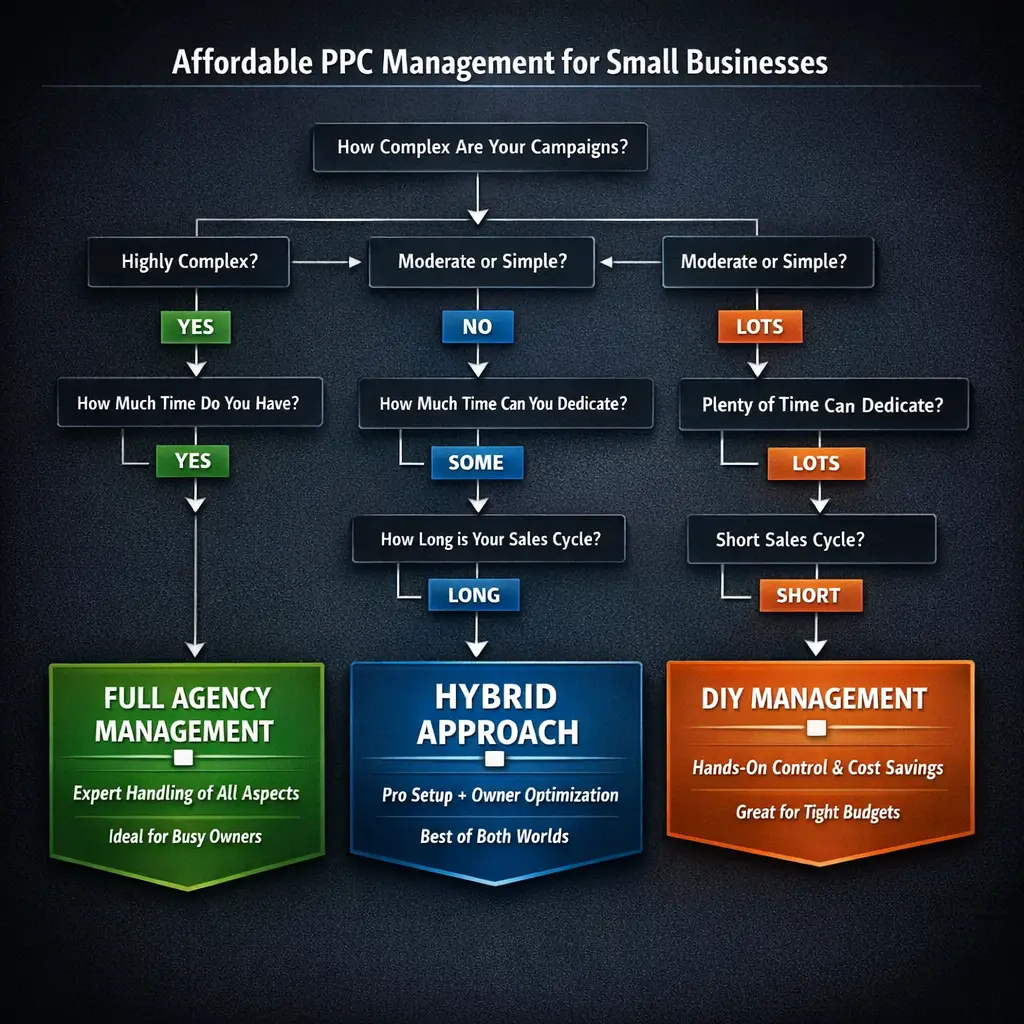
Full ongoing agency management. The agency builds, manages, optimizes, and reports on all PPC activity. Appropriate when campaigns are structurally complex, when conversion cycles are long and require sophisticated bid strategy management, or when the business owner has no realistic time to engage with campaign performance weekly.
Professional setup with owner-managed optimization. A professional account architect builds the campaign structure, implements conversion tracking, establishes the initial keyword and negative keyword framework, and creates a documented weekly review process. The business owner then manages the ongoing optimization — reviewing search term reports, adjusting bids, monitoring performance against defined benchmarks. This model delivers professional-grade infrastructure without permanent ongoing management fees. It works when the business owner can genuinely commit to a weekly review process and the campaign structure is not excessively complex.
DIY from scratch. Viable only for the most straightforward campaign scenarios, with a business owner willing to invest significant time in learning the platform. The risk is not the platform complexity — Google’s interface is learnable. The risk is that without practitioner-level knowledge of match type behavior, conversion tracking architecture, and Quality Score optimization, the learning curve is paid for with actual ad spend.
Choosing Based on Conversion Cycle Length
Conversion cycle length is one of the most important and least-discussed variables in this decision. A business where the purchase decision happens on the first visit — a restaurant, a retail product, an emergency service — has a short, direct conversion path where owner-managed optimization is realistically achievable.
A business with a multi-touch conversion cycle — professional services, high-value home improvement, B2B — requires bid strategy management that accounts for assisted conversions, cross-device journeys, and attribution modeling. This complexity genuinely benefits from professional management because the data interpretation required to make good bid decisions is not straightforward.
Conversion Tracking Integrity: The Foundation Everything Else Depends On
This is the single most consequential factor in whether affordable PPC management is even measurable — and it is the area where most small business accounts are most severely misconfigured.
The epidemic of broken, inflated, or misleading conversion tracking in small business PPC accounts is not a minor technical issue. It is a fundamental validity problem. When conversion data is inaccurate, every optimization decision made on that data is built on a false foundation. Campaigns that appear to be performing may be measuring noise. Campaigns that appear to be underperforming may be generating real business outcomes that aren’t being captured.
The Four Most Common Conversion Tracking Failures
Counting page visits as conversions. Thank-you page views recorded as conversion events without verifying that a form was actually submitted. This inflates conversion counts and makes campaigns appear more effective than they are. Common in accounts set up quickly without proper event verification.
Cross-device attribution gaps. A user clicks an ad on mobile, then completes the conversion on a desktop device. Google’s last-click attribution model frequently misses this journey. The conversion goes unrecorded, the campaign appears inefficient, and bid strategies optimize away from the targeting that actually drove the outcome.
Phone call tracking not implemented. For service businesses — trades, medical, legal, home services — the phone call is the primary conversion event. Campaigns that track only form fills or page views for these businesses are measuring the wrong outcomes entirely. Call tracking integration is not optional for these verticals; it is the core measurement infrastructure.
Existing customer form fills inflating conversion data. Service businesses with repeat clients frequently see inbound form submissions from existing customers counted as new conversions. This is particularly distorting in accounts using automated bidding strategies, which optimize toward the conversion signals they receive — including false signals.
What Accurate Conversion Infrastructure Actually Looks Like
Functional conversion tracking for a small business PPC account requires a connected stack: Google Analytics 4 as the measurement foundation, Google Tag Manager for reliable event firing without dependency on developer changes, call tracking integration that captures call duration and outcome data, and — where possible — CRM outcome matching that ties closed business back to campaign source.
Without this infrastructure, the word “performance” in any PPC reporting is aspirational. The numbers in the dashboard may or may not reflect what’s actually happening in the business. Any conversation about whether PPC management is delivering returns needs to start with verification that the measurement system is sound. Poor conversion optimization at the tracking layer is one of the fastest ways to misread a campaign that’s actually working — or continue funding one that isn’t.
What to Look for in a Managed PPC Partner
The practical test of whether a PPC management engagement is structured for your success isn’t the pitch deck — it’s the specific questions they ask before proposing anything.
A PPC partner operating at the level small businesses deserve should be asking about your actual conversion economics (what is a new customer worth over time, not just on the first transaction), your current landing page conversion rate baseline, your existing measurement infrastructure, and whether your vertical’s competitive dynamics support viable cost-per-acquisition at realistic budget levels.
If the first conversation is about ad spend levels and campaign types without these foundational questions, the engagement is likely to be structured around activity metrics rather than business outcomes.
Mongoose Digital Marketing works with small businesses across a range of industries, building PPC campaigns on accurate conversion infrastructure, honest competitive analysis, and campaign structures designed to generate real leads — not flattering dashboard numbers. If you’re ready to evaluate whether paid search is the right channel for your growth stage, the conversation starts with a free consultation.
Strategic Recommendations for 2026
Small businesses evaluating or refining their PPC programs heading into 2026 should focus on three specific areas where the return on attention is highest:
1. Invest in First-Party Data Infrastructure Before You Need It
Third-party tracking continues to degrade across browsers and platforms. Small businesses that build even a basic first-party data foundation — email capture tied to CRM, enhanced conversions in Google Ads using hashed customer data, and offline conversion imports — will maintain measurement accuracy as cookie deprecation and consent requirements tighten. This isn’t a future concern; campaigns running today are already losing signal quality without these integrations in place.
2. Consolidate on Google Analytics 4 with a Verified Event Audit
Many small business accounts technically have GA4 installed but are running on unverified event configurations inherited from a rushed Universal Analytics migration. Before scaling any paid search spend, commission a structured GA4 audit that confirms key conversion events are firing correctly, deduplication is in place, and the data visible in your dashboard corresponds to real business activity. Tools like GA4’s DebugView and Google Tag Manager’s preview mode make this verification achievable without enterprise-level technical resources.
3. Test Performance Max Thoughtfully, Not by Default
Google’s push toward Performance Max campaigns is aggressive, and many small business accounts are being migrated into PMax structures that sacrifice transparency for automation. For 2026, the right approach is systematic testing: run PMax alongside maintained search campaigns with strong negative keyword architecture, audit search term reports through available impression share and category data, and make expansion decisions based on actual lead quality — not volume metrics that look strong in isolation. For businesses weighing paid search against other growth channels, the article PPC Advertising for Small Businesses: Stop Wasting Budget covers the broader budget allocation considerations worth reviewing before committing to a channel mix.
Frequently Asked Questions
What does affordable PPC management actually mean for a small business?
Affordable PPC management means the management structure and campaign design are calibrated to your actual budget scale — not a service originally built for enterprise accounts with a reduced price tag attached. It means realistic expectations about what paid search can deliver at your volume, transparent reporting tied to business outcomes rather than vanity metrics, and a management approach that prioritizes lead quality over dashboard activity. Affordability without performance accountability isn’t a bargain; it’s just a recurring expense.
How do I know if my PPC campaigns are actually generating leads or just traffic?
This comes down to conversion infrastructure. If your campaigns are tracked only through Google Ads’ auto-imported goals or surface-level Analytics pageview events, you’re likely measuring activity rather than outcomes. Verified lead generation requires confirmed form submission tracking, call tracking with duration filtering to exclude wrong numbers and short calls, and ideally some form of CRM matching that connects campaign source to closed business. If your reporting can’t distinguish between a qualified inquiry and a bounce, the performance data isn’t reliable enough to make budget decisions from.
Is paid search the right channel for every small business?
No — and any PPC partner worth working with will tell you that upfront. Paid search works best in verticals where people actively search for the service you provide, where the competitive cost-per-click environment allows for viable economics at your budget level, and where your conversion infrastructure and landing pages are capable of turning clicks into inquiries. Businesses in highly competitive verticals with thin margins, or in categories where search intent is diffuse or informational, may find other channels deliver better returns. A honest pre-engagement analysis should surface these constraints before any spend begins.
How long does it take to see results from a PPC campaign?
Initial data accumulation typically takes several weeks before optimization decisions are statistically meaningful. However, the more important variable isn’t clock time — it’s conversion volume. Campaigns need sufficient conversion data before automated bidding strategies can perform, and that volume threshold depends on your industry’s search volume and your budget’s ability to generate clicks at a meaningful rate. Expect the first month to be primarily a data collection and structural refinement period, with performance optimization accelerating through months two and three as pattern data develops.
Conclusion
For small businesses that want PPC management built around actual lead generation — not activity reports that look impressive but don’t move the business forward — the difference is almost always in the foundation: accurate conversion tracking, honest competitive analysis, and campaign structures designed for your specific economics. Mongoose Digital Marketing specializes in paid search management and conversion tracking setup for small businesses that are serious about understanding what their advertising is actually producing. If you’re ready to find out whether paid search is the right fit for your growth goals, Contact Mongoose Digital Marketing for a free consultation.