
How to Use Social Media Chat Platforms to Generate Leads
Most businesses treating social media chat as a customer service tool are leaving their most direct sales channel completely underutilized. The reverse is equally true: businesses rushing to automate every chat interaction are burning leads faster than their ad spend can replace them. Both failures share the same root cause — a fundamental misunderstanding of what chat-based lead generation actually is.
This is not a messaging tactic. It is a conversation architecture discipline, and the businesses generating consistent, sales-ready pipeline from social media chat are operating with a structural sophistication that most published advice in this space never comes close to addressing.
What follows is a practitioner-level breakdown of how to use social media chat platforms to generate leads in a way that produces measurable pipeline results, not just high message volume with poor downstream conversion.
Why Chat Converts Differently Than Every Other Lead Channel
Before touching platform mechanics, you need to understand the behavioral foundation that makes chat-based lead generation structurally distinct from form fills, landing page conversions, or email sequences.
When a prospect fills out a contact form, they are performing a transaction. They trade their information for something — a download, a quote, a callback. The interaction is sequential and asynchronous, and the relationship equity at the point of conversion is close to zero.
When a prospect initiates or responds to a chat conversation, the social dynamics are entirely different. Chat carries an implicit social contract. There is an expectation of reciprocal exchange, responsiveness, and contextual relevance. A prospect who sends you a message on Instagram DM is not completing a transaction. They are opening a relationship. The moment you respond with a templated sales block or an immediate request for their email address, you violate that social contract and the lead collapses.
This is the core mechanism behind what experienced conversational marketers recognize as trust velocity — the rate at which a prospect moves from initial contact to sales-qualified status behaves fundamentally differently in chat environments than in any other channel.
Three specific dynamics drive trust velocity in chat:
Response latency signals. Prospects unconsciously calibrate your credibility and attentiveness based on the speed and contextual accuracy of your first response. A delayed or generic reply after a specific question does not just frustrate the prospect — it produces a credibility signal that undermines every subsequent message in the thread.
Message length mirroring. Responding to a short, casual prospect message with a lengthy automated information block signals to the prospect that they are interacting with a system rather than a person, or worse, a business that does not actually read their messages. The rule practiced by experienced operators: match the register and approximate length of the prospect’s opening message before gradually expanding the depth of conversation.
Progressive disclosure pacing. Requesting contact information too early in a chat conversation produces abandonment rates significantly higher than equivalent form-based requests. This is because chat carries an expectation of demonstrated value before commitment. Prospects are willing to give you their details, but only after the conversation has delivered enough insight or relevance to justify the exchange.
These three dynamics have direct operational consequences for how you should configure chat sequences, qualification flows, and automation rules — all of which are covered below.
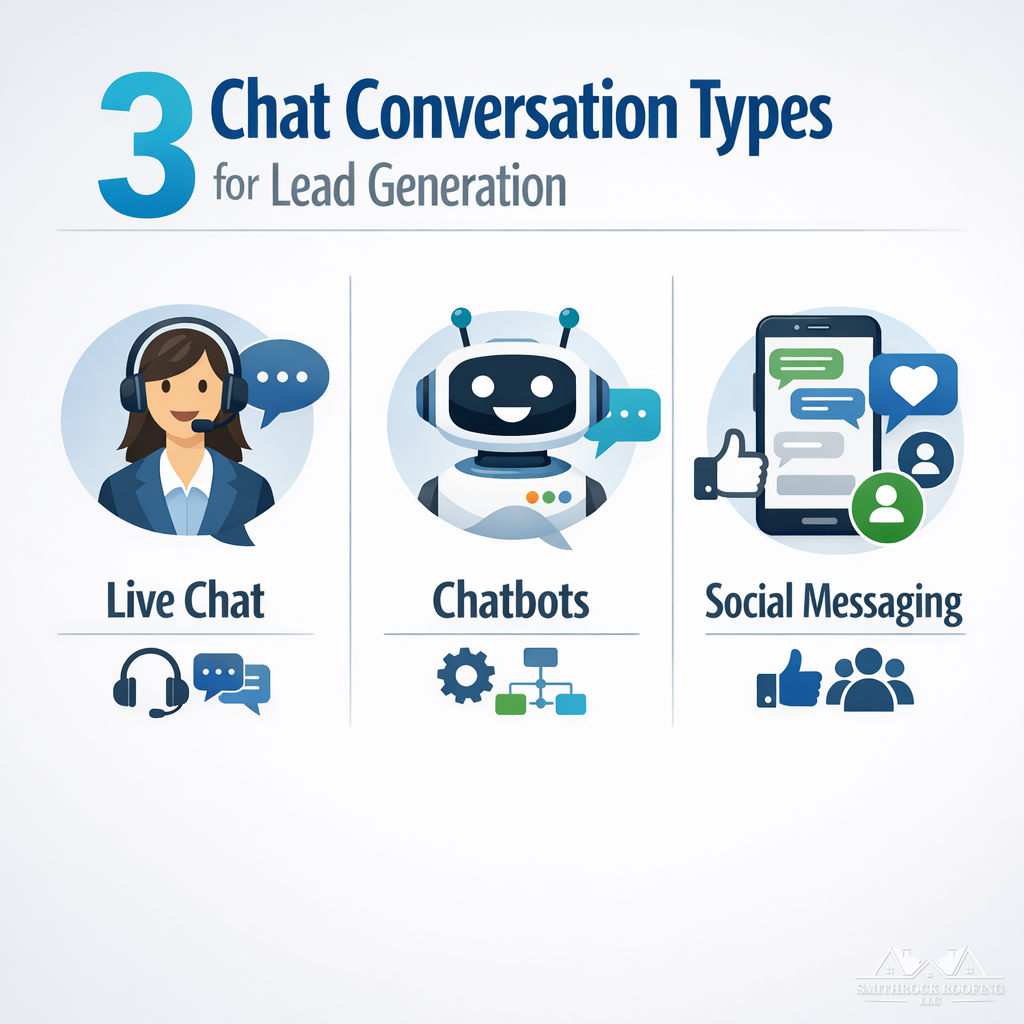
The Three Conversation Types That Drive Lead Generation
A foundational error in most chat lead generation implementations is treating all inbound and outbound chat interactions as equivalent. They are not. There are three structurally distinct conversation types, and applying the same script across all three consistently produces poor conversion outcomes.
Cold Initiation Conversations
These conversations are triggered by paid traffic — typically click-to-chat ads on Facebook, Instagram, or similar platforms — where the prospect has had minimal or zero prior exposure to your brand. The prospect’s intent signal is genuine but shallow. They clicked because something in the ad resonated, not because they have been evaluating your solution.
The correct architecture for cold initiation conversations prioritizes curiosity before qualification. Your opening message should acknowledge what brought them to the conversation, deliver one relevant piece of value immediately, and ask a single low-commitment question that advances understanding of their situation. Asking for their phone number or email in the opening exchange of a cold initiation conversation is the fastest route to a dead thread.
Warm Nurture Conversations
These conversations involve prospects who have already engaged with your content, visited your website, or interacted with your brand across multiple touchpoints before entering a chat interaction. The intent signal here is meaningfully stronger. This prospect is not browsing — they are evaluating.
Warm nurture conversations require a different opening frame that acknowledges the prior relationship implicitly. Treating a warm prospect like a cold lead is one of the most common and damaging errors in chat lead generation, because it signals that your business has no memory of the relationship and forces the prospect to re-establish context they already expected you to carry.
Re-engagement Conversations
These conversations target leads who previously opted into your chat channel — through a WhatsApp broadcast list, Messenger subscription, or similar mechanism — but have gone dormant. Re-engagement conversations carry the highest stakes in terms of opt-out risk, because the prospect already knows enough about your business to have made a prior decision not to continue engaging.
Re-engagement conversations must lead with pattern interruption. A re-engagement message that resembles the kind of communication the prospect was already ignoring will generate either no response or an opt-out. Effective re-engagement frames often reference a specific change in context — a new offer, a relevant piece of content tied to a problem the prospect raised previously, or a direct acknowledgment of the time gap and a reason for the outreach.
Platform-by-Platform Breakdown: Strategic Differences That Determine Results
Not all chat platforms operate on the same behavioral architecture. The differences between them are not cosmetic — they require fundamentally different lead nurturing approaches.
| Platform | Interaction Type | Primary Lead Use Case | Key Constraint | Opt-In Requirement |
|---|---|---|---|---|
| Facebook Messenger | Synchronous / Asynchronous hybrid | Click-to-chat ads, page inquiry responses | 24-hour messaging window post-interaction | Required for ongoing outreach beyond window |
| Instagram Direct | Asynchronous | Warm lead nurturing, DM-to-link flows | No bulk messaging, manual or API-only | Organic initiation or ad-driven |
| WhatsApp Business | Asynchronous | Relationship-based nurture, broadcast lists | WhatsApp Business Policy restricts promotional messaging frequency | Explicit opt-in mandatory |
| LinkedIn Messaging | Synchronous / Asynchronous | B2B prospect outreach, account-based targeting | Connection requirement for direct message; InMail for cold outreach | Connection or InMail credit |
| Telegram | Asynchronous | Community-driven lead capture, bot-assisted qualification | No native ad integration; requires organic or external traffic | Channel/group subscription |
| X (Twitter) DMs | Asynchronous | Reactive engagement, high-visibility prospect outreach | Follower requirement for unrestricted DMs | Following relationship may be required |
The most consequential distinction in the table above is the synchronous versus asynchronous classification. Synchronous-leaning platforms, where prospects expect rapid back-and-forth responses, require staffing capacity or automation sophisticated enough to maintain conversation momentum in near real time. Asynchronous platforms like WhatsApp allow for longer response gaps without the same trust deterioration, but they require careful cadencing to avoid appearing neglectful over extended follow-up sequences.
Facebook Messenger and the 24-Hour Window
Facebook Messenger imposes a 24-hour messaging window after a prospect’s last interaction. Outside of that window, businesses are restricted to sending only non-promotional message types. This makes immediate qualification within the initial conversation exchange significantly more valuable on this platform than on others.
The operational implication: your Messenger conversation flows should be designed to complete core qualification within the first exchange session, not across multiple days. Leaving qualification steps to a follow-up message the next day works only if you send that follow-up within the active window.
WhatsApp Business and the Consent Architecture
WhatsApp Business is among the highest-converting chat platforms for relationship-based lead nurturing, and also among the most compliance-sensitive. WhatsApp’s Business Policy prohibits initiating conversations for purely promotional purposes without explicit prior consent. Businesses that treat their WhatsApp broadcast lists like an email marketing list typically find their accounts flagged or restricted after user complaint thresholds are reached.
The correct model for WhatsApp lead generation involves building an explicit opt-in flow — typically through a website widget, a QR code, or a click-to-WhatsApp ad — that captures consent before any nurture messaging begins. The nurture sequence that follows should deliver value-first content with selective commercial calls to action, not promotional blast messaging.
LinkedIn Messaging for B2B Lead Generation
For businesses targeting other businesses, LinkedIn’s messaging infrastructure represents a distinct category of chat-based lead generation. The platform’s professional context sets prospect expectations differently from consumer-oriented platforms — direct, value-forward messaging is more tolerated here than on Instagram or Facebook, provided the outreach demonstrates genuine relevance to the recipient’s role or stated interests.
Connection-based messaging carries no credit cost, making it the preferred route for account-based outreach where a connection relationship already exists or can be initiated organically. InMail credits should be reserved for high-priority prospects where the business case for outreach is strong enough to justify the spend.
The Platform-Native Qualification Framework
This is the insight that separates businesses generating high chat volume with poor conversion rates from those building genuinely sales-ready pipeline through chat.
The instinct most teams follow is to capture a lead from chat as quickly as possible and push them into a CRM for follow-up. The problem is what gets lost in that transfer.
When a prospect has a substantive conversation through Instagram DM — raising specific objections, revealing their decision timeline, expressing enthusiasm about a particular feature or service — and that conversation gets collapsed into a CRM contact record containing only a name and email address, the entire relationship equity built during the chat disappears. The sales rep picking up that record has no visibility into the emotional tone of the exchange, the specific concerns raised, or the implicit buying signals embedded in how the prospect asked their questions.
This creates what can accurately be called a context collapse problem, and it is the primary reason many businesses report significant inbound chat activity without a corresponding improvement in their close rates.
The solution is a platform-native qualification workflow — a structured conversation sequence that completes a meaningful discovery and qualification process within the chat environment before any CRM handoff occurs. When the lead is eventually transferred, the CRM record carries enriched context: documented objections, stated needs, timeline, budget signals, and a summary of the relational dynamic established during the chat.
A practical platform-native qualification flow follows this structure:
- Acknowledgment — Open with a response that proves you read their message and understand their context
- Curiosity — Ask one open-ended question that advances understanding of their situation without requesting contact information
- Value delivery — Provide a genuinely useful response to what they have shared, demonstrating expertise rather than sales intent
- Qualification — Introduce one or two targeted questions that identify fit, urgency, and decision-making capacity
- Commitment request — Request contact information or a next-step action only after the above steps have established sufficient conversational value
- Context capture — Before closing the chat, summarize or tag the key signals from the conversation in a format that transfers useful context to the follow-up team
This sequence does not have to be long. In practice, a well-executed platform-native qualification flow can move through all six stages in six to eight messages. The discipline is in resisting the temptation to shortcut to the commitment request before the preceding steps have done their work.
Tiered Response Architecture: Moving Beyond the Bot-vs-Human Binary
Most businesses implement chat lead generation with either full automation or full manual handling. Both approaches have structural weaknesses that limit results at scale.
Full automation produces efficiency at the cost of conversion quality. Chatbots excel at handling the early stages of qualification — answering frequently asked questions, collecting initial information, filtering out clearly unqualified inquiries — but they consistently underperform at the trust-building stages that turn a warm conversation into a sales-ready lead. The moment a prospect senses that they are not speaking to a person, the conversation dynamic shifts and the trust velocity drops sharply.
Full manual handling produces quality at the cost of scale. A team responding individually to every chat inquiry cannot maintain response time standards across high message volume, and slow response times on chat carry a disproportionately negative effect on lead quality compared to the same delay in email.
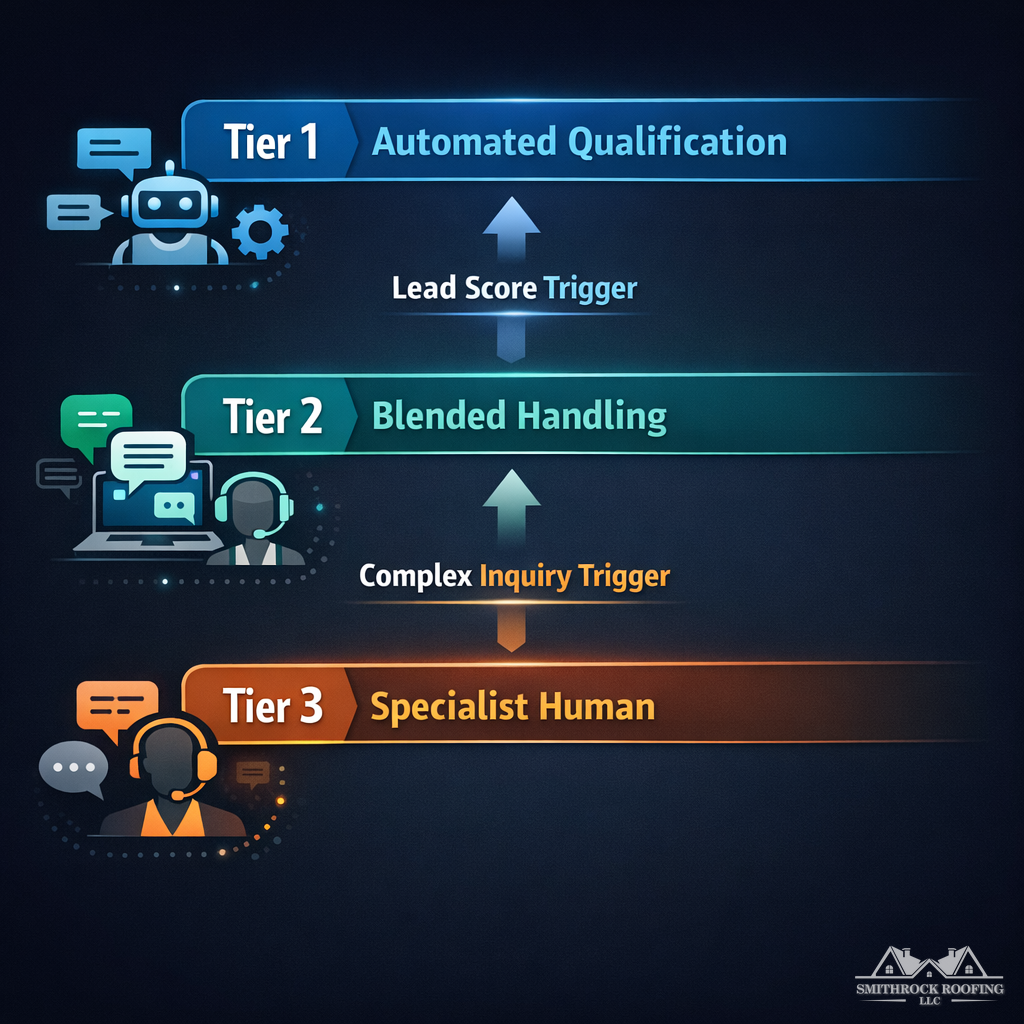
The operational model that resolves this tension is a tiered response architecture:
Tier 1 — Automated qualification: A bot or automated flow handles initial contact, answers common questions, and runs through a structured qualification sequence. This tier operates 24 hours a day and handles volume without human resource cost.
Tier 2 — Blended handling: For conversations that clear the initial qualification threshold, a semi-automated model takes over. Pre-built response templates are used by human agents to maintain speed while ensuring the interaction carries the contextual accuracy of a human reader. This tier bridges the gap between automation efficiency and human credibility.
Tier 3 — Specialist human handling: Late-stage, high-intent conversations involving complex objections, specific service questions, or signals of imminent purchase decision are escalated to dedicated team members with full authority to advance the conversation to a sales outcome.
The escalation triggers between tiers should be defined in advance and built into your chat platform configuration. Signals that typically warrant escalation from Tier 1 to Tier 2 include: a prospect asking a question that falls outside the FAQ structure, a prospect expressing frustration with automated responses, or a prospect providing information that indicates high commercial intent. Escalation from Tier 2 to Tier 3 is typically triggered by explicit purchase signals, requests for specific pricing conversations, or identification of an account size or profile that meets a defined high-value threshold.
Compliance and Consent: The Layer Most Businesses Skip
Social media chat lead generation does not operate in a compliance vacuum, and the businesses treating it as if it does are one platform policy update or regulatory inquiry away from losing the entire channel.
The three regulatory frameworks with the most direct impact on chat-based lead generation in the United States are:
TCPA (Telephone Consumer Protection Act). While originally written for phone calls and SMS, TCPA’s consent requirements have been interpreted to extend to certain messaging-based outreach, particularly where automated systems are involved. Initiating chat conversations through automated means without prior express consent from the recipient carries genuine legal exposure.
GDPR (General Data Protection Regulation). For any business with European customers or prospects, GDPR governs the collection and processing of personal data gathered through chat interactions. Chat conversations frequently collect personal data implicitly — through the content of messages, not just formal contact fields — which means data handling obligations apply even when no explicit form has been completed.
Platform-specific policies. WhatsApp Business Policy, Facebook’s Messenger Platform Policy, and Instagram’s messaging guidelines each impose their own restrictions on commercial messaging behavior. Violations of these policies result in account restrictions or termination, regardless of broader legal compliance. These policies are updated regularly, and staying current with them is an operational requirement, not a one-time setup task.
The practical compliance infrastructure for chat-based lead generation should include: a documented opt-in process for every contact added to any broadcast or nurture list, clearly accessible messaging about how contact information is used, a functional opt-out mechanism within every outreach sequence, and periodic audits of your chat conversation flows against current platform policies.
Intent Stratification: Treating Every Chat Lead Differently
One of the most costly errors in chat lead generation operations is applying the same nurture pressure to every inbound chat contact regardless of the intent signal they arrived with.
A prospect who sent you an Instagram DM after engaging with three posts, watching a Reel, and clicking a link in your bio is carrying a materially different intent signal than a prospect who clicked a broad awareness ad and typed a one-word question. Applying the same qualification sequence and follow-up cadence to both wastes your high-intent lead’s time and over-invests resources in a low-intent contact who needs significantly more warming before they are ready for a sales conversation.
Intent stratification in a chat context involves classifying inbound conversations by the traffic source that generated them, the prior engagement history of the prospect if it is visible, and the specificity and commercial relevance of their opening message. Platforms like Facebook and Instagram provide source data on ad-driven conversations, and tools integrating your chat platforms with your CRM can surface prior site behavior for identified contacts.
Once stratified, high-intent leads should move through an accelerated qualification flow with fewer steps before a human specialist engages. Low-intent leads should receive a longer educational nurture sequence before any commercial conversation is attempted. Blending these two populations into a single flat workflow systematically underserves both groups.
Attribution Across Multi-Platform Chat Journeys
Chat-based lead generation creates an attribution challenge that most standard analytics setups are not configured to handle.
A prospect’s journey through chat-based lead generation frequently spans multiple platforms. They might first encounter your business through a Facebook Messenger click-to-chat ad, continue a follow-up conversation through Instagram DM after seeing an organic post, and ultimately convert through a website live chat widget. A last-touch attribution model in this scenario assigns 100% of the conversion credit to the website chat, which accurately describes where the conversion happened but completely obscures the role that the earlier chat interactions played in building the relationship to that point.
This systematic undervaluation of early-stage chat touchpoints has a direct strategic consequence: businesses optimizing purely on last-touch conversion data tend to underinvest in the awareness and nurture stage chat interactions that are doing the actual relationship-building work.
A more accurate approach involves mapping each chat touchpoint in a prospect’s journey with a tagged identifier that allows the full sequence to be reconstructed. Most enterprise-grade CRM platforms and chat management tools support this through conversation tagging and contact-level timeline views. For businesses operating at smaller scale, even a manual notation practice — where chat agents record the source and key content of each prior chat interaction on a prospect’s record — provides significantly more attribution intelligence than default last-touch models.
Measuring What Actually Matters
The metrics that matter in chat-based lead generation are not the ones most dashboards default to showing. Open rates, message volume, and active conversation counts are activity metrics. They tell you the channel is being used, not whether it is generating business results.
The metrics that experienced practitioners track for chat lead generation programs include:
Conversation-to-qualified-lead ratio — Of all chat conversations initiated in a given period, what percentage result in a lead that meets your defined qualification criteria? This is the primary efficiency metric for chat programs.
Qualification stage drop-off rate — At which specific point in your conversation flow are prospects most frequently abandoning or going unresponsive? This identifies the weakest structural point in your conversation architecture.
Chat-attributed pipeline velocity — How long does it take a chat-sourced lead to move from initial conversation to sales opportunity, compared to leads from other channels? Chat-sourced leads that have been properly qualified through platform-native workflows typically move faster through the sales process than form-fill leads, because the relationship equity built during the chat reduces the work required in early sales stages.
Human escalation rate — What percentage of Tier 1 automated conversations are escalating to Tier 2 or Tier 3? A rate that is too low may indicate your escalation triggers are set too conservatively, leaving high-intent prospects in an automated flow that cannot close them. A rate that is too high may indicate your automation is inadequately handling volume it should be managing independently.
Context retention score — A qualitative metric worth implementing: after CRM transfer, what percentage of sales reps report that the chat context transferred with the lead record was sufficient to open the sales conversation without requiring the prospect to re-explain their situation? Low scores on this metric are the clearest indicator of a context collapse problem in your handoff process.
Building a reporting framework around these metrics — rather than defaulting to platform-provided vanity statistics — is what allows a chat lead generation program to be managed and optimized like the serious revenue infrastructure it can be, rather than treated as an informal communications channel with unpredictable results.
Strategic Recommendations for 2026
As chat-based lead generation matures from experimental tactic to core revenue infrastructure, the tools and processes you build around it in the next twelve months will determine whether your program scales efficiently or plateaus. Three specific moves are worth prioritizing heading into 2026.
1. Migrate to a unified conversational CRM layer. Platforms like HubSpot’s conversation intelligence suite and Salesforce’s messaging-native CRM integrations have matured to the point where chat transcripts, qualification signals, and contact records can exist in a single environment rather than being stitched together through Zapier workflows. The operational fragility of multi-tool handoff chains is one of the most common reasons chat lead programs underperform their potential. Consolidating onto a platform that treats chat as a first-class CRM input — not an afterthought — eliminates the context collapse problem at its source rather than managing it symptomatically.
2. Implement AI-assisted conversation review, not just AI-assisted conversation automation. Tools such as Gong, Chorus, and their emerging chat-native competitors now allow teams to analyze large volumes of chat transcripts at scale, surfacing the specific language patterns, objection sequences, and question types that correlate with qualified outcomes. Most teams using chat for lead generation are automating the front end of the conversation while leaving the analytical back end entirely to human intuition. In 2026, the competitive gap will widen between teams that are systematically learning from their chat data and teams that are simply accumulating it. For a deeper look at how social media management tools can support this kind of systematic analysis, the article on how to choose social media management software covers the evaluation criteria that matter most for operational teams.
3. Establish a platform-native lead capture presence on WhatsApp Business Platform if your target audience is outside the United States or operates in industries — construction, logistics, healthcare services — where WhatsApp penetration among decision-makers is measurably higher than LinkedIn or traditional chat widgets. WhatsApp’s API integrations with CRM platforms have reached a level of reliability that makes it viable as a primary lead qualification channel, not a secondary messaging supplement. Teams that have not yet evaluated WhatsApp as a structured lead channel are likely underestimating the volume of qualified conversations already happening informally on that platform among their target buyers.
Frequently Asked Questions
What is the most important first step to start generating leads through social media chat platforms?
The most important first step is defining your qualification criteria before you design any conversation flow. Many teams make the mistake of launching chat programs and then attempting to determine, after the fact, which conversations produced useful leads. When your qualification criteria — the specific signals that indicate a prospect has the intent, authority, and fit to move into a sales conversation — are defined in advance, your entire conversation architecture can be built to surface those signals deliberately. Without that foundation, you are building a system with no way to measure whether it is working.
How do you prevent a chat lead generation program from feeling impersonal or overly automated?
The key is designing your automation to handle triage and qualification while reserving genuine human interaction for moments of high intent or complexity. Prospects are generally not bothered by automation when it is fast, relevant, and moves them efficiently toward what they came for. What damages trust is automation that feels evasive, loops without resolution, or forces a prospect to repeat information they have already provided. Building clear escalation triggers, ensuring context transfers cleanly to human agents, and training your team to open escalated conversations with demonstrated awareness of what has already been discussed are the practical mechanics of a chat program that feels human where it needs to.
How long does it typically take to see qualified leads from a new chat lead generation program?
Most programs with properly structured conversation flows and adequate traffic volume begin surfacing qualified leads within the first two to four weeks of deployment. However, the optimization cycle — where you are analyzing drop-off points, refining qualification questions, and adjusting escalation thresholds based on real conversation data — typically requires sixty to ninety days before the program is performing at a level that reflects its actual potential. Teams that evaluate chat programs on four-week results and discontinue them are frequently abandoning a channel immediately before it would have compounded.
Which social media chat platform produces the highest quality leads?
There is no universally correct answer, because platform performance is a function of where your specific buyers are already spending attention and what context those platforms create for your type of conversation. LinkedIn Messaging consistently produces high-quality leads in B2B environments where professional context and role verification matter. Instagram and Facebook Messenger tend to outperform in consumer-facing and service-based businesses where visual content drives inbound intent before a chat is initiated. The most productive approach is to identify where your existing high-value customers are reachable, run structured tests on those platforms first, and expand based on what the conversion data demonstrates rather than what performs best for industries or buyer profiles different from your own. Pairing your chat strategy with a broader social media marketing for small businesses approach ensures your chat program is capturing demand that your content and paid activity are already generating.
Conclusion
Building a chat lead generation program that produces consistent, qualified pipeline is a systems problem as much as a marketing problem — and it requires the kind of strategic infrastructure thinking that Mongoose Digital Marketing brings to every engagement. Whether you need help structuring a social media marketing strategy that connects platform conversations to real sales outcomes, or you are looking for a digital marketing partner who understands how to turn chat activity into measurable revenue, the team at Mongoose has the experience to build it with you. Get a Free Estimate and let’s start the conversation.