

Why Most Google Business Profile Advice Keeps You Invisible
If you’ve ever searched “how to optimize Google Business Profile” and followed every tip you found, yet your business still isn’t appearing at the top of the local pack — you’re not doing it wrong. You’re following incomplete advice.
The standard GBP playbook is everywhere: claim your listing, add photos, pick a category, ask for reviews. It’s not bad advice. It’s just the surface layer. The businesses dominating your local search results aren’t winning because they checked those boxes first. They’re winning because they understand why those boxes matter and how each one connects to a larger ranking system that most guides never explain.
This article goes deeper. We’re going to break down Google Business Profile optimization from the standpoint of how Google’s local ranking algorithm actually works — and show you exactly how to engineer your profile as a strategic asset rather than a digital business card. Whether you’re a service-area business operating across multiple zip codes or a brick-and-mortar location serving a single neighborhood, the principles here translate directly into more visibility, more traffic, and more leads.
Understanding Google’s Three Local Ranking Factors First
Before any tactical optimization makes sense, you need to understand the framework Google uses to decide which businesses appear in the local pack. Google has publicly confirmed three core ranking factors for local results: Relevance, Distance, and Prominence. Every single optimization tip in this article maps back to one — or more — of these three signals.
Relevance measures how well your business profile matches what someone is searching for. This is influenced by your category selections, your service descriptions, the keyword signals in your reviews, and the content architecture of your website.
Distance measures how far your business location is from the searcher — or from the geographic center of the search term being used. You can’t move your business, but you can influence how Google interprets your service area.
Prominence measures how well-known and authoritative your business appears to Google. This is driven by backlinks, citation consistency, review volume and quality, and critically — how authoritatively your own website validates the claims made in your GBP listing.
Keep these three factors in mind throughout this article. When you understand which signal each tactic strengthens, optimization stops being a checklist and starts being a strategy.
The GBP-Website Authority Feedback Loop
This is the most under-discussed leverage point in all of local SEO, and virtually every surface-level guide ignores it entirely.
Your Google Business Profile does not operate in isolation. Google actively cross-references the claims your GBP makes — your categories, your service types, your location — against your website’s on-page content, structured data, and internal linking architecture. This cross-referencing is a core driver of the Prominence signal.
How Google Validates Your GBP Claims
When your GBP lists “Emergency Plumber” as a primary category, Google looks at your linked website to determine whether that claim is backed by authoritative content. A dedicated, well-optimized service page for emergency plumbing — with relevant on-page content, proper heading structure, and LocalBusiness schema markup — significantly amplifies the ranking power of that category selection. Without that on-page validation, your category selection is a weaker signal.
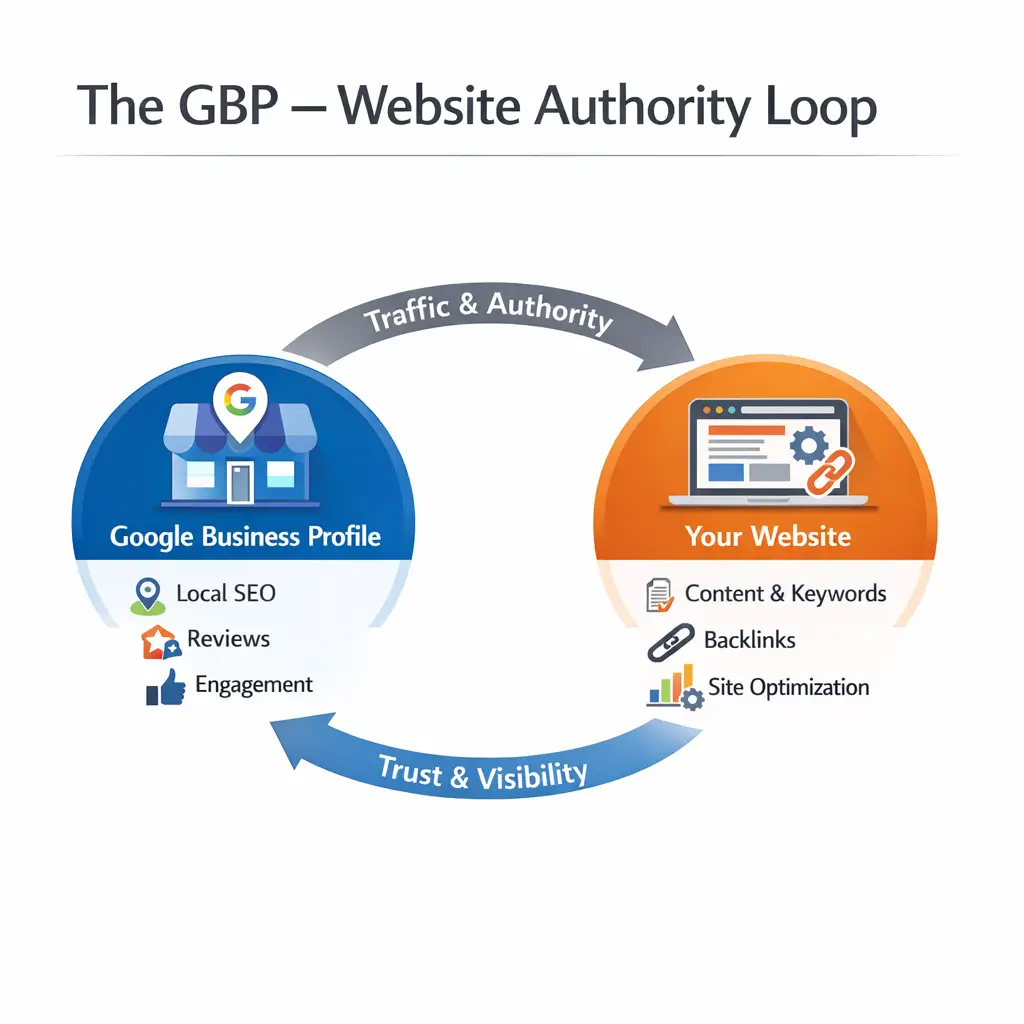
Here’s the practical architecture to build:
- Category-to-page mapping: Every primary and secondary GBP category should correspond to a dedicated, optimized page on your website. If your GBP claims five service categories, your website should have five service pages with substantive content — not thin placeholder pages.
- LocalBusiness schema markup: Implement structured data on your website that explicitly confirms your business name, address, phone number, operating hours, and service types. This is a direct communication channel to Google’s crawler that confirms your GBP data is accurate and trustworthy.
- Google Map embed on contact page: Embedding a live Google Map of your business location on your contact or location page creates a reverse geographic signal. It tells Google that your website is geographically anchored to the same location as your GBP — a relevance reinforcement that most businesses overlook.
- NAP consistency across all surfaces: Your business name, address, and phone number must be identical — character for character — across your GBP listing, your website footer, Yelp, Bing Places, Apple Maps, and any other directory where your business appears. Inconsistencies don’t just look unprofessional. They create conflicting authority signals that actively suppress your local rankings.
Service-Area Businesses: A Different Set of Rules
If your business serves customers at their location rather than at a fixed address — plumbers, landscapers, cleaning services, mobile pet groomers — your GBP optimization strategy requires a different approach. Service-area businesses (SABs) should hide their physical address in GBP settings (per Google’s guidelines) and instead define their service area by city, county, or zip code. Your website should support this with location-specific landing pages that are substantive enough to rank on their own — not duplicate pages with a city name swapped in.
Category Selection: Precision Over Volume
Category selection is one of the highest-impact decisions you’ll make in your GBP, yet most guides treat it as a quick step rather than a strategic one. Your primary category carries the most algorithmic weight and should be the single most precise description of your core business offering. Broader is not better here. “Plumber” and “Emergency Plumber” are different categories with different ranking implications for different search queries.
Secondary categories extend your relevance footprint — but adding every loosely related category is counterproductive. Google’s algorithm is sophisticated enough to recognize when a category list looks artificially padded, and over-categorization can dilute the relevance signal of your primary category.
How to audit your category strategy:
- Identify the top three to five search queries that drive the most business value for you
- Work backward from those queries to find the GBP categories that most precisely match them
- Verify that each category you select has a corresponding service page on your website
- Review your competitors’ category selections using Google Maps — click on a competitor’s listing, and their primary category is visible. This competitive intelligence takes three minutes and directly informs your own selection
Review Signal Architecture: Beyond the Star Rating
Every GBP guide says the same thing: get more reviews and respond to them. That advice isn’t wrong, but it describes approximately 10% of what’s actually happening algorithmically when Google evaluates your review profile.
Google weights reviews across at least four distinct dimensions, and understanding all four changes your entire approach to review acquisition and management.
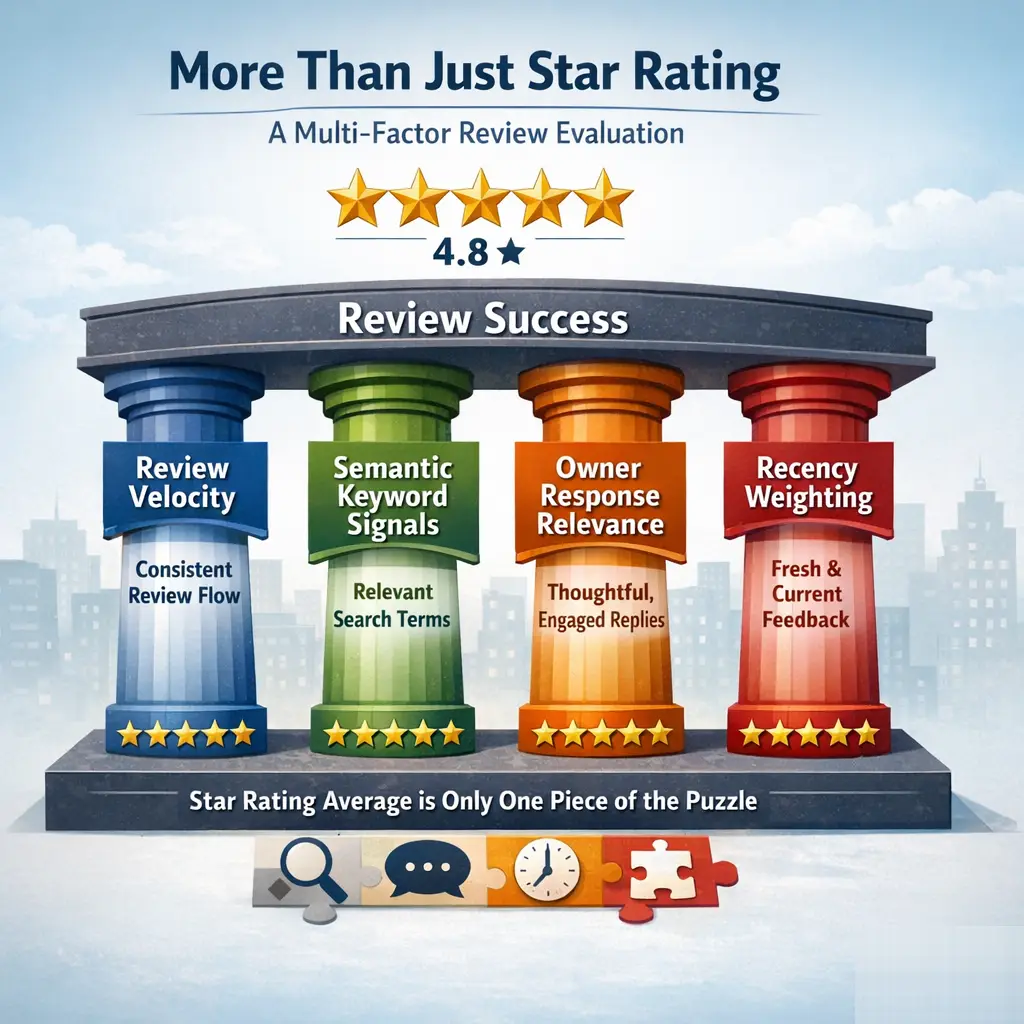
The Four Dimensions of Review Signal Strength
| Dimension | What It Means | What You Should Do |
|---|---|---|
| Review Velocity | The rate at which new reviews arrive over time. A sudden spike of 20 reviews in a single week can trigger Google’s spam detection and temporarily suppress rankings. | Build a consistent, sustainable review acquisition process — not a one-time push. Three to five new reviews per month, steady, outperforms 30 reviews in a week. |
| Semantic Keyword Signals | When customers naturally mention your service type and location in their review text (“best emergency plumber in Austin”), Google reads this as third-party confirmation of your relevance for those search terms. | Coach customers on what to include without scripting their reviews. Reminding them to mention the specific service and location they needed is entirely legitimate and strategically valuable. |
| Owner Response as Keyword Injection | Your responses to reviews are indexed by Google. The text of your responses contributes to your profile’s keyword relevance signals. | Respond to every review — positive and negative — and naturally include your service type and location in your response. “Thank you for trusting us with your roof repair in Denver” is more valuable than “Thanks for the kind words!” |
| Recency Weighting | Google’s algorithm appears to favor recent review activity over historical accumulation. A business with a 4.2-star average built over the last 90 days may outrank a 4.7-star average built over five years. | Treat review acquisition as an ongoing operational process, not a campaign. Active businesses generate fresh reviews. Fresh reviews signal an active business. |
Google Posts: The 7-Day Content Window Most Businesses Waste
Google Posts are consistently listed as a GBP feature to use. What competitors never explain is how they work algorithmically and why most businesses use them in a way that generates almost no benefit.
Standard Google Posts expire after seven days. After that window, they no longer appear prominently on your profile. This means a business that publishes one post per month is getting approximately six days of visibility per month from that feature — and nothing else.
The businesses getting real SEO value from Google Posts are publishing on a weekly cadence and structuring their posts with intent.
How to Structure Posts for Keyword Relevance
A Google Post is not a social media update. It’s an indexable content node inside Google’s own ecosystem. Treat it accordingly:
- Lead with your target service term and location in the first sentence. Google reads the opening text as the most authoritative content in the post.
- Include a specific call to action — not just “Learn More” but action-oriented language tied to the service: “Schedule your free roof inspection” or “Request a same-day service call.”
- Avoid purely promotional language. Posts that read like advertisements tend to generate lower engagement signals, which feed back into how prominently Google displays them.
- Use Event posts for time-sensitive offers and Update posts for general content. Each post type has different display real estate on your profile. Understanding when to use each type is the difference between a post that performs and one that disappears.
The Q&A Section: An Indexable Asset You’re Probably Ignoring
The Q&A section is the most underutilized high-value feature in all of Google Business Profile. Most businesses either leave it completely empty or don’t know it exists. That’s a significant missed opportunity — and a potential liability.
Why Q&A Matters Algorithmically
Questions and answers on your GBP profile are publicly indexed by Google. They appear in your Knowledge Panel and, in some cases, surface in featured snippets on the main SERP. This means your Q&A section is a direct channel to organic search real estate beyond the local pack.
More importantly: if you don’t manage your Q&A section, anyone can. Competitors, dissatisfied customers, or simply uninformed members of the public can post questions — and answer them — with no notification to you by default. Incorrect or misleading answers can appear publicly on your profile and influence purchasing decisions before you even know they’re there.
How to Seed and Manage Your Q&A Section
Business owners can ask and answer their own questions from the Google Maps app. This is explicitly within Google’s guidelines. Use this capability strategically:
- Identify the questions your sales team answers on the phone every day. Those are the questions your customers are asking Google, too.
- Write questions that mirror actual search query language. “Do you offer same-day HVAC service in [City]?” is more valuable than “What are your hours?” because it contains geographic and service-type keyword signals.
- Answer questions thoroughly but concisely. Include your service type, location, and a clear next step in every answer.
- Audit your Q&A section monthly. Check for questions that have been answered by the public with incorrect information and post the correct answer yourself. Upvote your own answers using your Google account to move them to the top.
Photo Strategy: What Google’s Vision AI Actually Sees
The standard photo advice — upload high-resolution images at the recommended dimensions — is necessary but insufficient. Google’s Vision AI actively analyzes the content of your photos to extract contextual signals about your business type, services, and location.
Building a Photo Strategy That Feeds Relevance Signals
- Label your photos by category before uploading. GBP allows you to assign photos to categories like Exterior, Interior, At Work, Team, and Food & Drink. These category labels are part of the metadata that Google reads. Use them deliberately.
- Geotag your images before uploading. Embedding GPS coordinates in your image metadata — using a free geotagging tool — tells Google’s systems the physical location associated with that photo, reinforcing your geographic relevance signal.
- Show your work, not just your brand. A photo of your team performing the actual service (“at work” in context) gives Google’s Vision AI more to work with than a logo on a white background. The algorithm extracts contextual signals from image content — tools, environments, uniforms, and settings all contribute.
- Don’t neglect the 360-degree interior photos. Google Street View interior photos are owned and managed separately from standard GBP photos, but they contribute to the overall completeness signal of your profile. Profiles with higher completeness scores consistently perform better in ranking studies.
- Monitor and manage customer-uploaded photos. Customers can upload photos to your profile without your approval. Review these regularly. Flag and request removal of any that are misleading, low-quality, or off-brand. You can flag photos directly from your GBP dashboard.
Attributes and Services: The Hidden Keyword Real Estate
Your Services section allows custom descriptions of up to 300 characters per service. Most businesses leave these blank or write a single-line entry. Each description is an opportunity to embed natural, keyword-relevant content inside Google’s own platform.
The architecture of your Services section should mirror your website’s service page hierarchy. If your website has dedicated pages for “Residential HVAC Installation,” “Commercial HVAC Maintenance,” and “Emergency HVAC Repair,” your GBP Services section should reflect exactly that structure — with descriptions that reinforce the same keyword signals.
Attributes are equally overlooked. GBP offers a range of business attributes — accessibility features, payment methods, service guarantees, certifications — that contribute to relevance matching for specific search queries. A business that selects “Licensed & Insured” as an attribute is more likely to appear for searches that include those terms than a competitor who left the field blank. Audit your available attributes, because Google periodically adds new ones based on your business category.
Bringing It Together: The GBP Optimization Priority Stack
Not every tactic carries equal ranking weight. Based on how Google’s three core ranking factors operate, here is the priority order for your optimization efforts:
| Priority | Tactic | Primary Ranking Factor Affected |
|---|---|---|
| 1 | Primary category selection + website service page alignment | Relevance |
| 2 | LocalBusiness schema markup on website | Prominence |
| 3 | Consistent NAP across all citation sources | Prominence |
| 4 | Systematic review acquisition with semantic coaching | Relevance + Prominence |
| 5 | Owner responses with keyword context | Relevance |
| 6 | Seeded Q&A section with search-query-mirrored language | Relevance |
| 7 | Services section with keyword-rich descriptions | Relevance |
| 8 | Weekly Google Posts with service + location context | Relevance |
| 9 | Geotagged, category-labeled photo uploads | Relevance |
| 10 | Attribute completion | Relevance |
For businesses starting from a weak baseline, working through this stack in order produces compounding results — each layer reinforcing the signals established by the one before it.
The Measurement Framework: What to Track and Why
Optimization without measurement is guesswork. Your GBP dashboard provides native performance data that most business owners either ignore or misread. The metrics that matter most are:
- Search queries: The actual terms people used to find your profile. This tells you whether your relevance signals are working for the keywords you care about — and reveals keyword opportunities you may not have targeted yet.
- Views by surface: Whether your profile appeared in the local pack (map view) or direct search. A high direct search rate suggests strong brand awareness; a high discovery rate suggests your keyword relevance is working.
- Direction requests and website clicks: These are the conversion metrics that connect GBP performance to actual business activity. If your views are high but direction requests are low, there’s a gap in how compelling your profile is to act on.
- Phone calls from profile: If a significant portion of your inbound calls are attributed to GBP, that’s a direct revenue line that you can track and optimize.
For more advanced rank tracking, look at where your listing appears in the local pack across a geographic grid — not just in your immediate location. Grid-based rank tracking tools give you a more accurate picture of your actual local search footprint across your full service area. If you want a deeper look at how local SEO optimization drives rankings beyond GBP alone, that article covers the broader strategic framework in detail. For independent verification resources on local SEO benchmarking, BrightLocal’s annual Local Consumer Review Survey and Moz’s State of Local SEO report are reliable industry references worth reviewing.
The difference between a GBP listing that generates consistent inbound leads and one that sits invisible in the local pack almost always comes down to strategic depth — not effort. The businesses winning in local search aren’t working harder on their profiles. They’re working from a better understanding of the system those profiles operate in. That’s the foundation this article is built on, and it’s the foundation your local SEO strategy should be built on too.
Final Strategic Recommendations for 2026
Understanding the system is only half the equation. The other half is choosing the right tools and actions to execute on that understanding consistently. Here are three specific recommendations worth prioritizing as you move into 2026:
1. Adopt a Grid-Based Local Rank Tracker
Tools like Local Falcon or BrightLocal’s rank tracking give you a geographic heat map of where your listing actually appears across your service area — not just at your business address. This visibility is essential for multi-location businesses and service-area businesses alike, because your ranking in the center of a city and three miles out can be dramatically different. Knowing that gap exists is the first step to closing it.
2. Build a Review Generation System — Not a Review Request Habit
The businesses with the strongest review velocity aren’t asking customers manually. They’ve built a repeatable process: a post-service follow-up sequence, a direct link to the GBP review form, and a response workflow so every review gets acknowledged. In 2026, with AI-generated summaries increasingly surfacing review sentiment in search results, the volume, recency, and language of your reviews matter more than ever. Systematize it or fall behind businesses that have.
3. Integrate GBP Activity With Your Broader Local Content Strategy
Google Posts, Q&A responses, product and service descriptions, and photo updates shouldn’t exist in isolation. They should reflect and reinforce the same topical signals your website is building. If your website targets “emergency HVAC repair in [city],” your GBP posts, service descriptions, and photo captions should echo that language naturally. Alignment across channels compounds your relevance signals — and that compounding is what separates profiles that rank consistently from those that rank occasionally. For a broader look at how these signals connect across channels, the article on local SEO for Ohio service businesses walks through how this integration plays out in practice for service-area companies.
Frequently Asked Questions
How often should I update my Google Business Profile to maintain good rankings?
There’s no single update frequency that guarantees ranking improvements, but consistent activity signals to Google that your profile is actively managed. At minimum, aim to post a Google Post once per week, respond to all new reviews within a few days, and audit your core business information — hours, services, description — at least once per quarter or whenever something in your business changes. Profiles that show regular engagement across multiple features tend to outperform dormant ones in competitive local markets.
Does the category I choose on my Google Business Profile really affect where I rank?
Yes — your primary category is one of the strongest relevance signals your profile sends to Google. It directly influences which searches your listing is eligible to appear in. Choosing a primary category that precisely matches your core service, rather than a broader or adjacent one, can meaningfully affect visibility. Secondary categories extend that reach for related services, but your primary category should always reflect the single most important thing your business does.
What’s the difference between a Google Business Profile appearing in the local pack versus organic search results?
The local pack — the map results that typically appear near the top of a search result — is driven primarily by your Google Business Profile, while organic results below it are driven by your website’s SEO. They’re related but separate systems. Optimizing your GBP improves your chances of appearing in the local pack; optimizing your website improves your organic rankings. The strongest local search strategies work both levers simultaneously, because appearing in both placements significantly increases the likelihood a searcher will choose your business. A technical SEO audit is often one of the most effective starting points for identifying what’s holding your website’s organic performance back.
Can a business with few reviews outrank a competitor with hundreds of reviews?
Yes, and it happens regularly. Review count is one factor among many. Google also weighs proximity to the searcher, the relevance of your categories and business description to the search query, the completeness and accuracy of your profile, and signals from your website. A well-optimized profile with a moderate number of recent, high-quality reviews will frequently outperform a neglected profile that accumulated a large review count years ago. Recency and profile depth can offset review volume gaps, especially in less competitive markets.
If you’re ready to stop guessing and start building a Google Business Profile strategy that produces measurable results, Mongoose Digital Marketing works with businesses across the region — from local service providers to multi-location companies — to turn underperforming GBP listings into consistent sources of inbound leads. Whether you’re focused on improving local search visibility in your immediate area or expanding your footprint across a broader service region, the work starts with a conversation. Contact Mongoose Digital Marketing to talk through where your profile stands and what it would take to get it working harder for your business.