
Key Takeaways
- Digital marketing SEO services encompass technical optimization, on-page content, off-page authority building, and local search visibility, each addressing a distinct layer of how Google discovers, evaluates, and ranks a website.
- Google’s official guidance lists “Optimizing for generative AI” among the useful services SEOs and agencies provide, meaning AI search visibility (appearing in ChatGPT, Gemini, and Google AI Overviews) is now a measurable, actionable component of a complete SEO strategy.
- A meaningful SEO result connects search actions to business outcomes, such as qualified leads, conversion rate improvements, and revenue, not just keyword ranking counts or raw traffic volume.
- Before granting any agency access to your Google Search Console, Google’s own documentation advises limiting that access to read-only during the audit phase, and any agency guaranteeing a first-place ranking is a disqualifying signal.
- The distinction between crawlability (can Google reach your pages?) and indexability (will Google include them in its index?) represents two separate technical problems requiring separate diagnoses, and collapsing them into a single “technical SEO” checkbox is a common agency shortcut that leaves real issues unresolved.
Choosing a digital marketing SEO partner comes down to three decisions: whether the agency can explain what it is actually doing and why, whether its reporting connects to your business outcomes rather than vanity metrics, and whether the contract structure aligns the agency’s incentives with your results. Everything else, the service menu, the badge count, the case study headlines, is secondary to those three questions.
This guide is written for business owners in Dayton, Kettering, Beavercreek, Centerville, Huber Heights, Miamisburg, and Springboro who are evaluating SEO services seriously and want a clear framework for understanding what good looks like, what to watch out for, and how to measure real progress.
What Digital Marketing SEO Services Actually Cover
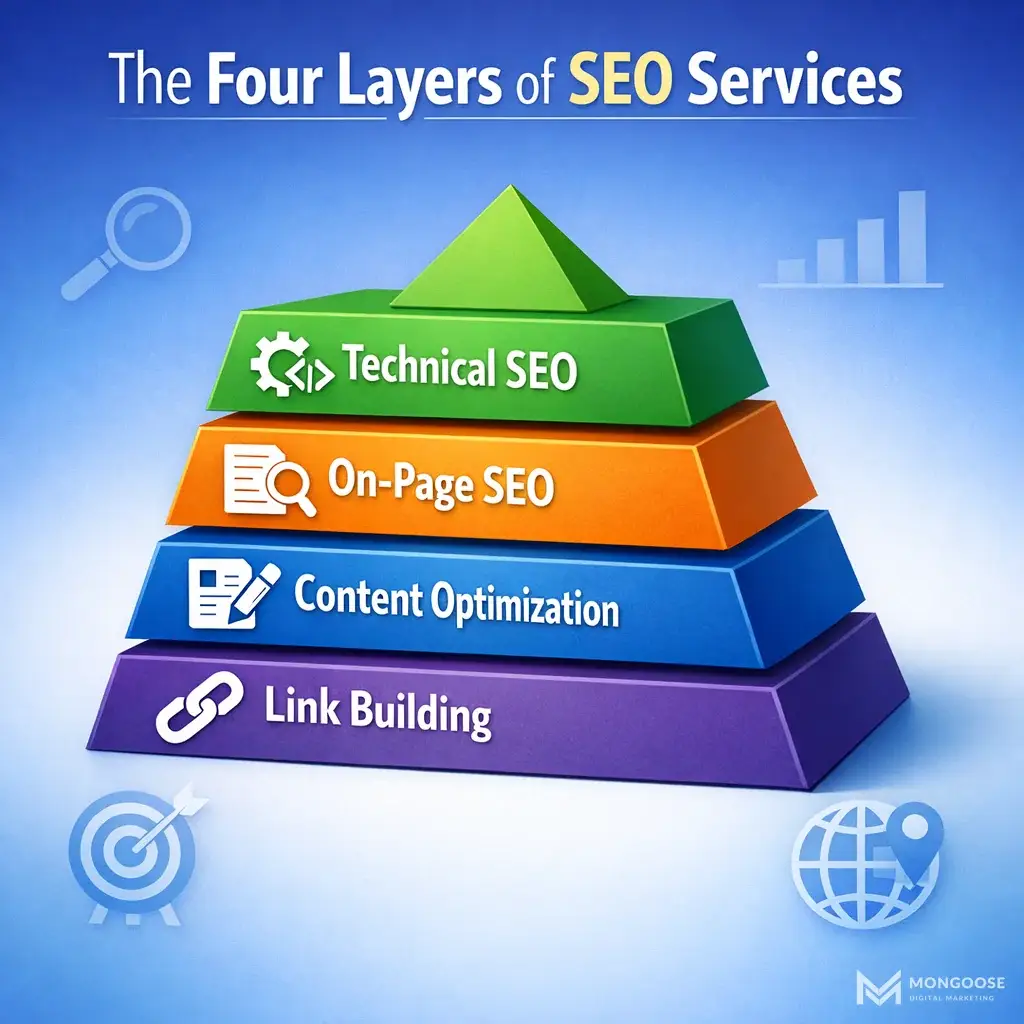
SEO is not a single service. It is a set of distinct disciplines that each address a different layer of how search engines find, read, and rank your website. A credible agency should be able to describe each layer separately and explain what problem it solves for your specific situation.
Technical SEO: Crawlability vs. Indexability
Most agencies bundle these together under “technical SEO,” but they are not the same problem.
Crawlability refers to whether Google’s automated crawlers can physically reach your pages. Blocked resources in your robots.txt file, JavaScript rendering issues, or server errors can prevent Googlebot from accessing content entirely. Google’s own starter guide confirms that if your site hides important components like CSS or JavaScript, Google may not be able to understand your pages at all. [Source: developers.google.com/search/docs/fundamentals/seo-starter-guide]
Indexability is a separate question: even if Google can crawl a page, will it include that page in its index and serve it in results? Duplicate content, canonical tag errors, thin pages, and manual actions can all cause Google to crawl a page without indexing it. A site can be perfectly crawlable and still have significant indexability problems.
When evaluating an agency, ask directly: “Do you treat crawlability and indexability as separate audits?” If the answer is a generic reference to “technical SEO,” that is a meaningful gap in diagnostic rigor. Our article on Technical SEO Services Dayton goes deeper on how these distinct diagnoses surface the issues most agencies overlook.
On-Page Optimization
On-page work covers the elements within each page that communicate relevance to search engines and value to readers. This includes title tags, meta descriptions, heading structure, internal linking, URL construction, page speed, mobile usability, and the alignment between a page’s content and the search intent behind its target keyword.
The keyword-to-intent alignment piece is where on-page SEO connects directly to business outcomes. Ranking for a keyword with no purchase intent produces traffic that does not convert. A well-structured on-page strategy targets keywords at the right stage of the buyer’s journey, which is what separates traffic growth from lead growth.
Off-Page Authority and Link Building
Off-page SEO centers on signals that exist outside your website, primarily the quantity and quality of other websites linking to yours. Google interprets links from credible, relevant sources as endorsements of your content’s authority. Link building is the process of earning or developing those endorsements systematically.
The quality of a link matters more than the volume. A single link from a well-regarded regional publication or an industry association carries more weight than dozens of links from low-authority directories.
Local SEO for Miami Valley Businesses
For businesses serving Dayton, Kettering, Beavercreek, Centerville, Huber Heights, Miamisburg, and Springboro, local SEO is the discipline with the most direct connection to lead generation. It focuses on ranking in Google’s local pack (the map results), maintaining a complete and accurate Google Business Profile, and building consistent name, address, and phone number (NAP) data across directories and citations.
Local SEO also includes geographically relevant content and locally focused keyword targeting, ensuring that searches with city or neighborhood modifiers surface your business prominently. For a closer look at how these strategies apply specifically to this market, the article on Digital Marketing Dayton OH outlines the local tactics that move the needle for Miami Valley businesses.
Illustration, not a photograph of a completed client project.
Have a question about digital marketing seo services? Send a message with the situation you are working through and the decision you need help with. Ask for a written explanation of possible next steps.
AI Search Optimization: What It Is and How It Actually Works
Every major SEO agency now mentions AI search optimization. Few explain the mechanism behind it.
Google’s official guidance on hiring an SEO lists “Optimizing for generative AI” among the useful services SEOs and agencies provide. [Source: developers.google.com/search/docs/fundamentals/do-i-need-seo] AI-generated answers in Google AI Overviews, ChatGPT responses, Gemini summaries, and Perplexity citations are becoming primary discovery points for consumers researching businesses and services.
The question is: what causes an AI model to cite your business rather than a competitor?
The Entity Disambiguation Chain
Large language models do not crawl the web in real time the way Googlebot does. They develop understanding of entities, specifically brands, people, products, and services, through repeated, consistent exposure to well-structured information across multiple authoritative sources. The mechanism works in a sequence:
Consistent entity information: Your business name, services, location, and core descriptors must appear consistently across your website, Google Business Profile, industry directories, and third-party publications. Inconsistency creates ambiguity that AI models resolve by choosing a competitor with clearer signals.
Schema markup for AI legibility: Structured data (schema.org markup) communicates machine-readable facts about your business. Schema types like Organization, Service, LocalBusiness, and FAQ each serve a different purpose. Organization schema helps AI systems identify who you are and what category you belong to. Service schema specifies what you offer. FAQ schema provides direct question-and-answer content that AI tools can extract and cite verbatim.
Authoritative content signals: AI models cite sources they can verify against multiple reference points. Content that demonstrates clear expertise on a specific topic, backed by named entities and linkable facts, increases the probability of citation. Thin pages or content that hedges on every claim are less likely to be referenced.
Third-party brand mentions: AI training and retrieval systems weight information that appears in independent, credible sources. Press coverage, industry association listings, local business citations, and expert roundups all contribute to brand authority in AI retrieval contexts.
The practical implication: AI search optimization is not a separate product added on top of traditional SEO. It is an extension of the same foundation. Strong entity clarity, consistent structured data, and authoritative content serve both Google’s traditional ranking systems and AI generative answers simultaneously.
How to Evaluate SEO Results: Business Metrics vs. Vanity Metrics
This is where most agency relationships go wrong. A case study headline showing a large percentage increase in keyword rankings is not, on its own, evidence of business impact.
Google’s guidance on hiring an SEO states that an honest agency should provide “realistic estimates of improvement,” with the clear implication that SEO actions should connect to business outcomes, not just search metrics. [Source: developers.google.com/search/docs/fundamentals/do-i-need-seo]
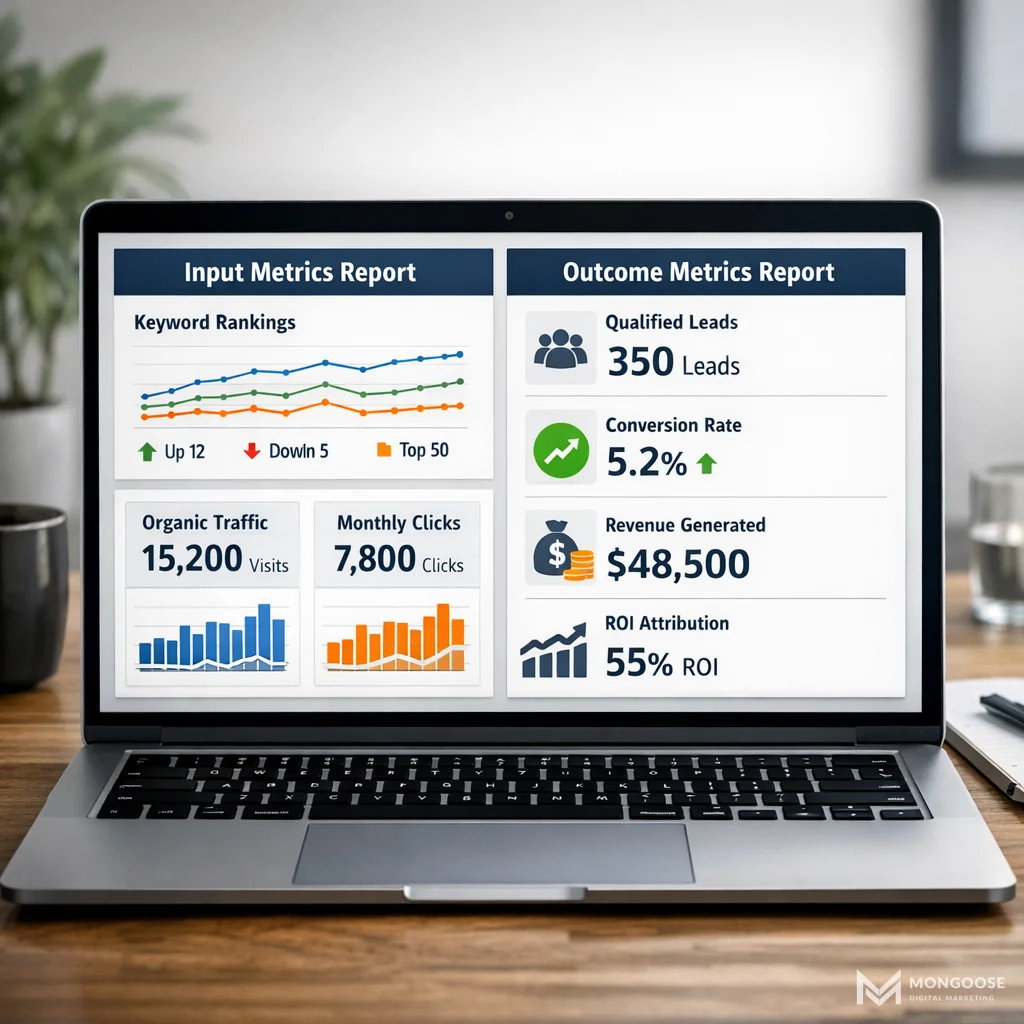
The table below distinguishes input metrics (what agencies control) from outcome metrics (what your business actually cares about):
| Metric Type | Example | What It Tells You | What It Does Not Tell You |
|---|---|---|---|
| Input metric | Keyword rankings increased 400% | Pages are gaining visibility | Whether those keywords have purchase intent |
| Input metric | Organic traffic up 200% | More visitors arriving | Whether visitors match your target customer profile |
| Input metric | Backlinks acquired: 85 new | Off-page authority building | Quality and relevance of those linking domains |
| Outcome metric | Qualified leads from organic: up 60% | SEO is generating real demand | Baseline lead quality still requires review |
| Outcome metric | Conversion rate on organic traffic: up 35% | Traffic is better matched to offer | Whether this scales with volume |
| Outcome metric | Revenue attributed to organic: up 40% | SEO is contributing to growth | Attribution model accuracy matters here |
When reviewing an agency’s case studies or monthly reports, ask which column their headline numbers come from. Input metrics are easier to move and easier to manipulate. Outcome metrics require genuine alignment between search strategy and business goals.
What Constitutes a Meaningful Result at Different Stages
For a business with little existing online presence, meaningful early results include: indexation of all key pages confirmed in Google Search Console, Google Business Profile appearing in local pack results for primary service keywords, and baseline organic traffic establishing a measurable starting point.
For a business with existing organic traffic, meaningful results include: conversion rate improvement on organic landing pages, lead volume growth from non-branded keyword traffic, and reduction in cost-per-lead across channels as organic picks up share.
For a business competing in a mature, competitive market, meaningful results include: share-of-voice growth against named competitors on high-intent keywords, AI search citation tracking across primary product and service queries, and revenue attribution from organic channels over rolling 90-day windows.
Red Flags When Evaluating a Digital Marketing SEO Agency
Google’s official guidance on hiring SEO professionals is direct about the risks. The following signals are worth treating as disqualifying:
- Guaranteed first-place rankings. Google’s documentation states directly: “If they guarantee you that their changes will give you first place in search results, find someone else.” No agency controls Google’s algorithm. [Source: developers.google.com/search/docs/fundamentals/do-i-need-seo]
- Write access to Search Console during an audit. Google advises granting only read access during an initial audit phase. An agency that requests write access before you have a signed agreement and established trust is asking for more control than the audit stage requires.
- AI visibility claims without a measurement methodology. If an agency claims to improve your AI search citations but cannot explain how they track which AI models reference your brand, which queries trigger those citations, and what a baseline looks like, the claim is unverifiable.
- Keyword rankings as the primary success metric. Rankings are an input. If an agency’s reporting stops at ranking positions without connecting to traffic quality and conversions, the reporting is incomplete.
- Long-term contracts with no performance benchmarks. The contract structure question is worth examining directly. A confident agency should be willing to define what success looks like at 90 days and 180 days, with clear benchmarks that hold both parties accountable.
Illustration, not a photograph of a completed client project.
How SEO and Paid Channels Work Together
One dimension that most SEO service pages skip entirely is the interaction between organic SEO and paid advertising (PPC). These channels do not operate in isolation, and treating them as separate line items misses real strategic leverage.
PPC campaign data reveals which keywords convert at the highest rate in your specific market. That conversion data directly informs which organic keywords are worth the investment to target, because you already know they produce leads, not just traffic. Without this cross-channel feedback loop, organic keyword prioritization relies on search volume and competition estimates alone, which is a coarser instrument.
Similarly, strong organic rankings for branded and near-branded keywords reduce your dependence on paid branded campaigns, lowering cost-per-acquisition across the board. Businesses that grow organic share of voice systematically reduce the paid budget required to maintain lead volume targets.
For businesses in the Miami Valley region, working with a single partner who manages both SEO and PPC creates this feedback loop by default. Data from one channel informs the other in real time, without the delays and translation errors that come from coordinating between separate vendors. The article on digital marketing services for small businesses explains how this integrated approach works in practice for businesses at different stages of growth.
Working With Mongoose Digital Marketing on SEO
Mongoose Digital Marketing serves businesses across Dayton, Kettering, Beavercreek, Centerville, Huber Heights, Miamisburg, Springboro, and the broader Miami Valley with SEO, PPC, web design, and social media under one roof. The integration matters strategically: paid search data informs organic priorities, web design decisions are made with SEO architecture in mind from the start, and reporting connects to business outcomes rather than stopping at rankings.
If you want to understand what an honest assessment of your current search visibility looks like, start with a free consultation. There is no obligation and no audit designed to manufacture urgency. The goal is a clear picture of where you stand and what the realistic path forward looks like for your specific business.
Contact Mongoose Digital Marketing to schedule your free consultation.
For the foundational framework Google uses to evaluate SEO quality and what it recommends for businesses hiring an SEO partner, Google’s official SEO Starter Guide and hiring guidance are the primary reference points: developers.google.com/search/docs/fundamentals/seo-starter-guide and developers.google.com/search/docs/fundamentals/do-i-need-seo.
Frequently Asked Questions
How long does it take to see results from digital marketing SEO services?
Google’s own guidance notes that changes can take anywhere from a few hours to several months to be reflected in search results. For most businesses, a realistic framework is this: technical and indexation improvements tend to show measurable progress in Google Search Console within the first 60 to 90 days, while competitive keyword rankings and meaningful lead volume growth from organic channels typically develop over a six to twelve month horizon. Any agency promising dramatic ranking improvements within days is describing a timeline that contradicts how Google’s systems actually work.
What is the difference between local SEO and general organic SEO?
Local SEO focuses specifically on visibility in geographically filtered searches, including Google’s local pack (the map results), Google Business Profile optimization, and consistent name, address, and phone number data across directories. General organic SEO targets non-geographic search visibility across a broader keyword landscape. For businesses serving defined areas like Dayton, Kettering, Beavercreek, or Centerville, local SEO is typically the higher-priority investment because it directly connects search visibility to the geographic market where leads actually convert. The two disciplines share a technical foundation but require distinct strategies and are measured differently.
What should I actually look at in an SEO agency’s monthly report?
A well-constructed report connects search activity to business outcomes rather than stopping at input metrics. Look for data on qualified lead volume from organic traffic, conversion rates on organic landing pages, and changes in non-branded keyword traffic, meaning searches from people who did not already know your business name. Rankings and traffic volume are useful context, but they are not the answer to the question your business is actually asking, which is whether SEO is generating real demand. If a report leads with a large percentage increase in keyword rankings but does not show what those keywords produced in terms of leads or conversions, ask directly for the outcome data.
Does appearing in AI-generated answers like Google AI Overviews require a completely different strategy from traditional SEO?
No. AI search visibility is an extension of the same foundation that supports traditional organic rankings, not a separate product built on different principles. Consistent entity information across your website and third-party sources, accurate structured data markup, and content that demonstrates clear expertise on specific topics all serve both Google’s traditional ranking systems and the AI retrieval systems that generate answers in tools like Google AI Overviews, ChatGPT, and Gemini. Google’s own documentation lists “Optimizing for generative AI” among the useful services SEOs and agencies provide, which confirms that the underlying work is continuous with, not separate from, a complete SEO strategy. [Source: developers.google.com/search/docs/fundamentals/do-i-need-seo] The meaningful difference is in measurement: tracking AI citations requires different tooling than tracking keyword rankings, and any agency claiming AI visibility improvements should be able to show you a baseline and a methodology for tracking change over time.
Conclusion
The decision about which digital marketing SEO partner to work with comes down to a simple diagnostic: can the agency explain what it is doing, why it matters for your specific business, and how it will be measured in terms that connect to your actual goals rather than to a dashboard of rankings and traffic counts?
This guide has covered the distinct disciplines within SEO, the mechanism behind AI search visibility, the difference between input metrics and outcome metrics, the contract and access questions worth asking before you sign anything, and the specific ways SEO and paid channels interact to strengthen each other when managed together. Every section points back to the same core standard: transparency about process, honesty about timelines, and reporting that serves your business decisions rather than an agency’s renewal conversation.
For businesses in Dayton, Kettering, Beavercreek, Centerville, Huber Heights, Miamisburg, Springboro, and the broader Miami Valley, the framework above is the clearest way to distinguish a partner who will invest in your long-term search presence from one selling the appearance of progress. Apply it to every conversation you have, including any conversation with Mongoose Digital Marketing.