
Key Takeaways
- SEO strategy for a startup should be sequenced by bottleneck: technical integrity first, then keyword architecture, then content depth, then authority-building link campaigns, because pouring budget into link acquisition on a technically broken site solves the wrong constraint.
- The winner-takes-all nature of search results, where the top three positions capture the majority of clicks, means a startup that cannot yet compete for head terms is better served by a deliberate long-tail and niche-cluster entry strategy, not a scaled-back version of the same plan.
- Funding stage materially changes what SEO work looks like: a pre-launch startup needs a crawlable foundation and keyword architecture, a post-seed startup needs content depth to convert informational demand, and a post-Series A company needs authority-building campaigns to contest competitive head terms.
- AI search platforms including ChatGPT, Perplexity, and Google AI Overviews now distribute traffic independently of traditional blue-link rankings, and a startup in an informational category faces meaningfully greater displacement risk than one competing for transactional queries.
- SEO is not the right channel for every startup at every stage; a qualified agency should assess competitive difficulty and runway against realistic ranking timelines before any engagement begins.
Startup SEO fails in a predictable pattern. A founder allocates budget, an agency runs an audit, a content calendar launches, and twelve months later the organic traffic chart is essentially flat. The service stack looked right on paper. The reporting showed activity. But the underlying constraint was never correctly identified, so every tactic addressed the wrong problem.
This article explains how to identify the actual bottleneck in your startup’s search performance, how SEO strategy should shift as your company moves through funding stages, and what questions to ask before engaging any agency including Mongoose Digital Marketing. The goal is to give you enough of the decision framework that you can evaluate options with clarity rather than hope.
Why the Standard Startup SEO Package Rarely Reflects Your Actual Situation
Every agency selling startup SEO services offers roughly the same stack: technical audit, keyword research, on-page optimization, content production, link building, and monthly reporting. The sequence is presented as universal. It is not.
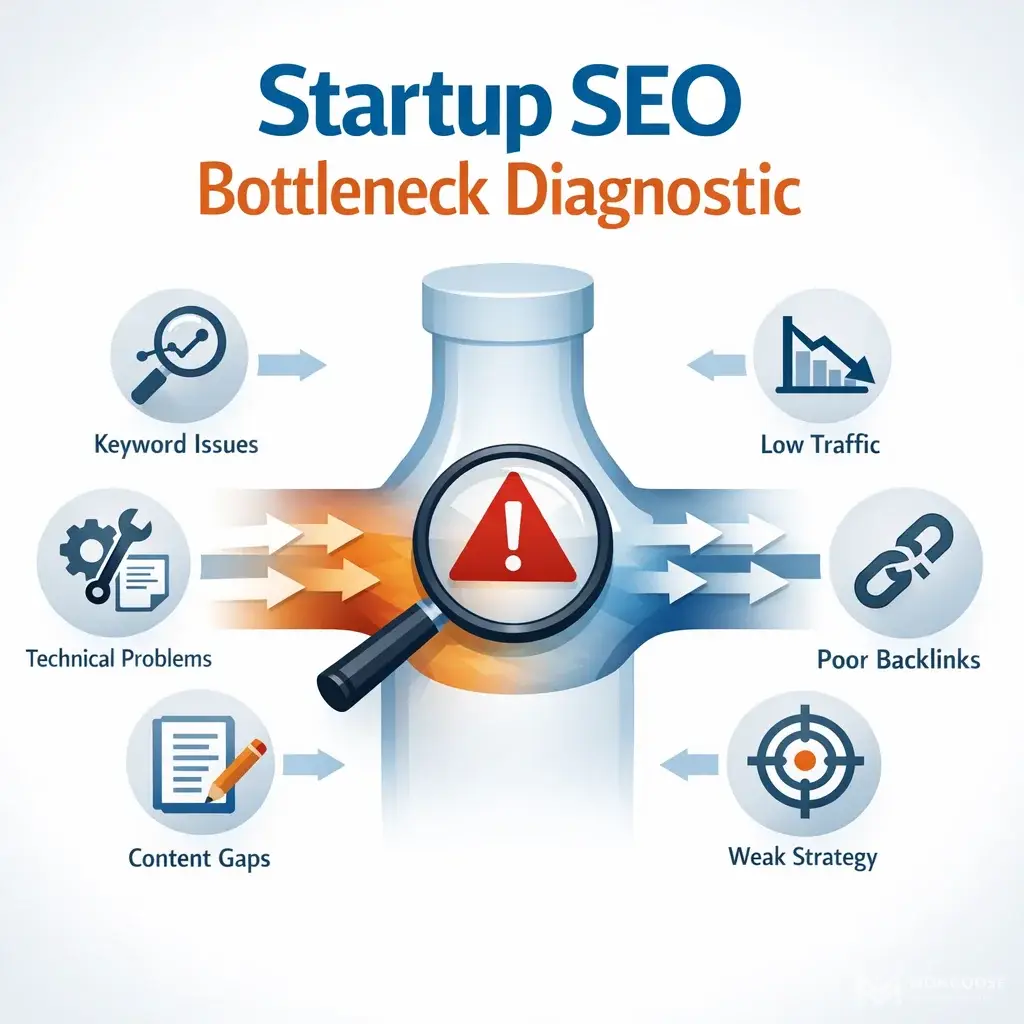
The service list is not wrong. The problem is that the order of priority, the budget allocation between those activities, and the realistic competitive window all depend on variables that are specific to your startup. Two companies in adjacent SaaS verticals can have entirely different binding constraints. One might have a technically sound site with strong keyword architecture but zero domain authority. The other might have decent inbound links from press coverage but a site that search engines cannot crawl efficiently. Applying the same playbook to both produces mediocre results for at least one of them.
What a strong agency does before any work begins is diagnose which of those constraints is actually limiting your ranking potential right now. The diagnosis drives the plan, not the other way around. For a deeper look at how a structured diagnostic process works in practice, the SEO Strategy Services Dayton article walks through what going beyond the basics actually requires.
Illustration, not a photograph of a completed client project.
The Sequencing Logic Most Agencies Skip
Technical integrity comes first because it is the prerequisite that determines whether any other investment can compound. A site with crawl errors, slow load times, or broken internal linking structure limits how much credit search engines can assign to content and links, regardless of their quality. Fixing the foundation first is not a bureaucratic formality. It is the condition under which everything downstream produces a measurable return. The Technical SEO Services Dayton article covers the specific failure modes that silently suppress rankings even on sites that appear functional on the surface.
Once technical integrity is confirmed, keyword architecture becomes the highest-leverage activity. This is where funding stage begins to matter significantly, which is covered in the next section.
Content depth and authority-building link campaigns come third and fourth in the sequence, not because they matter less, but because their ROI is calculable only after you know your site is being read correctly by search engines and you have identified keywords where you have a realistic path to the top three positions.
Investing heavily in link acquisition before technical and content foundations are established is one of the most common ways startup SEO budgets produce poor returns. Links amplify whatever signal your site already sends. If that signal is weak or technically compromised, more links produce diminishing results.
Have a question about startup seo services? Send a message with the situation you are working through and the decision you need help with. Ask for a written explanation of possible next steps.
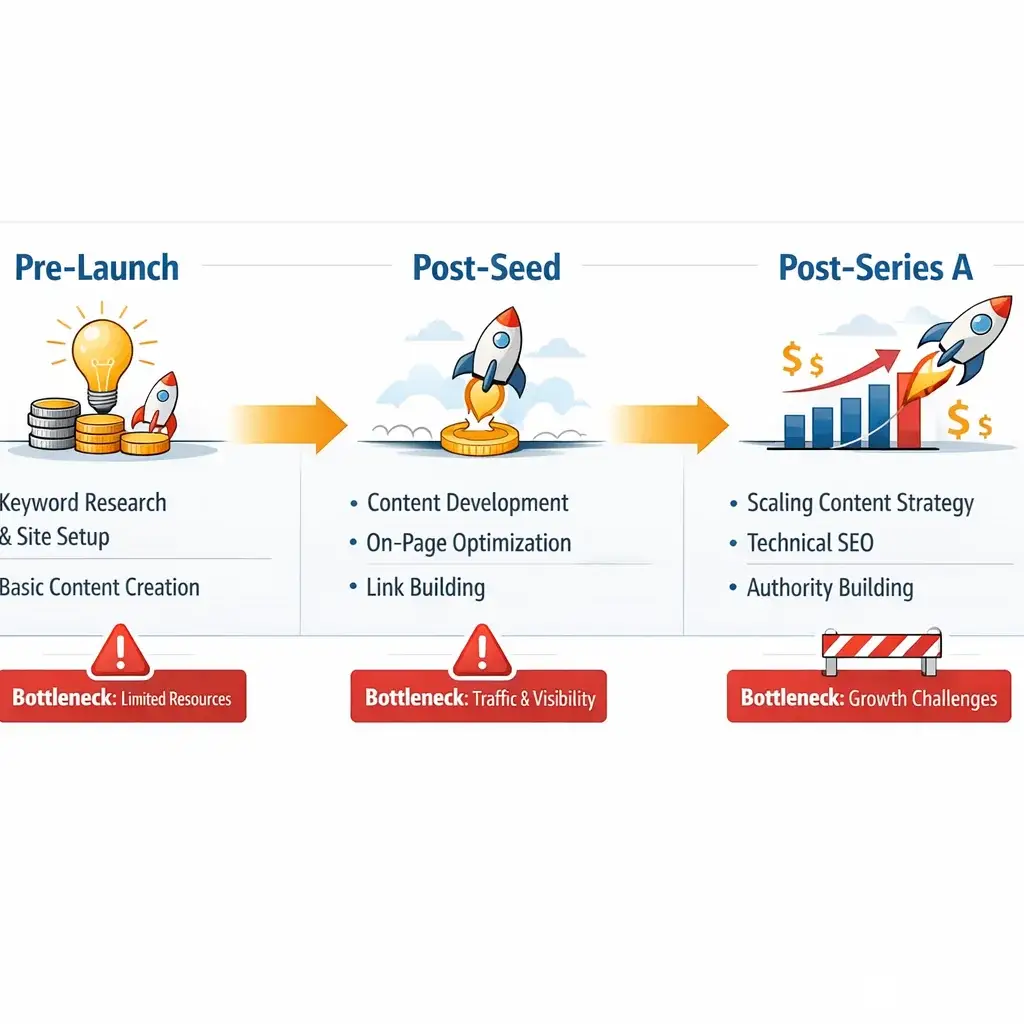
How Funding Stage Changes What SEO Actually Looks Like
Most agencies acknowledge that strategy differs between a pre-launch startup and a post-Series A company. Almost none explain the specific differences in operational terms.
The reasoning is straightforward when you walk through it stage by stage.
Pre-Launch: Foundation and Architecture
A pre-launch startup has no organic traffic to protect and no existing content assets to optimize. The highest-value SEO work at this stage is structural. This means establishing a technically clean site from day one, conducting keyword research that maps buyer intent across the full purchase journey, and building a content architecture that gives the site a clear topical structure search engines can parse.
The keyword work at this stage should prioritize long-tail queries with low competition and clear commercial or informational intent. Head terms in most competitive categories will be held by established players with years of domain authority. Targeting them before building any authority is not ambitious. It is a misallocation of resources that produces no traffic and builds no momentum.
The goal at pre-launch is to enter the index cleanly, establish topical relevance in a defined cluster, and create the foundation on which later content and link work can compound.
Post-Seed: Content Depth and Conversion of Informational Demand
A startup that has launched and is generating initial traffic faces a different constraint. At this stage, the keyword architecture is in place but the site typically lacks the content depth to fully satisfy the informational intent of searches that are adjacent to its core product.
Post-seed SEO investment should focus on publishing content that converts informational searches into brand awareness and product consideration. For SaaS and B2B startups in particular, this means building out comparison pages, category explainers, use-case documentation, and problem-specific guides that intercept potential customers earlier in the decision process.
This is also the stage where initial link acquisition becomes worthwhile, specifically targeted at the pages most likely to convert, rather than broad authority campaigns. The goal is to create concentrated ranking momentum on a small number of high-value pages before scaling the content operation.
Post-Series A: Authority Campaigns and Head Term Competition
A startup with significant runway and an established content library is finally in a position where aggressive link-building campaigns produce the ROI they promise. At this stage the site has topical authority, the technical foundation is sound, and the question shifts to whether domain authority is sufficient to compete for the head terms that carry the highest search volume in the category.
This is the stage where the gap between your site’s authority and the sites currently ranking in positions one through three becomes the primary metric. Closing that gap requires systematic acquisition of high-quality links from relevant, authoritative publications. It requires digital PR. It requires the kind of patience that comes from understanding the compounding nature of organic search rather than expecting linear month-over-month gains.
Illustration, not a photograph of a completed client project.
The Long-Tail Entry Strategy Is Not a Consolation Prize
One of the most consequential misunderstandings in startup SEO is treating long-tail keyword targeting as an inferior version of the strategy you would run if you had more authority. It is not inferior. For most early-stage companies, it is the only path to generating organic traffic that converts within a reasonable timeframe.
The winner-takes-all dynamic in search is real. The top three positions in competitive categories capture disproportionate click volume. A startup that enters a competitive category targeting head terms without the domain authority to reach those positions will spend runway generating impressions at positions 15 through 40, which produce near-zero traffic. The same budget applied to a cluster of long-tail and mid-tail queries, where positions one through three are actually achievable, generates real traffic, real leads, and real compounding authority.
The strategic logic is to identify a niche cluster where competition is low relative to search volume, build genuine topical authority in that cluster, and use the traffic and links generated there to support later campaigns targeting more competitive terms. This is not a detour. It is the sequence.
How to Evaluate Whether a Keyword Is Worth Targeting
The evaluation criteria that matter for a startup with limited domain authority:
| Evaluation Factor | What to Look For | Red Flag |
|---|---|---|
| Top 3 domain authority | Sites with DA below 60 holding top positions | All top 3 positions held by DA 80+ domains |
| Content depth of ranking pages | Thin pages with limited coverage of the topic | Long-form, highly comprehensive existing content |
| Keyword intent alignment | Query intent matches your product or service offer | Query intent is purely informational with no commercial angle |
| Search volume vs. competition ratio | Meaningful volume with limited paid competition | High volume with dense paid ad presence signals tough organic competition |
| Keyword specificity | Multi-word, specific queries describing a problem | Single-word generic terms with massive head term competition |
The purpose of this evaluation is not to avoid hard keywords permanently. It is to sequence your entry so that early wins build the authority needed to compete later in more contested territory. The SEO Consulting Services article outlines how a structured consulting engagement translates this kind of keyword evaluation into a prioritized action plan.
AI Search Is Not the Same Channel as Traditional Google Results
AI search platforms including ChatGPT, Perplexity, and Google AI Overviews are increasingly appearing as the first answer a user receives to a query. For startups, this creates a distinction that changes the priority of certain content decisions.
Traditional SEO is built around earning blue-link rankings through technical optimization, content quality, and domain authority. AI search citations operate differently. They draw from content that demonstrates clear expertise, is structured in a way that large language models can parse accurately, and is referenced by other authoritative sources. An AI overview answer is not a direct consequence of ranking position one. A page ranking in position four with highly structured, citable content can appear in an AI overview while the position one page does not.
The practical implication for startups is category-dependent. A startup in a primarily transactional category, where the user query is something like “accounting software for e-commerce,” faces less AI displacement than a startup in an informational category, where queries like “how does multi-currency accounting work” are likely to be answered entirely within an AI overview. If your category is heavily informational, the content strategy that drives blue-link traffic and the content strategy that earns AI citations need to be built in parallel, not treated as the same problem.
Structured content, authoritative citations within the content itself, and clear topical depth are the factors that improve AI citation likelihood. These overlap substantially with traditional E-E-A-T signals, which means investment in this area compounds across both channels.
What to Verify Before Signing with Any SEO Agency
Before any agency begins work on startup SEO services, the engagement should begin with a diagnostic conversation that answers three specific questions.
First, is SEO the right channel for your startup right now? The honest answer depends on your competitive category, your available runway, and how quickly you need traffic to convert. Some early-stage companies are better served leading with paid search until organic authority begins to build. An agency that recommends SEO for every startup regardless of these variables is selling a service, not solving a problem.
Second, what is the specific bottleneck in your current search performance? Technical integrity, keyword architecture, content depth, and domain authority are different constraints that require different interventions. An agency should be able to name yours after reviewing your site against competitive benchmarks, not after running an automated audit that flags 8,000 undifferentiated issues.
Third, what does success look like in six months, twelve months, and eighteen months, given realistic competitive conditions? Agencies that cannot define leading indicators of progress beyond rankings, such as crawl coverage, indexed content volume, content engagement metrics, and referring domain acquisition rate, are likely managing your expectations rather than your strategy.
Mongoose Digital Marketing works with startups across Dayton, Kettering, Beavercreek, Centerville, Huber Heights, Miamisburg, Springboro, and the broader Miami Valley region through exactly this diagnostic process. If you want to understand which constraint is actually limiting your search growth before committing to a direction, reach out to start a conversation.
The right SEO strategy for your startup is specific to where you are right now, not to what the standard service package contains. Getting that sequence right from the start is the difference between compounding organic growth and twelve months of well-documented activity with nothing to show for it.
Frequently Asked Questions
How long does it realistically take for a startup to see organic traffic from SEO?
The honest answer depends on which bottleneck is limiting your site right now. A startup that enters the index cleanly with a well-structured keyword architecture targeting achievable long-tail queries can see measurable traffic movement within six to nine months. A startup targeting competitive head terms without sufficient domain authority may see minimal organic traffic gains for twelve months or longer, regardless of how much content or technical work is completed. The timeline is driven primarily by competitive difficulty and the gap between your current domain authority and the authority of the pages already holding the top three positions in your target category. Any agency that gives you a firm traffic timeline before analyzing that gap is guessing.
Should a startup invest in SEO before launching, or wait until the product is live?
Pre-launch SEO work has genuine value, but the scope should be limited to what can produce compounding returns from day one. That means establishing a technically clean site architecture, building out a keyword map that covers your target buyer’s full decision journey, and creating the topical structure search engines will use to understand what your site is about. Publishing content or acquiring links before a site is live produces limited benefit. The goal of pre-launch SEO is to ensure that when Google first crawls your site, it reads a coherent, well-organized signal rather than a placeholder that has to be re-evaluated from scratch after launch.
What is the difference between SEO for a SaaS startup and SEO for a local service business?
The mechanics of technical SEO and content quality apply to both, but the keyword intent, competitive landscape, and success metrics differ substantially. A SaaS startup is typically competing for informational and commercial queries that are national or global in scope, where domain authority and topical depth determine ranking outcomes. A local service business competes primarily for location-modified queries where Google’s local ranking signals, including the completeness of a Google Business Profile, proximity to the searcher, and the volume and quality of reviews, carry significant weight alongside traditional SEO factors. A startup operating in a regional market may benefit from both approaches simultaneously, particularly if the product or service has a geographic component. The Local SEO Services article explains how location-based ranking signals differ from traditional authority factors and why the two strategies require separate planning.
How do you know when SEO is not the right channel for a startup right now?
Several conditions suggest SEO should not be the primary investment for a startup at a given moment. If your runway is short enough that you need revenue-generating traffic within 90 days, organic search is unlikely to deliver in time, and paid search is a more appropriate channel until authority builds. If your category is dominated by high-authority domains across every commercially relevant keyword, including long-tail variations, the investment required to achieve meaningful ranking positions may exceed what your current stage can support. If your product targets a buyer who searches primarily on AI platforms rather than traditional search engines, and your category is heavily informational, the content strategy required to earn AI citations may need to precede traditional SEO work rather than run in parallel. A qualified agency should surface these constraints before any engagement begins, not after several months of activity have passed without results.
Conclusion
The core problem with most startup SEO engagements is not the tactics themselves. It is that the tactics are selected before the actual constraint is identified. Technical work applied to a content problem wastes months. Link acquisition applied to a technically broken site amplifies the wrong signal. Content investment in keywords your site cannot yet reach produces impressions without traffic.
The framework in this article is designed to reverse that sequence. Identify the bottleneck first. Match the investment to what the bottleneck actually requires. Adjust the strategy as your funding stage and authority level change. Treat long-tail entry not as a lesser version of the plan but as the plan itself, until the authority exists to contest more competitive territory.
For startups in the Dayton region and across the Miami Valley, these decisions carry particular weight because local competitive windows and category dynamics shape what is actually achievable. If you want to understand which constraint is limiting your startup’s search growth before committing to any direction, reaching out to Mongoose Digital Marketing to start that diagnostic conversation is the right first step.