
The Real Problem With Digital Marketing Advice for Small Businesses
Most digital marketing content for small businesses follows the same tired formula: define the channels, list the benefits, and suggest you “get started today.” It’s advice that’s technically accurate and practically useless — the equivalent of telling someone who needs to lose weight that they should “eat less and exercise more.”
The reality is that a small business owner managing payroll, operations, and customer relationships simultaneously doesn’t have the bandwidth to implement ten marketing strategies at once. More importantly, activating the wrong channels at the wrong stage of business development doesn’t just waste money — it actively delays growth by consuming the attention and capital that should be directed somewhere more productive.
This guide takes a different approach. Rather than presenting digital marketing services for small businesses as a flat menu of options, we’ll walk through a strategic framework built around sequencing, diagnostics, and long-term channel equity. If you’ve read six articles about digital marketing and still don’t know where to start, this is the one that will change that.
Why the Standard Channel-Menu Approach Fails Small Businesses
The dominant template in digital marketing content positions every channel — SEO, social media, PPC, email, content marketing — as roughly equivalent in value. The implicit message is: more channels equal more results. For a small business with limited budget and limited time, this framing creates paralysis at best and expensive misallocation at worst.
There are three structural reasons this advice consistently fails in practice.
1. It Ignores the Feedback Loop Problem
Different channels return data on vastly different timelines. A well-managed PPC campaign can deliver conversion data within days. An organic SEO strategy typically requires six to twelve months before rankings compound into meaningful traffic volume. Content marketing and social media brand-building operate on timelines measured in quarters, not weeks.
For a business under cash flow pressure, investing heavily in channels with long feedback loops before establishing short-loop channels is a real risk. You may not survive long enough to see the long-horizon investments pay off.
2. It Treats “Small Business” as a Single Category
A residential plumber, a B2B accounting firm, a boutique retail store, and a regional ecommerce operation are all technically “small businesses.” Their digital marketing priorities share almost nothing in common. The plumber lives and dies by local search visibility and Google reviews. The accounting firm depends on trust signals, referral networks, and LinkedIn presence. The retailer needs foot traffic conversion tools and local awareness campaigns. The ecommerce brand is running a completely different playbook around product feed management, shopping ads, and email automation.
Advice that doesn’t segment by business type isn’t strategy — it’s filler.
3. It Skips the Diagnostic Step
The most common and expensive mistake small businesses make is pouring marketing spend into a broken system. If your website loads slowly, your contact form is buried, your Google review profile is thin, or your follow-up process is non-existent, then driving more traffic doesn’t produce more revenue. It just produces more evidence that “marketing doesn’t work” — when the real problem is that marketing is being asked to compensate for operational and structural gaps.
No credible agency should move you to tactics before running a diagnostic. Any proposal that skips straight to deliverables without auditing your current baseline is a proposal that prioritizes their billing cycle over your results.
The Digital Diagnostic: What to Audit Before Spending a Dollar
Before selecting channels, before setting a budget, and before evaluating any agency proposal, a small business needs an honest assessment of its current digital position. This is not a step that agencies love to talk about, because it delays billable work. It is, however, the single most important thing you can do to ensure that any subsequent investment produces a return.
Here’s what a genuine pre-strategy audit covers:
Conversion Path Audit
The central question: can a visitor arriving from any traffic source complete a desired action — a phone call, a form submission, a purchase — in three clicks or fewer?
Walk through your own website as a first-time visitor. Note every point of friction: slow load times, unclear calls to action, navigation that requires guesswork, mobile layouts that break the user experience. These are not cosmetic issues. They are conversion killers that no amount of traffic acquisition will overcome.
Most small business websites have at least two to three significant friction points that are suppressing conversion rates. Fixing those before scaling traffic is the highest-ROI action in most digital marketing engagements.
Attribution Baseline
Before launching any new campaign, you need to know what’s already working. Do you currently have visibility into which traffic sources are producing qualified leads versus empty form fills or window shoppers? If you’re running Google Ads and receiving organic search traffic simultaneously, do you know which is driving more revenue — not just more clicks?
Without an attribution baseline, every new campaign decision is a guess. Establishing tracking infrastructure — even basic UTM parameters, a correctly configured analytics property, and call tracking — is a prerequisite for intelligent marketing spend.
Reputation Audit
For any business serving a local or regional market, your Google review profile functions as a conversion asset or a conversion liability. No PPC campaign or SEO investment will overcome a 3.4-star average rating or a review history that goes silent for six months at a stretch.
Audit your current average rating, review velocity (how frequently new reviews are being added), and recency of the most recent reviews. Also audit the review profiles of your top three local competitors. If they’re outperforming you on reputation signals, understanding that gap is a strategic priority before driving more traffic.
Competitor Gap Analysis
Standard competitor analysis in most content focuses on keyword gaps — which search terms your competitors rank for that you don’t. This is useful but incomplete.
A complete gap analysis also examines:
- Offer gaps: Are competitors packaging or presenting their services in ways that create stronger perceived value?
- Trust signal gaps: Do competitors have more case studies, certifications, industry affiliations, or testimonials?
- Content depth gaps: Is your content answering the questions your target audience is actually asking, or is it thinner than what competitors publish on the same topics?
These gaps explain organic ranking differences more completely than keyword data alone.
The Stage-Gate Framework: Sequencing Channels by Business Reality
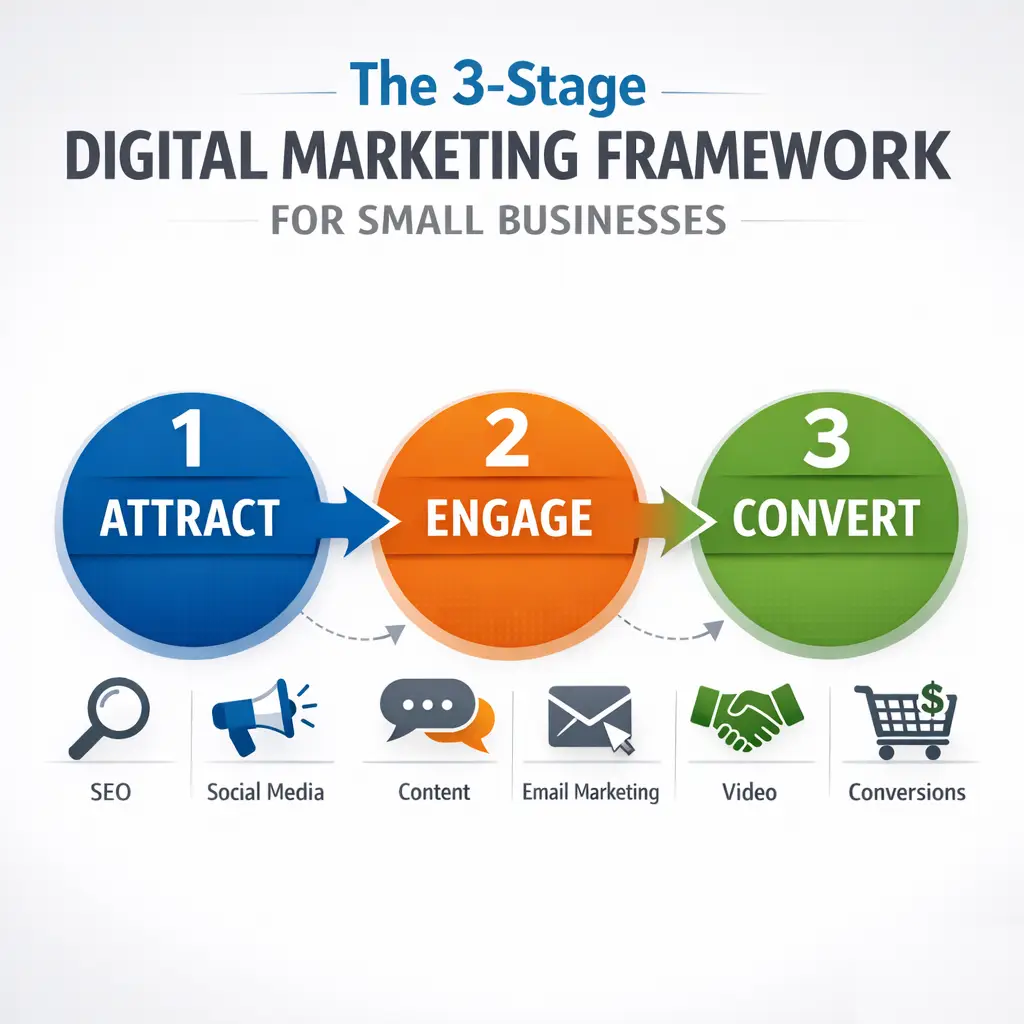
Once the diagnostic is complete, the question is where to direct investment first. The answer depends almost entirely on your business stage — specifically, your cash flow stability and your ability to absorb delayed returns.
Stage 1 — Survival: Direct-Response Channels Only
A business in survival stage is either newly launched or experiencing revenue instability. The defining characteristic is that the business cannot afford to wait six to twelve months for a marketing investment to compound into results.
At this stage, the appropriate channel set is narrow and deliberate:
- Google Business Profile optimization: The highest-leverage free action available to any local business. A fully optimized GBP with consistent review velocity, accurate service categories, and active Q&A content drives significant local search visibility without ad spend. For a deeper look at exactly how to do this, the article Google Business Profile Optimization Tips That Actually Work covers the specific steps that move the needle.
- Local SEO fundamentals: Citation consistency, on-page location optimization, and basic technical health. These don’t produce immediate traffic but they set the foundation for everything that follows.
- Targeted PPC: Specifically, campaigns with tight geographic parameters, tightly themed ad groups, and an aggressive negative keyword strategy. PPC at survival stage is about generating qualified leads quickly — not brand awareness, not impression volume.
Social media brand building and content marketing are not survival stage priorities. Their returns are real but delayed. A business under cash pressure needs feedback loops measured in days and weeks, not quarters.
Stage 2 — Stability: Building Owned Channel Equity
A business in stability stage has consistent revenue but is still overly dependent on paid acquisition or referral networks that it doesn’t control. The strategic priority at this stage is reducing that dependency by building owned channels.
- Email list acquisition: The email list is the most resilient marketing asset a small business can build. Unlike a social media following, it cannot be algorithm-suppressed. Unlike paid traffic, it doesn’t stop when the budget does. Every stage 2 business should have active list-building mechanisms in place.
- SEO content investment: This is the stage where content strategy begins in earnest — not generic blog content, but specific, intent-matched content that answers the questions your target buyers are actively searching for at each stage of their decision process.
- Conversion rate optimization: Once baseline traffic is established, systematic CRO — testing landing pages, CTAs, form structures, and offer framing — compounds the value of every existing traffic source.
Stage 3 — Growth: Efficiency at Scale
A growth-stage business has proven unit economics and is ready to scale what’s working. The priorities shift from channel activation to optimization and compounding:
- Marketing automation: Systematic follow-up sequences, lead nurturing workflows, and retention campaigns that operate without manual intervention.
- Multi-channel attribution modeling: Understanding the full customer journey across touchpoints to make smarter budget allocation decisions.
- Expanded paid media: Broadening PPC reach, introducing retargeting campaigns, and potentially exploring additional platforms — with the discipline to only scale channels with demonstrated positive ROI.
The Rented vs. Owned vs. Earned Channel Distinction
This is the strategic framing that most digital marketing content never addresses directly, and it may be the single most important concept for a small business owner evaluating where to invest.
Every channel you use falls into one of three categories:
| Channel Type | Examples | Control Level | Risk Profile | Value Over Time |
|---|---|---|---|---|
| Rented | Meta Ads, Google Ads, TikTok, Instagram | Low — platform controls reach and cost | High — algorithm changes, policy shifts, or auction competition can eliminate reach overnight | Stops when spend stops |
| Owned | Email list, website, SMS subscribers, branded app | High — you control access and delivery | Low — assets remain regardless of platform changes | Compounds over time |
| Earned | Organic search rankings, backlinks, word-of-mouth, press mentions | Medium — influenced by your work, confirmed by third parties | Low to medium — can be lost if quality declines but builds durable authority | Highest long-term compounding |
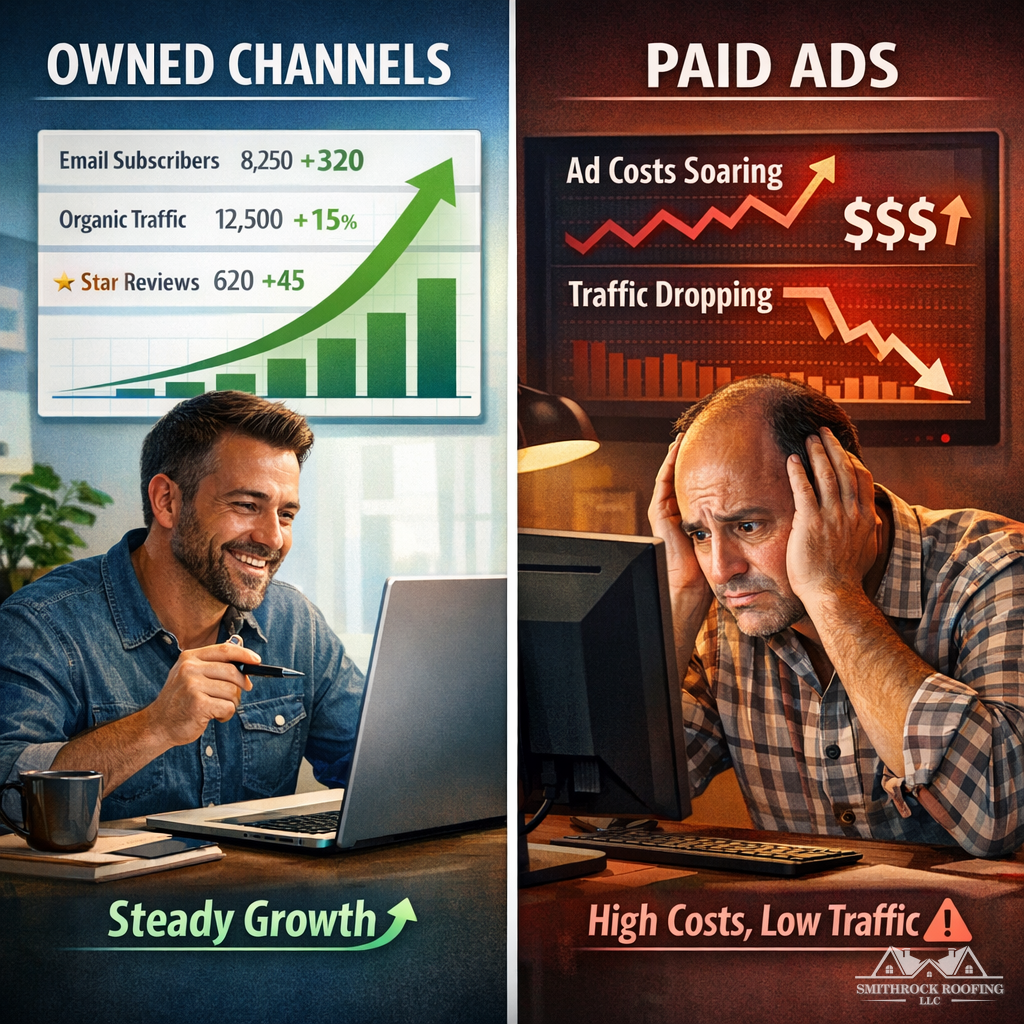
The strategic implication is direct: small businesses are disproportionately over-invested in rented channels. It’s understandable — rented channels offer immediate reach and clear dashboards. But a business that derives the majority of its leads from Meta Ads or Google Ads is structurally fragile. One platform policy change, one sudden increase in auction competition, or one iOS privacy update can materially damage its marketing reach overnight — and that has happened repeatedly to businesses that didn’t see it coming.
The strategic goal of any sound digital marketing program for a small business should be the progressive shift from rented to owned and earned channels over time. This doesn’t mean abandoning paid media — it means using paid media to fund list building and content creation that reduces future dependency on paid media.
When evaluating an agency proposal, this framework gives you a lens to ask a pointed question: Does this agency’s work build long-term owned equity, or does it create ongoing dependency on their services and the platforms they manage?
Matching Digital Marketing Services to Business Type
Because “small business” is not a useful strategic category on its own, here is a practical breakdown of how channel priorities shift by business model:
Service-Area Businesses (Plumbers, HVAC, Electricians, Contractors)
Top priorities: Google Business Profile, local SEO, Google Local Services Ads, review velocity management, PPC with service-specific ad groups.
Why: These businesses compete for high-intent, location-specific searches. The buyer is ready to act — they need someone today. The entire strategy centers on being visible and credible at the moment of maximum intent. Social media and content marketing play supporting roles at best.
Professional Services (Accountants, Attorneys, Consultants, Financial Advisors)
Top priorities: Reputation and trust signal development, LinkedIn presence, content-driven organic SEO, email nurture sequences, referral network amplification.
Why: The sales cycle is longer, and trust is the primary conversion variable. A prospective client evaluating a financial advisor or attorney is doing significant research before making contact. Content that demonstrates expertise — not just describes services — is the primary differentiator.
Brick-and-Mortar Retail
Top priorities: Local SEO, Google Business Profile, Google Performance Max campaigns, local social advertising for in-store promotions, email list building for repeat purchase campaigns.
Why: Foot traffic conversion is the primary goal. Digital channels serve as discovery and consideration tools, with the conversion happening in person. Retention economics — getting an existing customer to return — are typically more favorable than new customer acquisition costs.
B2B Product or Service Companies
Top priorities: LinkedIn advertising and organic content, SEO for high-intent commercial search terms, email nurture automation, case study and social proof development.
Why: B2B purchase decisions involve multiple stakeholders and longer evaluation periods. The content strategy must address different buyer roles (economic buyer, technical evaluator, end user) with material tailored to each stage of the decision process.
Separating Activity Metrics from Outcome Metrics
One of the most consistent credibility failures in digital marketing reporting — both from agencies and from the platforms themselves — is the conflation of activity metrics with outcome metrics. Understanding the difference protects your budget and your decision-making.
Activity metrics tell you what happened inside a platform:
– Impressions, reach, and follower growth
– Click-through rates and page views
– Email open rates and social media engagement
Outcome metrics tell you what the marketing activity produced for your business:
– Qualified leads generated
– Conversion rate from lead to customer
– Revenue attributable to specific campaigns
– Customer acquisition cost by channel
– Customer lifetime value by acquisition source
Activity metrics are not worthless — they provide diagnostic signals when something isn’t working. But they are not the measure of success. A campaign can generate ten thousand impressions and zero revenue. A campaign can generate a 5% CTR on traffic that has no purchase intent. These are not wins.
When reviewing reports from any marketing partner, the question to ask consistently is: What did this produce for the business, not the platform? Insisting on outcome-based reporting is one of the clearest ways to align agency incentives with your actual business goals.
The Internal Capacity Question Agencies Rarely Ask
Before committing to any digital marketing strategy, small business owners need an honest assessment of their internal capacity to support it. This is a conversation most agencies avoid because it can slow the sales process — but skipping it creates implementation gaps that undermine results.
Consider the following questions honestly:
- Who on your team will handle the intake of new leads generated by marketing campaigns, and how quickly?
- Does your business have the operational capacity to fulfill a significant increase in demand?
- Who will provide content approvals, brand assets, and strategic input to an agency team?
- What is the realistic time commitment from ownership or leadership to meaningful campaign oversight?
A business that cannot respond to leads within a few hours, cannot fulfill increased demand, or cannot dedicate time to agency communication will not extract full value from any digital marketing investment — regardless of how well the campaigns are executed.
This isn’t a reason to delay marketing. It’s a reason to scope your initial engagement at a level your organization can actually absorb, and scale deliberately as capacity grows.
The most effective digital marketing partnerships are ones where both sides are honest about what’s realistic, aligned on what success looks like, and measuring against the same outcome metrics from day one. That’s the foundation on which actual growth gets built.
Strategic Recommendations for 2026
The digital marketing landscape continues to shift, and small businesses that make deliberate choices about where to focus their energy will outperform those who chase every emerging trend. Three specific priorities stand out for 2026:
1. Invest in First-Party Data Infrastructure
Third-party cookies are increasingly unreliable, and platforms are tightening audience targeting restrictions. Small businesses that build their own email lists, customer databases, and CRM systems now will have a durable competitive advantage over those who remain dependent on rented platform audiences. If you don’t have a functioning email capture and nurture sequence in place, that is the highest-leverage starting point available to most small businesses today.
2. Prioritize Local SEO and Conversational Search Optimization
AI-driven search experiences are changing how people find local businesses. Optimizing for conversational, question-based queries — not just traditional keyword phrases — is becoming essential for maintaining organic visibility. This means structured content that answers specific questions, consistently updated Google Business Profiles, and a review acquisition strategy that reflects real customer experiences. Local search is still one of the most cost-effective channels available to small businesses, and it rewards consistency over time. The article SEO Services for Small Businesses That Actually Work goes deeper on how to approach this in a way that produces durable results rather than short-term gains.
3. Audit Your Conversion Infrastructure Before Scaling Ad Spend
More traffic does not solve a conversion problem — it amplifies it. Before increasing paid media investment in 2026, conduct an honest audit of what happens after a click: landing page clarity, load speed, mobile experience, contact form functionality, and response time. Businesses that fix their conversion foundation before scaling spend will see dramatically better returns than those who simply increase volume into a leaky system.
Frequently Asked Questions
What digital marketing services matter most for small businesses?
The services that matter most depend on your specific market, customer base, and business model — but for most small businesses, local SEO, Google Business Profile management, and paid search advertising consistently deliver the clearest connection between marketing activity and actual revenue. Email marketing remains one of the highest-return channels available when paired with a quality list and relevant messaging. The right starting point is an honest audit of where your customers are looking for what you sell and whether your business is visible and compelling in those places.
How long does it take to see results from digital marketing?
The timeline varies significantly by channel. Paid advertising can generate traffic and leads within days of launch, though optimizing for quality and efficiency typically takes several weeks of data. Search engine optimization is a longer-term investment — meaningful organic visibility gains generally take several months of consistent effort. Email marketing and retargeting campaigns tend to show results in a timeframe that falls between the two. Any agency that guarantees specific results within a fixed timeline without knowing your market, competitive landscape, and current baseline should be approached with caution.
How do I know if my digital marketing agency is actually delivering results?
The clearest indicator is whether your agency reports on business outcomes — leads generated, calls received, appointments booked, or revenue attributed — not just platform metrics like impressions, clicks, or follower counts. Ask for regular reporting that connects campaign activity to real business results, and insist on transparency about what is and isn’t performing. If your agency cannot clearly explain what their work is producing for your business beyond vanity metrics, that is a meaningful red flag. The article How to Choose an SEO Service Provider (Smart Guide) covers the specific questions and criteria that help you evaluate whether a marketing partner is genuinely accountable to your outcomes.
Should a small business handle digital marketing in-house or hire an agency?
Both models can work, and the right answer depends on the internal capacity, skill sets, and time availability within your organization. In-house management offers deep familiarity with your brand and faster communication cycles, but it requires genuine expertise and consistent time investment to execute well. Agencies bring specialized knowledge, platform experience, and dedicated capacity — but they require active communication and oversight from your side to stay aligned with business goals. A hybrid approach, where an agency handles technical execution and paid media while an internal team manages content and community, is often an effective middle ground for growing small businesses.
Conclusion
Small businesses deserve marketing partners who are straightforward about what works, honest about timelines, and focused on outcomes that actually move the business forward. Mongoose Digital Marketing brings that approach to every engagement — whether that means building a local SEO foundation that generates consistent organic visibility or running paid search campaigns that connect directly to revenue. If you’re ready to have an honest conversation about what digital marketing can realistically do for your business, Contact Mongoose Digital Marketing and let’s figure out the right starting point together.