

Key Takeaways
- A Dayton-area website built without local schema markup (specifically
LocalBusinessstructured data) is missing one of the most direct technical levers for improving Google Maps and map pack visibility in Montgomery, Greene, and Warren Counties. - Google’s Core Web Vitals — Largest Contentful Paint (LCP), Cumulative Layout Shift (CLS), and Interaction to Next Paint (INP) — are active ranking signals, meaning a visually polished website can still quietly underperform in search if these metrics fail.
- Dayton’s B2B manufacturing and defense-adjacent businesses frequently show desktop-dominant research behavior, which means a mobile-only design philosophy can actively work against conversion for those specific sectors.
- Without Google Search Console and Google Analytics 4 configured at launch, a business has no reliable baseline to measure whether their new website is generating leads, traffic, or any measurable return.
- A well-built Dayton small business website typically experiences ranking degradation within 12 to 18 months without a structured content refresh plan — the build is a starting point, not a finish line.
Most Dayton businesses approach web design the same way they’d order a business card: pick something that looks professional, pay for it once, and move on. That mindset is why so many local websites quietly stop generating leads six months after launch while the business owner wonders why the phone isn’t ringing.
The reality is that web design in 2025 — especially in a market as economically layered as the Miami Valley — is not a one-time creative project. It’s a performance infrastructure decision. The choices made during design and development directly affect your search rankings, your conversion rates, your legal exposure, and your ability to compete against businesses in Kettering, Beavercreek, Centerville, and beyond.
This guide is written for Dayton business owners who are serious about getting real, measurable results from their website — not just a digital brochure that sits dormant. We’re going to cover what competitors in this space won’t tell you: the industry-specific requirements Dayton’s economy demands, how local search behavior should shape your design decisions, and exactly what needs to happen after your site goes live to ensure it keeps working.
Why “Local Web Design” Means Something Different in Dayton
Every web design agency in Dayton claims to understand the local market. Very few demonstrate it. Understanding the Dayton market isn’t about knowing the zip codes — it’s about recognizing that the Miami Valley’s economic mix creates genuinely different website requirements depending on what sector your business operates in.
Dayton is not a monolithic market. You have Wright-Patterson Air Force Base driving a dense ecosystem of defense contractors and aerospace suppliers across the eastern suburbs. You have Kettering Health and Premier Health anchoring a substantial healthcare-adjacent business community. You have skilled trades and home services blanketing the residential suburbs of Huber Heights, Springboro, Miamisburg, and Centerville. And you have a growing professional services sector that doesn’t fit neatly into any of those categories.
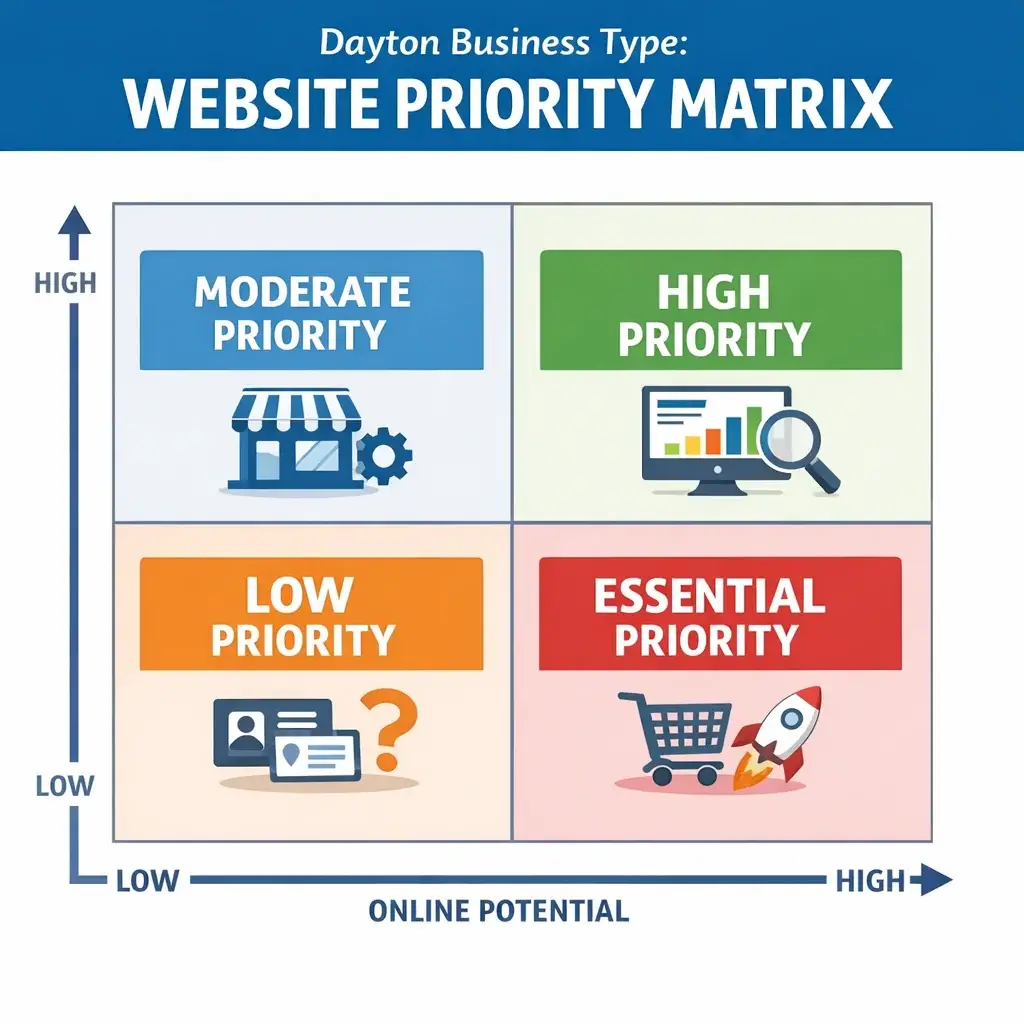
Each of these business types needs a fundamentally different website — not just a different color scheme, but different UX priorities, different technical requirements, and different conversion architectures.
Defense and Aerospace Suppliers: Credibility-First Design
Businesses supplying to Wright-Patterson or operating within the defense contractor ecosystem are selling to procurement officers and program managers who conduct thorough due diligence before any vendor relationship begins. For these businesses, the website’s primary job is to establish institutional credibility.
That means:
– Clean, authoritative visual design that signals organizational stability
– Clear capability statements (what you can certify, what standards you meet, what programs you’ve supported)
– Secure contact forms with explicit privacy policies — government-adjacent buyers are sensitive to how their data is handled
– Case studies and past performance documentation, not just a portfolio gallery
– ADA/WCAG 2.1 compliance, which is increasingly expected in any organization doing business with federal entities
Flashy animations and aggressive sales copy actively undermine trust in this sector. The design goal is competence, not excitement.
Healthcare-Adjacent Businesses: Compliance Is Non-Negotiable
For businesses operating near the healthcare space — medical billing, physical therapy practices, mental health providers, medical equipment suppliers — web design carries regulatory weight. HIPAA-conscious form design is not optional. Any form that could collect protected health information (PHI), even indirectly, needs to be built with appropriate safeguards.
Beyond HIPAA, ADA compliance (WCAG 2.1 AA standard) is both an ethical baseline and a growing legal risk. The volume of ADA-related web accessibility lawsuits has increased significantly each year since 2018. For healthcare-adjacent Dayton businesses, this is not a niche concern — it’s a real liability.
Practical requirements for this sector:
– No contact forms that ask for health-related information without appropriate disclosures
– Color contrast ratios meeting WCAG 2.1 AA minimums
– Screen reader compatibility built in from the design phase, not retrofitted after launch
– Privacy policy pages that are accurate, current, and linked from every form
Skilled Trades and Home Services: Conversion Speed Over Everything
For HVAC companies, plumbers, electricians, roofers, and landscapers serving the Dayton suburbs, the website’s primary job is to convert a visitor who already intends to hire someone. These users are often on mobile, often searching with phrases like “emergency plumber Huber Heights” or “AC repair Beavercreek,” and they make decisions fast.
For these businesses, the conversion architecture matters more than the visual design:
– Click-to-call phone numbers visible above the fold on every page
– Google Business Profile embedded or directly linked
– Service area pages that specifically name Kettering, Centerville, Miamisburg, Springboro, and surrounding communities
– Fast load times — every additional second of load time measurably reduces conversion rates on mobile
– Customer reviews prominently featured (not buried in a footer)
A beautifully designed website that takes 6 seconds to load and hides the phone number below three paragraphs of copy will consistently lose business to a plainer site that answers one question immediately: “Can you help me, and how do I reach you?”
How Dayton Search Behavior Should Shape Your Website
Most web designers build websites based on how they think users browse. High-performing sites are built around how your specific audience actually behaves. In Dayton, that distinction matters more than most agencies acknowledge.
The “Near Me” Search Pattern in Montgomery, Greene, and Warren Counties
Local search in the Dayton metro is heavily intent-driven. Users in Beavercreek, Centerville, and Springboro searching for local services are typically in active decision mode — they’re not browsing for information, they’re looking for a business to contact. This behavior pattern has direct design implications.
Your website needs to make geographic relevance immediately obvious. If a user lands on your homepage from a “near me” search and can’t tell within three seconds that you serve their area, they will leave. This is not a theory — it’s measurable bounce behavior that shows up in Analytics data consistently.
Geographic signals that matter:
– City and suburb names in page titles and H1 headers (not just buried in body copy)
– A service area page or section that explicitly lists the communities you serve
– Local phone numbers (not just an 800 number)
– A physical address displayed in the footer with proper LocalBusiness schema markup
B2B and Manufacturing: Desktop Isn’t Dead in Dayton
The blanket industry statement that “mobile-first is everything” is not wrong — but it requires nuance for specific Dayton sectors. Procurement managers, operations directors, and engineers at Dayton-area manufacturing firms are frequently conducting supplier research from their office workstations. Desktop traffic share in B2B manufacturing niches consistently runs higher than consumer-facing businesses.
This doesn’t mean ignoring mobile. It means your website needs to perform excellently on both — and that the desktop experience shouldn’t be an afterthought, which happens frequently when agencies design mobile-first and then simply scale up. For a deeper look at how to balance both experiences without sacrificing either, the article on responsive design in 2025 covers the practical tradeoffs in detail.
For B2B Dayton businesses specifically, this has concrete implications:
– Data-rich pages with technical specifications need to be readable on desktop without horizontal scrolling
– Multi-column layouts for comparison tables or product specs are appropriate and expected
– PDF downloads (spec sheets, capability statements) should be easy to find and access from desktop navigation
The University Population Effect on Certain Business Categories
Dayton hosts Wright State University, the University of Dayton, and Sinclair Community College — a combined student and staff population that meaningfully affects web traffic patterns for businesses in specific categories. Retail, food service, fitness, apartment rentals, and entry-level professional services all see traffic and conversion behavior influenced by this demographic.
If your business falls into a category where this population is relevant, your website content, visual design, and even platform performance expectations need to account for it. This group has high expectations for mobile UX, loads pages on variable-quality cellular connections, and makes decisions quickly based on social proof signals (reviews, ratings, peer recommendations visible on the site).
The Technical Foundation That Separates Sites That Rank From Sites That Don’t
Here is where most Dayton web design conversations stop. The site launches, it looks good, the client signs off, and everyone moves on. What follows is the quiet degradation that nobody warned you about.
Core Web Vitals: The Metrics That Determine Whether Google Trusts Your Site
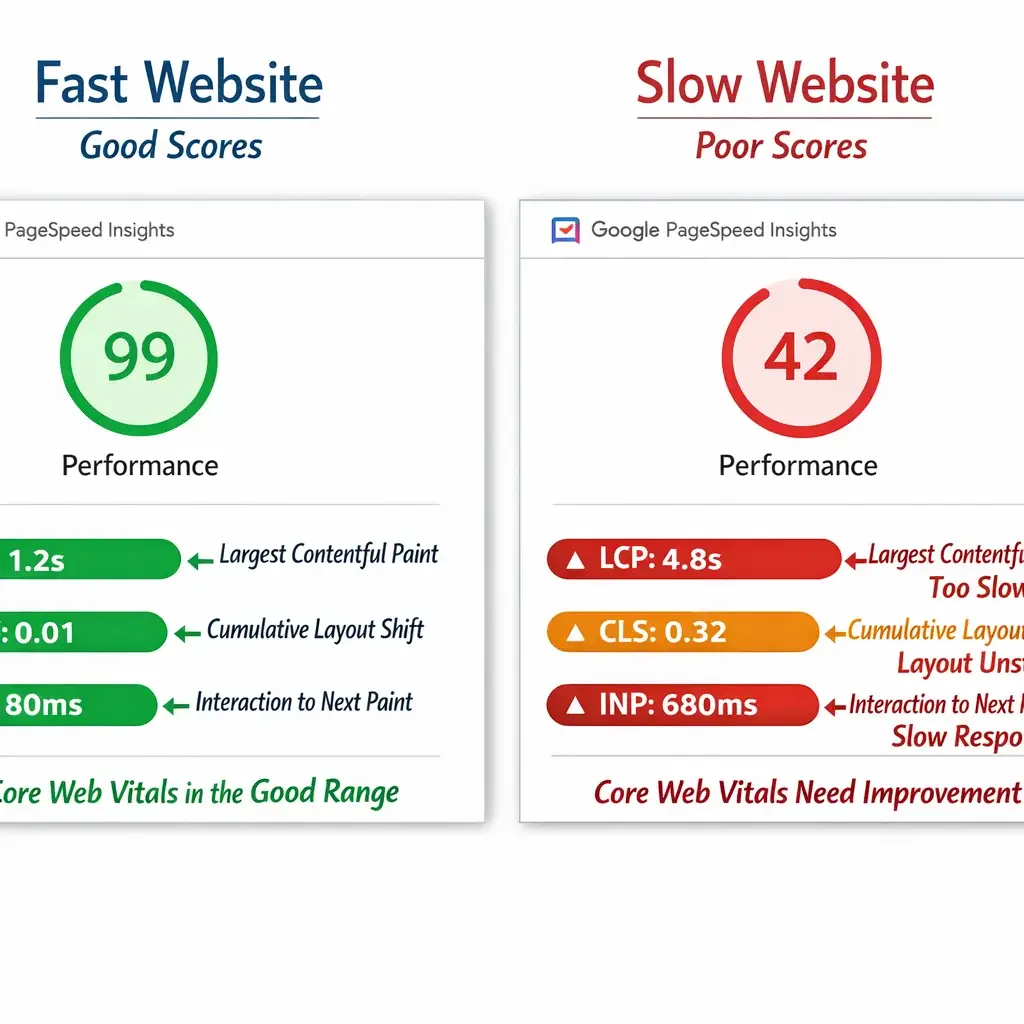
Google’s Core Web Vitals have been confirmed ranking signals since 2021. They measure real user experience, not design aesthetics. A website can look exceptional and fail all three metrics simultaneously — and that failure has direct consequences for search rankings.
| Metric | What It Measures | Google’s “Good” Threshold | Common Failure Causes |
|---|---|---|---|
| Largest Contentful Paint (LCP) | How fast the main content loads | Under 2.5 seconds | Unoptimized images, slow server response, render-blocking resources |
| Cumulative Layout Shift (CLS) | How much the page visually shifts as it loads | Under 0.1 | Images without defined dimensions, late-loading ads or embeds |
| Interaction to Next Paint (INP) | How quickly the page responds to user input | Under 200 milliseconds | Heavy JavaScript, excessive third-party scripts |
These are measurable. They can be tested using Google’s PageSpeed Insights tool before and after launch. Any web design agency worth hiring should be able to show you these scores for sites they’ve built — and should be actively optimizing for them during development, not as an afterthought. If your current site is already struggling with load times, the guide on website speed optimization for small businesses breaks down the most common causes and how to address them without a full rebuild.
Local Schema Markup: The Technical Step Nobody Mentions
LocalBusiness structured data is a standardized code block embedded in your website that explicitly tells Google what your business is, where it operates, what its hours are, and how to contact it. It directly supports map pack visibility — the three-business box that appears at the top of local search results.
Almost no Dayton web design agencies discuss this with clients. It’s not visible to the human eye, which means it’s easy to skip and easy to miss when reviewing a completed site. But its absence is measurable in local search performance.
A properly implemented LocalBusiness schema for a Dayton business should include:
– Business name, address, and phone number (NAP) consistent with Google Business Profile
– Service area specification (can include multiple suburbs)
– Business hours
– Business category
– URL
If your current website doesn’t have this, it can be added without a full redesign. But it should be built in from the start on any new site.
Platform Decisions: What Nobody Tells You Before You Sign
WordPress, Webflow, Squarespace, Wix, custom-built — these are not equivalent options, and the choice has long-term consequences that most clients aren’t informed about before they commit.
What to understand about platform selection:
- WordPress remains the most flexible platform for growth and SEO customization, but it requires active maintenance (plugin updates, security patches). Neglected WordPress sites become security liabilities and performance problems within 12–18 months. The guide on WordPress web design for small businesses offers an honest look at when it’s the right call and when it isn’t.
- Webflow offers strong design control and cleaner code output than most WordPress page builders, with lower ongoing maintenance burden. It’s well-suited for professional services businesses that want a polished site without managing a server environment.
- Squarespace and Wix are entry-level platforms appropriate for very small businesses with minimal SEO ambitions. They impose real ceilings on technical SEO customization that become frustrating as a business grows.
- Custom-built sites can be optimal for specific use cases (complex functionality, unique integrations) but come with higher ongoing development dependency — every change requires a developer.
The right answer depends on your business’s growth trajectory, technical resources, and content needs. Any agency that recommends the same platform for every client, regardless of those factors, is not building for your business — they’re building for their own workflow convenience.
What Happens After Launch: The 90-Day Performance Framework
Building the site is 40% of the work. What happens in the 90 days after launch determines whether that site becomes a business asset or an expensive digital brochure.
Analytics Configuration at Launch Is Non-Negotiable
Before your site goes live, two tools need to be installed and verified:
Google Analytics 4 (GA4): Tracks user behavior — where traffic comes from, which pages users visit, how long they stay, and what actions they take. Without this, you have no data. With it, you have the baseline from which every future decision should be made.
Google Search Console: Tracks search performance — which queries are bringing users to your site, which pages are indexed, whether Google has flagged any technical errors, and how your Core Web Vitals scores measure against real user data. This is also where you submit your sitemap after launch to accelerate indexing.
If an agency launches your site without confirming both tools are configured and reporting data, that’s a significant gap in their process — not a minor oversight.
The 90-Day Post-Launch Review Checklist
| Timeline | Action | Why It Matters |
|---|---|---|
| Launch Day | Submit sitemap to Google Search Console | Accelerates page indexing |
| Launch Day | Verify GA4 is receiving data | Confirms tracking is live |
| Launch Day | Confirm LocalBusiness schema is rendering correctly | Validates local search signals |
| Week 1 | Run Core Web Vitals test via PageSpeed Insights | Establishes performance baseline |
| Week 2 | Check for crawl errors in Search Console | Identifies broken links or blocked pages |
| Month 1 | Review top landing pages and bounce rates in GA4 | Identifies pages that may need UX adjustment |
| Month 2 | Publish first content update (blog post, service page expansion) | Signals ongoing activity to Google |
| Month 3 | Full performance review: rankings, traffic, conversions vs. baseline | First opportunity to assess ROI and identify gaps |
This is not an optional process. It’s the minimum operational framework for a site that’s meant to generate business rather than simply exist.
Content Decay: The 18-Month Problem
Google rewards websites that demonstrate ongoing relevance. A site that launches strong and then goes completely static — no new content, no page updates, no additions — will begin losing search ground within 12 to 18 months, even if it was technically well-built at launch.
For Dayton small businesses, this is the most common point of failure. The site gets built, it ranks reasonably well in the first few months on the strength of the initial optimization, and then it plateaus and declines while the business owner assumes the website is “working.”
A structured content plan doesn’t require daily publishing. For most Dayton small businesses, a consistent schedule of two to four substantive content additions per month — service area pages, FAQ sections, case studies, or relevant local blog content — is enough to maintain and grow search presence over time.
The key is that this plan should be part of the web design conversation from day one, not an upsell six months after launch when rankings start dropping.
Questions Every Dayton Business Owner Should Ask Before Hiring a Web Designer
Most vendor evaluation conversations focus on price and portfolio. Those are the wrong primary questions. The answers below — and whether your prospective agency can give clear, specific responses — tell you far more.
Ask: “Can you show me Core Web Vitals scores for three sites you’ve built?”
A legitimate performance-focused agency has these numbers ready. Hesitation or deflection here is a meaningful signal.
Ask: “What platform are you recommending and why is it right for our specific business?”
The answer should reference your business’s size, growth goals, content needs, and technical resources. A one-size answer means they’re not tailoring anything.
Ask: “What local schema markup will you implement, and how will we verify it’s working?”
If the answer is “schema what?” — that’s your answer about their technical SEO depth.
Ask: “What does the post-launch process look like for the first 90 days?”
A serious agency has a defined answer. A vendor relationship that ends at launch is not a partnership built for your growth.
Ask: “How do you measure whether the website succeeded?”
Success should be defined in concrete terms before the project begins: leads generated, traffic targets, ranking improvements, conversion rates. If an agency can’t define success metrics upfront, they can’t be held accountable to them.
Ask: “What does ongoing maintenance include and who handles it?”
WordPress security updates, plugin conflicts, broken links, and hosting performance issues are ongoing realities. Know who handles them before you sign anything.
Working With Mongoose Digital Marketing
Mongoose Digital Marketing works with businesses across Dayton, Kettering, Beavercreek, Centerville, Huber Heights, Miamisburg, Springboro, and the surrounding Miami Valley. Our approach to web design is built around one question: what does this specific business need its website to do, and how do we build, optimize, and maintain it to ensure that happens?
That means we start every engagement with a discovery process that maps your audience’s search behavior, your competitive landscape, and your conversion goals before a single design decision is made. It means every site we deliver is configured with analytics, validated schema markup, and a post-launch review schedule. And it means we’re still your partner at month six and month twelve — not just at launch.
If you’re ready to have a direct conversation about what your Dayton business website should be doing for you — and what it would take to get there — we offer a free consultation with no strings attached. Reach out to the Mongoose team and let’s talk about what real results look like for your business.
Strategic Recommendations for 2026
As search behavior, AI-driven results, and user expectations continue to shift, Dayton businesses that invest in web design should be thinking beyond the launch date. Here are three specific directions worth prioritizing heading into 2026:
1. Prioritize Core Web Vitals as a Business Metric, Not Just a Technical Checkbox
Google’s continued emphasis on page experience signals means that load speed, visual stability, and interactivity directly affect both rankings and conversion rates. Use Google Search Console and PageSpeed Insights regularly — not once at launch — to monitor performance across your key service pages. Businesses that treat Core Web Vitals as an ongoing operational concern, rather than a one-time build requirement, consistently outperform those that don’t.
2. Invest in Structured Local Content That Reflects How Miami Valley Customers Actually Search
Generic service pages no longer compete effectively. In 2026, the businesses winning in Dayton search results are those with content built around specific neighborhoods, service combinations, and locally relevant questions. Tools like Google Search Console’s query data and BrightLocal’s local rank tracking help identify exactly where your gaps are and where your content investment will have the highest return.
3. Implement Conversion Rate Optimization as an Ongoing Process
Most businesses treat website conversion as a fixed outcome of design. In reality, it’s a moving target that improves through systematic testing. Microsoft Clarity (free) and Google Optimize alternatives like VWO or Convert allow you to run A/B tests on headlines, calls-to-action, and form placements — turning your existing traffic into more leads without increasing your ad spend. For a full breakdown of how to structure this process, the article on conversion optimization beyond the basic CRO playbook is worth reviewing before you start. Schedule a quarterly conversion review as a standard business practice.
Frequently Asked Questions
How long does it take to build a professional website for a Dayton business?
Most professional web design projects for small to mid-sized Dayton businesses take between six and twelve weeks from discovery to launch, depending on the size of the site, the complexity of the functionality required, and how quickly content and approvals move through your internal process. Rushing a website build to meet an arbitrary deadline almost always results in technical debt that costs more to fix later. A realistic timeline with defined milestones is a sign of a disciplined process, not a slow agency.
What makes a web design agency a good fit for businesses in the Dayton, Ohio area specifically?
A web design agency that understands the Dayton market brings more than design skills — they bring familiarity with the local competitive landscape, regional search behavior, and the kinds of service-based businesses that drive the Miami Valley economy. That context matters when structuring local SEO, choosing which neighborhoods to target in your content, and understanding what your specific competitors are doing online. An agency that has worked with businesses across Dayton, Kettering, Beavercreek, and Centerville will ask better questions and make faster, more relevant strategic decisions than one treating your market as generic.
Do I need ongoing website maintenance after my site launches?
Yes — and any agency that tells you otherwise is not being straightforward with you. Websites running on platforms like WordPress require regular security updates, plugin compatibility management, and performance monitoring. Beyond the technical side, search algorithms change, competitor content evolves, and your own business offerings shift over time. A website that isn’t actively maintained and periodically updated will lose ground in search rankings and become a liability rather than an asset. Ongoing maintenance isn’t optional overhead — it’s what keeps the investment you made at launch working for you.
How do I know if my current Dayton business website is actually hurting my lead generation?
There are several clear indicators worth examining. If your bounce rate is high on key service pages, your site may not be matching user intent quickly enough. If you’re getting traffic but few or no form submissions or phone calls, there’s likely a conversion problem in the design or messaging. If your site doesn’t appear in Google results for searches your customers logically use, there’s a local SEO gap. Google Search Console and Google Analytics are both free tools that can surface these patterns — and a qualified web design agency can translate that data into a concrete diagnosis within a single conversation.
Conclusion
For businesses across Dayton, Kettering, Beavercreek, and Centerville that are serious about turning their website into a genuine growth asset, Mongoose Digital Marketing brings the local market knowledge, technical depth, and long-term partnership approach that the work actually requires. Whether you’re starting from scratch or trying to understand why your current site isn’t delivering, the conversation starts with an honest look at what your website should be doing for your business — and that’s exactly where we begin. Contact Mongoose Digital Marketing today to schedule your free consultation.