
The Wrong Question Is Costing You More Than You Think
Most conversations about social media software start and end the same way: someone compiles a list of tools, ranks them by feature count, and tells you Buffer is great for small teams while Hootsuite is built for enterprise. Then they move on.
If you’ve read three of those articles, you’ve read all of them.
The problem isn’t that the information is wrong — it’s that it’s answering the wrong question entirely. Choosing a social media software platform isn’t a purchasing decision. It’s an infrastructure decision. And like any infrastructure decision made without a framework, the wrong call doesn’t just cost you money — it creates process debt, governance gaps, and organizational risk that compounds quietly over months until something breaks visibly.
This article is built for marketing leaders, operations managers, and agency professionals who are past the “what’s the best free scheduler?” stage. We’re going to cover what competitor content consistently ignores: how to evaluate social media software against your actual organizational maturity, why API dependency is an operational risk category — not a minor inconvenience — and how to architect social data flows that generate intelligence far beyond a weekly engagement report.
If you want a ranking of features with star ratings, this isn’t that. If you want a framework that scales with your business and protects it from the hidden costs most brands discover the hard way, keep reading.
What Social Media Software Actually Is (And What It Isn’t)
Before getting into selection strategy, it’s worth establishing a precise definition — because the market uses “social media software” as an umbrella term that covers meaningfully different tool categories, often with overlapping feature sets that obscure what each is genuinely built to do.
The Four Core Tool Categories
1. Social Media Management Platforms
These are the broadest category. They handle scheduling and publishing, basic analytics, and often include a unified social inbox. Tools like Hootsuite, Sprout Social, and Buffer fall here. They’re designed to consolidate multi-platform activity into a single operational interface.
2. Social Listening and Intelligence Tools
Brandwatch, Mention, and Talkwalker are built primarily for monitoring — tracking brand mentions, competitor activity, sentiment trends, and emerging conversations across the open web and social platforms. Some management platforms include watered-down listening features, but purpose-built tools operate at a fundamentally different data depth.
3. Influencer and Creator Management Platforms
Tools like Grin, Aspire, and Creator.co manage influencer discovery, outreach, contract tracking, and campaign reporting. These sit adjacent to social media management but serve a distinct workflow.
4. Social Commerce and Paid Social Tools
Platforms like Smartly.io or Madgicx focus specifically on paid social execution — ad creative management, audience targeting optimization, and performance attribution. These are distinct from organic management tools and require different evaluation criteria entirely.
The gap in most content is treating all four categories as variations of the same thing. A business asking “what social media software should we use?” is often conflating three separate tool needs without realizing it. Clarity on which category you’re actually buying into — and which gaps you’re leaving unaddressed — is the first decision that matters. For a broader look at how aggregating multiple social data sources creates its own strategic challenges, the article on social media aggregators covers what most guides won’t tell you.
The Social Media Maturity Model: Matching Tools to Organizational Stage
Here is the framework that changes how this entire conversation should be structured. Instead of matching tools to company size, match them to organizational maturity — specifically, where your social media function sits on a defined capability progression.
Getting this wrong in either direction is expensive. A stage-one organization implementing enterprise social infrastructure doesn’t gain capability — it gains complexity without the process structure to absorb it. A stage-four organization running on a stage-two tool doesn’t just lack features — it lacks the audit trails, governance enforcement, and data architecture that regulated industries, multi-brand portfolios, and board-level reporting require.
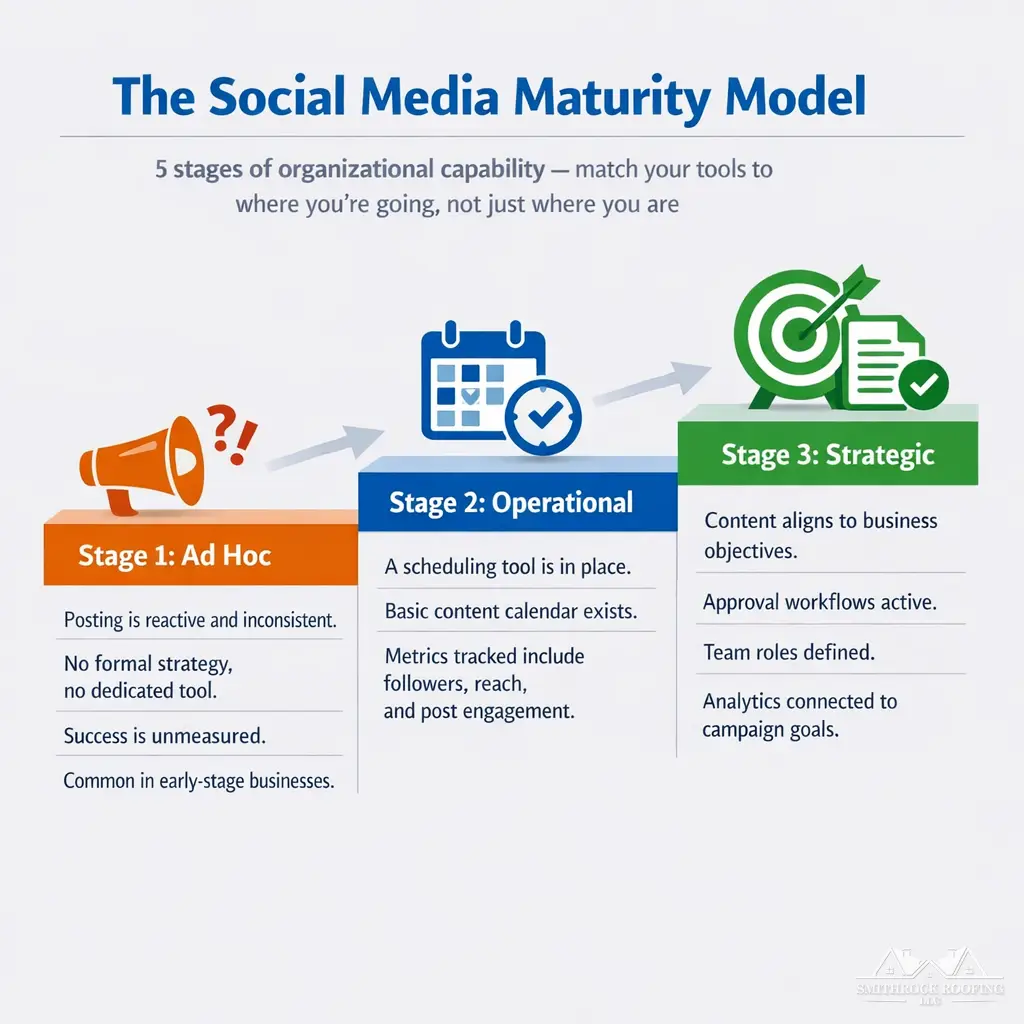
(https://www.consumerreports.org/consumer-protection/tech-companies-too-secretive-about-algorithms-that-curate-feeds-a8134259964/)”; item5_title=”Stage 5: Intelligence-Led”; item5_body=”Social listening informs executive decisions. Predictive analysis used for trend identification. Social function has organizational influence beyond marketing.”; footer=”Mongoose Digital Marketing”]
How to Self-Assess Your Current Maturity Stage
The honest version of this assessment requires looking at three indicators simultaneously:
- Process formalization: Do you have documented workflows for content creation, approval, publishing, and crisis response — or does institutional knowledge live in people’s heads?
- Data utilization: Are social analytics informing decisions in other business functions, or do they stop at a monthly report nobody fully reads?
- Governance structure: Is there a defined policy for who can post, what requires legal or compliance review, and what the escalation path looks like when something goes wrong publicly?
Organizations consistently overestimate their maturity stage when evaluating tools. A team that has been using a scheduler for two years and runs a monthly report is almost always at Stage 2, regardless of how sophisticated their content looks externally.
Evaluating Social Media Software: A Framework That Goes Beyond Feature Checklists
Most feature comparison tables evaluate tools on the same five or six dimensions. The problem is that these dimensions have different weights depending on your organizational structure, industry, and maturity stage — and that context is never surfaced.
Below is a more complete evaluation framework that includes the variables most comparison guides leave out entirely.
Comprehensive Social Media Software Evaluation Matrix
| Evaluation Dimension | What Most Guides Cover | What Actually Matters at Scale |
|---|---|---|
| Scheduling & Publishing | Supported platforms, post queue depth, bulk scheduling | Publishing permissions by user role, approval workflow enforcement, regulated content review pathways |
| Analytics & Reporting | Engagement rates, reach, follower growth | Attribution modeling, cross-channel data blending, connection to CRM or revenue data |
| Social Listening | Brand mention monitoring, keyword tracking | Historical data depth, sentiment accuracy, competitive share-of-voice, crisis signal detection speed |
| Team Collaboration | Multi-user access, task assignment | Role-based permission structures, content governance enforcement, audit log completeness |
| AI Capabilities | Caption suggestions, optimal send time | Brand voice consistency controls, AI output review workflow, misinformation risk evaluation |
| API & Integration Architecture | CRM and Slack integrations listed | Webhook availability, data export format and frequency, Zapier dependency vs. native integration depth |
| Platform Concentration Risk | Notes on Twitter/X API changes | What percentage of core functionality is dependent on any single platform’s API access |
| Data Ownership & Portability | Rarely mentioned | Can you export full historical data on contract termination? What data is retained by the vendor? |
| Governance & Compliance | Rarely mentioned | GDPR-compliant data handling, regulated industry content controls, brand safety framework enforcement |
| Organizational Fit | “Great for teams of X size” | Centralized vs. decentralized social org design requirements, multi-brand vs. single-brand architecture |
Working through this matrix with your actual organizational requirements — not the requirements you think you should have — will surface mismatches that feature comparisons never catch.
The API Dependency Problem: A Strategic Risk Most Brands Are Ignoring
In 2023, Twitter/X repriced its API access in a way that effectively broke or significantly degraded functionality for a significant portion of third-party social media management tools overnight. Organizations that had built social listening programs, crisis monitoring systems, and competitive intelligence workflows on top of that API access didn’t just lose features — they lost years of institutional process investment.
This is not a one-time anomaly. It is a systemic risk category that every organization building on third-party social APIs needs to treat with the same rigor applied to any other single-supplier dependency.
Understanding Platform Concentration Risk
A Platform Concentration Audit is the structured process of evaluating what percentage of your social media operations — audience reach, customer data, engagement metrics, listening intelligence — sits inside any single platform’s ecosystem.
The questions this audit asks:
- If Platform X removed API access for third-party tools tomorrow, which of your workflows would break entirely?
- How much of your audience data (email addresses, behavioral signals, purchase intent data) do you own versus rent from a platform’s algorithm?
- Are your social listening capabilities dependent on access that could be repriced or restricted based on a platform’s commercial priorities?
- What is the rebuild cost — in time, money, and institutional knowledge — of reconstructing these workflows if they disappear?
The goal of this audit isn’t to avoid building on social platforms — it’s to make strategic decisions with open eyes about concentration risk, and to build contingency workflows for the capabilities that matter most.
The Practical Implication for Tool Selection
Tools that rely heavily on direct API integration with a small number of platforms carry higher concentration risk. Tools that have invested in direct publishing partnerships, first-party data infrastructure, or diversified data sourcing carry lower risk.
When evaluating social media software, ask the vendor directly: How did your platform respond to the 2023 Twitter/X API changes, and what is your contingency architecture for similar disruptions from other platforms? The quality of the answer tells you significantly more than any feature comparison chart.
Social Data as Organizational Intelligence: The Capability Most Teams Leave on the Table
Here’s the gap that represents the largest missed opportunity in how most organizations deploy social media software: they use it to measure content performance when it could be generating intelligence that informs decisions across the entire organization.
What “Social as Organizational Intelligence” Actually Looks Like
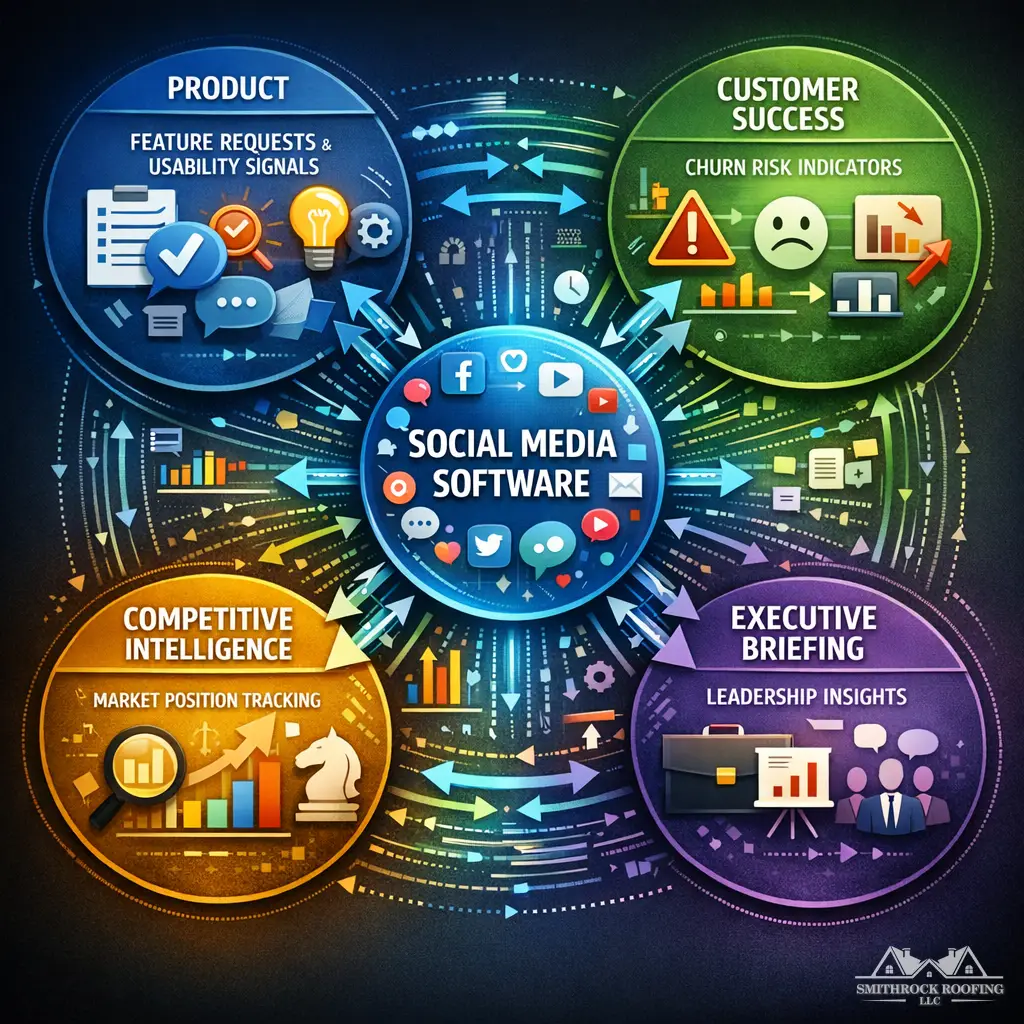
The distinction between a social media team that reports on activity and one that drives organizational influence comes down to how they architect data flows. Consider what becomes possible when social data is treated as a cross-functional asset:
Product Development
Social listening captures feature requests, usability frustrations, and competitive comparisons months before they surface in formal research, support tickets, or NPS surveys. Organizations that feed structured social signal data into product roadmap processes gain a continuous, low-cost customer intelligence channel that most research methods can’t replicate in speed or volume.
Customer Success and Churn Prediction
Sentiment tracking on brand mentions can surface early churn signals — customers publicly expressing frustration, switching conversations, or comparing alternatives — that arrive before a cancellation request hits the CRM. The organizations catching these signals and routing them to account management teams are turning social listening into a retention tool.
Competitive Intelligence
Share-of-voice tracking, competitor mention monitoring, and analysis of competitor community engagement patterns can identify strategic shifts in positioning, new product announcements, and emerging messaging strategies weeks before they show up in press coverage or quarterly reports.
Executive Decision Intelligence
The organizations where social data has the most organizational influence are those where the social team has built a structured briefing cadence — translating listening signals into business-relevant intelligence summaries for leadership, not engagement reports for marketing managers.
The Technical Architecture That Makes This Possible
None of the above happens without deliberate integration architecture. The social media software tools that enable cross-functional intelligence share a few specific technical capabilities:
- Structured data export: The ability to export tag-categorized listening data in formats that downstream tools (CRM, BI platforms, data warehouses) can ingest without manual processing
- Custom tagging and categorization frameworks: Building a consistent taxonomy inside your listening tool that maps to the business questions you’re trying to answer — not just keyword tracking for keyword tracking’s sake
- Webhook and API outbound capability: Pushing specific signal types (competitor mentions, crisis keywords, high-intent conversations) directly into operational systems in real time, rather than waiting for a human to check a dashboard
- Role-based data access: Allowing product managers, customer success leads, and executives to access relevant social intelligence views without needing a social media management login or training on the full tool interface
Governance Architecture: The Feature Nobody Mentions Until Something Goes Wrong
Enterprise-scale social media operations — and increasingly, mid-market operations navigating regulated industries or multi-brand environments — require governance infrastructure that goes far beyond user roles and approval toggles.
What a Brand Safety Framework Requires From Your Software
A permission hierarchy defines who can access publishing controls. A brand safety framework defines what actually gets published, under what conditions, with what review requirements. These are not the same thing, and most social media software documentation conflates them.
A complete governance architecture includes:
- Content approval routing by content type: Different review paths for promotional content, crisis communications, regulatory-sensitive topics (financial advice, health claims, legal statements), and real-time reactive content
- Audit log completeness: A full, exportable record of who created, edited, approved, and published every piece of content — essential for regulated industries and brand accountability
- Crisis communication protocols: A defined escalation path that the software actually enforces — not just a PDF document someone wrote once — including the ability to pause all scheduled content instantly and route real-time response to authorized personnel only
- Brand voice consistency enforcement: Beyond style guides and brand documents, this means evaluating how AI-generated content suggestions are reviewed for voice alignment before they enter the approval queue
Organizations in financial services, healthcare, legal, and pharmaceutical sectors need to pressure-test these governance capabilities specifically — not assume that “enterprise plan” implies the controls their compliance teams require.
The Vanity Metrics Problem: What You’re Measuring vs. What Actually Matters
This is the measurement conversation that almost never surfaces in tool comparison content, despite being the central challenge at the CMO and VP level right now.
Activity Metrics vs. Impact Metrics
Most social media software dashboards are optimized to show activity metrics: reach, impressions, follower growth, engagement rate, clicks. These numbers are easy to visualize, easy to improve with the right tactics, and relatively easy to generate executive-friendly graphs from.
The problem is that they measure what happened on social media, not what business outcomes resulted. This is the difference between:
- Reporting that a campaign reached 400,000 people (activity)
- Demonstrating that social-influenced leads converted at a 23% higher rate than paid search leads in the same period (impact)
Activity metrics are lagging indicators of brand health. They tell you whether your content operations are functioning. They don’t tell you whether your social media investment is generating a return that justifies its budget allocation.
The shift to impact measurement requires three things that tool selection alone cannot provide:
- UTM discipline: Consistent, structured UTM tagging across all social content so traffic from social channels is accurately attributed in your analytics platform
- CRM integration: Connecting social touchpoints to contact records so you can see how social engagement intersects with the customer journey
- Attribution model clarity: A shared organizational agreement on what credit model you’re using for multi-touch attribution — because the answer changes significantly whether you use first-touch, last-touch, or linear attribution
The best social media software implementations acknowledge that the platform’s native analytics are a starting point, not an authoritative measurement system. Platform-native metrics use inconsistent definitions (what constitutes a “view” on YouTube, TikTok, and LinkedIn are three different standards), are self-reported without third-party verification, and carry inherent survivorship bias toward the content types each algorithm favors.
Sophisticated measurement connects social data to business outcomes through your analytics infrastructure — not by taking dashboard numbers at face value. The same principle applies across all digital channels; if you’re working through how to connect marketing activity to pipeline more broadly, the guide on SEO for lead generation addresses what actually drives pipeline in 2026.
Strategic Recommendations for 2026
The measurement gap described above points toward a clear set of priorities for teams looking to get more out of their social media software in the year ahead. Rather than adding more tools to an already fragmented stack, the goal should be integration depth, workflow consolidation, and closing the loop between social activity and business outcomes.
1. Audit and consolidate around a unified social management platform with native CRM connectors.
The market in 2026 is moving decisively away from best-of-breed point solutions toward platforms that combine publishing, listening, analytics, and CRM data in a single interface. Tools like Sprout Social, Hootsuite, and Brandwatch have continued building out bi-directional integrations with Salesforce, HubSpot, and Microsoft Dynamics. If your current setup requires manual data exports to connect social engagement to pipeline data, that is the gap to close first. Evaluate platforms not on their feature lists but on the quality of their CRM sync — specifically whether social touchpoints write back to contact records automatically or require human intervention.
2. Implement a structured UTM governance framework before expanding your content volume.
No platform upgrade compensates for inconsistent UTM tagging. In 2026, the recommended next step for any team serious about attribution is to establish a UTM taxonomy document, a naming convention standard, and a shared parameter builder — whether that is a spreadsheet, a tool like UTM.io, or a custom solution inside your project management platform. This is a process investment, not a software investment, and it delivers compounding returns as your content output scales. Without it, adding new channels or team members erodes attribution accuracy over time.
3. Evaluate AI-assisted content intelligence tools that connect performance signals to content decisions.
The most significant capability shift in social media software over the past two years has been the integration of predictive content intelligence — tools that analyze historical performance data and recommend content formats, posting windows, and topic clusters based on what has actually driven downstream conversions for your specific audience. Platforms like Recently, Emplifi, and Sprinklr’s AI layer are maturing in this space. The evaluation criterion that matters most is not whether the AI can generate content, but whether its recommendations are grounded in your first-party performance data rather than generic industry benchmarks. The former compounds your competitive advantage; the latter does not. For organizations also looking to build content authority through owned channels, the article on blog writing services covers what most providers won’t tell you about making content work strategically.
Frequently Asked Questions
What is social media software and what does it actually do?
Social media software is a category of tools designed to help individuals, teams, and organizations plan, publish, monitor, and analyze activity across social media platforms from a centralized interface. At the functional level, this includes scheduling and publishing content to multiple platforms simultaneously, monitoring brand mentions and relevant conversations, responding to comments and messages through a unified inbox, and pulling performance analytics into consolidated reports. More advanced platforms extend into audience segmentation, social listening at scale, influencer identification, paid social campaign management, and integration with CRM or marketing automation systems. The right definition of what social media software “does” for your organization depends heavily on team size, channel mix, and how closely you need to connect social activity to revenue outcomes.
How do I choose the right social media software for my team?
The most reliable selection framework starts with workflow mapping rather than feature comparison. Document how content moves from idea to published post today, where reporting bottlenecks occur, and which platform integrations your team actually relies on. Then evaluate tools against those specific friction points rather than against a generic checklist. Key criteria to assess include the quality of native integrations with your CRM and analytics platforms, the depth of the listening and monitoring capabilities relative to your brand volume, the usability of the approval and collaboration workflow for your team structure, and the granularity of analytics reporting available without requiring a data export. Free trials and pilot periods with real content workflows — not demo environments — are the most reliable way to identify fit before committing.
What is the difference between social media management tools and social media analytics platforms?
Social media management tools are primarily workflow tools — they are built around the operational tasks of publishing, scheduling, inbox management, and team collaboration. Social media analytics platforms are primarily measurement tools — they are built around aggregating performance data, identifying trends, and generating insights from social activity. In practice, the line between these categories has blurred significantly, with most leading management platforms now including analytics modules and many analytics-first platforms adding publishing capabilities. The distinction that still matters in practice is depth: a management platform’s analytics are typically sufficient for operational reporting and content optimization, while a dedicated analytics or social intelligence platform is better suited for competitive benchmarking, sentiment analysis at scale, and connecting social data to broader business intelligence infrastructure.
How should social media software fit into a broader marketing technology stack?
Social media software should function as a connected node in your marketing technology stack rather than a standalone system. The integrations that deliver the most analytical value are the connection to your CRM — so social touchpoints appear in contact and lead records — and the connection to your web analytics platform — so social-referred traffic is accurately attributed and segmented. Secondary integrations worth evaluating include connections to your project management or content calendar tool to reduce duplicate scheduling work, connections to your customer support platform if social serves a service function, and connections to your paid media management tools if organic and paid social are managed by the same team. The underlying principle is that social data becomes significantly more actionable when it is contextualized alongside data from other channels rather than interpreted in isolation.
Conclusion
Social media software is not a shortcut to social media effectiveness — it is infrastructure that amplifies the quality of the strategy, processes, and measurement discipline behind it. The organizations that extract the most value from these platforms in 2026 will be those that treat tool selection as one input in a larger system, not the system itself. If you are evaluating platforms, building a business case for a stack consolidation, or working through the attribution challenges outlined in this article, we are glad to be a resource. Contact Us