

Why Most Brands Are Running Social Media Aggregators Wrong — And Leaving Real Visibility on the Table
Most businesses treat social media aggregators the same way they treat a content calendar reminder: a useful operational tool that saves time and keeps feeds looking active. That framing isn’t wrong, exactly. It’s just incomplete — and that gap between “operational tool” and “strategic visibility architecture” is where significant brand growth gets left behind.
A social media aggregator pulls content from across platforms — Instagram, LinkedIn, TikTok, Facebook, X — and consolidates it into a unified stream you can display, analyze, and act on. The operational value is obvious. The strategic value, however, runs much deeper than most marketing teams ever explore.
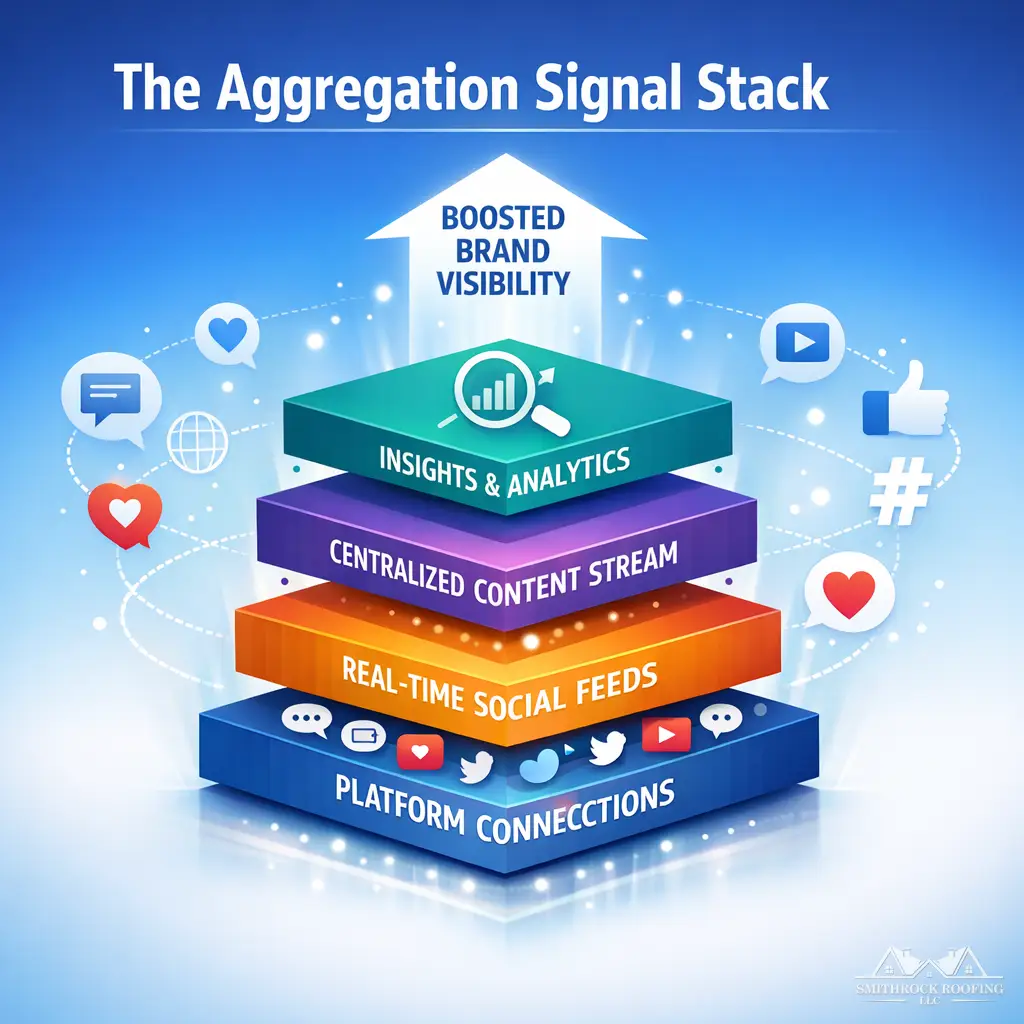
When aggregation is designed with intent, it stops being a content management shortcut and starts functioning as a multi-layered signal system — one that influences how algorithms categorize your brand, how audiences develop trust in you across touchpoints, and how your content creation engine gets smarter with every campaign cycle.
This guide breaks down the mechanics of that deeper strategy: how aggregation works as an algorithmic trust architecture, how your moderation queue becomes a primary research asset, and how to close the loop between collected content and your next campaign brief. These are the frameworks that separate brands building compounding visibility from those just filling screens with content.
What Social Media Aggregation Actually Does to Your Brand’s Discoverability
Before getting into strategy, it’s worth correcting a common mental model. Most brands think of aggregation as a display problem — collect content, show it somewhere, repeat. The more accurate framing is that aggregation is a signal architecture problem.
Every piece of content that gets collected, displayed, and interacted with generates data. That data flows back into platform algorithms, search engines, and audience behavior patterns. If you’re not designing your aggregation system to generate specific types of signals, you’re generating signals by accident — and accidental signals rarely compound in your favor.
How Aggregated Content Influences Algorithmic Systems
There are three distinct algorithmic environments where a well-designed aggregation strategy creates measurable lift:
1. Platform-Native Social Search and Recommendation Engines
When you consistently aggregate content around specific hashtags, branded mentions, and topic clusters, you’re doing more than keeping a feed current. You’re training platform recommendation systems to associate your brand entity with specific subject-matter categories. TikTok’s interest graph, Instagram’s Explore algorithm, and LinkedIn’s content relevance model all operate on pattern recognition — they learn from behavioral consistency over time. A brand that appears repeatedly in a specific content cluster, with engagement data to back it up, gets surfaced more frequently within that cluster to new audiences.
2. Owned Web Property Performance Signals
When UGC and aggregated social content are embedded on product pages, landing pages, or blog posts, they change how visitors interact with those pages. Dwell time increases when authentic community content is present. Scroll depth improves. Return visits go up. These behavioral signals feed directly into organic search ranking for brand-related queries. The aggregated content doesn’t just make your page look more credible — it makes the page perform differently in ways search engines measure and reward.
3. Entity Disambiguation in Search Knowledge Graphs
Consistent, structured aggregation of branded mentions across multiple platforms helps search engines build a more accurate and robust picture of what your brand actually does, who it serves, and what topics it owns. This is the process of entity disambiguation — Google’s Knowledge Graph becomes more confident in its categorization of your brand, which influences how your business surfaces in AI-generated search results, knowledge panels, and brand-related queries.
The expert-level insight here is this: most brands operate aggregation and SEO as two completely separate programs managed by different teams. The compounding advantage belongs to brands that map aggregation flows to specific signal types before building the system — not after the fact, when the architecture is already locked in.
The Platform Selection Problem Nobody Addresses Honestly
Every surface-level guide tells you to “choose platforms where your audience spends time.” That’s the starting point, not the answer. The real strategic question is how to prioritize aggregation infrastructure when your audience is distributed across multiple platforms but your team has the capacity to do fewer than all of them well.
Here’s a decision framework that senior marketers actually use:
Platform Prioritization Criteria for Aggregation Strategy
| Criteria | What to Measure | Strategic Weight |
|---|---|---|
| Audience Intent | Are users in discovery mode or community mode on this platform? Discovery-mode platforms generate better top-of-funnel aggregation value. | High |
| Content Decay Rate | How quickly does a post lose algorithmic reach after publishing? Platforms with fast decay rates benefit most from aggregation because content lifespan extension is most impactful there. | High |
| UGC Volume and Quality | Does your brand generate enough authentic community content on this platform to make aggregation worthwhile? Low-volume platforms produce thin aggregation feeds. | Medium-High |
| Embedding Compatibility | Can aggregated content from this platform be embedded cleanly on your owned web properties without format degradation? Format entropy erodes brand consistency. | Medium |
| Secondary Engagement Data | When aggregated content from this platform is displayed elsewhere, does it drive measurable engagement? Not all platform content travels well. | Medium |
| Algorithm Transparency | Do you have sufficient data on how this platform’s recommendation engine works to design aggregation flows that generate specific signals? Low-transparency platforms require more testing budget. | Low-Medium |
The practical implication: a brand with a highly active LinkedIn community and moderate Instagram presence should likely anchor aggregation infrastructure on LinkedIn first — not because Instagram is less popular, but because the intent signal quality from LinkedIn UGC often generates stronger behavioral data when embedded on B2B web properties.
Understanding Content Decay and Why It Changes Everything
Content decay is the rate at which a published post loses algorithmic reach and engagement after its initial distribution window. Different platforms operate on fundamentally different decay curves:
TikTok operates on a slow-burn, interest-graph model — content can resurface weeks after publication if the algorithm identifies an engaged audience cluster. Aggregation strategy here is less about rescuing decaying content and more about identifying which content the algorithm is already amplifying organically and doubling down.
Instagram Reels have a medium decay curve — strong initial 24–48 hour windows followed by sharp drop-off unless engagement velocity signals a long-tail push. Aggregating and redistributing Instagram content to owned properties during the decay phase extends the content’s impression count without requiring additional platform spend.
LinkedIn articles and long-form posts have the slowest decay curve of major platforms — content can generate meaningful traffic for weeks or months. Aggregation here is most valuable for surfacing thought leadership content to audiences who missed the initial distribution window.
X (formerly Twitter) operates on one of the fastest decay curves in the ecosystem — posts typically exhaust their reach within hours. Aggregating X content for display purposes has limited lifespan value unless the content ties to a live event or trending topic with search volume attached.
When you calibrate aggregation frequency and prioritization to actual decay mechanics rather than treating all platforms uniformly, you recover significantly more visibility value from content you’ve already created and paid for. For a deeper look at how to evaluate and select the tools that support this kind of platform-aware strategy, the article on how to choose social media management software covers the decision criteria worth applying before committing to any aggregation infrastructure.
Turning Your Moderation Queue Into a Competitive Intelligence Asset
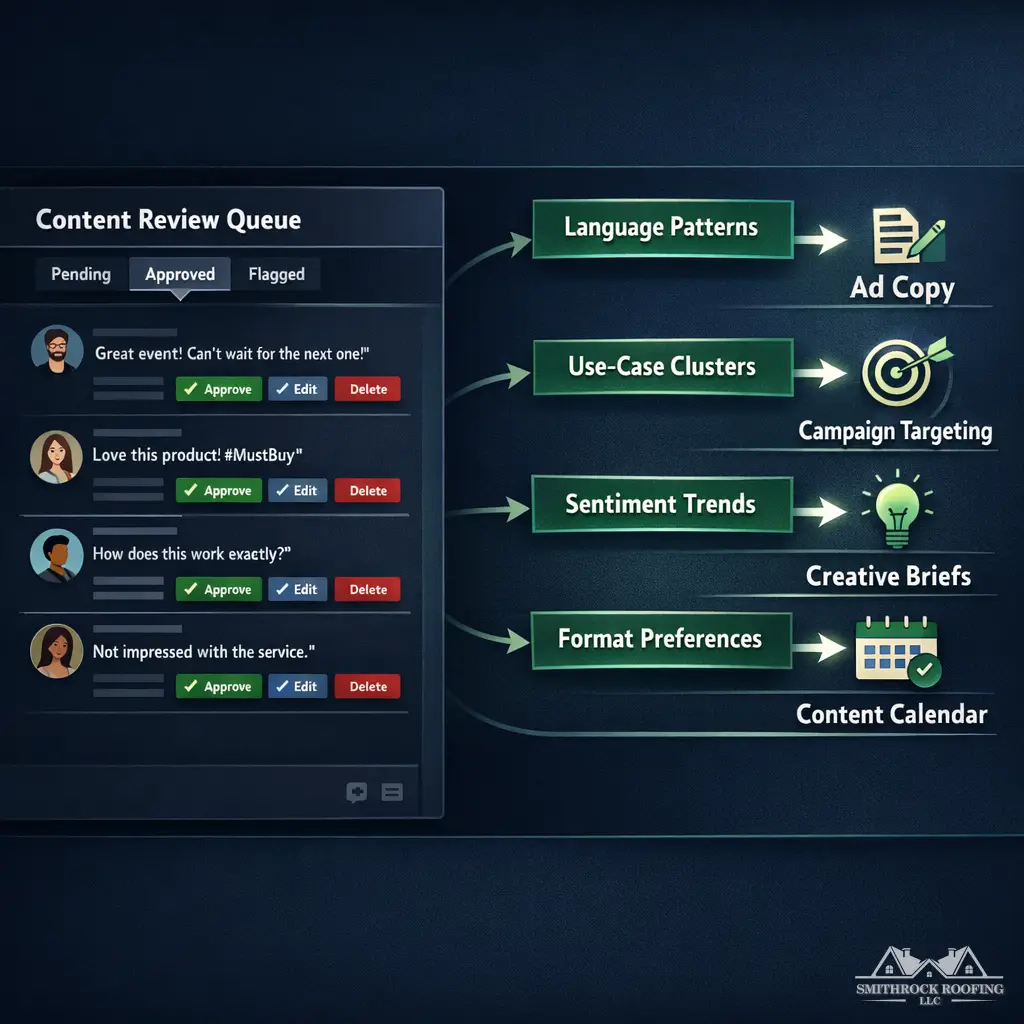
Here is a strategic insight that most brands never act on: your content moderation queue — the stream of UGC submissions that your team reviews before approving for display — is one of the most underutilized primary research datasets your marketing operation generates.
The standard framing treats moderation as a risk management activity. Filter out low-quality content, block off-brand submissions, approve what’s safe. That’s necessary, but it captures maybe 20% of the available value.
The remaining 80% is audience intelligence that your formal research process would cost significant resources to replicate.
Four Ways Moderation Data Drives Smarter Strategy
Language Pattern Analysis
Review the vocabulary your UGC community uses to describe your products, services, and outcomes. Specific phrases, analogies, and descriptive terms that appear repeatedly in organic UGC are high-signal indicators of how your actual buyers think and communicate. These are the words your paid ad copy, landing page headlines, and email subject lines should be using — and often aren’t, because internal teams default to brand-approved terminology that doesn’t match buyer language.
Use-Case Clustering
When you review aggregated UGC at volume, specific product applications, workflow contexts, and lifestyle scenarios emerge organically. A software company might discover that a significant segment of their user base is applying the product in an industry vertical the marketing team hadn’t prioritized. A product brand might find a use case appearing in UGC that no campaign has ever addressed. These clusters are high-intent audience micro-segments — and they’re telling you exactly what content to create next.
Sentiment Trajectory Mapping
Track the ratio of positive-to-neutral-to-negative sentiment in your moderation queue across campaign phases. Shifts in that ratio often appear in the moderation queue weeks before they surface in formal social listening dashboards, because formal tools measure published, public content while your moderation queue captures the full incoming stream including content users submitted but didn’t publish elsewhere. This gives you a genuine leading indicator of brand sentiment movement rather than a lagging report. Building a structured social media monitoring strategy around this data stream is what separates brands that react to sentiment shifts from those that anticipate them.
Content Format Preference Signals
Which format of UGC — short-form video, static image, text post, long-form review — generates the highest secondary engagement when aggregated and displayed on your owned properties? This data directly informs your creative brief for the next campaign cycle. If video UGC consistently drives 3x the dwell time of static image UGC when displayed on your product pages, that’s a signal your content production budget should be reweighted toward video creator partnerships.
The Aggregation-to-Activation Flywheel: Closing the Loop
The most significant structural problem in how most brands run aggregation is that content collection and content creation are treated as separate workstreams managed by separate teams, with no shared data layer connecting them. Collection happens. Display happens. And then the creative team starts the next campaign brief from a relatively blank page.
This is where the compounding advantage breaks down.
The Aggregation-to-Activation Flywheel is a closed-loop operational model that connects aggregation output directly to campaign input — so every aggregation event doubles as a creative intelligence event.
Stage 1 — Collection With Metadata Tagging
Aggregation starts with tagged collection, not raw ingestion. Every piece of content entering the system is tagged on intake with structured metadata: campaign association, product line, sentiment classification, creator tier (brand ambassador, loyal customer, new customer, industry voice), and platform of origin. Without this tagging discipline at intake, you’re collecting content but not generating usable data.
Stage 2 — Performance Pattern Recognition
Analyze which aggregated content clusters generate the highest secondary engagement when displayed across owned touchpoints — product pages, email embeds, event screens, paid retargeting units. Measure not just click-through rates but behavioral depth metrics: how long do visitors interact with pages featuring specific content clusters? Do certain content types drive return visits more than others?
Stage 3 — Creative Signal Extraction
From the top-performing aggregated content clusters, extract the specific creative elements driving performance. This is not about copying UGC — it’s about identifying the underlying creative logic: visual composition patterns, caption structure, topic angle, emotional register, problem-solution framing. These extracted signals become the creative brief inputs for your next production cycle.
Stage 4 — Seeded Amplification
Use Stage 3 insights to brief influencer partners, content creators, and internal production teams on content designed to perform well and aggregate effectively. This is the concept of engineered aggregation — creating content that is designed from the brief stage to feed the flywheel. The content isn’t just made to perform on its original platform; it’s structured to travel well, embed cleanly, and generate the behavioral signals your owned properties need.
Stage 5 — Measurement Loop Closure
Track how Stage 4 seeded content performs when it re-enters the aggregation system. Does it generate higher secondary engagement than the organic UGC that informed it? Does it improve moderation queue quality by setting a higher content standard for community submissions? Does it shift the sentiment trajectory you’re tracking? This measurement loop continuously tightens the relationship between audience behavior and content strategy — making each cycle more efficient than the last.
The brands winning on aggregated visibility aren’t just collecting more content. They’ve built an operational model where aggregation and activation share a data layer — and that structural connection is what turns a content management tool into a compounding brand growth system.
Solving the Attribution Problem: Measuring Visibility Lift From Aggregation
The measurement question that never gets answered in surface-level aggregation guides is this: when your brand’s visibility increases during a campaign that involves aggregation across owned web properties, social platforms, paid media, and events simultaneously, how do you isolate the visibility contribution of aggregation specifically?
The honest answer is that clean, isolated attribution is rarely achievable in complex multi-channel environments. But there are proxy measurement approaches that give senior marketers actionable data without requiring perfect attribution:
Aggregation Attribution Measurement Framework
Baseline vs. Active Comparison: Measure brand-related search volume, direct traffic to owned properties, and social brand mention volume during periods with and without active aggregation campaigns. Persistent lifts that appear across multiple metrics simultaneously are indicative of aggregation contributing to brand salience rather than any single-channel activity.
Embedded Content Interaction Metrics: Tag all aggregated content embeds on owned properties with UTM parameters and event tracking. Measure interaction rates, time-on-page differentials between pages with and without aggregated embeds, and conversion rate comparison for high-intent pages featuring UGC vs. those without. This creates a direct performance attribution line from aggregated content to owned property outcomes.
Social Share-of-Voice Tracking: Monitor branded hashtag volume and mention velocity across aggregation windows. When aggregation is actively driving UGC participation campaigns, share-of-voice lift that tracks with aggregation campaign activity — rather than paid media spend timing — is a reliable aggregation-specific signal.
Content Velocity Mapping: Track how quickly new UGC is submitted to brand hashtags and mention streams over the course of a campaign. Accelerating submission velocity indicates that aggregation display is generating participation feedback loops — community members see their content (or similar content) displayed and are motivated to contribute their own.
None of these proxy measures gives you a single clean attribution number. But together, they give you a directional confidence model — enough data to make resource allocation decisions with reasonable confidence that aggregation is generating measurable visibility return.
Cross-Platform Content Entropy: The Brand Consistency Risk Nobody Talks About
There is a visibility risk embedded in aggregation strategy that most guides don’t address at all: when you aggregate content from Platform A and display it in a Platform B environment, that content was created for Platform A’s native format expectations, visual language, and audience consumption behavior. Displayed elsewhere, it may perform inconsistently — and at scale, that inconsistency creates brand perception fragmentation.
This is cross-platform content entropy, and it’s a real brand consistency risk.
A vertical video optimized for TikTok’s full-screen, fast-cut consumption pattern looks compositionally wrong when embedded in a horizontal grid on a product page. A text-heavy LinkedIn post that performs well in a professional feed context reads as visually dense and low-energy when displayed in an event screen aggregation wall. The content hasn’t changed — but the format mismatch erodes the brand quality signal it was meant to deliver.
Managing content entropy requires format-aware moderation rules built into your aggregation system:
- Define minimum visual quality standards per platform of origin
- Establish display environment specifications (aspect ratio, caption length, visual density) for each owned property where aggregation is displayed
- Build format compatibility checks into your moderation workflow so content is reviewed not just for brand safety but for format fitness in the intended display context
- Prioritize native format content in high-visibility display positions; use format-mismatched content only in contexts where it can be cropped, reformatted, or supplemented with brand design framing
Brands that manage format fitness alongside content quality produce aggregation displays that reinforce brand consistency rather than quietly eroding it.
What a High-Performing Aggregation Strategy Actually Looks Like in Practice
Pulling these frameworks together, a brand operating at the strategic level of aggregation — rather than just the operational level — is doing the following things simultaneously:
- Designing aggregation flows to generate specific algorithmic signals, not just to populate displays with content
- Selecting and prioritizing platforms based on intent quality, decay dynamics, and embedding compatibility rather than audience size alone
- Running moderation queues as primary research operations, extracting language intelligence, use-case clusters, and sentiment signals alongside quality control
- Connecting aggregation output to creative brief input through a shared data layer that makes every campaign cycle smarter than the last
- Measuring visibility lift through multi-proxy models rather than waiting for single-source attribution that rarely materializes in complex environments
- Managing format entropy actively so aggregated content reinforces brand consistency across every display context
These are not advanced tactics requiring enterprise-scale resources. They are strategic disciplines that any brand with a structured approach and the right agency partnership can operationalize — and that produce compounding returns as each cycle generates better data for the next.
If your current aggregation approach is primarily about saving time and keeping displays looking active, you’re capturing a fraction of the available value. The brands building durable visibility through aggregation are the ones treating every piece of collected content as both a display asset and a data event — and building the operational systems to act on both.
Strategic Recommendations for 2026
As aggregation strategy matures into a core brand visibility discipline, the tools and operational approaches you build around it will determine whether you’re compounding value or simply keeping displays populated. Three specific moves worth prioritizing heading into 2026:
1. Integrate an AI-assisted moderation and language intelligence layer.
Tools like Tagbox or Juicer have evolved beyond simple content filtering. In 2026, the brands getting the most from these platforms are using their moderation interfaces as structured listening environments — tagging content by use-case language, sentiment cluster, and product mention type before it ever reaches a display. If your current moderation workflow ends at approve/reject, you’re leaving the most valuable half of the operation unused.
2. Adopt a cross-platform intent mapping framework using a tool like Brandwatch or Sprout Social’s listening suite.
Platform selection in aggregation strategy should be driven by documented intent signals, not assumed audience demographics. These platforms now offer decay-rate modeling and engagement-type breakdowns that make it possible to build a defensible, data-backed platform priority stack — and to update it quarterly as signal quality shifts.
3. Build a shared aggregation-to-creative data layer using a connector tool like Zapier, Make, or a native CRM integration.
The gap between what moderation queues reveal and what creative teams actually use is primarily an infrastructure gap, not a strategic one. Establishing a structured handoff — even a simple tagged spreadsheet synced automatically from your aggregation platform to your creative brief template — closes that gap without requiring enterprise tooling.
Frequently Asked Questions
What is a social media aggregator and how does it support brand visibility?
A social media aggregator is a tool or system that collects content from multiple social platforms — including user-generated posts, branded mentions, hashtag feeds, and reviews — and displays that content in a unified format, typically on a website, landing page, or digital screen. For brand visibility, the value goes beyond display: aggregation creates social proof signals, extends the reach of organic content, reinforces algorithmic activity across platforms, and gives brands a continuous stream of authentic content to surface. When managed strategically, an aggregation system functions as both a visibility engine and a research operation running in parallel.
How do you measure whether an aggregation strategy is actually improving visibility?
Single-source attribution rarely captures the full effect of aggregation on visibility, because the impact distributes across search behavior, direct traffic, time-on-site, and social engagement rather than concentrating in one trackable conversion path. A more reliable measurement approach uses a multi-proxy model: tracking changes in branded search volume, monitoring referral traffic from aggregation display pages, measuring engagement rates on aggregated content versus produced content, and logging shifts in organic reach on the platforms feeding the aggregation flow. Taken together, these proxies build a visibility picture that no single metric can provide on its own.
What types of content work best in a social media aggregation strategy?
The highest-performing aggregated content tends to share three characteristics: it uses language that reflects how real customers describe products or services rather than how brands describe themselves, it shows the product or service in a recognizable real-world context, and it carries implicit social endorsement through the fact of its public posting. User-generated posts, customer reviews formatted for display, and event or community content typically outperform polished promotional content in aggregation contexts because they deliver authenticity signals that branded creative cannot easily replicate. Format compatibility — ensuring the content renders cleanly in the display environment without distortion — is a secondary but important quality filter.
How often should an aggregation strategy be reviewed and updated?
Platform signal quality, audience behavior, and content decay dynamics all shift on timescales shorter than annual review cycles. A quarterly review cadence is the practical minimum for a functioning aggregation strategy — covering platform priority weighting, moderation tagging taxonomy, display format performance, and the handoff process between aggregation data and creative planning. Brands operating in fast-moving categories or running active campaign cycles benefit from a lighter monthly check on decay rates and engagement-type distribution, with the full strategic review reserved for quarterly intervals.
Conclusion
A well-executed social media aggregation strategy is one of the more durable visibility investments a brand can make — but only when it’s built with the operational discipline to turn collected content into compounding data, not just active displays. Mongoose Digital Marketing works with brands at exactly this level, bringing structured thinking to social media marketing for small businesses and content strategy so that every aggregation cycle produces better inputs for the next one. If you’re ready to move from keeping your feeds populated to building real visibility infrastructure, we’d welcome the conversation — Get a Free Estimate and let’s map out what a smarter aggregation strategy looks like for your brand.