
Key Takeaways
- A social media monitoring strategy built around pre-awareness keywords — the problem language your customers use before they know your business exists — generates more actionable leads than brand-name tracking alone.
- Sentiment velocity (the rate of change in sentiment over time) is a more reliable performance indicator for small businesses than static sentiment scores, because direction and momentum reveal what a snapshot cannot.
- A 2×2 Triage Matrix that scores mentions by urgency and influencer weight eliminates decision fatigue for solo operators and creates a response protocol that scales without adding headcount.
- Most entry-level monitoring tools surface less than 15% of relevant social conversations due to platform API restrictions — understanding this data ceiling prevents false confidence in your coverage.
- Competitor sentiment spikes create direct acquisition windows: when a competitor’s reputation deteriorates rapidly, businesses that detect the signal early can intercept dissatisfied customers actively looking for alternatives.
Running a small business in the Dayton area means you wear more hats than any single job title can describe. You are the decision-maker, the customer service rep, the content creator, and — if you’re reading this — the marketing strategist. The last thing you need is a social media monitoring framework built for a company with a dedicated analytics team and a six-figure tech stack.
Here’s the problem with most guidance on this topic: it was written for someone else. The standard advice — set up Google Alerts, track your brand name, check engagement rates — was designed for marketing departments that have time to run weekly reports and dedicated analysts to interpret them. When a Centerville restaurant owner or a Beavercreek home services contractor follows that advice, they end up with a dashboard full of noise and no clear path to action.
What follows is a monitoring strategy built for how small businesses in the greater Dayton market actually operate. It addresses the signal-to-noise problem competitors ignore, introduces a prioritization framework for single-operator businesses, and reframes monitoring entirely — from a defensive reputation tool into an offensive demand-generation asset.
Why Most Small Business Monitoring Strategies Fail Before They Start
The dominant advice in this space follows a predictable sequence: define goals, pick platforms, choose a tool, track basic metrics, adjust content. It reads like a checklist written by someone who has never tried to monitor social media at 7 PM after a ten-hour day running their own business.
The actual failure points are more specific — and more fixable.
The Signal-to-Noise Problem Nobody Talks About
When a small business sets up keyword alerts for its own name, it often triggers hundreds of irrelevant mentions. A Springboro landscaping company called “Green Ridge” will capture every passing reference to ridges, green spaces, and countless unrelated conversations. Without filtering logic, the alerts become background noise — and eventually get ignored entirely.
Effective monitoring requires exclusion architecture: defining not just what you want to track, but what you want the system to ignore. That means building negative keyword lists, domain exclusion filters, and language-pattern rules that narrow your alert feed to mentions that are actually relevant to your business and your market.
This is the daily operational work of social media monitoring that no competitor article explains — and it’s the difference between a tool you check every morning and a tool you unsubscribed from three weeks after signing up.
The Platform API Ceiling
Here is a fact that most monitoring tool vendors prefer you not think too hard about: free and entry-level monitoring tools surface a fraction of relevant conversations. Following the Twitter/X API restructuring in 2023 and Meta’s ongoing privacy adjustments, access to public social data has become significantly more restricted across the major platforms.
A small business owner using a basic-tier monitoring tool may believe they have comprehensive coverage of their brand mentions and industry conversations. In practice, they may be seeing less than 15% of the conversations that are actually occurring. That’s not a tool failure — it’s a structural limitation of the data access tier. Understanding this ceiling is essential before you build any strategy on top of it. It means you treat monitoring data as directional intelligence, not complete surveillance — and you supplement tool-based monitoring with manual checks in the communities where your customers actually talk.
For Dayton-area businesses, that means regularly checking local Facebook groups like Dayton Ohio Community or neighborhood-specific groups in Kettering, Huber Heights, and Miamisburg where residents genuinely discuss local service providers.
The Keyword Architecture That Actually Generates Leads
Every competitor article instructs you to monitor your brand name, your competitors’ names, and generic industry keywords. That approach captures people who already know you exist or are already deep in the buying process. It misses the largest segment of your potential market entirely.
Pre-Awareness Monitoring: Find Customers Before They Find You
The most valuable keyword layer you can build is one that captures problem language — the exact phrases people use when they are experiencing the problem your business solves, before they’ve started looking for a vendor.
An HR consulting firm in the Dayton market shouldn’t only monitor “HR consulting Dayton” or its own company name. It should monitor phrases like “employee keeps calling off” or “can I fire someone for this” in local professional groups and community forums. A plumber in Kettering should track “water heater making noise” and “low water pressure upstairs” across local Facebook groups, Nextdoor neighborhoods, and Reddit’s r/dayton community. A residential cleaning service in Centerville should flag “overwhelmed with housework” and “can’t keep up with cleaning” in local mom groups and neighborhood boards.
This is pre-awareness monitoring — and it transforms your monitoring program from a reputation management tool into a demand interception system. People expressing these problems are not yet in the market because they don’t yet know a solution exists. If your business shows up in that conversation authentically and helpfully, you create demand rather than competing for existing demand.
Building a pre-awareness keyword cluster involves three layers:
- Symptom language: The words people use to describe their problem without naming a solution category (“my gutters are pulling away from the house”)
- Frustration language: Emotional expressions of the problem (“so tired of dealing with this every year”)
- Comparison language: Early-stage research phrases (“is it worth hiring someone to…” or “should I just do this myself”)
None of these phrases mention your business or your industry by name. All of them represent someone who is one conversation away from becoming your customer.
Platform Selection Based on Where Your Market Actually Talks
The Dayton metro market has specific platform behaviors worth understanding. General advice to “be on the platforms where your audience is” doesn’t account for how Dayton-area consumers actually use social media to find and discuss local businesses.
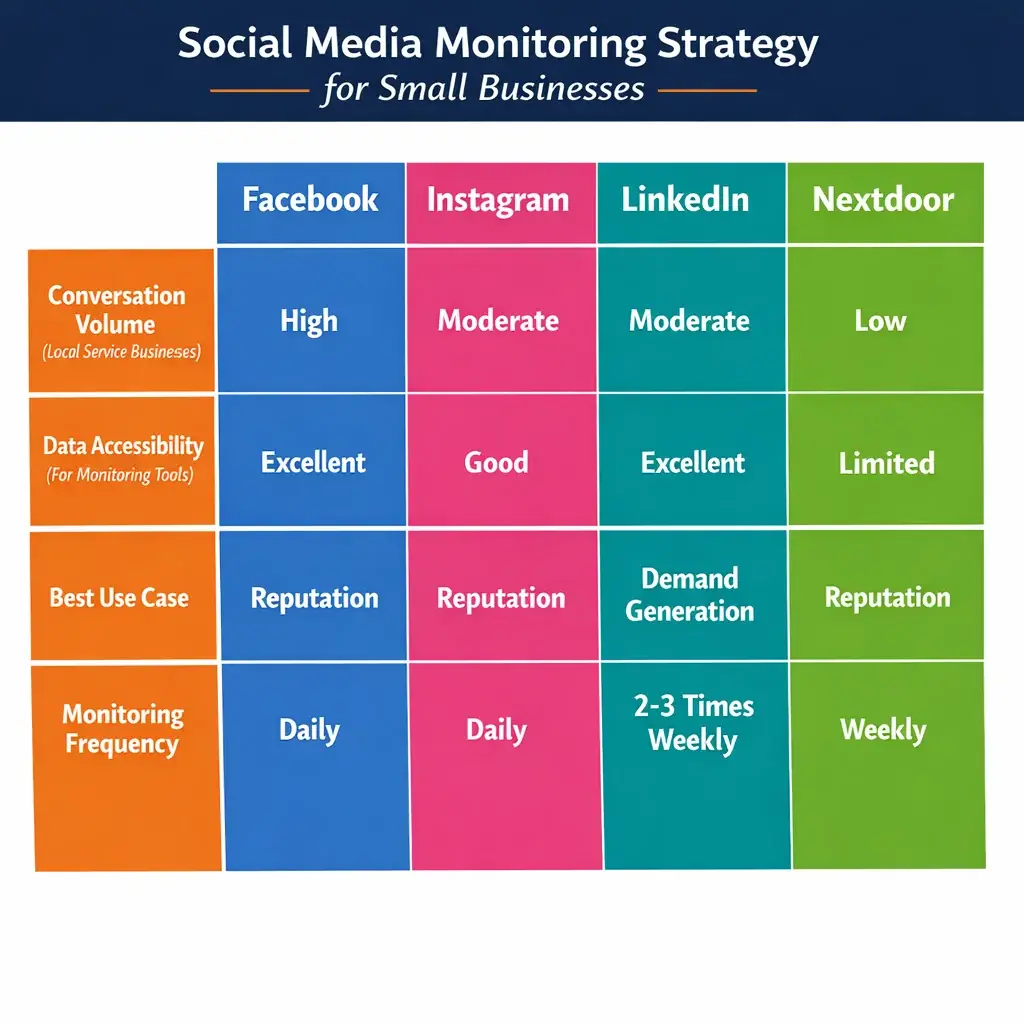
Platform-by-Platform Monitoring Priorities for Dayton-Area Small Businesses
| Platform | Best Monitoring Use | Conversation Type | Data Accessibility | Priority for Local Monitoring |
|---|---|---|---|---|
| Facebook Groups | Pre-awareness demand capture, reputation management | High-intent local discussion, direct recommendations | Limited via tools; requires manual monitoring | Very High |
| Nextdoor | Hyper-local reputation tracking, neighbor referrals | Location-specific, high purchase intent | Very limited via tools; primarily manual | High |
| Google Reviews / Maps | Reputation monitoring, sentiment tracking | Post-purchase, high credibility weight | Moderate via tools | Very High |
| Brand perception, visual storytelling engagement | Awareness and brand affinity | Moderate via tools | Medium | |
| B2B demand monitoring, professional reputation | Industry discussion, professional peer influence | Good via tools | Medium (B2B businesses) | |
| Reddit (r/dayton) | Pre-awareness capture, candid customer voice | Unfiltered opinions, problem-first language | Moderate via tools | Medium-High |
| YouTube Comments | Long-term reputation, how-to demand signals | Research-phase buyers, problem-aware audiences | Limited via tools | Low-Medium |
The key insight in this table is that the platforms with the highest local conversation value — Facebook Groups and Nextdoor — have the lowest tool-based data accessibility. This means your monitoring strategy for the Dayton market must include structured manual monitoring sessions for these platforms, not just automated alerts. Schedule them like any other business task: two 20-minute sessions per week, focused on the groups and neighborhoods where your customers live.
The Monitoring Triage Matrix: A Framework for Single-Operator Businesses
One of the most paralyzing aspects of social media monitoring for small business owners is deciding what to respond to and when. Without a framework, every mention feels equally urgent — or equally ignorable. Both responses hurt your business.
The solution is a triage approach that scores every mention across two dimensions before you decide how to respond.
The 2×2 Triage Matrix
Axis 1: Urgency — Is this conversation time-sensitive? A complaint escalating in real time is urgent. A positive review posted this morning is not.
Axis 2: Influencer Weight — Does this account have meaningful reach in your market? A local Facebook group admin with 4,000 Beavercreek neighbors following their posts carries high weight. A private account with 40 followers carries low weight. Note that for local businesses, “influencer weight” doesn’t mean follower counts in the millions — it means local reach and community credibility.
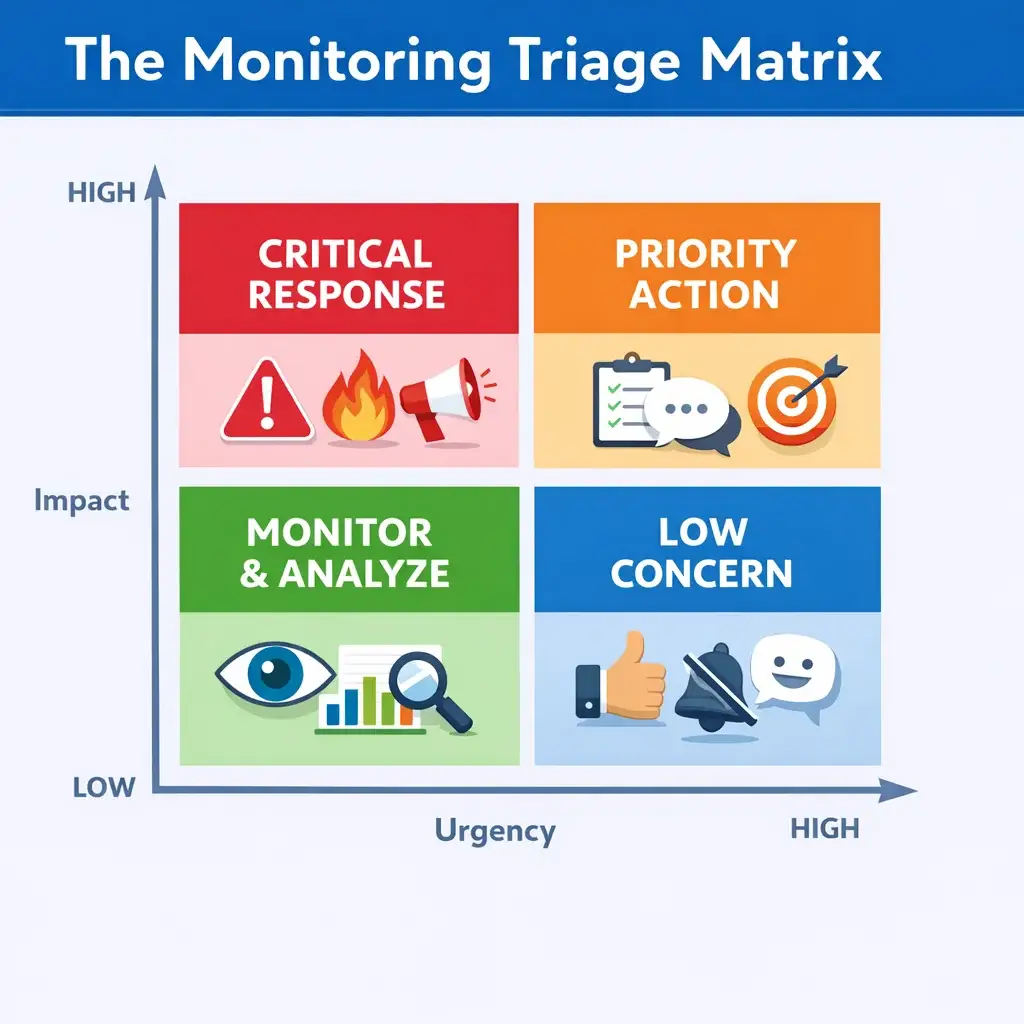
This matrix does something no other monitoring framework provides for small businesses: it removes the decision from the moment of stress. When a notification arrives, you don’t have to decide how to react — you simply score it and follow the pre-set protocol for that quadrant. Over time, this becomes instinctive, and the mental load of monitoring drops significantly.
Sentiment Velocity: The Metric That Tells You What’s Actually Happening
Most monitoring guides recommend tracking sentiment — positive, negative, or neutral — as a primary KPI. This advice isn’t wrong, but it’s dangerously incomplete for small businesses that operate with low mention volumes.
Why Static Sentiment Scores Mislead Small Businesses
If your business has 82% positive sentiment this week, that number tells you almost nothing in isolation. Is that up from 71% three weeks ago? You’re on a strong recovery trajectory. Is it down from 96% six weeks ago? You have a deteriorating trend that demands immediate investigation — even though the absolute number still looks healthy.
Sentiment velocity is the rate and direction of change in your sentiment score over a rolling time window. It’s the difference between knowing your altitude and knowing whether the plane is climbing or descending.
For small businesses in the Dayton market with limited mention volumes — say, 15 to 40 mentions per month — tracking velocity over a 30-day rolling window gives you a more reliable signal than any single weekly snapshot. Here’s how to apply it practically:
Step 1: Record your sentiment distribution (% positive, % negative, % neutral) at the same point each week — Friday afternoon works well.
Step 2: Plot the change in your positive sentiment percentage week over week. You’re looking for the trend line, not the number.
Step 3: Flag any week where positive sentiment drops more than 8 percentage points from the previous week. That’s your early warning threshold — investigate before it becomes a visible problem.
Step 4: When you’re reviewing competitor sentiment (more on this below), apply the same velocity lens. A competitor whose positive sentiment has dropped 20 points over six weeks is experiencing a vulnerability window you should be paying attention to.
Competitive Intelligence: Beyond Looking at Their Comments Section
The standard advice to “check your competitors’ social media comments” was barely adequate in 2018. In a market like greater Dayton — where established local businesses compete with regional chains and national franchises on a daily basis — you need a more systematic approach to competitive monitoring.
Share of Voice Over Rolling Windows
Share of voice (SOV) measures what percentage of the total online conversation in your category mentions your business versus your competitors. For a Miamisburg HVAC company, this means tracking what portion of “HVAC repair Miamisburg” and related conversations across local platforms feature their name versus the names of three or four key competitors.
You don’t need enterprise software to do this. A simple monthly tracking log that records the volume of mentions your business receives versus two or three primary competitors — pulled from Google Alerts, your monitoring tool, and a manual Facebook group check — gives you directional SOV data over a rolling 90-day window. That 90-day view smooths out the noise of one-off events and shows you genuine trend lines.
Identifying Competitor Vulnerability Windows
When a competitor experiences a surge in negative sentiment — a bad review situation that gains traction, a service failure that gets discussed in local groups, a public complaint that spreads across Nextdoor neighborhoods — that’s not just competitive intelligence. It’s an acquisition opportunity with a narrow time window.
Customers experiencing active dissatisfaction with a competitor are in the market right now. They are often vocal about it, which means they’re findable. A well-timed, helpful presence in those conversations — not predatory or self-promotional, but genuinely useful — positions your business as the credible alternative at exactly the moment that alternative is being sought.
For a Dayton-area business to execute this effectively, you need to be monitoring competitor mentions consistently enough that you catch the signal early. A competitor vulnerability window is typically 72 to 96 hours wide before the conversation either resolves or fades. If you’re running weekly reviews only, you’ll often miss it entirely.
Connecting Monitoring to Business Outcomes
The most common failure point in small business monitoring programs isn’t the strategy — it’s the failure to close the loop between monitoring activity and actual revenue outcomes.
Building a Monitoring-to-Pipeline Connection
Social media monitoring generates intelligence. Intelligence only has value if it informs a decision that produces a measurable outcome. Here’s how to build that connection without overcomplicating your process:
Track which monitoring-sourced insights led to a specific action:
– Did a pre-awareness keyword alert lead you to respond to someone in a local Facebook group? Record it.
– Did that response result in a direct message or an inquiry? Record it.
– Did that inquiry convert to a customer? Record it.
This is a simple log — a spreadsheet with four columns: Date, Insight Source, Action Taken, Outcome. Over 90 days, this log builds a picture of which monitoring activities actually drive pipeline movement for your specific business in your specific market.
Account for attribution lag in local service markets:
In service-based businesses across the Dayton metro area, the gap between a social media interaction and a booked service call can be days or weeks. Someone who sees your comment in a Centerville Facebook group today might not book your service until their furnace stops working in January. Build attribution windows of 60 to 90 days into your outcome tracking — otherwise you’ll undercount the revenue impact of your monitoring program and underinvest in the activities that are actually working.
Building Your Monitoring Stack Without Wasting Resources
You don’t need an enterprise platform to run an effective monitoring strategy. What you need is a stack that’s matched to your actual data needs, your available time, and the platform landscape in the Dayton market.
Recommended Monitoring Stack for Dayton-Area Small Businesses
Free and low-cost tools that provide real utility:
Google Alerts — Best for tracking brand name mentions across indexed web content, news, and public blogs. Not useful for private Facebook groups or dark social. Set alerts for your business name, owner name, primary service keywords + city, and your top two competitors. Use exact-match quotation marks for brand names to reduce noise.
Meta Business Suite (native) — Tracks all mentions, comments, and direct messages across Facebook and Instagram properties you own. Free, comprehensive for your owned channels, and integrates with your content calendar. This is your primary tool for owned-channel monitoring.
Google Business Profile notifications — Set up review alerts so you are notified immediately when a new review is posted. First-response time on reviews directly affects local SEO signals. For Dayton-area businesses competing for local pack rankings, this is not optional. Our Google Business Profile optimization tips article covers exactly how to configure your profile to maximize the impact of every review response.
A paid monitoring tool (entry-level) — Tools like Mention, Brand24, or Hootsuite Listening provide broader keyword tracking across public social channels. Understand that entry-level tiers have data caps, and be realistic about what you’re actually capturing. Use these tools primarily for trending analysis and competitor share-of-voice tracking, not as a source of complete coverage.
Manual monitoring sessions — Two 20-minute structured sessions per week in local Facebook groups, Nextdoor, and Reddit. Use a consistent checklist: search your business name, search two competitor names, search three pre-awareness keywords relevant to your service. Log anything significant in your monitoring spreadsheet.
What to stop doing:
If you’ve set up keyword alerts and are receiving more than 30 notifications per day with a relevance rate below 50%, your keyword architecture needs refinement before you add more tools. More volume is not better. Actionable signal is better.
Monitoring Cadence: When to Watch vs. When to Act
One of the most practical decisions a small business owner can make is separating routine monitoring cadence from trigger-based real-time response thresholds.
Routine Monitoring Rhythms
| Frequency | Activity | Time Required |
|---|---|---|
| Daily | Review Google Business Profile for new reviews; scan Meta Business Suite for urgent comments or messages | 10 minutes |
| Twice weekly | Manual Facebook Groups and Nextdoor check using pre-awareness keyword checklist | 20 minutes per session |
| Weekly | Review keyword alert digests from Google Alerts and monitoring tool; update sentiment velocity log; log any monitoring-sourced interactions in pipeline spreadsheet | 30 minutes |
| Monthly | Competitive share of voice review; 90-day sentiment velocity trend analysis; keyword cluster audit to add new pre-awareness terms or remove low-value terms | 60 minutes |
| Quarterly | Full monitoring strategy review; assess which monitoring activities produced pipeline outcomes; adjust tool stack and keyword architecture accordingly | 90 minutes |
Trigger-Based Real-Time Alerts
Separate from your routine cadence, set up immediate notifications for:
- Any new one-star or two-star review on any platform
- Any mention of your business name in conjunction with negative sentiment language (complaint, terrible, avoid, warning, scam)
- Any competitor mention that gains more than 25 interactions within a 4-hour window in local community groups
- Any pre-awareness keyword that appears in a local group post with more than 10 comments — this indicates high community engagement around a problem your business solves
These triggers pull you out of routine mode and into Quadrant 1 or Quadrant 2 of the triage matrix — requiring an active response rather than a scheduled review.
The Monitoring Strategy as a Growth System, Not a Chore
The businesses in the Dayton area that build durable monitoring programs — the ones that actually generate leads and protect their reputations — are the ones that stop treating monitoring as a reactive task and start treating it as an intelligence system that feeds growth decisions.
When your monitoring reveals which pre-awareness keywords appear most frequently in local groups, that’s content strategy input. When your competitive sentiment tracking shows a vulnerability window opening for a key competitor, that’s a paid advertising targeting opportunity. When your sentiment velocity trend shows a recovery trajectory following a service issue you addressed, that’s proof your reputation management is working — and a data point worth sharing with your team.
The Triage Matrix keeps the system from overwhelming you. The cadence framework keeps it manageable. And the pipeline connection log keeps it accountable to the only metric that actually matters for a small business: is this generating revenue?
A monitoring strategy without that connection to business outcomes is just noise collection. With it, it becomes one of the highest-leverage investments a Dayton-area small business owner can make in their marketing program. For a broader look at how monitoring integrates with your full marketing mix, the social media strategy for small businesses article walks through how these intelligence signals translate directly into content and campaign decisions.
Final Strategic Recommendations for 2026
As you move into 2026, three developments deserve your attention and deliberate integration into any monitoring program built for a local market like Dayton.
1. Prioritize AI-Assisted Sentiment Analysis Tools With Local Filter Capability
Generic sentiment tools treat a mention in a Dayton neighborhood Facebook group the same as a national Reddit thread. In 2026, tools like Brand24 and Mention have expanded their geographic filtering and local source weighting. For small businesses in Kettering or Beavercreek, the ability to separate hyperlocal signal from national noise is the difference between actionable intelligence and irrelevant data. Evaluate your current tool stack specifically on this capability — if it cannot weight local sources differently, it is not optimized for your use case.
2. Integrate Google Business Profile API Alerts Into Your Triage System
Google Business Profile continues to be the single highest-impact reputation surface for local businesses. In 2026, the expanded API access allows third-party tools and even custom notification setups to surface new reviews, Q&A activity, and suggested edits in near-real time. If your monitoring stack does not yet have a direct integration with your GBP data, closing that gap is your highest-leverage technical next step. A review that sits unanswered for 48 hours costs you more than the content you will produce this quarter.
3. Build a Quarterly Monitoring Audit Into Your Calendar Now
Tools change, platforms shift their algorithms, and the community groups where your pre-awareness conversations happen in 2025 may not be the ones where they happen in late 2026. Schedule a standing 90-minute quarterly audit — not of your daily monitoring results, but of the monitoring system itself. Are your keyword lists still capturing the right conversations? Are your alert thresholds still calibrated correctly? Is your pipeline connection log showing attribution? This structural review is what separates a monitoring program that compounds value over time from one that quietly becomes obsolete.
Frequently Asked Questions
How much time per week does a realistic social media monitoring program actually require for a small business?
For most small businesses in the Dayton area, a well-structured monitoring program runs on roughly 30 to 45 minutes of active daily review time, broken into two short sessions — one in the morning and one in the late afternoon. That cadence covers your routine keyword checks, competitor activity, and sentiment review without pulling you away from operations for extended periods. The key is building a triage system in advance so that when you sit down to monitor, you are reviewing organized inputs rather than searching from scratch. Immediate alert triggers handle the time-sensitive exceptions automatically, so routine monitoring stays contained and manageable.
Which social media platforms matter most for local businesses in Dayton and nearby communities like Centerville and Kettering?
For most local service businesses in the greater Dayton area, the highest-value monitoring surfaces are Google Business Profile, Facebook — particularly local neighborhood groups and community pages — and Nextdoor. These three platforms generate the most local conversation, the most review activity, and the most pre-awareness keyword traffic relevant to service-based businesses. Instagram and TikTok matter more if your business has a strong visual component or a younger primary demographic. The honest answer is to let your monitoring data tell you where your customers are actually talking — and weight your attention accordingly rather than spreading effort equally across every platform.
What is the difference between social media monitoring and social media management, and do I need both?
Social media monitoring is the practice of listening — tracking what is being said about your business, your competitors, and the problems your customers experience, across platforms you may not even own or post to. Social media management is the practice of publishing — creating and scheduling content, responding to your own posts, and maintaining your brand presence on owned channels. For a local business building toward revenue-generating outcomes, monitoring is frequently the higher-leverage activity because it surfaces opportunities and threats that management alone cannot detect. Both serve different functions, and a complete local marketing program benefits from both operating in coordination rather than treating them as interchangeable. The article on how to manage social media accounts for business breaks down exactly how to structure that management layer so it works in sync with your monitoring system.
How do I know if my social media monitoring is actually contributing to business growth rather than just generating reports?
The clearest signal is the pipeline connection log — a simple record that links monitoring-sourced opportunities to actual business outcomes. When a pre-awareness keyword surfaces a community conversation, you engage, and that engagement leads to a consultation request, that sequence gets logged. When a competitor vulnerability window you identified through sentiment tracking corresponds to a month where your inquiry volume increases, that correlation gets noted. Over 90 days, patterns emerge that either confirm your monitoring is feeding your pipeline or reveal that the activity is disconnected from revenue. If you cannot point to at least a handful of traceable connections between your monitoring activity and a lead, a conversion, or a retained customer within a quarter, your system needs recalibration — not more volume.
Work With a Team That Understands the Dayton Market
A monitoring strategy is only as strong as the team interpreting the data and connecting it to real marketing decisions — and that is exactly the kind of work Mongoose Digital Marketing proudly serving Dayton, Kettering, Beavercreek, and Centerville specializes in, from local SEO and reputation management to full-service social media strategy built around how your specific community actually searches and talks. If you are ready to stop guessing and start building an intelligence system that feeds your growth, we would be glad to walk through what that looks like for your business. Get a Free Estimate and let’s build something that works.