

What Social Media API Integration Actually Means for Your Marketing Strategy
Most articles on social media API integration are written for developers. They cover authentication flows, endpoint documentation, and rate limit tables — useful if you’re building software, but nearly useless if you’re a business owner or marketing leader trying to make a strategic decision about your marketing infrastructure.
This article takes a different approach. The goal here is to explain what API integration genuinely enables for business marketing, where the real risks live, and how to evaluate whether your organization is actually ready to build on this kind of infrastructure — before you invest time and budget into it.
If you’ve heard that APIs can “automate your social media” or “give you better analytics,” that’s true, but it’s also the shallowest possible version of the story. The deeper opportunity — and the deeper risk — is something most marketing conversations never reach.
What a Social Media API Actually Does for Marketing Teams
An API (Application Programming Interface) is a structured channel through which two software systems exchange data according to agreed rules. When you connect your marketing platform to Facebook, LinkedIn, or TikTok through their respective APIs, you’re not just automating posts. You’re establishing a direct data pipeline between your business systems and the platform’s activity layer.
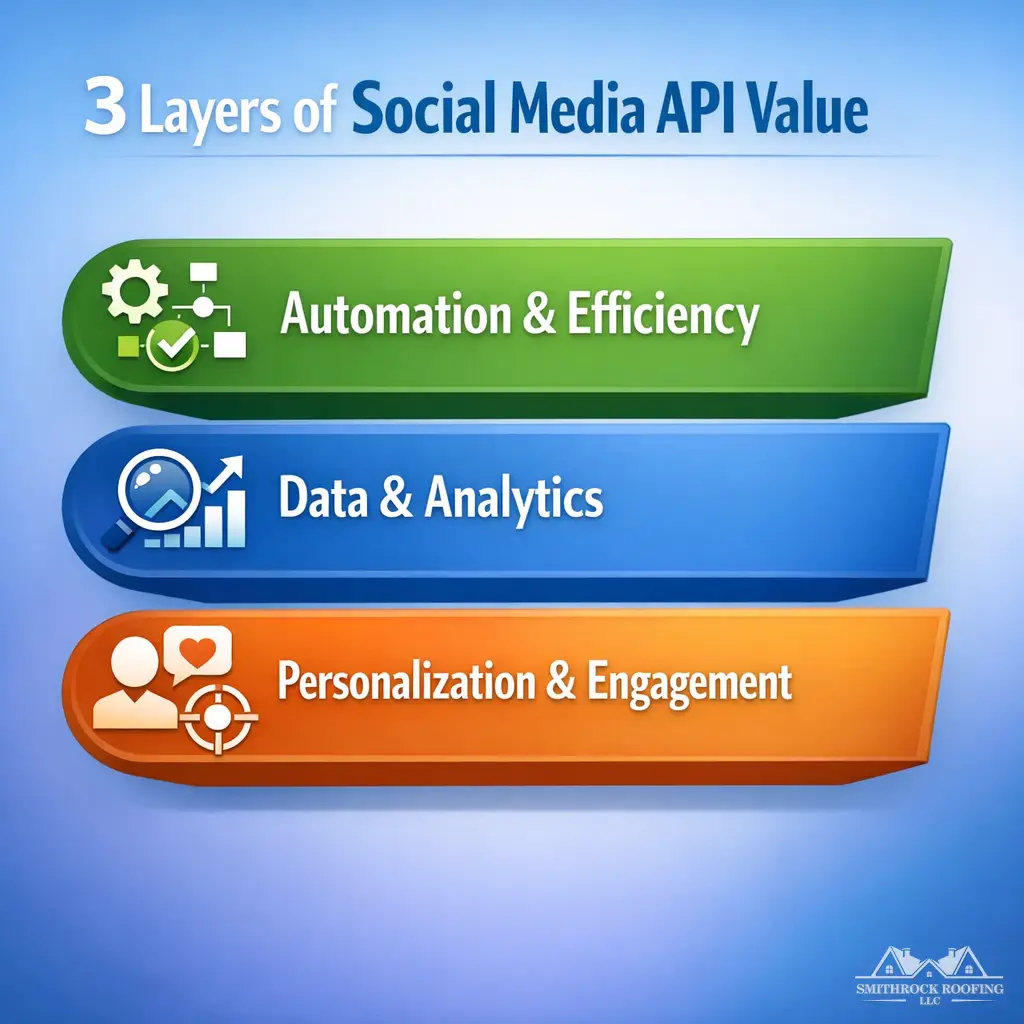
For marketing, this matters in three distinct ways:
Publishing automation — scheduling and posting content across platforms from a single system without manual platform-by-platform login.
Data retrieval — pulling engagement metrics, audience signals, ad performance data, and sometimes raw event data directly into your own analytics environment.
Audience interaction — responding to comments, routing direct messages, and triggering automated engagement workflows based on user behavior signals.
The first use case is what most people think of. The second and third are where API integration becomes a genuine strategic asset — and where most businesses leave significant value on the table.
The Attribution Opportunity Most Businesses Are Missing
Here’s the insight that separates businesses using APIs strategically from those just using them for scheduling convenience: API-level data access changes what marketing attribution is possible.
Platform dashboards show you what platforms want you to see. They’re designed to demonstrate platform value — which means the numbers are curated, modeled, and sometimes estimated in ways that favor the platform’s own ad products. When you rely exclusively on native analytics, you’ve handed measurement control to the same entity selling you ad inventory.
API integration is the mechanism for reclaiming that control.
Raw Event Data vs. Reported Data
When you pull data through a platform API, you can access event-level data — individual impression events, click timestamps, engagement sequences — rather than the aggregated summaries presented in dashboards. This raw data lets you build independent measurement models that aren’t subject to platform-side processing decisions.
In practical terms: you may discover that your LinkedIn content drives significantly more website behavior than LinkedIn’s own campaign manager reports, because cross-device attribution between the platform’s mobile app and your website is handled differently in raw event data versus the platform’s internal last-touch model.
Dark Social Attribution
LinkedIn and Meta APIs both support webhook configurations that can capture engagement signals from content shared into private messages or closed groups — interactions that never register in standard analytics dashboards. This “dark social” layer represents a meaningful share of B2B content distribution, particularly on LinkedIn, where content is frequently shared in private professional conversations.
Without API-level access, that traffic arrives at your website with no referral attribution. With proper webhook configuration, you can begin building a more honest picture of how your content actually travels.
Cross-Platform Journey Stitching
The most powerful attribution use case is building unified customer journey models that span platforms. A user sees your content on Instagram, visits your LinkedIn page, and converts through a Facebook retargeting ad — three separate platform events that appear as three unrelated data points in three separate native dashboards.
With simultaneous API access across those platforms and a unified data layer, you can begin connecting those touchpoints using shared identifiers. This kind of cross-channel journey mapping is structurally impossible within individual platform interfaces. It requires owning the data pipeline at the API level.
This is what we mean when we say API integration is a strategic marketing intelligence asset, not just an automation tool.
The API Dependency Audit: A Framework Marketing Teams Actually Need
Before building any significant marketing workflow on social media APIs, your team needs to answer one honest question: What breaks, and how badly, if this API changes, gets restricted, or disappears?
This isn’t a hypothetical risk. In 2023, Twitter/X restructured its API access model with roughly 30 days of effective transition time. Marketing teams that had built scheduling workflows, social listening infrastructure, and analytics pipelines on that API faced a forced rebuild under deadline pressure. The warning signs existed — the platform had been signaling policy review for months — but most marketing teams had no framework for evaluating that risk before it became a crisis.
The API Criticality Scoring Model
Evaluate each of your current or planned API integrations across three dimensions:
| Integration | Criticality Tier | Marketing Function at Risk | Fallback Option Exists? | Time-to-Rebuild Estimate |
|---|---|---|---|---|
| Primary scheduling platform | Mission-Critical | Content distribution across all channels | Low | High — weeks to months |
| Paid social reporting feed | Mission-Critical | Campaign optimization decisions | Medium | Medium — days to weeks |
| Social listening / monitoring | Operational | Brand response, competitor tracking | Medium | Medium |
| Audience export / CRM sync | Operational | Lead nurturing, segmentation | Low | High |
| Engagement automation (DMs, comments) | Supplementary | Customer response time | High | Low |
| Influencer performance tracking | Supplementary | Partnership measurement | High | Low |
Mission-Critical integrations are those where a disruption directly stops revenue-generating activity. Operational integrations are those where disruption degrades performance but doesn’t halt it. Supplementary integrations affect reporting and optimization but can be managed manually in the short term.
The goal of this audit is not to avoid API integration — it’s to ensure you know your exposure before you’re living it.
The Platform Leverage Problem
There’s a strategic reality that sophisticated marketing teams need to internalize: when a platform knows your marketing operations depend on its API, it has pricing and policy leverage over you.
This is especially true for businesses that have consolidated significant workflow investment into a single platform’s ecosystem. Meta’s Graph API versioning history, TikTok’s research API access restrictions, and LinkedIn’s tiered API access model all demonstrate that platforms exercise this leverage actively — and usually in the direction of steering businesses toward managed, paid advertising products rather than open data access.
Building API dependency into your marketing infrastructure without an exit strategy isn’t a technical oversight. It’s a business negotiating position you’ve accepted without realizing it.
Redundancy Mapping for Marketing Operations
For each Mission-Critical integration, your team should have documented answers to these questions:
- If this API returns a 429 (rate limit exceeded) or 503 (service unavailable) during an active campaign, who is alerted, and what is the manual fallback procedure?
- If this platform announces a breaking API change with 60 days notice, what is the rebuild timeline and who owns it?
- If the developer or agency who built this integration is no longer available, where is the documentation that allows a different technical resource to maintain it?
Most marketing teams cannot answer all three questions for their primary integrations. The ones that can have dramatically better marketing continuity when platform changes inevitably happen.
Why Most API Integrations Fail Before the First Campaign Runs
The technical barrier to social media API integration is lower than it has ever been. The organizational barrier is where most real-world implementations break down — and almost no one in the industry talks about it honestly.
The Ownership Vacuum
Social media API integrations sit at the intersection of three teams: marketing, engineering, and data/analytics. Each team has legitimate claim to parts of the problem. Marketing owns the use case and the campaign logic. Engineering owns the build and the infrastructure. Data owns the measurement architecture and the analytics output.
In practice, this means no single team feels full accountability for the integration’s health. OAuth tokens expire on a 60-day cycle without anyone noticing because marketing thinks engineering is monitoring it, engineering thinks it’s a marketing tool, and the data team assumes the numbers would drop if something broke.
This isn’t a technical failure. It’s a governance failure — and it is the most common reason API-dependent marketing campaigns silently malfunction for days before anyone investigates.
Token Management as a Marketing Operations Problem
OAuth tokens are the authentication credentials that allow your systems to communicate with platform APIs. They expire. They get revoked when a user who authorized the connection changes their password. They sometimes fail silently rather than loudly.
For marketing operations, the practical failure mode looks like this: a token expires over a weekend, scheduled posts stop publishing, and the marketing team discovers the problem on Tuesday when they notice engagement metrics have flatlined. The campaign has run dark for 72 hours. That’s budget spent on ads pointing at content that wasn’t being posted. That’s audience momentum lost on a content calendar that quietly stalled.
Proper token management requires:
- Automated expiry monitoring with notification thresholds well before expiration
- Documented re-authorization procedures that non-technical marketing staff can execute
- Campaign-level health dashboards that surface publishing failures in real time, not retroactively
None of this is technically complicated. All of it requires intentional setup that most teams skip in the rush to get a campaign live.
Scope Creep as an Approval Risk
Platform APIs — particularly Meta and LinkedIn — require formal app review processes before granting access to certain data endpoints. Approval is not automatic, and the stated purpose of your integration must match the scope of data you’re requesting.
The failure pattern that teams fall into: start with a narrow, approved integration (publishing to a Page, reading basic post metrics), then incrementally request access to additional endpoints as marketing needs expand. Each incremental addition feels small. Cumulatively, you’ve built a data access profile that looks very different from your original approved use case description.
This can trigger an unexpected app review, temporary data access suspension, or outright rejection — often at the worst possible campaign timing. The strategic approach is to map your full intended data use case before the first API access request and build your approval submission around the complete scope, even if you’ll implement features in phases.
Documentation Debt
When the developer who built your API integration leaves or is no longer available, the marketing team inherits a system they don’t fully understand. Without documentation written for non-technical stakeholders, the integration becomes a black box: it works until it doesn’t, and when it breaks, nobody knows where to start.
Living documentation for marketing API integrations should include:
- What each integration does in plain language — what data it pulls, what actions it triggers, what campaigns depend on it
- Who the authorized user account is for each platform connection — and what happens if that person leaves the organization
- How to recognize a failure — what does a broken integration look like in the marketing dashboard?
- Who to contact when something needs to be fixed — internal escalation path and external technical contacts
This documentation doesn’t need to be technical. It needs to be actionable for the people who will be managing campaigns when something goes wrong.
Platform-by-Platform: What the APIs Actually Enable for Marketing
The major platforms vary significantly in what API access provides for marketing teams — both in capability and in what they restrict.
Meta (Facebook and Instagram)
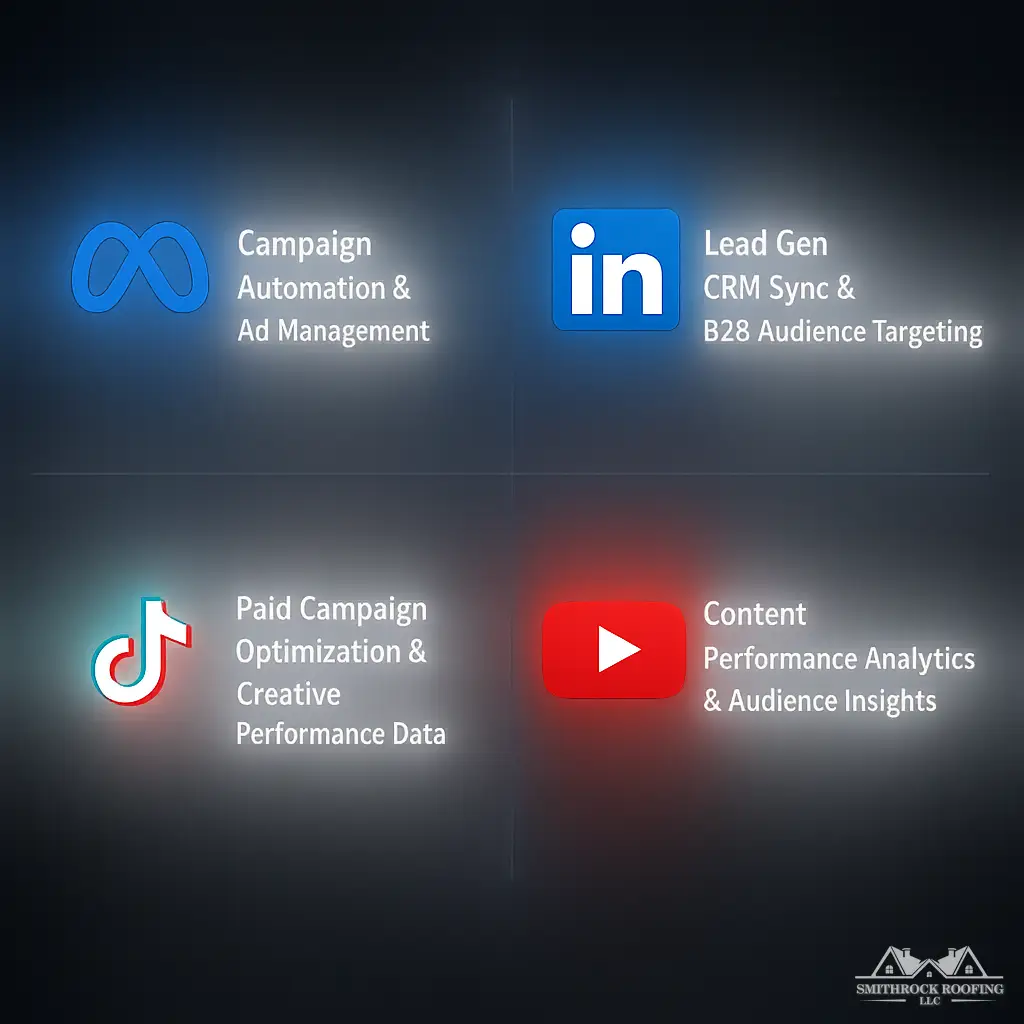
Meta’s Graph API is one of the most capable and most frequently changed API ecosystems in social media. It supports publishing to Pages and Business accounts, reading post-level and account-level engagement metrics, managing ad campaigns programmatically, and accessing Messenger and Instagram DM interactions at scale.
The business marketing value is high, but the maintenance burden is significant. Meta versions its Graph API aggressively, with each version supported for a defined period before deprecation. An integration built on API v14 may require meaningful updates when v14 support ends — and Meta’s version lifecycle moves faster than many marketing teams’ development cycles.
For businesses running significant paid social investment through Meta, API-level ad management access enables programmatic budget adjustment, creative rotation, and real-time bidding parameter changes that simply cannot be executed at the speed campaigns require through manual interface management.
LinkedIn’s API access is tiered more tightly than Meta’s, with the Marketing Developer Platform requiring an explicit partnership or app approval process for most meaningful marketing endpoints. The restricted access model reflects LinkedIn’s positioning as a professional network — they are protective of member data in ways that affect what’s available to marketers.
What is available through approved access is genuinely valuable for B2B marketing: programmatic content publishing to Company Pages, Sponsored Content creation and management, campaign analytics at a granular level, and Lead Gen Form submission data retrieval that can feed directly into CRM systems.
The direct CRM connection for Lead Gen Forms is particularly high-value for B2B organizations. Rather than manually exporting lead data from Campaign Manager, API integration enables automated lead routing to your sales team in near real-time — reducing the response latency that kills lead conversion rates.
TikTok
TikTok’s marketing API ecosystem has matured significantly, supporting campaign management, creative asset publishing, and performance data retrieval for business accounts. The platform’s research API — which provides broader content and trend data — has faced access restrictions that narrowed its availability for non-research commercial uses.
For marketing teams running TikTok as a paid channel, the API’s value is primarily in campaign automation: budget management, ad set optimization triggers, and creative performance data that can feed into cross-platform reporting models.
Organic content publishing through TikTok’s API is available for business accounts but operates within posting frequency limits that require workflow planning if TikTok is a high-volume content channel.
First-Party Data: The Strategic Case for API Integration Beyond Automation
In a marketing environment where third-party cookie deprecation has narrowed audience targeting options and privacy regulations have tightened data collection practices, first-party data has become the primary competitive differentiator in digital marketing.
Social media API integration is one of the most direct mechanisms for building first-party audience data at scale.
When you retrieve engagement data through platform APIs and route it into your CRM, you are building behavioral audience profiles from direct signals — users who engaged with specific content, responded to certain topics, clicked through to specific landing pages. These signals are richer and more current than most third-party data sources.
The practical workflow looks like this: a user engages with three consecutive LinkedIn posts on a specific topic, triggering an API webhook event that your system captures. That engagement pattern is written to a CRM record, updating the contact’s topic interest profile and triggering a nurture sequence tailored to that topic. The entire sequence is driven by first-party behavioral signals captured at the API level — no third-party data vendor, no cookie dependency.
This is how API integration connects directly to one of the most pressing strategic priorities in marketing right now: building durable audience relationships that don’t depend on infrastructure your organization doesn’t control. For a closer look at how proper social media monitoring strategy supports this kind of first-party data capture, that article covers how small businesses can structure ongoing signal collection without enterprise-level tooling.
The Build vs. Buy vs. Integrate Decision
For most businesses, the question isn’t whether to use social media API capabilities — it’s which path to those capabilities makes sense.
Build — develop a custom integration directly against platform APIs using internal or contracted engineering resources. Offers maximum control and customization. Requires sustained engineering investment and carries full organizational ownership of maintenance, versioning, and security.
Buy — use a purpose-built marketing platform that handles API connections as part of its product (scheduling tools, social management platforms, analytics suites). Reduces technical burden significantly. Creates a second-order dependency: you’re now exposed to both the platform API’s stability and the vendor product’s stability. Our article on how to choose social media management software walks through the evaluation criteria that matter most when selecting a platform that won’t become a liability.
Integrate — connect existing systems (CRM, analytics platform, ad management tools) through their native API connectors or through middleware. Lower build cost than custom development, more flexibility than a single-vendor buy. Requires clear mapping of which system owns which data.
The most important consideration in this decision isn’t technical capability — it’s honest assessment of your organization’s engineering support capacity for ongoing maintenance. An integration that’s technically sophisticated but organizationally unsupported will create more disruption than it prevents.
For most small to mid-sized businesses, the right answer involves a combination: purpose-built tools for publishing and basic analytics, with selective custom API work for the high-value use cases (lead data routing, attribution modeling, first-party data capture) where the business impact justifies the investment.
What This Means for Your Marketing Results
Social media API integration, approached strategically, changes the quality of information your marketing team operates on. It means campaign decisions are made on data your organization owns, not on summaries provided by the platforms selling you ad space. It means audience relationships built through social engagement flow directly into your CRM, compounding over time into a proprietary audience asset. It means publishing, optimization, and measurement workflows run faster and more reliably than manual processes allow.
Approached without a governance plan, an organizational ownership model, and a clear-eyed view of API dependency risk, it means quiet failures, missing campaign data, and marketing infrastructure that breaks at the worst possible time.
The difference between those two outcomes isn’t the technology. It’s the strategy behind the implementation — and the operational discipline to maintain it over time.
Strategic Recommendations for 2026
The social media API landscape is shifting fast enough that recommendations made even twelve months ago are already showing their age. These three priorities reflect where the practical value is concentrating heading into 2026.
1. Prioritize first-party data infrastructure before platform deprecations force your hand.
Meta, TikTok, and LinkedIn are each moving toward more restricted API access for third-party data retrieval while simultaneously offering expanded access for advertisers who route first-party data back through their conversion APIs. The businesses that will be best positioned in 2026 are those building the pipelines now — Conversions API implementations, CRM-to-ad-platform audience syncs, and owned email and SMS lists that reduce dependence on platform-mediated reach. The tool category to evaluate here is customer data platform (CDP) middleware that sits between your CRM and your ad platforms, managing consent, data hygiene, and audience syndication in one place.
2. Build around API-stable platforms, not API-generous ones.
LinkedIn’s API has historically been more restrictive than Meta’s or Twitter/X’s, but that restriction has also made it more stable. Twitter/X’s API story over the past two years should serve as a permanent reminder that generous access can be revoked with little notice. As you evaluate your 2026 stack, weight API governance history as heavily as current feature availability. Platforms with clear versioning policies, advance deprecation notices, and developer relations programs are lower-risk infrastructure bets.
3. Invest in integration monitoring as a standalone function.
The most overlooked operational gap in social media API programs is the absence of systematic monitoring. In 2026, treat integration health the same way you treat website uptime — with alerting, documented runbooks, and assigned ownership. Tools in the observability category (webhook monitoring services, API health dashboards, automated data validation checks) have matured considerably and are worth formalizing into your marketing operations stack rather than treating as a nice-to-have. Businesses looking to connect this kind of infrastructure to broader revenue outcomes will find our social media marketing for small businesses resource useful for understanding how monitoring and integration discipline translate into measurable growth.
Frequently Asked Questions
What is social media API integration and why does it matter for marketing?
Social media API integration connects your business’s existing systems — CRM, analytics tools, ad management platforms — directly to social media platforms through their programmatic interfaces. Rather than manually exporting reports or entering data between systems, the API handles data transfer automatically and reliably. For marketing, this means campaign data flows directly into your measurement environment, leads captured through social engagement route immediately into your CRM, and your team operates on accurate, timely information instead of platform-provided summaries.
How do I know if my business is ready to implement social media API integrations?
Readiness depends less on company size and more on three things: whether you have clear ownership assigned for technical maintenance, whether your data governance policies cover how social data will be stored and used, and whether you’ve identified specific business outcomes — lead routing, attribution accuracy, audience building — that justify the implementation effort. Businesses that implement API integrations without those foundations in place tend to experience quiet failures that go undetected until a major campaign is already underway.
What are the biggest risks of relying on social media APIs for core marketing operations?
The primary risk is API dependency — platforms change access terms, deprecate endpoints, and adjust rate limits on timelines that don’t account for your campaign calendar. Secondary risks include data quality issues that surface gradually rather than obviously, and organizational gaps where no one has clear ownership of integration maintenance. Mitigating these risks requires versioned documentation, monitoring systems that flag failures in real time, and a governance model that keeps integrations actively maintained rather than set-and-forgotten.
How do social media API integrations affect data ownership and audience building?
This is one of the most strategically important reasons to build proper integrations. When audience data — engagement signals, lead form submissions, conversion events — flows into systems your organization owns and controls, you’re building a proprietary asset that compounds over time. If that same data lives only inside the platform’s native interface, you’re renting access to your own audience insights. Properly implemented integrations shift first-party data into your CRM and analytics environment, where it remains available and useful regardless of what any individual platform does with its API policies in the future.
Work With a Team That Understands the Full Stack
Social media API integration is one of those areas where the technical decisions and the marketing strategy have to be developed together — a disconnect between the two is usually where implementations go sideways. Mongoose Digital Marketing works with businesses to build and manage social media marketing programs and digital advertising strategies that are grounded in data your organization actually owns, not summarized reports from platforms with their own interests in what you see. If you’re ready to move from fragmented social tools to an integrated marketing infrastructure that compounds over time, we’re straightforward to reach.