
Why Most Small Business Social Media Advice Is Setting You Up to Fail
Walk into any social media marketing guide written for small businesses and you’ll find the same reassuring playbook: pick a platform, post three times a week, use a content calendar, be authentic, and track your engagement rate. It’s tidy, it’s templateable, and it largely doesn’t work — not because the individual pieces are wrong, but because the framework was never designed around the operational realities of running a small business.
The real problem is what’s missing from that advice. There’s no discussion of what happens when your posting schedule collapses under the weight of actually running a business. No honest conversation about Facebook’s organic reach hitting near-zero for business pages. No framework for deciding whether social media is even the right primary channel for your specific business model. And certainly no acknowledgment that “be authentic” is not a strategy — it’s a fortune cookie.
This guide is written differently. It’s built around the decisions you actually face, the trade-offs that rarely get named, and the mechanics of how social media platforms distribute content in 2024 — not 2018. If you’re a small business owner who’s spent time on social media and felt like the returns didn’t justify the effort, there’s a good reason for that, and it has a fixable answer.
The Question Competitors Won’t Ask: Is Social Media Actually Right for Your Business?
Before investing time in any platform, there’s a strategic question that virtually every social media guide skips: For your specific business model, is social media a high-ROI channel — or is it a distraction from better opportunities?
This isn’t pessimism. It’s opportunity cost thinking, and it’s the first thing a rigorous strategist asks.
Social media performs unevenly across business types. For businesses where discovery, inspiration, and identity are part of the purchase decision — restaurants, boutique retail, fitness studios, home renovation contractors, specialty food producers — social content has a direct line to revenue. The platform becomes a digital storefront that customers visit before they visit the real one.
But for businesses built on repeat local customers and service-area search intent — HVAC companies, dry cleaners, auto repair shops, neighborhood accountants — the highest-ROI digital investments are often Google Business Profile optimization and review velocity, not Instagram content calendars. A customer searching “furnace repair near me” at 9pm in January is not browsing Instagram first. They’re going to Google, and they’re calling whoever has the most credible local search presence.
This doesn’t mean those businesses should abandon social media. It means they should size the investment correctly and not treat social media as their primary growth lever when another channel will generate more qualified leads with less effort.
Ask these three questions before committing to a social media strategy:
- Do my customers research or discover businesses like mine through social content, or through search and referrals?
- Is there a visual, educational, or community dimension to my product or service that social media content can authentically represent?
- Can I realistically produce content that matches the format requirements of my chosen platform without it becoming a second job?
If the honest answers suggest social media is a secondary channel for your business, that’s a legitimate strategic conclusion — not a failure. Size the investment accordingly, and put your primary energy where the returns are highest.
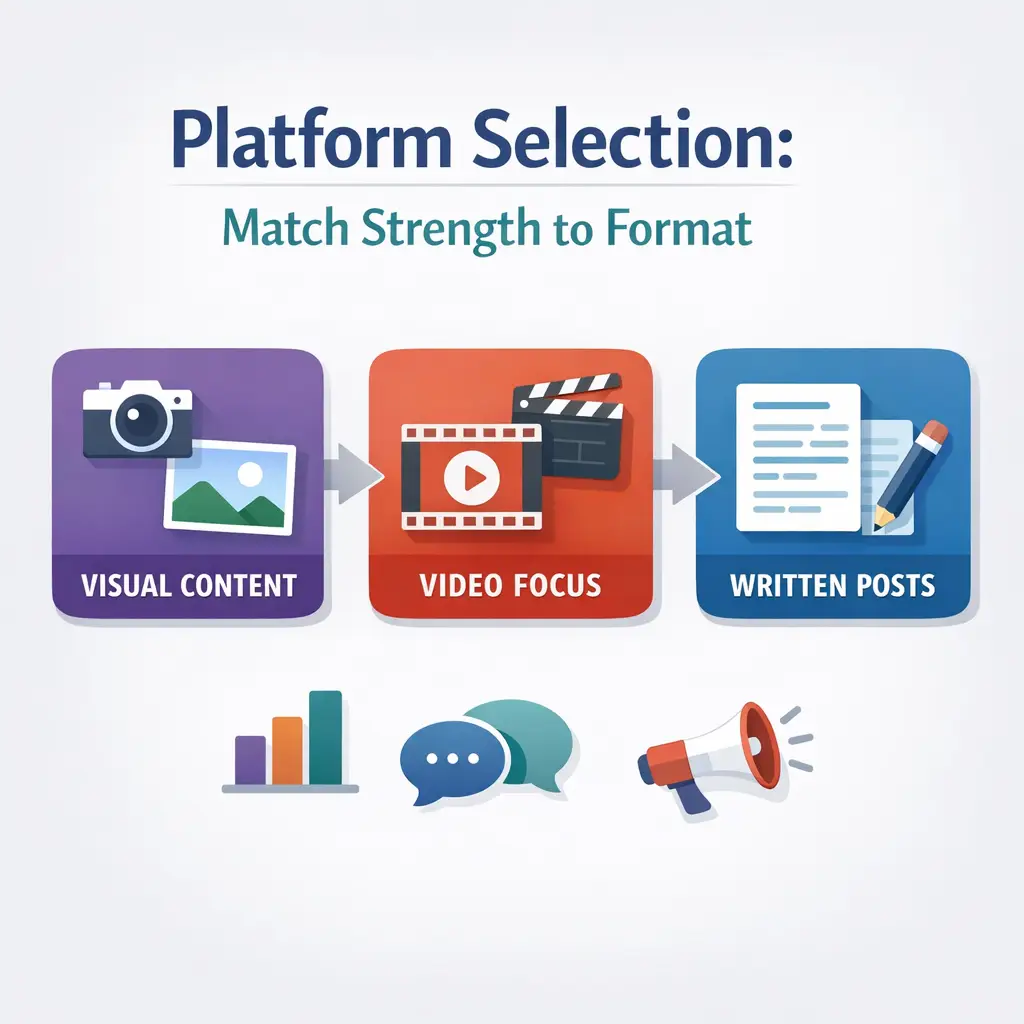
Platform Selection: The Framework That Actually Works
Most platform selection guides are organized by demographics: LinkedIn for B2B, Instagram for visual brands, TikTok for younger audiences. This framework is not wrong — it’s just incomplete in a way that leads to bad decisions.
The variable that gets left out is content production capacity matching platform format requirements. A platform is only viable if your natural content output aligns with what that platform’s algorithm rewards and what its audience expects.
Matching Your Content Strengths to Platform Requirements
Consider what you can consistently and naturally produce. Not what you aspire to produce — what you will actually still be producing six months from now without burning out.
| Content Strength | Matched Platform | Format Requirement | Content Decay Rate |
|---|---|---|---|
| Writing, professional insight | Long-form text posts, articles | Moderate — articles index for months | |
| Photography, visual storytelling | High-quality static images, Reels | Fast — feed posts peak in 24–48 hours | |
| Short on-camera presence | TikTok, Instagram Reels | Vertical video, 15–90 seconds | Very fast — primary window 24–48 hours |
| Educational how-to content | YouTube, Pinterest | Long video or vertical image-text | Slow — high evergreen potential, 12–18 months |
| Community and event-driven | Text, events, group participation | Moderate — group content has longer tail | |
| Product demonstration | YouTube, Pinterest | Video tutorials, step-by-step pins | Slow — strong compounding discovery value |
The content decay rate column is the one most guides omit, and it matters enormously for small businesses with limited content production resources. A well-optimized YouTube video or Pinterest pin can generate organic discovery traffic for twelve to eighteen months after publication. A standard Instagram feed post has a primary engagement window of twenty-four to forty-eight hours. A TikTok video can spike in reach days or weeks after posting — but most don’t.
This is not an argument that Instagram or TikTok are poor investments. For the right business with the right content production capacity, short-form video generates outstanding awareness returns. The argument is that a solo operator who forces YouTube-level production effort into a platform with a forty-eight-hour content window is making a poor resource allocation decision — and no amount of posting consistency will change that math.
Secondary filter — then apply demographics: Once you’ve identified one or two platforms where your content production strengths actually match format requirements, apply the audience demographic filter. If your content strength is photography and your audience skews professional B2B, that’s a genuine tension worth resolving before you commit.
How Reach Actually Works Now (And Why Your 2018 Instincts Are Wrong)
One of the most significant gaps in small business social media guidance is that most of it was written before a fundamental architectural shift in how major platforms distribute content. Understanding this shift changes your entire strategic approach.
From Social Graphs to Interest Graphs
Until roughly 2020–2022, most social platforms operated primarily on social graphs — meaning content reached people because those people had chosen to follow you. Your follower count was a direct proxy for potential reach. Building an audience meant building reach.
That model has been structurally replaced on Instagram, TikTok, and increasingly Facebook, by interest graphs — where the algorithm distributes content based on topic signals and engagement patterns, not follower relationships. Your content reaches people who have demonstrated interest in related topics, regardless of whether they follow your account.
The implications for small businesses are significant:
What this means for follower growth strategy: “Grow your followers” is no longer the correct primary objective on interest-graph platforms. Reaching people who don’t yet follow you has become the default behavior of the algorithm — provided your content generates strong early engagement signals. A post with five hundred followers that hits strong saves and watch-time metrics can outperform a post from a ten-thousand-follower account with weak engagement. The platform cares about content performance, not your audience size.
What this means for Facebook specifically: Facebook’s shift has been more severe than Instagram’s. Organic reach for business pages has declined to an average of one to six percent of page followers, a structural collapse from the fifteen to twenty percent reach of 2012–2015. This is not a temporary algorithm penalty that better posting will fix — it reflects Facebook’s deliberate commercial model. For most small businesses, Facebook’s current value lies in paid amplification, community management within Groups, and retargeting audiences — not organic page reach. For a deeper look at how Meta’s ad system can complement your organic strategy, the article on Facebook advertising management covers how the algorithm works and where paid investment makes sense.
What this means for niche content: The interest graph actually benefits small businesses willing to be genuinely specific. Broad content performs broadly and shallowly. Hyper-specific content — the kind that makes a very particular type of customer think “this was made for me” — generates the high-signal engagement that interest-graph algorithms redistribute. A bakery that posts general food content competes against every food account. A bakery that posts specifically about sourdough fermentation science, with genuine technical depth, surfaces to an audience actively interested in artisan bread regardless of geography.
The Metrics That Actually Tell You Something
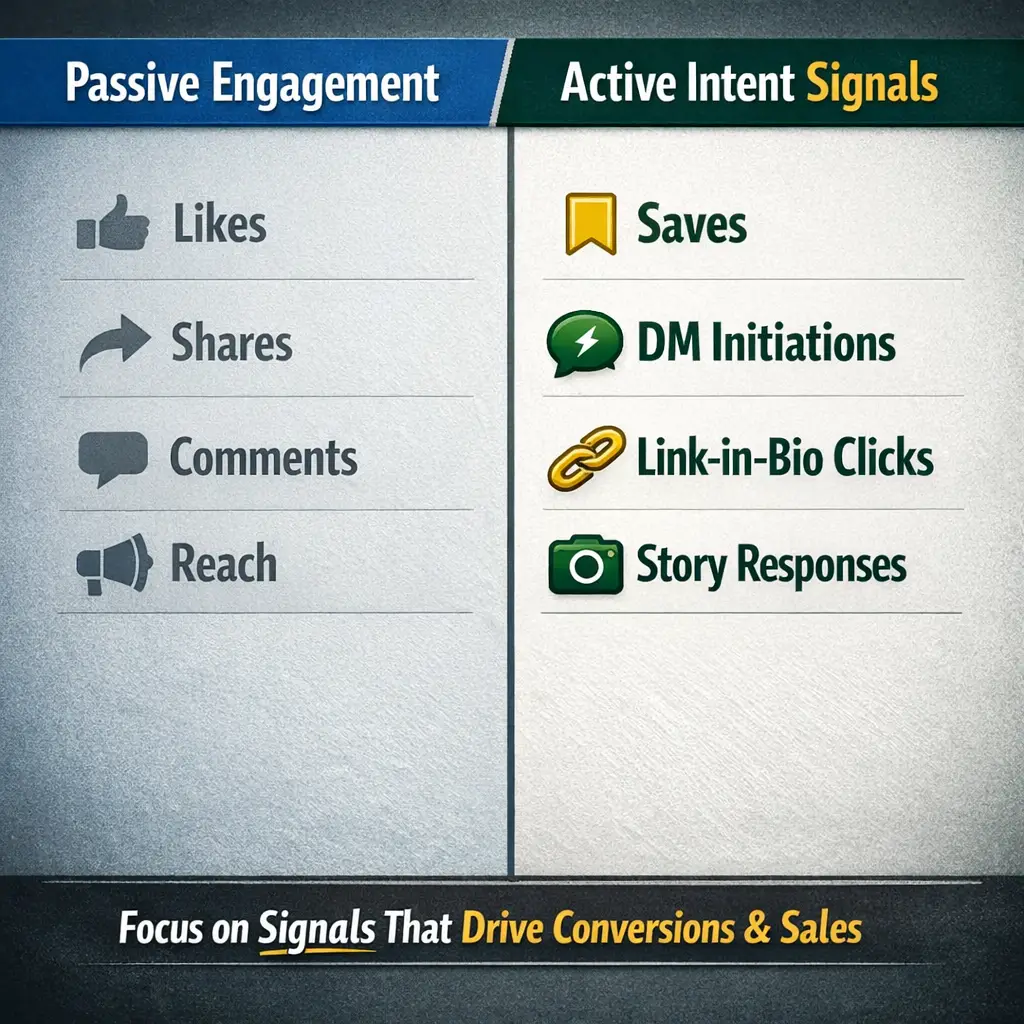
The engagement rate consensus in most social media guides is misleading — not because engagement rate is worthless, but because it conflates passive engagement with active intent signals in a way that produces bad decisions for small businesses.
Rethinking Your Signal Hierarchy
Passive engagement metrics — likes, shares, comments, and the composite engagement rate — measure audience reaction. They have algorithmic value and social proof value, but they are poor direct indicators of purchase intent. Comment sections can be dominated by giveaway hunters, bots, and industry peers. A post can have high engagement and generate zero business inquiries.
Active intent signal metrics are the ones that matter for small business revenue:
Saves: A save is the user explicitly declaring they want to return to this content. On Instagram, saves have the highest correlation with future action of any engagement type. They also feed directly into algorithmic redistribution — saved content gets surfaced more broadly. A save is a declared future purchase intent signal that most analytics dashboards bury.
Direct message initiations from organic content: A DM triggered by a post is a self-qualified lead that bypassed your entire funnel. They didn’t click an ad, fill out a form, or respond to a call to action — they chose to contact you based on content alone. Track DM initiations separately from other engagement and treat them as top-tier leads.
Link-in-bio clicks (profile visits following a post): When someone reads a post and then navigates to your profile to find your website link, they’ve taken two intentional steps. That sequence indicates stronger intent than a like registered from a scrolling thumb.
Story poll and question responses: Interactive Story content that generates responses creates direct dialogue — and that dialogue, handled correctly, converts at significantly higher rates than passive feed engagement.
The metric to stop optimizing for: Reach. On interest-graph platforms, reach without engagement signal quality is algorithmic noise. A post seen by forty thousand people who scroll past it signals to the algorithm that the content lacks resonance. A post seen by three thousand people who save it, DM you, and watch it through to completion signals strong relevance and triggers wider distribution. Prioritize response quality over distribution volume.
The Two-Tier Content Architecture: Replacing the Content Calendar Trap
The standard content calendar advice — plan posts two to four weeks ahead, schedule consistently, post three to four times per week — optimizes for one thing: output predictability. That’s a real operational benefit. But for small businesses, it comes at a cost that rarely gets named.
A rigid content calendar, executed in isolation, optimizes for consistency at the direct expense of relevance timing. And relevance timing is a competitive advantage that small businesses have over large brands — because you can move faster, react more genuinely, and produce content that reflects what’s actually happening in your business right now.
Large brands cannot easily replicate the immediacy of a small business owner who turns a real customer interaction into a resonant piece of content the same day it happened. That’s structural authenticity — content that carries genuine immediacy because it emerged from a real event, not a planning meeting.
Building Your Two-Tier System
Tier 1 — Anchor Content (approximately 40% of output):
This is your planned, brand-positioning content. Evergreen posts, core service explanations, testimonials, educational content relevant to your audience’s decisions. These are planned two to three weeks ahead, batched when possible, and scheduled through your publishing tool. This tier creates baseline consistency and ensures your profile isn’t dormant.
Tier 2 — Reactive Relevance Content (approximately 60% of output):
This is content triggered by real business events — not a calendar date. A customer question that came up three times in one week. A local news development that connects to your business. A product or service result you’re genuinely proud of. A behind-the-scenes moment that happened organically, not because you staged it for content.
This tier consistently outperforms scheduled content on engagement metrics and intent signals, for a direct reason: it carries authentic timing signals that audiences and algorithms both respond to. The reason this advice rarely appears in social media guides is that it requires editorial judgment, not a template. Content calendars are teachable, scalable, and easy to package. Reactive content strategy requires the business owner to develop an instinct for what moments are worth capturing — and that’s harder to turn into a listicle.
The Operational Protocol for Reactive Content
To make Tier 2 work without creating chaos, build a lightweight capture system:
- Keep a running note on your phone titled “Content Moments” — when something interesting, useful, or genuinely story-worthy happens in your business, log it immediately with a brief note
- Set a weekly thirty-minute window to review your list and produce one to two reactive posts from the most resonant moments
- Don’t over-produce them. Reactive content derives its value from immediacy and specificity, not polish. A genuine, slightly imperfect post about a real customer outcome will almost always outperform a beautifully designed graphic about a generic industry tip
Avoiding the Tool Integration Trap
Most social media tool recommendations treat software as isolated utilities. Pick a scheduling tool, pick a design tool, pick an analytics tool. What’s missing is any discussion of what happens when these tools don’t talk to each other — and what happens to your audience data and operational workflow as your business grows. The article on how to choose social media management software covers the evaluation criteria in detail, including data portability and integration requirements worth understanding before committing to a platform.
What to Evaluate Before Committing to a Tool Stack
Data portability: If you build an audience insights history inside a free-tier tool and need to migrate, can you export your performance data in a usable format? Many freemium platforms make export difficult or impossible, which means you lose the historical data that would inform your next strategy. Before committing, verify the export options.
Integration with your primary business systems: Your social media tool should connect, at minimum, to your CRM or contact management system. If a DM lead comes in and has to be manually transferred to your sales process, that’s friction that kills conversion rates. Look for tools that allow direct lead capture integration.
The operational ceiling: Free and low-cost tools are appropriate for single-platform, low-volume publishing. As you add platforms, team members, or content volume, free tiers create friction — limited scheduling queues, no collaboration features, limited analytics history. Plan for where your operational needs will be in twelve months, not just today, before committing to a tool stack that will require a disruptive migration later.
The hidden cost of tool-switching: Every time you switch social media management platforms, you pay in time and in data loss. The workflow re-learning curve, the historical performance data you can’t carry over, and the setup time for new integrations all represent real operational costs. Choosing a tool that scales with your business is more valuable than choosing the tool with the best free tier today.
Compounding vs. Linear Returns: Allocating Your Effort for Long-Term Growth
This is the strategic layer that most social media advice never reaches — and it’s the one that most directly determines whether your social media investment builds durable business value or requires constant reinvestment to maintain.
The Compounding vs. Linear Distinction
Linear-return content generates engagement during its active distribution window and then stops producing value. Standard Instagram feed posts, Facebook posts, and most feed-based content operates this way. The effort you put in produces returns for twenty-four to seventy-two hours. If you stop posting, the returns stop. The channel requires constant feeding.
Compounding-return content builds discovery equity over time. A well-optimized YouTube video ranks in both YouTube and Google search results — it generates views, leads, and brand exposure for months or years after the initial production effort. A thorough LinkedIn article gets indexed by search engines and continues attracting professional traffic organically. A Pinterest strategy built on keyword-optimized pins drives referral traffic with a long compounding tail.
For small businesses with limited content production capacity, the strategic allocation question is direct: What percentage of your social media effort should go toward content that stops producing value the day after you post it?
There’s no universal answer — a restaurant with daily specials legitimately needs linear, timely content. But a service business, professional practice, or product company with an educational angle has a genuine opportunity to weight its content investment toward platforms and formats that compound, rather than spending the majority of effort on content that evaporates in forty-eight hours.
The businesses that build durable social media equity are the ones that treat at least some portion of their content production as an infrastructure investment — creating assets that work for them while they’re focused on running their business, not just while they’re actively posting.
To explore how a tailored social media strategy could be structured specifically around your business model and production capacity, reach out to Mongoose Digital Marketing for a free consultation. A strategy that actually fits your business is worth significantly more than a generic content calendar.
Strategic Recommendations for 2026
As social media continues to evolve, small businesses that commit to intentional strategy rather than reactive posting will hold a meaningful advantage. Based on the principles covered throughout this guide, here are three specific recommendations worth prioritizing heading into 2026.
1. Consolidate around a primary compounding platform. Rather than spreading effort across every available channel, identify one platform where long-form, searchable content aligns with your audience — whether that’s YouTube for video-forward businesses, LinkedIn for professional services, or Pinterest for visually driven product companies. Build depth on that platform before expanding horizontally.
2. Use AI-assisted scheduling and repurposing tools strategically. Tools like Buffer, Metricool, and later-generation AI content assistants are increasingly capable of helping small teams repurpose a single piece of foundational content into platform-specific formats. The goal isn’t to automate your voice — it’s to extend the productive life of content you’ve already invested in creating.
3. Audit your current content mix before producing anything new. Before adding to your publishing schedule, take stock of what you’ve already published. Identify which posts drove lasting traffic, which generated inquiries, and which evaporated within forty-eight hours. That audit shapes smarter decisions about where your next production effort should go — and prevents the common pattern of simply doing more of what isn’t working.
Frequently Asked Questions
How many social media platforms should a small business be active on?
Most small businesses are better served by being genuinely consistent on one or two platforms than by maintaining a surface-level presence across five or six. The right number depends on where your target audience actually spends time and what your team can realistically sustain without sacrificing content quality. Spreading too thin is one of the most common reasons small business social media efforts plateau.
What type of content works best for small businesses that don’t have a dedicated marketing team?
Content that serves double duty tends to perform best — specifically, educational or demonstrative content that answers real questions your customers ask. This type of content works organically in search, builds trust with new audiences, and can be repurposed across platforms without requiring a large production team. Short-form video, how-to posts, and FAQ-style content are practical starting points that don’t require significant infrastructure.
How long does it take to see results from a social media strategy?
Linear content on platforms like Instagram or Facebook can generate engagement within days, but meaningful business results — inquiries, conversions, and sustained traffic — typically emerge over a longer window when a strategy is properly built. Compounding-return content on platforms like YouTube or LinkedIn may take several months to gain traction, but continues delivering value long after. Realistic expectations and consistent execution matter far more than chasing early metrics.
Is it worth hiring a professional to manage social media, or should small businesses handle it in-house?
The honest answer depends on capacity and opportunity cost. If social media management is consuming hours that would be better spent on core business operations — and the results don’t justify that trade — professional management or strategic consulting is worth considering. The most important factor isn’t who does the posting, but whether the strategy itself is sound, the content is genuinely useful, and the effort is weighted toward formats that actually build long-term equity for the business.
Conclusion
Building a social media presence that consistently generates awareness, trust, and leads requires more than a posting schedule — it requires a strategy aligned with how your specific business operates and grows. Mongoose Digital Marketing works with small businesses on exactly this kind of focused work, from developing a sustainable content strategy to hands-on social media management that prioritizes real business outcomes over vanity metrics. If you’re ready to make your social media effort actually count, Contact Mongoose Digital Marketing to start the conversation.