
Facebook Advertising Management: What the Setup Guides Don’t Tell You About How Meta’s Algorithm Actually Decides Who Sees Your Ads
Most guides to Facebook advertising management will walk you through creating a Business Portfolio, connecting your Page, and navigating the Ads Manager interface. That information has its place. But it answers the wrong question.
The question most business owners are actually asking isn’t where do I click to create a campaign. It’s why isn’t my advertising working, and what do I change to make it work. Those are fundamentally different problems — and the difference between them is the gap between using a tool and managing a strategy.
Facebook advertising management, done properly, means understanding three things that most setup guides never address: how Meta’s delivery system makes decisions, how your account architecture either supports or undermines those decisions, and how to build an operational infrastructure resilient enough to sustain performance over time. This article covers all three in the depth they deserve.
If you’ve already run campaigns and found the results frustrating or inconsistent, what follows will reframe how you look at the entire platform. If you’re newer to paid social, consider this the foundation that will save you from the most expensive mistakes Meta advertisers make.
The Strategic Layer Most Facebook Advertising Guides Skip
Before touching a single campaign setting, you need to understand what Facebook advertising management actually is at a systems level. Meta’s advertising platform isn’t a directory where you place an ad and a human decides who sees it. It’s an automated auction environment where machine learning models are continuously predicting which users are most likely to take a specific action — and showing your ad accordingly.
That means every decision you make in Ads Manager is, in effect, an instruction to an algorithm. The quality of your results depends almost entirely on whether those instructions give the algorithm what it needs to optimize effectively.
This is why two advertisers with identical budgets, identical audiences, and identical placements can see wildly different results. One has given the algorithm clean, abundant signal data and a stable campaign structure. The other has fragmented their budget across too many ad sets, reset their learning cycles repeatedly, and fed the system ambiguous conversion data. The platform treats these advertisers very differently — and it should.
How Meta’s Delivery System Actually Makes Decisions
Predicted Action Rates: The Core Mechanism
Every time a Meta ad has the opportunity to be shown to a user, an auction occurs. Your ad competes against other advertisers targeting the same person, and the winner isn’t simply the highest bidder. Meta calculates a Total Value score for each competing ad using three inputs:
- Advertiser bid — how much you’re willing to pay for the outcome
- Estimated action rate — how likely Meta predicts that specific user is to take your desired action
- Ad quality — a composite score based on engagement signals, user feedback, and landing page experience
The estimated action rate is the variable most advertisers have the least intuitive grasp of — and it’s the most important one. Meta’s system is continuously learning which users are likely to convert based on the behavioral patterns of people who have already converted for you. This is why early campaign performance is inherently unstable and why feeding the algorithm clean historical data accelerates its ability to optimize.
The Learning Phase Is Not Optional
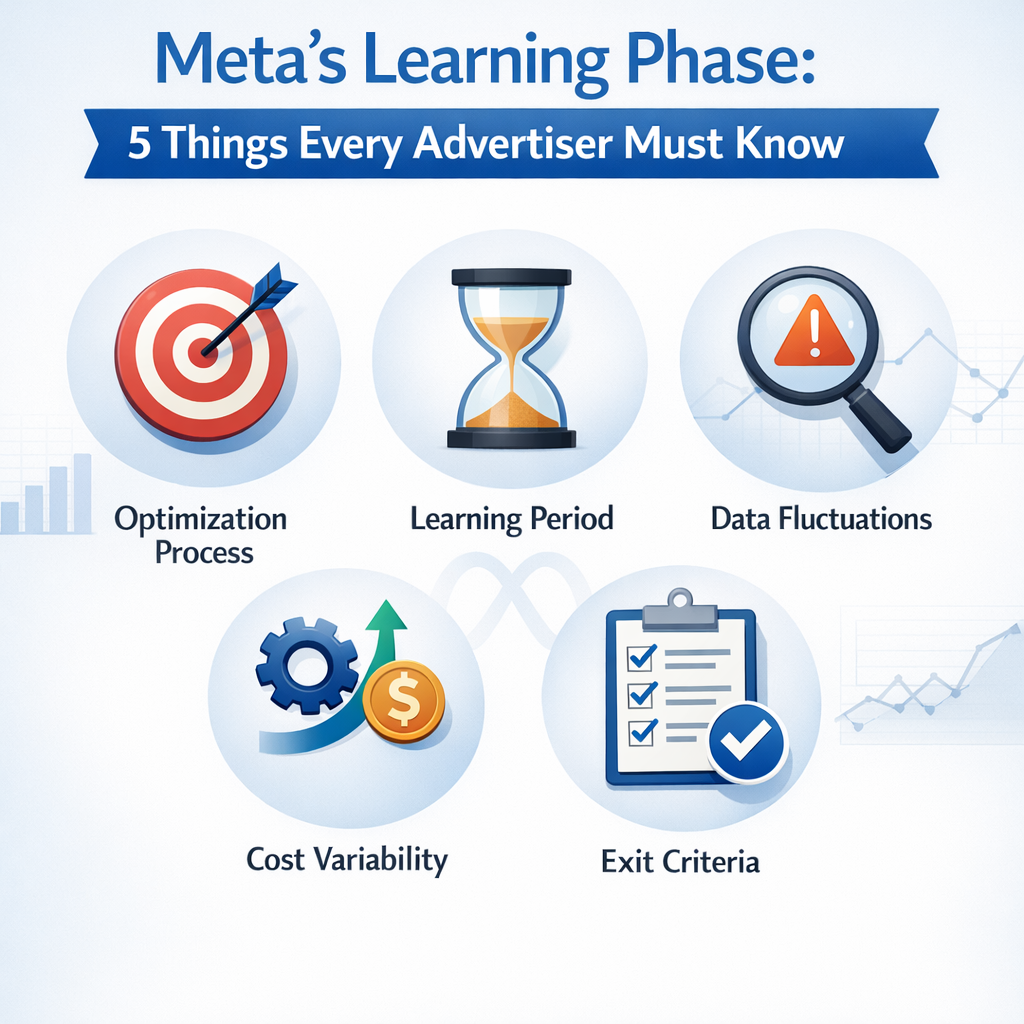
Every new ad set enters a learning phase when it launches. During this period, Meta is actively testing delivery across different users, times, and placements to understand where your optimization event is most likely to occur. Performance during the learning phase is volatile by design — this is expected and normal.
What matters is getting through the learning phase. Meta’s published threshold is 50 optimization events per ad set within a 7-day period. Below that number, the algorithm doesn’t have enough data to stabilize delivery, and your results will remain inconsistent.
Two behaviors commonly prevent ad sets from clearing this threshold:
- Budget that’s too low relative to your event cost — if a conversion costs $40 and you’re spending $50/week per ad set, you’ll never generate enough events to exit learning
- Significant edits mid-flight — changing creative, audience, budget (beyond incremental adjustments), or bid strategy resets the learning phase entirely
This is the single most common reason campaigns underperform. An advertiser sees inconsistent early results, makes changes to “fix” it, resets the learning phase again, and enters a loop where the algorithm never stabilizes. Patience and structural discipline in the early phase of a campaign are not passive behaviors — they’re active strategic choices.
Campaign Structure Is a Strategic Decision, Not an Administrative One
The Architecture Problem Most Advertisers Don’t Know They Have
Open any competitor’s guide to Facebook advertising management and you’ll find a description of the campaign hierarchy: campaigns contain ad sets, ad sets contain ads. What you won’t find is a discussion of how the way you organize that hierarchy directly determines whether your campaigns can perform.
The core issue is data fragmentation. Every ad set operates as a separate learning unit with its own budget and optimization data. When you split your budget across five ad sets targeting five overlapping audience segments, you’re not giving each segment its best chance — you’re giving the algorithm five separate pools of data that are each too small to learn from effectively.
Here’s a practical illustration:
| Structure Type | Ad Sets | Weekly Budget Per Ad Set | Events Needed to Exit Learning | Realistic Weekly Events | Learning Phase Outcome |
|---|---|---|---|---|---|
| Fragmented | 5 | Low | 50 | 8–12 | Never exits — perpetual instability |
| Moderate | 3 | Moderate | 50 | 18–22 | Borderline — exits slowly with luck |
| Consolidated | 1–2 | Full budget | 50 | 45–60+ | Exits learning, algorithm stabilizes |
The math is unambiguous. Consolidation isn’t a simplification strategy — it’s a performance strategy backed by how the platform’s optimization system actually operates.
CBO vs. ABO: When Each Structure Makes Sense
This is one of the most debated structural decisions in Facebook advertising management, and the answer isn’t one-size-fits-all.
Campaign Budget Optimization (CBO) places your budget at the campaign level and lets Meta distribute spending across ad sets in real time based on predicted performance. The algorithm allocates more budget to the ad set it believes will generate the best results at any given moment.
Ad Set Budget Optimization (ABO) gives you fixed, manual control over how much each ad set spends daily. You decide the allocation.
When CBO serves you better:
– You have 2–4 ad sets that you genuinely want the algorithm to compare and prioritize between
– You’re testing creative concepts and want Meta to identify the winner organically
– Your campaign has stable audience definitions and clear, trackable optimization events
When ABO serves you better:
– You have ad sets targeting audiences of significantly different sizes (CBO tends to over-invest in large audiences)
– You want to guarantee minimum spend in a specific market segment or funnel stage
– You’re testing new ad sets against proven ones and need controlled exposure to avoid budget cannibalization
The choice isn’t about which is “better” in the abstract. It’s about which gives you the right balance of algorithmic efficiency and strategic control for your specific campaign objective.
Audience Overlap and Internal Auction Competition
Here’s a problem that’s invisible until you know to look for it: when two ad sets in the same account contain overlapping audiences, they don’t cooperate — they compete. Your ad sets bid against each other in the same auction for the same users, driving up your own costs without any external competitor involved.
Meta provides an Audience Overlap tool inside Ads Manager that allows you to compare audience sizes and intersection percentages. Any meaningful overlap — generally above 20–30% between ad sets — is a signal to consolidate, differentiate, or add exclusion logic.
This is where audience exclusions become a structural tool rather than just a targeting refinement. Adding exclusion rules at the ad set level (for example, excluding existing customers from a prospecting campaign, or excluding top-of-funnel visitors from a retargeting campaign) both reduces overlap and increases targeting precision simultaneously.
Signal Quality: Why Your Pixel Setup Matters More Than Your Targeting
The Post-iOS 14 Reality
In 2021, Apple’s App Tracking Transparency framework fundamentally changed the data environment Facebook advertising management operates within. Users gained the ability to opt out of cross-app tracking, and the majority chose to do so. The practical effect: a significant portion of conversion events — particularly on iOS devices — stopped being reported directly to Meta.
Meta’s response was to introduce modeled conversions: statistically estimated conversions that the system infers based on aggregated, anonymized signals when direct attribution isn’t available. This means that the conversion numbers you see inside Ads Manager today are not all confirmed events — a portion are modeled estimates.
This has three direct implications for how you interpret campaign data:
- Reported ROAS and conversion volume may differ from what you see in your CRM or analytics platform — this isn’t a discrepancy to ignore; it reflects the estimation gap
- Attribution window settings change what’s counted — a 7-day click window will always show more conversions than a 1-day click window, not because more people converted, but because more conversion credit is being assigned
- Optimizing based solely on in-platform metrics without cross-referencing backend data is a meaningful risk
Understanding this doesn’t mean the platform’s data is useless. It means you need to interpret it with appropriate context.
Meta Pixel vs. Conversions API: Why You Need Both
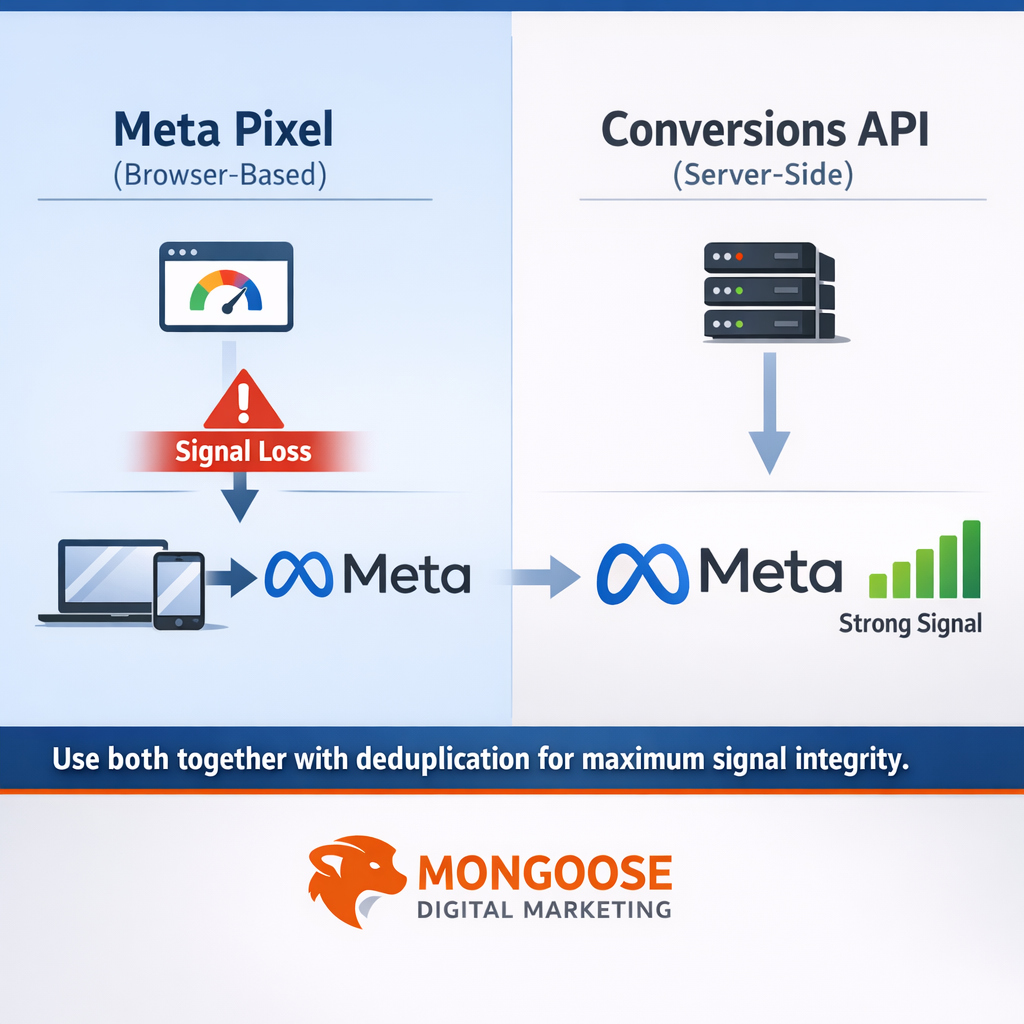
The Meta Pixel is browser-based tracking — it fires when a user’s browser loads a page after taking an action. In a post-iOS 14 environment, browser-based tracking is progressively less reliable due to cookie restrictions, ad blockers, and opt-out behavior.
The Conversions API (CAPI) is a server-side integration that sends event data directly from your server to Meta, bypassing browser-based limitations entirely. When both run simultaneously with proper deduplication configured, you significantly improve the completeness of the conversion signal Meta receives.
This matters because signal quality is directly connected to algorithm performance. A better-fed algorithm makes better delivery decisions. In practice, advertisers with robust CAPI implementations often see improved optimization outcomes — not because their targeting changed, but because the system now has more accurate data to learn from.
Objective Selection: The Algorithmic Instruction Most Advertisers Underestimate
When you create a campaign, Meta asks you to select an objective. Most guides treat this as a labeling exercise — pick the one that sounds closest to your goal. In reality, objective selection is one of the most consequential decisions you make in the entire campaign setup.
Your objective tells Meta’s system which type of action to optimize for. It changes the pool of users your ads are shown to. It changes the bidding signals the system prioritizes. It changes the delivery algorithm’s behavior at a fundamental level.
| Objective | What Meta Optimizes For | Delivery Pool Characteristics |
|---|---|---|
| Awareness | Reach and impressions | Broadest possible audience; no action-taking signal required |
| Traffic | Link clicks | Users with a history of clicking ads; lower purchase intent |
| Engagement | Likes, comments, shares, video views | Users who interact with content; not optimized for downstream conversions |
| Leads | Form submissions (native or external) | Users who have historically completed lead forms |
| Sales | Purchase or conversion events | Users with demonstrated purchase behavior — highest-intent delivery pool |
The consequence of choosing the wrong objective is significant. An e-commerce brand running a Traffic campaign isn’t just getting cheaper clicks — they’re getting clicks from people the algorithm has identified as likely clickers, not likely buyers. Those users may never convert regardless of how good the landing page is, because the system was never optimizing for purchase behavior in the first place.
The right objective is determined by two things: what action you want users to take, and whether you have enough conversion data to support optimization for that action. If you don’t yet have 50 weekly purchase events to support a Sales campaign, you may need to optimize for an upstream event (like Add to Cart or Initiate Checkout) temporarily — then transition once your pixel has built sufficient signal history.
Account Health: The Infrastructure Most Advertisers Ignore Until It’s Too Late
Understanding Meta’s Three-Tier Restriction System
Account restrictions are the single largest operational risk in Facebook advertising management — and they’re almost never discussed in setup guides because setup guides assume a frictionless environment. Experienced practitioners know better.
Meta’s enforcement operates on three escalating levels:
Level 1 — Ad Disapproval: An individual ad is rejected for policy violations. This is routine and manageable. The issue is that repeated disapprovals within an account affect your account quality score, which compounds over time.
Level 2 — Ad Account Restriction: Your ad account loses the ability to advertise. This can happen due to policy violations, unusual payment activity, sudden large budget increases, or automated flagging systems. At this level, active campaigns stop delivering immediately.
Level 3 — Business Manager Restriction: The entire Business Portfolio is restricted, affecting every ad account, page, and asset connected to it. Recovery at this level is lengthy and uncertain.
Most businesses operating with a single ad account have zero contingency plan for a restriction event. A legitimate backup ad account — properly set up within your Business Portfolio and warmed up with modest spend before you need it — is standard professional practice for any advertiser with meaningful revenue depending on Meta advertising continuity.
Ad Account Quality Score and What Affects It
Inside your Business Manager, the Account Quality section provides a view of your account’s standing with Meta. This score is influenced by:
- The ratio of approved to disapproved ads over time
- User feedback signals on your ads (specifically, how often users report or hide your ads)
- Landing page quality assessments
- Payment reliability history
- Policy violation history
Maintaining a healthy account quality score isn’t passive. It requires proactive policy compliance reviews when creating new campaigns, particularly when advertising in sensitive categories (finance, health, employment, housing) that trigger additional scrutiny. It also requires monitoring your ads’ user feedback scores — available in Ads Manager — because a high “hide ad” rate signals to Meta that users are finding your creative intrusive or irrelevant, which suppresses delivery even when no formal policy violation exists.
Creative Is the Primary Performance Variable — And Most Advertisers Treat It Last
This bears stating directly because it contradicts how most Facebook advertising management content is structured: creative quality is the dominant performance lever in Meta advertising, and it has been increasingly so since Meta expanded its algorithmic targeting capabilities.
The underlying logic is straightforward. As Meta’s audience targeting has become more automated and less reliant on manual audience definition — a trajectory accelerated by Advantage+ audience tools — the creative becomes the primary signal that attracts the right users. The algorithm doesn’t find your audience and show them your ad. It shows your ad broadly and learns, from engagement and conversion patterns, which audience responds. The creative is doing the targeting work.
This means a technically flawless campaign structure with mediocre creative will consistently underperform a simpler structure with compelling creative. It also means that creative testing — systematic, statistically valid creative testing — is one of the highest-ROI activities in Facebook advertising management.
What systematic creative testing looks like in practice:
- Isolate one variable at a time — testing hook vs. hook is actionable; testing a completely different ad against another ad tells you nothing specific
- Respect minimum runtime and audience thresholds — Meta’s A/B testing tool requires minimum audience sizes and runtime periods to generate statistically significant results; running a test for three days with a small audience produces noise, not insight
- Track the right metrics for your objective — CTR matters for awareness; cost per lead matters for lead generation; cost per purchase matters for e-commerce. A beautiful ad with a high CTR that doesn’t convert is a problem, not a success
- Build a creative library, not a creative lottery — the goal of testing is to accumulate learnings about what resonates with your audience, so each test informs the next rather than starting from scratch
Tying It Together: What Effective Facebook Advertising Management Actually Looks Like
Effective Facebook advertising management isn’t about knowing where every button is in Ads Manager. It’s about making decisions that align with how the platform’s systems actually operate — and building the strategic and operational infrastructure to sustain performance over time.
That means structuring campaigns to give the algorithm sufficient data to learn. It means selecting objectives that match your actual conversion intent. It means maintaining signal quality through proper Pixel and CAPI configuration. It means understanding that your account quality score is an asset worth protecting. And it means investing in creative with the same rigor you apply to audience and budget decisions.
Every one of these factors compounds. A well-structured campaign with clean signal data, a healthy account, and strong creative doesn’t just perform better on its own — it outperforms a poorly configured campaign by an increasingly wide margin over time, because the algorithm is continuously improving its delivery based on better inputs.
That compounding effect is what separates advertisers who get consistent, scalable results from Meta advertising and those who are perpetually troubleshooting why their campaigns aren’t working. The platform is capable of delivering significant business outcomes. Getting there requires managing it with a level of strategic depth that most surface-level guides simply don’t provide. Businesses looking to integrate paid social into a broader performance system may also find value in reviewing how SEO for lead generation in 2026 can complement and reinforce the pipeline that Meta advertising builds.
Strategic Recommendations for 2026
The Meta advertising landscape continues to shift toward automation, privacy-first infrastructure, and AI-assisted creative production. Advertisers who adapt their tooling and workflows accordingly will be positioned to compound gains while others scramble to keep up. Three specific areas deserve immediate attention:
1. Implement Conversions API via a Server-Side Tag Management Solution
Tools like Stape.io or a self-hosted Google Tag Manager server container allow you to route conversion events server-side without relying entirely on a development team for every update. In a post-cookie environment, this is no longer optional infrastructure — it is the foundation on which signal quality, audience building, and optimization depend. Prioritize a setup that deduplicates browser and server events correctly and passes hashed customer data consistently.
2. Adopt an AI-Assisted Creative Testing Framework
Platforms like Motion (formerly Motion App) or MadgicX allow you to systematically analyze creative performance across your Meta ad account, identifying which visual formats, hooks, and messaging angles are driving results at a granular level. Rather than guessing what to test next, you build a data-informed creative roadmap. In 2026, with Meta’s algorithm increasingly favoring creative differentiation over audience targeting precision, this kind of creative intelligence layer is a meaningful operational advantage.
3. Conduct a Quarterly Account Architecture Audit
As Meta continues expanding Advantage+ automation, account structures that made sense two years ago may now create signal fragmentation or conflict with how the algorithm allocates delivery. Build a recurring audit process — either internally or with a qualified Meta partner — that evaluates campaign objectives, conversion event mapping, audience overlap, creative fatigue indicators, and account quality standing. Treat your account architecture as a living document, not a set-and-forget configuration. If your broader digital strategy needs the same level of structural review, our digital marketing services are built to provide exactly that kind of systematic, channel-integrated oversight.
Frequently Asked Questions
What is Facebook advertising management and why does it matter?
Facebook advertising management refers to the strategic and operational oversight of paid campaigns running on Meta’s advertising platform, including Facebook and Instagram. It encompasses campaign structure, objective selection, audience configuration, creative testing, signal tracking via the Meta Pixel and Conversions API, budget allocation, and ongoing performance optimization. It matters because the platform’s algorithm is highly responsive to how campaigns are configured — poor management produces wasted spend and inconsistent results, while disciplined management compounds into scalable, predictable performance over time.
How does the Meta algorithm decide who sees my ads?
Meta’s delivery system runs a real-time auction for every available ad impression. Your ad competes based on a combination of your bid, the estimated probability that a given user will take your desired action, and the perceived quality and relevance of your ad to that user. The algorithm learns from conversion signals — events reported via the Pixel or Conversions API — to identify which users are most likely to convert and prioritize delivery to those audiences. This is why signal quality and campaign structure directly affect who sees your ads and at what efficiency.
What is the Meta Pixel and do I still need it?
The Meta Pixel is a browser-based JavaScript snippet that tracks user actions on your website — such as page views, add-to-cart events, and purchases — and reports those events back to Meta for optimization and attribution purposes. While browser-based tracking has become less reliable due to privacy regulations, iOS changes, and ad blockers, the Pixel still plays an important role as part of a dual-tracking setup. It should be used alongside the Conversions API, which reports events server-side and is significantly more resilient to data loss. Using both in a deduplicated configuration provides the most complete signal picture available.
What is Advantage+ and should I be using it?
Advantage+ is Meta’s suite of AI-driven automation tools, which includes Advantage+ Shopping Campaigns, Advantage+ audience targeting, Advantage+ placements, and Advantage+ creative. These tools allow Meta’s algorithm to take greater control over delivery decisions with less manual configuration. For advertisers with sufficient conversion volume and clean signal data, Advantage+ Shopping Campaigns in particular have demonstrated strong performance for e-commerce. However, Advantage+ is not universally the right approach — it requires meaningful conversion data to optimize effectively, and it reduces the granular control that some account structures depend on. Evaluate it against your specific account maturity and objectives.
How many ad sets and ads should I run at once?
There is no universal correct number, but the principle that governs the answer is data consolidation. Each ad set requires enough conversion events during its learning phase — typically around fifty optimization events within a seven-day window — to exit the learning phase and stabilize delivery. Running too many ad sets simultaneously fragments your budget and prevents any single ad set from accumulating sufficient data to learn efficiently. A focused account structure with fewer, well-resourced ad sets will generally outperform a fragmented structure with many underfunded ones. For creative, test meaningfully different concepts rather than minor variations to generate actionable learnings.
How do I know if my Facebook campaigns are actually working?
Campaign performance should be evaluated against the objective you selected at campaign creation, using metrics that reflect actual business outcomes rather than vanity metrics. For lead generation campaigns, cost per lead and lead quality are the primary indicators. For e-commerce, purchase volume, return on ad spend, and cost per purchase matter most. Click-through rate and reach are directionally useful but should never be treated as proxies for business performance on their own. Additionally, because Meta’s attribution window may not capture all conversions accurately, many sophisticated advertisers supplement in-platform reporting with incrementality testing or third-party attribution tools to understand true campaign contribution.
What is account quality and how does it affect ad performance?
Account quality is Meta’s assessment of your advertising account’s trustworthiness and policy compliance history. It is influenced by ad rejection rates, policy violation flags, user feedback scores on your ads, and payment history. A strong account quality standing gives Meta’s algorithm greater confidence in your account, which translates into more favorable delivery, lower auction friction, and greater access to platform features. A degraded account quality — accumulated through repeated policy issues or poor user feedback — can limit delivery, increase costs, and in severe cases result in account restriction. Protecting account quality requires proactive policy compliance review and monitoring of user feedback metrics in Ads Manager.
Should I manage Facebook ads myself or hire an agency?
The right answer depends on the complexity of your advertising goals, the internal resources you have available, and the strategic depth required to achieve your objectives. Managing Meta campaigns effectively at scale requires continuous attention to creative performance, signal integrity, account structure, platform policy changes, and algorithm behavior — all simultaneously. Many businesses find that in-house management is viable for straightforward campaigns, but that scaling performance or navigating more complex account challenges benefits significantly from specialized expertise. An experienced agency or consultant brings pattern recognition across many accounts and campaigns that is difficult to replicate through managing a single account alone.
Closing Thoughts
Meta’s advertising platform remains one of the most powerful performance marketing channels available — but its power is conditional. It rewards advertisers who understand how its systems actually work and penalizes those who treat it as a simple self-serve tool. The gap between surface-level campaign management and genuinely strategic account stewardship is where most advertising results are won or lost.
The guidance throughout this article is designed to move you toward that deeper level of operational clarity — so that your investment in Meta advertising produces outcomes that compound rather than stagnate. For businesses that want to understand how paid social fits within a broader, data-driven growth strategy, the article on stopping wasted marketing budget with a data-driven digital marketing strategy offers a useful complement to the frameworks covered here. If you’re ready to take that further with expert support, we’d welcome the conversation.