
Why Most Small Businesses Aren’t Getting Real Results from SEO (And What Actually Changes That)
If you’ve researched SEO services for small businesses, you’ve likely encountered the same recycled advice: optimize your Google Business Profile, build citations, publish blog posts, wait three to six months. That framework isn’t wrong — it’s just dangerously incomplete.
The difference between small businesses that see compounding organic growth and those that spend months watching their rankings flatline isn’t which tactics they chose. It’s whether those tactics were applied to the right foundation, in the right competitive context, at the right stage of business development. That distinction is what this guide is built around.
We’re going to cover what competitors consistently skip: the pre-investment readiness factors that determine whether SEO spending produces any return at all, how to read your local competitive landscape before committing resources, and what the current AI-driven search environment actually means for small business SEO strategy in practical terms.

The Pre-SEO Readiness Audit: What Has to Be True Before Any Strategy Works
Most articles skip straight to tactics. This is the part where we don’t.
Before any SEO strategy produces measurable results, four foundational conditions have to be in place. Skipping this step is one of the most common reasons small businesses invest in SEO services and see nothing in return — not because the strategy was wrong, but because the infrastructure beneath it couldn’t support the traffic even if rankings improved.
Technical Crawlability: Can Google Actually See Your Site?
This sounds elementary, but it’s a widespread problem. Many small business websites — particularly those built on low-cost drag-and-drop platforms — ship with settings that accidentally block search engine crawlers. A single misconfigured robots.txt file or a stray noindex meta tag can render months of SEO work invisible to Google.
Before any off-page or content strategy begins, confirm:
- Your XML sitemap exists, is accurate, and is submitted to Google Search Console
- Your robots.txt file doesn’t block crawlers from key pages
- No pages you want indexed carry a noindex directive
- Internal links are functional and create a logical crawl path between your most important pages
If you’re working with an SEO partner and they haven’t addressed these items in the first 30 days, that’s a meaningful signal about their process. For a deeper look at the technical issues that silently damage rankings, the Small Business Technical SEO Audit: 10 Hidden Website Issues That Are Killing Your Google Rankings is worth reviewing before you invest in any off-page work.
Conversion Infrastructure: Does Your Site Turn Traffic Into Leads?
SEO’s job is to deliver relevant visitors to your website. Your website’s job is to convert them. These are two distinct functions, and failing at the second one makes success at the first one worthless.
A business that moves from page three to page one for a competitive local keyword and sees no uptick in leads almost always has a conversion problem, not an SEO problem. Before investing in traffic growth, honestly audit:
- Do your service pages have a clear, specific call to action above the fold?
- Does your contact form actually work and deliver submissions to a monitored inbox?
- Is your site fully functional on mobile? For most local service businesses, the majority of search traffic arrives on mobile devices.
- Is your page load speed acceptable? Google’s own data indicates that a meaningful percentage of mobile users abandon a page that takes longer than three seconds to load.
Sending organic traffic to a slow, confusing, or non-functional website is like filling a leaking bucket. Fix the bucket first.
Google Business Profile Ownership and Verification
This is non-negotiable for any small business with a physical location or a defined service area. Google Business Profile (GBP) is the primary driver of local pack placement — the map results that appear for searches with local intent. Businesses that haven’t claimed or fully verified their GBP are essentially handing that real estate to competitors.
What’s more, some small businesses discover they have multiple unverified GBP listings — a common outcome after address changes, rebrands, or when a third party created a listing on their behalf. Each unverified or duplicate listing dilutes your local authority and can actively hurt your rankings.
Claiming, verifying, and fully optimizing your GBP — complete with accurate categories, service areas, business hours, and a steady stream of genuine customer reviews — is the single highest-ROI action in local SEO. No other investment produces results faster. The article on Google Business Profile optimization tips that actually work covers the specific steps that move the needle most for local businesses.
NAP Consistency: Why Getting This Wrong Compounds Over Time
NAP stands for Name, Address, and Phone number — the three data points Google uses to confirm your business identity across the web. When these details are inconsistent across directories, social profiles, and your own website (which happens routinely after a rebrand, phone number change, or office relocation), it creates conflicting signals that erode Google’s confidence in your business information.
The dangerous part: citation-building campaigns that begin before NAP data is standardized will actively replicate the incorrect information at scale. You end up with dozens of new citations, all pointing to the wrong address or outdated phone number — making the cleanup job significantly harder and more time-consuming.
Audit your existing NAP data across your website, GBP, major directories, and any industry-specific listings before any citation work begins. Correct discrepancies first. Then build.
Understanding Your Local Competitive Landscape Before You Spend Anything
Local SEO is a zero-sum competition. The Google local 3-pack has three positions. When your business moves up, another business moves down. That’s not pessimism — it’s the operating reality of local search, and understanding it properly changes how you allocate resources.
Local Competitive Displacement Analysis: Reading the Field
Before committing to a local SEO strategy, it’s worth doing a structured analysis of exactly who occupies the rankings you want and what it would realistically take to displace them. This is not a five-minute task, but it’s the difference between a realistic strategy and an expensive guess.
Evaluate your local competitors across these dimensions:
| Factor | What to Measure | Why It Matters |
|---|---|---|
| Domain Age | Years since domain registration | Older domains have accumulated authority that takes time to compete with |
| Referring Domains | Number of unique sites linking to competitor | A proxy for off-page authority — more isn’t always better, but entrenched leaders are harder to displace |
| Review Count | Total Google reviews on GBP | Higher counts signal established trust, but are not insurmountable |
| Review Velocity | Rate of new reviews over the last 90 days | Recent, active review generation signals engagement to Google’s local algorithm |
| Content Depth | Quality and specificity of service pages | Thin or generic content is a displacement opportunity |
| GBP Completeness | Photos, posts, Q&A, services filled in | Incomplete profiles signal lower engagement — a tactical gap to exploit |
| Citation Consistency | NAP accuracy across directories | Inconsistent citations are a weakness you can leverage through your own clean data |
The insight most small businesses miss: the bar varies enormously by market. In a smaller regional market, incumbents frequently have unclaimed GBPs, zero citation strategy, and websites that haven’t been touched since 2018. In those environments, executing the fundamentals with discipline produces rankings gains within weeks, not months.
In a dense urban market with multiple well-funded competitors, the same fundamentals get you to the starting line — not the finish line. Understanding which scenario you’re in before you invest shapes the entire strategy.
Review Velocity vs. Review Total: Why the Wrong Metric Misleads You
Most small business owners look at a competitor with 300 Google reviews and feel outgunned. That framing misses something important.
If those 300 reviews accumulated over six years and the competitor is currently generating two reviews per month, they’re actually more vulnerable than a competitor with 80 reviews accumulated over eight months. Google’s local ranking algorithm responds meaningfully to review recency and velocity — a steady cadence of genuine, recent reviews signals that a business is active, engaged, and trusted right now.
A structured review generation process — following up with satisfied customers through email, SMS, or in person with a direct link to your GBP review page — consistently produces one of the best returns of any local SEO activity. It’s also something that larger, less agile competitors often do poorly.
What SEO Services for Small Businesses Should Actually Include
Understanding what a competent SEO engagement looks like helps you evaluate your options accurately and ask the right questions when speaking with any agency.
On-Page SEO: The Foundation That Everything Else Builds On
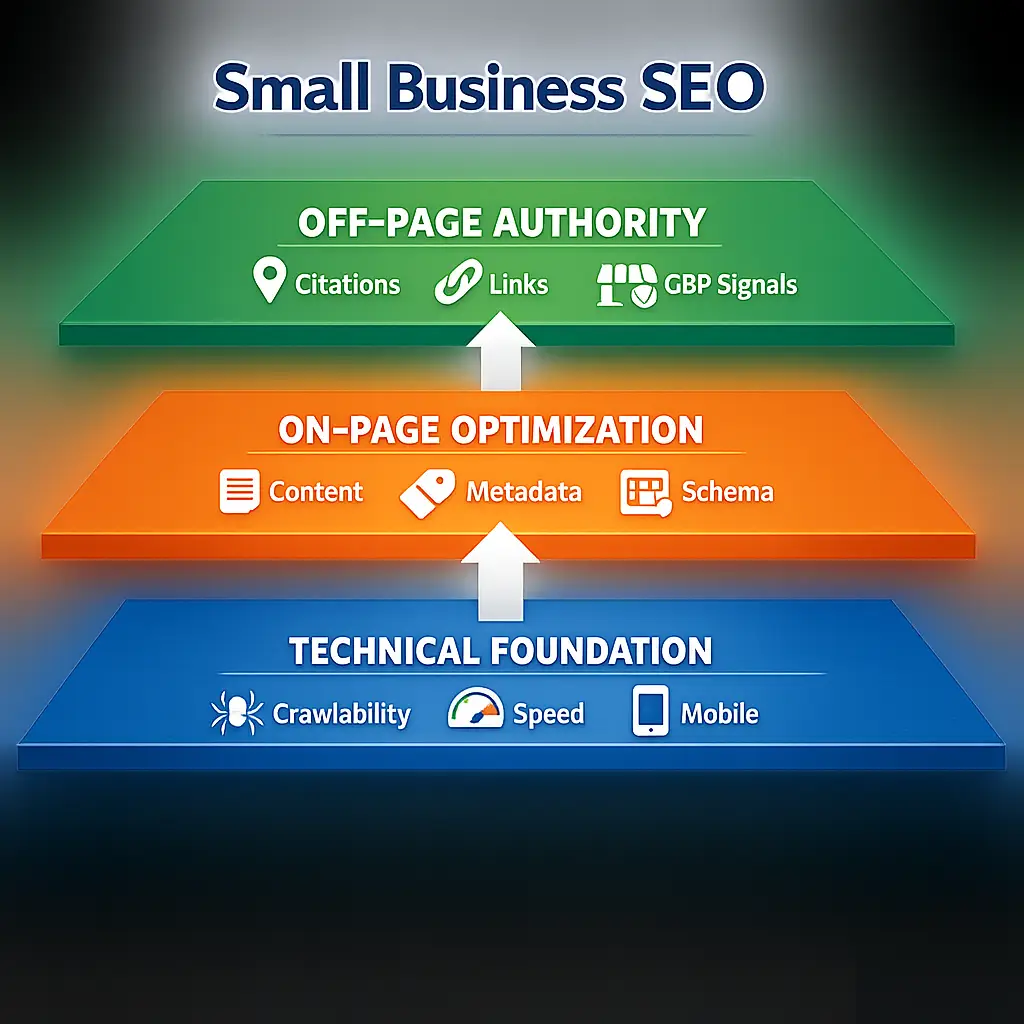
On-page optimization refers to changes made directly to your website — content, structure, metadata, and internal linking. For small businesses, the highest-priority on-page work typically includes:
- Title tags and meta descriptions that accurately reflect search intent for target keywords while remaining compelling enough to earn the click when rankings improve
- Header structure (H1, H2, H3) that organizes content logically for both users and crawlers
- Service page specificity — individual, dedicated pages for each core service, optimized around specific search queries rather than one generic “Services” page that dilutes relevance across dozens of keywords
- Location pages for businesses serving multiple geographic areas, built with genuinely useful, location-specific content rather than templated copy that swaps city names
- Schema markup — structured data that helps Google understand who you are, what you do, and where you’re located, which also increases your likelihood of appearing in rich results
Off-Page SEO: Building Authority That Google Trusts
Off-page SEO encompasses everything that happens outside your website that signals your authority and relevance to search engines. For small businesses, this centers on:
Local Citations: Consistent listings in reputable directories — both general platforms and industry-specific directories relevant to your business category. The value here isn’t individual citation volume; it’s the consistency of your NAP data across trusted sources.
Link Acquisition: Earning links from other websites to yours remains one of the strongest ranking signals in Google’s algorithm. For local businesses, this means community relationships, local press coverage, sponsorships, and partnerships that naturally produce mentions and links. Link acquisition that’s manufactured, purchased, or built through low-quality networks creates algorithmic risk that can erase rankings — often at the worst possible time.
GBP Engagement Signals: Regular posting, Q&A responses, photo uploads, and active review management all contribute to how Google perceives your business as active and trustworthy in the local map results.
Technical SEO: The Infrastructure Layer
Technical SEO addresses the under-the-hood factors that affect how efficiently Google can crawl, index, and rank your site. For small businesses, the most impactful technical priorities are:
- Site speed and Core Web Vitals — Google’s page experience signals directly affect rankings, and slow-loading pages bleed both rankings and conversions simultaneously
- Mobile-first design — Google indexes the mobile version of your site first; a substandard mobile experience affects your rankings, not just your user experience
- HTTPS security — a basic trust signal that Google has treated as a lightweight ranking factor for years
- Crawl efficiency — eliminating duplicate content, fixing redirect chains, and ensuring crawl budget isn’t being wasted on low-value pages
Local SEO: The Highest-ROI Channel for Most Small Businesses
For businesses that serve customers in a defined geographic area — whether a physical location or a service-area business — local SEO is where most of the meaningful search opportunity lives.
Local SEO operates through two distinct ranking systems:
The Local 3-Pack (Map Results): Driven primarily by GBP optimization, proximity to the searcher, review signals, and citation authority. Appearing here for high-intent local searches directly produces calls, direction requests, and website visits from people who are actively ready to buy.
Organic Local Results: The standard blue-link results that appear below the map pack. Driven by traditional on-page and off-page signals, with location relevance layered in through geographic signals on the website and in link profiles.
A complete local SEO strategy targets both systems simultaneously — because searchers interact with both, and over-indexing on one at the expense of the other leaves real opportunity on the table.
How AI Overviews Are Reshaping Small Business SEO Right Now
This is the most significant shift in search behavior in the past decade, and most SEO guides for small businesses are still writing as if it’s 2022.
Google’s AI Overviews — the AI-generated summaries that now appear at the top of results for a wide range of queries — are changing the click-through economics of search in ways that affect small businesses differently than they affect enterprise brands.
The Cannibalization of Informational Content
AI Overviews are most prevalent on informational queries: “how to,” “what is,” and “why does” searches. When Google generates a comprehensive AI answer at the top of the page, a meaningful share of users get what they need without clicking through to any website.
This has direct strategic implications for small businesses that have invested in blog content as their primary SEO growth mechanism. The traditional playbook — publish helpful articles targeting informational keywords, earn traffic, convert that traffic into leads — produces diminishing click-through returns when the search query triggers an AI Overview that answers the question before anyone reaches your content.
This doesn’t mean content is worthless. It means the type of content that earns clicks in an AI Overview environment has shifted.
Where Small Business SEO Investment Is Most Defensible
Transactional and local intent queries remain largely resistant to AI Overview cannibalization. When someone searches “emergency plumber near me” or “HVAC repair in [city],” they’re not looking for a summary — they’re looking for a business to call. Google’s results for these queries still surface local pack results and service pages where the user’s intent is to make contact.
This is where small business SEO investment is most protected from the AI Overview dynamic, and it reinforces a strategic principle: for most small businesses, doubling down on local search visibility and high-intent transactional keywords produces more defensible returns than broad informational content volume. The article on SEO for lead generation in 2026 explores this shift in depth and what it means for businesses building their pipeline through search.
Entity Optimization: The Emerging Priority
AI systems — including Google’s AI Overviews — pull from structured, entity-rich information sources. A business with consistent, complete, and structured information across its website, GBP, major directories, and relevant industry databases is far more likely to be cited or referenced in AI-generated results than one with fragmented or inconsistent data.
“Entity optimization” — ensuring Google can confidently identify your business as a distinct, trustworthy entity with verified attributes — is an emerging priority that intersects with traditional local SEO fundamentals. Businesses that have done the citation and GBP work correctly already have a structural advantage here.
The ROI Attribution Problem: What No One Tells Small Business Owners
Here’s a reality gap that doesn’t get discussed enough: measuring the true return on SEO investment is genuinely difficult for small businesses, particularly service-area businesses where the primary lead channel is an inbound phone call rather than a tracked form submission.
Why Standard Attribution Models Fall Short
Most small business owners think about SEO ROI in terms of keyword rankings and website traffic. Those are legitimate leading indicators, but they’re not business outcomes. The outcome that matters is new customers — and connecting those customers back to a specific SEO action requires deliberate tracking infrastructure that most businesses don’t have by default.
The attribution gap is widest for:
- Phone-call-driven businesses (contractors, medical practices, legal services, home services) where the conversion happens off-site and offline
- Multi-touch conversion paths where a customer first found you through organic search, left, saw a social post, and then called three days later — and your analytics credits the last touchpoint
- Service-area businesses where customers don’t fill out forms; they call, show up, or request quotes by phone
Building a Functional Measurement Framework
A practical attribution framework for small business SEO doesn’t require enterprise analytics tooling. It requires:
Call tracking: A dedicated phone number used exclusively in your digital presence (website, GBP, directories) that routes to your main line and logs call volume, call source, and call duration. This is the single most effective way to connect organic search activity to actual lead volume for phone-driven businesses.
Google Search Console: Free, directly from Google, and essential. It shows you exactly which queries are driving impressions and clicks to your site — giving you keyword-level visibility into what’s actually working before it shows up in revenue.
Conversion events in Google Analytics: Tagged goals or events for contact form submissions, click-to-call actions, appointment bookings, or any other micro-conversion that signals genuine lead intent. Without these configured, your analytics data tells you about visitors but nothing about what those visitors did.
Monthly reporting rhythm: Tracking the right metrics consistently over time — not just rankings, but organic traffic trends, local pack visibility, call volume from tracked numbers, and form submission counts — creates the data history needed to make confident investment decisions and identify what’s actually moving the needle.
How to Evaluate an SEO Agency Without Getting Misled
Every SEO article tells you to hire an agency. Almost none of them tell you how to vet one rigorously. Here’s a more useful framework.
Questions That Reveal Real Competence
“What does your onboarding process look like, and what do you need from us in the first 30 days?”
A competent agency has a structured onboarding that includes access requests (Google Search Console, Google Analytics, GBP), a technical audit, a competitive analysis, and a documented strategy. An agency that jumps straight to deliverables without this foundation is building on sand.
“How do you handle algorithm updates, and can you give me a specific example of how you adjusted a client strategy after a major update?”
This question separates practitioners from order-takers. Real SEO professionals monitor algorithm changes actively and can articulate specific, concrete adjustments they’ve made. Vague answers about “staying current with best practices” are not answers.
“What metrics will you report on, and how do you connect those metrics to business outcomes like leads and revenue?”
Agencies that report rankings and traffic without connecting those to actual business outcomes are reporting vanity metrics. A results-focused partner ties their reporting to what actually matters to your business.
“Do you work with any of my direct competitors, and how do you manage conflicts?”
Some agencies decline to work with direct competitors to protect strategic confidentiality. Others have policies around it. Neither position is inherently wrong, but understanding it upfront prevents future surprises.
Red Flags That Warrant Serious Caution
- Promises of specific ranking positions within a defined timeframe, regardless of competitive context
- Proprietary “black box” strategies that can’t be explained in plain terms
- Backlink packages sold by volume with no discussion of source quality
- Contracts that make it difficult to access your own analytics accounts, GBP, or website if you leave
- Reporting that shows rankings activity but never connects to lead or revenue data
The Timeline Reality: Why “Three to Six Months” Is Too Simple
The three-to-six month SEO timeline is one of the most repeated and least useful pieces of guidance in this industry. Here is what actually determines how quickly you’ll see results:
| Variable | Faster Results | Slower Results |
|---|---|---|
| Domain Age | Established domain with existing index history | New domain with no prior authority |
| Competitive Density | Smaller market with weak incumbent competitors | Dense urban market with well-funded competitors |
| Technical Health | Clean site, no crawl issues, fast load times | Multiple technical issues requiring remediation before SEO gains hold |
| Content Publication Cadence | Consistent, high-quality content publishing | Sporadic or no new content |
| GBP Status | Claimed, verified, fully optimized | Unclaimed or incomplete GBP |
| Link Profile | Existing relevant referring domains | Zero external links to the domain |
| Algorithm Timing | Strategy aligns with current ranking signals | Strategy built around outdated signals |
The honest answer to “how long will this take?” is always: it depends on where you’re starting from and where you’re trying to go. An agency that gives you a timeline without understanding these variables is estimating without data.
What a results-focused partner can commit to is a clear diagnostic process that produces realistic expectations based on your actual situation — not a generic timeline designed to manage expectations.
Putting It Together: A Stage-Based SEO Framework for Small Businesses
Not every small business needs the same SEO strategy, and not every strategy applies equally at different stages of business development. Here’s how the priorities shift:
Stage 1: New or Establishing (0–18 Months in Business)
At this stage, the primary SEO objectives are establishing your digital presence, fixing any technical issues that would prevent indexing, and claiming your local real estate.
Priority actions:
– Complete technical audit and remediation
– Claim and fully optimize Google Business Profile
– Standardize NAP data across all existing mentions
– Build out core service pages with specific, location-relevant content
– Begin structured review generation from day-one customers
Organic rankings at this stage are limited by domain age, but local GBP optimization can produce map pack visibility relatively quickly when the competitive bar is low.
Stage 2: Growth Phase (18 Months–4 Years)
With a functional foundation in place, the focus shifts to competitive displacement — systematically targeting the specific keywords and competitors where meaningful traffic and lead gains are achievable.
Priority actions:
– Competitive displacement analysis for target keywords
– Targeted link acquisition through community and industry relationships
– Expansion of service and location page coverage
– Content strategy focused on transactional and local-intent queries
– Call tracking and conversion infrastructure to measure ROI accurately
Stage 3: Mature Presence (4+ Years)
Established businesses with solid rankings shift their SEO investment toward defending and expanding their position — protecting against algorithm shifts, capturing adjacent keyword territory, and building the entity authority that positions them well in an AI-driven search landscape.
Priority actions:
– Entity optimization and structured data expansion
– Content authority development in specific topical areas relevant to the business
– Proactive monitoring and response to algorithm changes
– Ongoing review velocity maintenance
– Exploration of featured snippet and People Also Ask opportunities for transactional queries
At Mongoose Digital Marketing, we work with small businesses across each of these stages — building strategies that match where you actually are, not where a generic template assumes you should be. If you’re ready to have an honest conversation about what SEO can realistically do for your business, a free consultation is the right place to start.
Strategic Recommendations for 2026
As search continues to evolve — with AI-generated answers, map pack consolidation, and tighter local intent signals — small businesses that act on the right priorities now will be better positioned heading into the next phase of search. Here are three specific areas worth prioritizing in 2026.
1. Invest in Entity-First SEO Infrastructure
Google’s understanding of businesses is increasingly built around entities — not just keywords. Tools like Google’s Knowledge Panel management, schema validation through Google’s Rich Results Test, and platforms like Semrush or BrightLocal for local citation auditing help small businesses build a coherent, trustworthy identity across the web. If your business name, category, and service descriptions aren’t consistent and reinforced across your website, GBP, and third-party directories, you’re leaving authority on the table that competitors will claim.
2. Build a Review Velocity System — Not a One-Time Push
Review generation tools like GatherUp, Birdeye, or even a well-structured SMS follow-up workflow integrated into your CRM have become table stakes for local SEO. The ranking signal isn’t the total count — it’s consistent, ongoing velocity. A business that gets five new reviews every month will outperform one that got fifty reviews two years ago and went quiet. Prioritize a repeatable system over a one-time campaign.
3. Audit Your Content for AI Search Visibility
With AI Overviews appearing for a growing range of local and informational queries, content that clearly answers specific questions — formatted for readability, supported by genuine expertise, and aligned with what your customers actually ask — is more valuable than ever. Use tools like AlsoAsked or Answer the Public to identify the exact question clusters relevant to your services, then build or update content that addresses them directly and completely. Thin service pages with no supporting content context will underperform in both traditional and AI-assisted search results.
Frequently Asked Questions
How long does SEO take to show results for a small business?
Most small businesses begin to see measurable movement in local search visibility — particularly in Google’s map pack — within three to six months of consistent, well-executed SEO work. Organic keyword rankings typically take longer, often six to twelve months or more, depending on the competitiveness of your market and how much foundational work was in place before the campaign started. Businesses in less saturated local markets can see meaningful results faster; those competing in dense urban areas or against well-established incumbents should plan for a longer runway.
What is the difference between local SEO and general SEO for small businesses?
Local SEO focuses specifically on improving your visibility in geographically-targeted searches — the map pack, “near me” queries, and city-specific keyword rankings. It emphasizes your Google Business Profile, local citation consistency, and reviews. General SEO encompasses the broader set of strategies that improve your website’s organic search rankings regardless of location, including technical site health, content development, and link acquisition. Most small businesses need both, but local SEO typically delivers the fastest and most directly business-relevant results for service-area and brick-and-mortar companies.
Do small businesses really need ongoing SEO, or is a one-time fix enough?
A one-time technical and content audit can address existing problems, but SEO is not a set-it-and-forget-it investment. Search algorithms update regularly, competitors continue working on their own visibility, new content opportunities emerge, and your own business offerings change over time. Maintaining and improving rankings requires ongoing attention — fresh content, continued link and review acquisition, and monitoring for technical issues. Businesses that stop active SEO work after an initial push typically see gradual ranking erosion within twelve to eighteen months.
How do I know if my current SEO provider is actually doing anything?
A legitimate SEO provider should be able to show you clear, regular reporting that ties their activities to measurable outcomes — keyword ranking movement, organic traffic trends, map pack visibility, and lead attribution. You should be able to see what work was completed each month, what the results have been over time, and what the plan is going forward. If your current provider can’t answer specific questions about what they’ve done, why they did it, or what results it produced, that’s a meaningful red flag worth investigating.
Conclusion
Navigating SEO as a small business is genuinely complex — but working with a team that understands both the technical side and the local search landscape makes the difference between spending money and actually growing. At Mongoose Digital Marketing, our local SEO and content strategy services are built specifically for small businesses that need results that connect directly to new customers, not just rankings on a report. If you’re ready to find out what’s actually possible for your business in search, we’d welcome the conversation — Contact Mongoose Digital Marketing and let’s start with a free consultation.