
On-Page SEO Best Practices for Small Business Websites: The Complete Guide to Ranking in 2025
Most small business owners treat on-page SEO as a checklist — drop the keyword in the title tag, write a meta description, add some headers, done. That approach might have worked in 2018. Today, it’s the reason a lot of well-intentioned small business websites are stuck on page three with no clear path forward.
This guide goes deeper than the standard advice you’ll find recycled across the internet. We’re covering the on-page factors that actually move rankings for small business websites specifically — accounting for the real constraints you face: limited domain authority, small page counts, local intent signals, and competition from both regional players and large national brands targeting your keywords.
If you’re a business owner managing your own site or working with a marketing partner, this is the framework that will actually make a difference.
Why On-Page SEO Looks Different for Small Businesses
Before diving into tactics, it’s worth establishing why small business websites require a different on-page SEO approach than what you’d apply to a large e-commerce site or media publisher.
Small business sites typically have between 5 and 50 pages. That means every page carries more weight, every internal link decision matters more, and thin or poorly differentiated content creates site-wide suppression faster than on a 10,000-page domain. Google’s quality signals — particularly those tied to the Helpful Content system — evaluate domain-level content quality, not just individual pages. A few weak service pages drag down every page on the site.
At the same time, small businesses have a genuine competitive advantage that most owners fail to leverage: specificity. A business with a clearly defined geographic service area, a documented specialty, and real operational experience has the raw material to build on-page authority that generalist competitors simply can’t replicate.
The goal of on-page SEO for small business sites is to make that specificity visible to both Google and the people searching for exactly what you do.
Search Intent Alignment: The Most Misunderstood On-Page Factor
Ask most people what on-page SEO is about, and they’ll say keywords. That’s not wrong, but it’s incomplete to the point of being misleading in 2025. The more accurate answer is search intent alignment — ensuring that every element of your page reflects why someone is performing that search, not just what words they used.
Google classifies search intent into four primary categories:
- Informational — the user wants to learn something (“how does HVAC maintenance work”)
- Navigational — the user is looking for a specific brand or website (“Mongoose Digital Marketing”)
- Commercial investigation — the user is comparing options before deciding (“best SEO agencies for small business”)
- Transactional — the user is ready to act (“hire SEO agency near me”)
Where small business pages consistently fail is mismatching intent. A service page optimized for a transactional keyword — “emergency plumber Atlanta” — that opens with three paragraphs of company history is already losing the ranking battle. The user searched with urgency and intent to hire. The page opened with a story. That mismatch generates behavioral signals (quick back-clicks to search results, short dwell times) that Google interprets as the page failing to satisfy the query.
The Information Scent Test
Here’s a practical audit you can run on every page of your site today: read your H1 and your opening paragraph, then ask — does this immediately confirm to someone who just searched your target keyword that they’ve found what they were looking for?
This is called information scent continuity. The language, tone, and focus of your page’s opening content must mirror the emotional intent behind the search, not just the literal keyword. A user searching “emergency plumber near me” needs to see confirmation of immediacy and proximity in the first 100 words — something like “Available 24/7 across [your service area] for urgent pipe and drain emergencies.” That’s scent continuity. It confirms they’re in the right place before they’ve even had a chance to question it.
Run this test on your highest-priority pages. If the first thing a visitor reads doesn’t directly reflect why they searched, that page has an intent alignment problem that no amount of keyword density will fix.
Title Tags, H1s, and Meta Descriptions: What Still Matters (and What Doesn’t)
Yes, these elements still matter. No, they don’t work the way outdated guides describe.
Title tags remain one of the strongest on-page signals Google uses to understand page topic. But mechanical keyword insertion — bolting your target phrase onto a templated title — is not the same as optimizing a title tag. An effective title tag for a small business page should:
- Lead with the primary keyword or a close variant
- Include a geographic modifier when local intent is part of the query
- Communicate a specific benefit or differentiator, not just a category
- Stay under 60 characters to avoid truncation in search results
Weak example: “Plumbing Services | Joe’s Plumbing”
Stronger example: “Emergency Plumber in Denver | Same-Day Service Available”
The stronger version earns higher click-through rates, which reinforce rankings. Title tags are both a ranking signal and a conversion element — they’re the first persuasion opportunity you have with a potential customer.
Meta descriptions are not a direct ranking factor, but they directly affect click-through rates, which are a behavioral signal. Write them as a direct response to the user’s query intent. For transactional pages, include an action and a differentiator. For informational pages, briefly preview the specific answer or insight the user will find. Never write a meta description that just restates your title tag.
H1 tags should be on-page once per page, should align closely with (but not necessarily duplicate) the title tag, and should be written for the human reading it, not just for the algorithm. A visitor’s eye goes to the H1 the moment they land — it should reinforce their decision to stay.
The Small Business Thin Content Problem
This is one of the most damaging and least discussed issues affecting small business websites, and it rarely gets addressed in standard SEO guides.
If your website has five service pages and each one follows this template — “We offer [Service] in [City]. Our experienced team is ready to help. Call us today!” — you have a thin content problem. Not because the pages are short, but because they are functionally identical in structure and semantic content. Google’s systems detect this pattern at the domain level and it suppresses the entire site’s ability to rank, regardless of how well you’ve placed your keywords.
The fix isn’t to pad those pages with generic filler content. The fix is content differentiation through genuine specificity.
Here’s what actually makes a service page substantively different and algorithmically stronger:
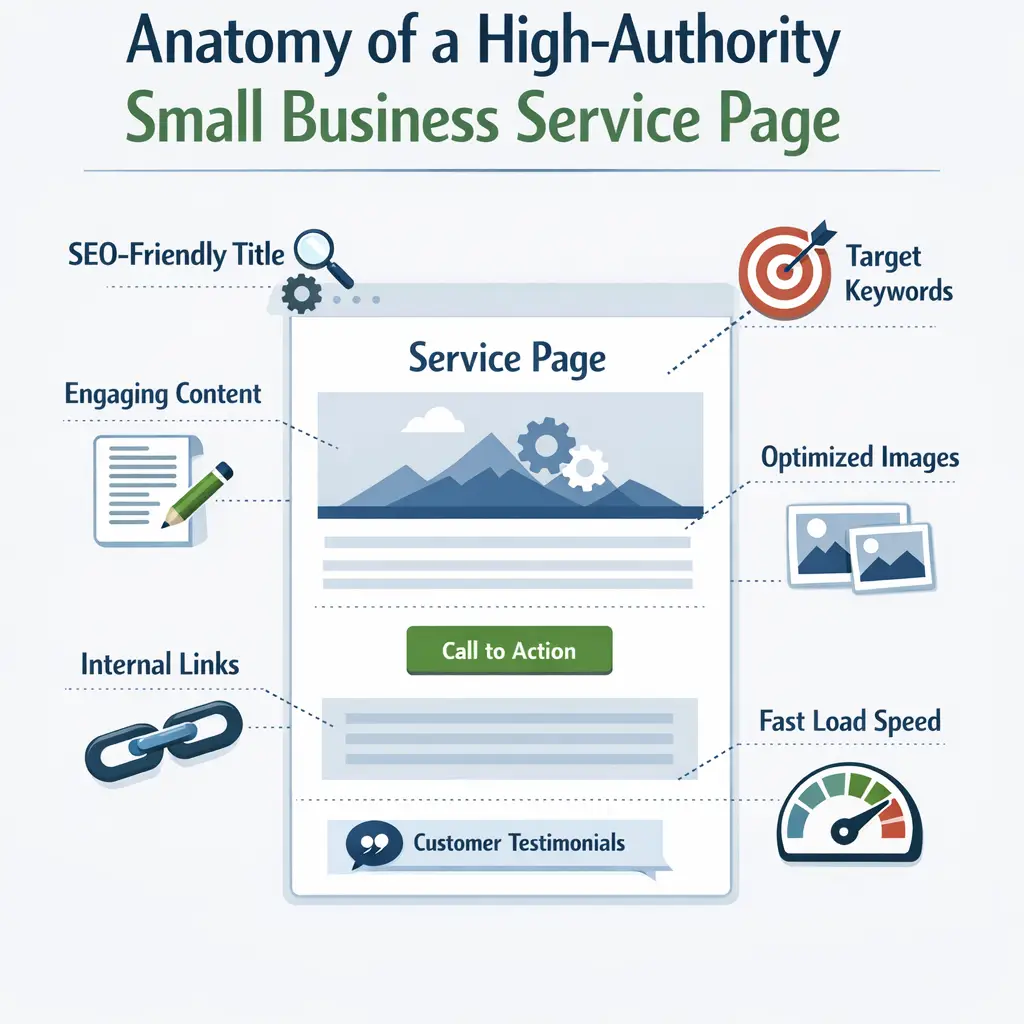
What a High-Authority Small Business Service Page Contains
1. Methodology specificity
Don’t just say you offer the service — describe how you do it. What’s your process? What makes your approach different from the competitor across town? Google’s systems evaluate whether pages contain original information that can’t be found elsewhere. Your operational methodology is inherently original.
2. First-person experience signals
The updated E-E-A-T framework (Experience, Expertise, Authoritativeness, Trustworthiness) explicitly values demonstrated experience — evidence that the person or business writing the content has actually done the thing. Include specific project outcomes, years of hands-on work in the specific service category, or concrete results from past customers. This isn’t just about ranking — it’s about converting visitors into leads. Our article on conversion optimization breaks down how these trust signals translate directly into higher conversion rates once visitors land on your page.
3. Location-specific context
For small businesses with defined service areas, local specificity is both an SEO signal and a trust signal. Reference specific neighborhoods, regional considerations that affect your service (local soil conditions for landscapers, local building codes for contractors, climate-specific considerations for HVAC companies), or community context that makes the page genuinely relevant to a local audience.
4. FAQ schema drawn from real customer questions
Identify the three to five questions your customers actually ask before hiring you — not questions you invented to stuff keywords — and answer them directly on the page, marked up with FAQ schema. This serves multiple functions: it adds legitimate semantic depth to the page, it increases chances of appearing in featured snippets, and it addresses objections in the sales process simultaneously.
Entity Optimization: The Gap Most Small Business SEO Advice Misses Entirely
Here’s where modern on-page SEO diverges significantly from the keyword-centric advice that still dominates most guides.
Google doesn’t just read words — it recognizes entities. An entity is any clearly defined, distinguishable thing: a business, a location, a service category, a person, a concept. Google’s Knowledge Graph connects entities to each other and uses those connections to evaluate whether a page is a credible, authoritative source on a given topic.
For small businesses, this means your on-page SEO work needs to go beyond placing keywords and start asking: does Google confidently understand who we are, what we do, and where we operate as an entity?
The signals that answer that question include:
- Consistent NAP data (Name, Address, Phone Number) on every page — formatted identically to your Google Business Profile and all directory listings
- LocalBusiness schema markup that explicitly connects your website to your physical business entity, service category, and operating area
- Topical entity clustering — using semantically related terms, industry-specific language, and location-based references that confirm your page belongs to the right knowledge cluster
A quick way to audit your entity clarity: paste a key service page into Google’s Natural Language API demo (available free through Google Cloud) and review what entities Google extracts. If your business name, service type, and location are not among the prominent entities identified, your page has an entity optimization gap that keyword work alone won’t solve.
Core Web Vitals as an On-Page Factor
There’s an artificial separation in most SEO guides between “on-page SEO” and “technical SEO” that doesn’t reflect how Google actually evaluates pages. Core Web Vitals — the page experience signals that measure load performance, visual stability, and interactivity — are page-level measurements. They are on-page factors in every practical sense, and they disproportionately hurt small business websites.
Here’s why small business sites are particularly vulnerable:
Most small business websites run on page builders (WordPress with Elementor or Divi, Wix, Squarespace) that generate bloated code, render-blocking scripts, and unoptimized image files. These platforms trade ease of use for performance, and the performance cost shows up directly in Core Web Vitals scores that suppress rankings. If you’re evaluating your platform options, our article on why WordPress is the smart choice for small business websites covers what most web designers won’t tell you about how platform decisions affect long-term SEO performance.
The three metrics that matter for your pages:
| Metric | What It Measures | Good Threshold | Common Small Business Failure |
|---|---|---|---|
| LCP (Largest Contentful Paint) | How fast the main content loads | Under 2.5 seconds | Unoptimized hero images, slow hosting |
| CLS (Cumulative Layout Shift) | Visual stability as the page loads | Under 0.1 | Fonts, ads, or embeds causing content to jump |
| INP (Interaction to Next Paint) | Responsiveness to user input | Under 200 milliseconds | Heavy JavaScript from plugins or chat widgets |
You can assess your pages’ Core Web Vitals scores using Google Search Console’s Core Web Vitals report — it’s free, it’s tied to real-world user data, and it identifies specific URLs that are failing. Start with your highest-traffic and highest-priority pages. A page with an excellent title tag, strong content, and well-structured headers that loads in 6 seconds is still losing to a competitor page that loads in 2.
Schema Markup Prioritization for Small Business Sites
Schema markup is consistently mentioned in SEO guides and consistently implemented poorly by small business sites. The issue isn’t awareness — most business owners have heard of schema. The issue is that most guides list every possible schema type without telling you which ones actually deliver value for a small business context.
Here’s the prioritized implementation order for most small business websites:
Tier 1 — Implement immediately:
– LocalBusiness schema (or a more specific subtype like Plumber, LegalService, AutoRepair) — connects your site to your physical entity and geographic service area
– BreadcrumbList schema — communicates site structure to Google and improves how your URLs display in search results
Tier 2 — High value for conversion-focused pages:
– Service schema — describes individual services with name, description, and area served
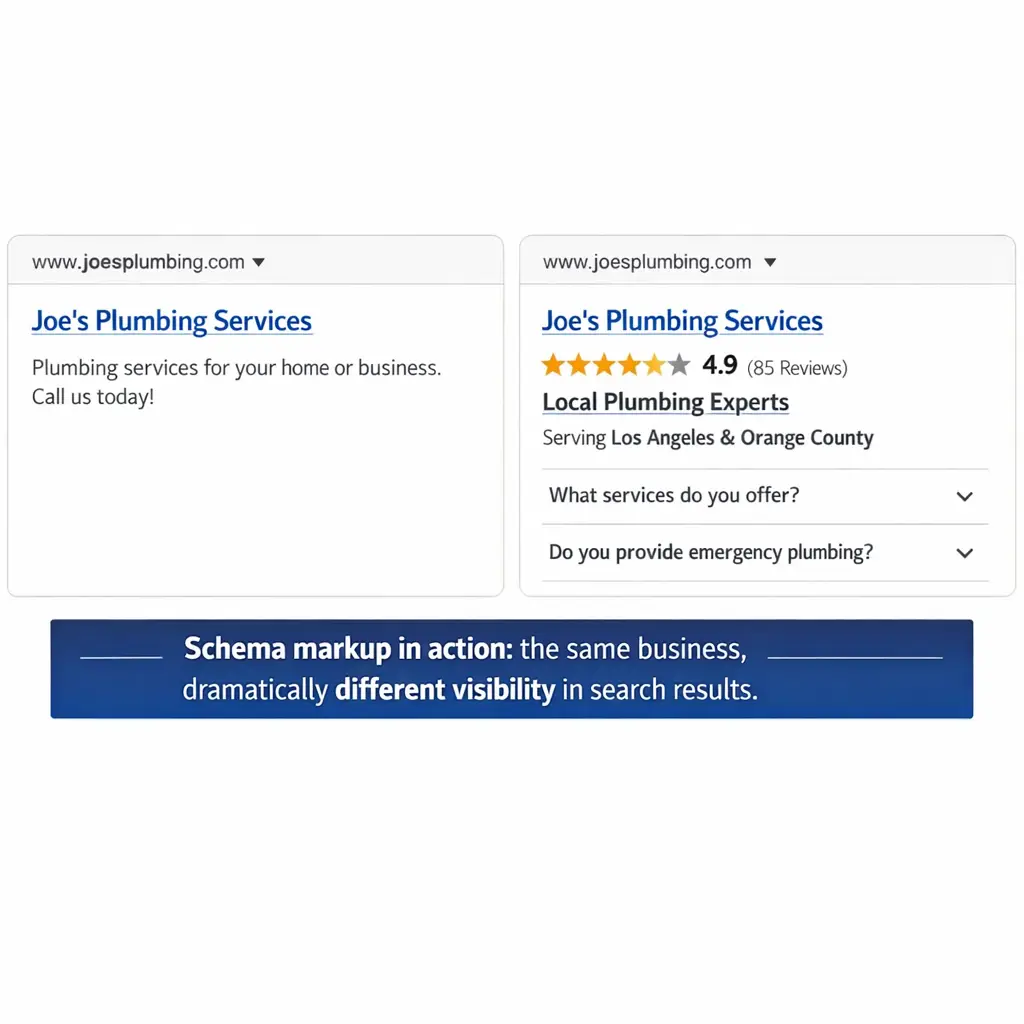
– Review/AggregateRating schema — displays star ratings in search results, significantly improving click-through rates (requires legitimate review data)
Tier 3 — Situational, based on content type:
– FAQ schema — for service pages with genuine customer Q&A sections
– HowTo schema — for educational content that walks through a step-by-step process
– Person schema — for team and author pages, supporting E-E-A-T signals
The highest-impact schema decision for most small business websites is getting LocalBusiness schema correctly implemented and synchronized with your Google Business Profile data. If the name, address, phone number, and service area in your schema don’t match your GBP exactly, you’re undermining the entity clarity that local rankings depend on.
Internal Linking Strategy for Small Sites
For small business websites, internal linking isn’t just a navigation tool — it’s the primary mechanism for distributing PageRank across a small page ecosystem and communicating topical relationships to Google.
The core principles for small business internal linking:
Link from high-authority pages to conversion pages. If your homepage or a well-ranking blog post attracts significant organic traffic, internal links from those pages pass authority to your service and contact pages. Map your site’s link equity flow intentionally.
Use descriptive anchor text. “Click here” and “learn more” are wasted internal linking opportunities. Anchor text is a relevance signal — link to your HVAC maintenance page with “seasonal HVAC maintenance in [your city],” not a generic phrase.
Build topical clusters, not flat architecture. If you write a blog post about the signs you need a roof repair, that post should link to your roofing service page. Your roofing service page should link to related posts about roof maintenance and roof replacement. This cluster architecture reinforces topical authority and keeps users engaged in a way that generates positive behavioral signals.
Audit for orphan pages regularly. On small sites, it’s common for pages to exist with no internal links pointing to them. Google discovers and evaluates pages through crawling, and a page with no internal links receives neither PageRank equity nor reliable crawl attention. Run a crawl with any site auditing tool and eliminate orphan pages.
E-E-A-T Signals You Can Build Directly Into Your Pages
Google’s E-E-A-T framework isn’t just evaluated at a domain or author level — it’s assessed page-by-page through specific on-page signals. For small businesses, especially those in home services, healthcare-adjacent services, financial services, or legal services, on-page E-E-A-T signals are increasingly non-negotiable for competitive rankings.
The on-page elements that build E-E-A-T for small business pages:
- Author attribution with credentials — service pages and blog content attributed to a named individual with a brief credential statement (“Written by [Name], licensed [profession] with [X] years serving [region]”) signal expertise and accountability
- Original data, outcomes, or case references — specific project outcomes (“We’ve completed over 400 bathroom remodels across the Denver metro”) are both trust signals and original content that strengthens page authority
- Third-party validation on the page — references to licenses, certifications, industry associations, or notable media mentions that can be verified
- Transparent business information — a clearly accessible About page, physical address, and contact information aren’t just good for users; they’re signals Google uses to evaluate trustworthiness
None of these elements require a large content team or an ongoing publishing schedule. They require honest documentation of the experience your business already has — and making that experience visible on the page.
Putting It Together: On-Page SEO Priority Order for Small Business Sites
Given that most small business owners are working with limited time and resources, here’s a prioritized implementation sequence based on impact-to-effort ratio:
| Priority | Action | Impact | Effort |
|---|---|---|---|
| 1 | Audit and fix search intent alignment on top 5 pages | High | Low |
| 2 | Rewrite thin service pages with methodology, experience signals, and local context | High | Medium |
| 3 | Implement LocalBusiness + Service schema markup | High | Medium |
| 4 | Optimize title tags for click-through, not just keyword placement | High | Low |
| 5 | Build internal linking clusters between blog content and service pages | Medium | Low |
| 6 | Audit Core Web Vitals via Google Search Console, address LCP failures | High | Medium–High |
| 7 | Add FAQ sections with schema markup to service pages | Medium | Low |
| 8 | Perform entity audit using NLP tools; align NAP data site-wide | Medium | Medium |
| 9 | Add author attribution and E-E-A-T signals to key pages | Medium | Low |
| 10 | Review and update alt text on images to include natural local modifiers | Low–Medium | Low |
Start at the top and work down. The first two priorities alone — intent alignment and service page differentiation — will produce measurable ranking improvements on most small business sites before any of the more technical work begins.
The Bottom Line
On-page SEO for small business websites isn’t about doing more — it’s about doing the right things with the pages you already have. A 15-page website with every page optimized for search intent, differentiated with genuine expertise signals, technically sound on performance metrics, and structured around entity clarity will outperform a 200-page site built on templated content and keyword stuffing.
The businesses that win in local and regional search results in 2025 are the ones that make their real expertise visible on the page. That’s what Mongoose Digital Marketing builds — strategies designed around your specific business, your actual service area, and the customers who are already searching for exactly what you do. If you want to see what a tailored on-page SEO audit would reveal for your site, we offer a free consultation to walk through exactly that.
Strategic Recommendations for 2026
As search continues to evolve toward entity-based understanding and AI-assisted results, small business websites need to stay ahead of a few specific shifts. These three recommendations will position your site for stronger performance through 2026 and beyond.
1. Adopt an AI-Assisted Content Audit Workflow
Tools like Surfer SEO or Clearscope have matured to the point where they provide genuinely useful topical coverage analysis — not just keyword density reports. Use them to identify content gaps on your existing service pages rather than generating new pages from scratch. The goal is depth on pages that already have traction, not volume for its own sake.
2. Prioritize Google Search Console’s New Performance Signals
Google Search Console continues to expand its diagnostic capabilities. In 2026, pay close attention to the Search Appearance filters for AI Overview appearances and structured data enhancements. These signals now indicate whether your pages are being considered for featured placements — and small businesses that monitor them consistently will find optimization opportunities their competitors are missing entirely.
3. Build a Systematic Entity Consistency Process
As local search increasingly relies on knowledge graph relationships, your NAP data, business categories, and service descriptions need to be consistent not just on your website but across every platform where your business appears. Tools like BrightLocal or Semrush’s Listing Management feature can help you audit and maintain that consistency at scale — which directly supports the on-page signals you’ve worked to build. For a deeper look at how local SEO optimization drives rankings at the local level, that article walks through exactly how these signals interact in competitive local markets.
Frequently Asked Questions
How long does it take to see results from on-page SEO improvements?
Most small business websites begin to see measurable movement in rankings and click-through rates within 60 to 90 days of implementing core on-page changes — particularly intent alignment and service page improvements. That said, the timeline depends heavily on how competitive your local market is, how often Google crawls your site, and whether the changes address the specific gaps holding your rankings back. Technical fixes and schema implementation tend to show faster signals than content depth improvements, which compound over time.
Do I need to rewrite my entire website to improve my on-page SEO?
Not at all. In most cases, a targeted audit of your top five to ten pages produces far more impact than a full site rewrite. The priority is identifying which pages are closest to ranking well and removing whatever is holding them back — whether that’s a title tag misaligned with search intent, thin content on a service page, or missing local context signals. A strategic, page-by-page approach almost always outperforms starting over from scratch.
What’s the difference between on-page SEO and technical SEO for a small business site?
On-page SEO focuses on the content and structure of individual pages — things like title tags, heading hierarchy, search intent alignment, internal linking, and E-E-A-T signals. Technical SEO addresses the underlying infrastructure that affects how search engines crawl and index your site — things like Core Web Vitals, site speed, mobile usability, and crawl errors. For most small business websites, both matter, but on-page improvements typically deliver faster, more visible results because they directly affect what users and search engines see when they land on a page.
Is on-page SEO still relevant now that AI is changing how search results work?
Yes — arguably more than ever. AI-powered search features like Google’s AI Overviews draw directly from pages that demonstrate clear expertise, topical depth, and strong entity signals. A page optimized for genuine search intent with well-structured content and credible authority signals is exactly the kind of source these systems are built to surface. Small businesses that treat on-page SEO as a foundation — not a checkbox — are better positioned for both traditional rankings and emerging AI-assisted search placements.
Ready to Put This Into Practice?
Understanding on-page SEO best practices is one thing — applying them consistently across your specific pages, your service area, and your competitive landscape is where most small businesses need a knowledgeable partner. Mongoose Digital Marketing works with local and regional businesses to translate these strategies into real ranking improvements, with a particular focus on service-based businesses navigating competitive local markets. If your website isn’t bringing in the leads it should, a focused on-page audit is the right place to start.