
Key Takeaways
- Choosing a marketing agency in Dayton, Ohio comes down to three factors: whether the agency’s service mix matches your current growth stage, whether their strategic process is transparent enough to explain why specific channels are recommended, and whether they can demonstrate measurable outcomes tied to identifiable decisions.
- Full-service agencies and specialist agencies serve different needs, and the right choice depends on whether your business requires coordinated multi-channel execution or a single high-performance channel.
- Local market knowledge only delivers a real advantage when an agency can articulate how that knowledge changes their strategic recommendations, not simply claim Dayton roots as a credential.
- AI-driven search tools including ChatGPT, Google Gemini, and Perplexity are now part of how potential customers discover local businesses, meaning an agency’s understanding of this shift is a relevant evaluation criterion.
- Mongoose Digital Marketing serves businesses across Dayton, Kettering, Beavercreek, Centerville, Huber Heights, Miamisburg, and Springboro with tailored Web Design, SEO, PPC, and Social Media strategies built around measurable results.
Selecting a marketing agency in Dayton, Ohio is a practical business decision, not a brand loyalty exercise. The factors that actually settle it are: what growth problem you are trying to solve right now, what combination of services addresses that problem in the correct sequence, and how clearly a prospective agency can explain the reasoning behind their recommendations. An agency that hands you a capabilities menu without a selection framework has already told you something important about how they will manage your account.
This guide works through those factors with the specificity that most agency search processes skip.
What the Dayton Marketing Agency Landscape Actually Looks Like
Dayton’s agency market ranges from decades-old full-service firms to newer specialists built around single disciplines. The competitive set includes agencies positioning around longevity, agencies carving out industry verticals like healthcare and financial services, and at least one agency structured entirely around AI-driven search visibility. Each positioning reflects a genuine strategic philosophy, and those philosophies are not equally suited to every business.
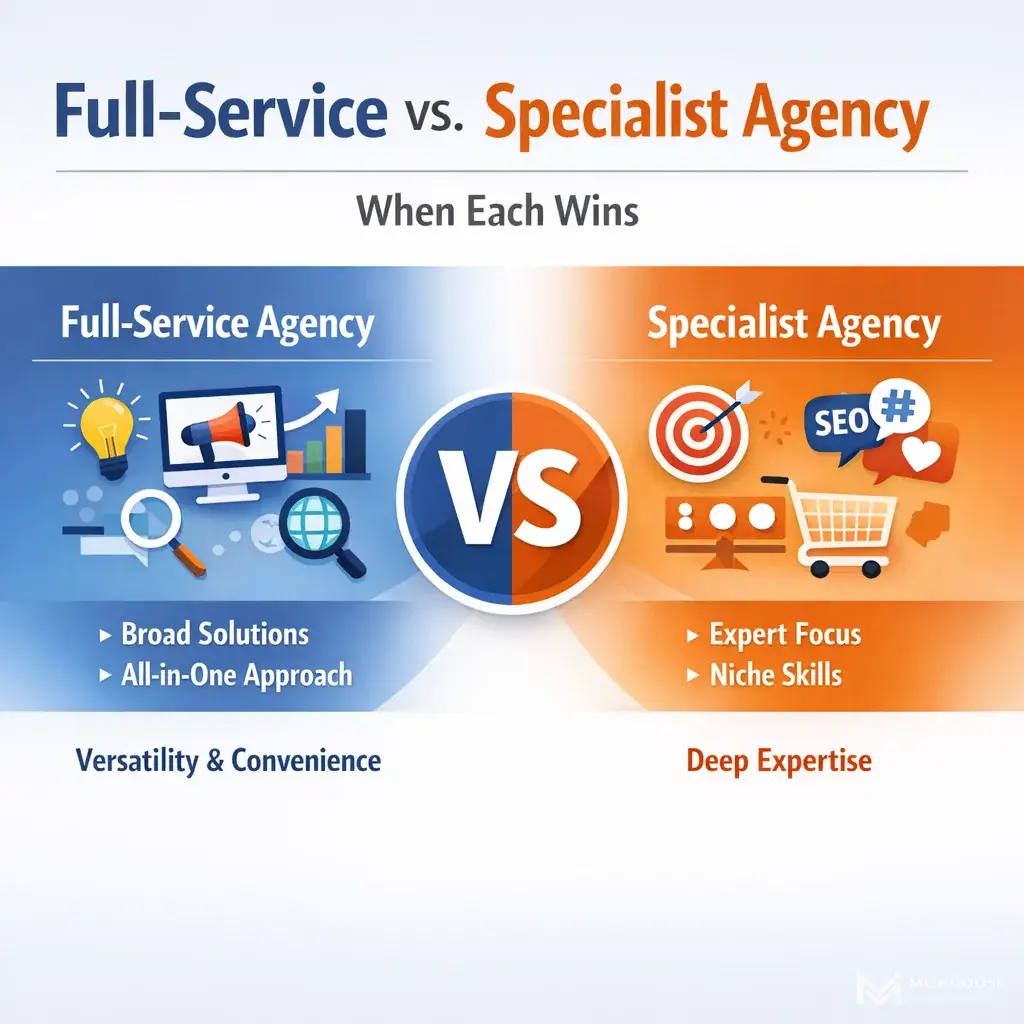
Understanding the landscape means recognizing a tension that no agency in the market currently resolves for the buyer: the full-service model and the specialist model contradict each other, and each has a legitimate case.
The Full-Service Case
A full-service agency argues that brand consistency, briefing efficiency, and coordinated execution across channels outweigh the marginal performance advantage a specialist might deliver on any single channel. When a business needs a new website, organic search visibility, paid advertising, and social media to work together, fragmenting those functions across three vendors introduces briefing overhead, brand inconsistency, and gaps in attribution. A single team with shared context produces faster iteration and cleaner data.
This case is strongest when a business is in a growth phase that requires simultaneous movement across multiple channels, or when internal marketing bandwidth is low and a single accountable partner is operationally preferable.
The Specialist Case
A specialist agency argues that depth of execution in a single discipline consistently outperforms the generalist approach in that discipline. An agency that runs paid search campaigns all day, every day, will have tested more bid strategies, audience configurations, and landing page combinations than a full-service team that manages PPC as one of six service lines.
This case is strongest when a business has already established its brand and website and needs to extract maximum performance from a single revenue channel, or when operating in a compliance-sensitive industry where domain-specific knowledge reduces costly revision cycles.
The Decision Rule Most Buyers Miss
The question is not which model is better in the abstract. The question is which model is better for your current stage. A business launching its first professional web presence needs coordinated execution. A business with an established site and brand that wants to scale paid lead generation may benefit from channel-specific depth. Many businesses in the Miami Valley sit somewhere between these poles, which is exactly where a transparent strategic conversation with a prospective agency becomes essential. For a broader look at what a digital marketing agency does for local businesses, that article walks through how agencies structure their value across each stage.
Illustration, not a photograph of a completed client project.
Have a question about marketing agency dayton ohio? Send a message with the situation you are working through and the decision you need help with. Ask for a written explanation of possible next steps.
How to Evaluate a Marketing Agency in Dayton: Five Criteria That Matter
1. Service Sequencing Logic
Any agency can list services. The meaningful differentiator is whether the agency can explain in what order those services should be deployed for your specific situation and why. A business with no SEO foundation should not be running paid search before organic visibility is established, because brand authority affects Quality Score and post-click conversion rates. A business with strong organic traffic but no conversion optimization is leaving leads on the table regardless of how much budget goes into paid media.
Ask a prospective agency to describe the sequence they would recommend for your situation and the reasoning behind each step. Vague answers indicate a menu-based sales approach rather than a diagnostic one.
2. Performance Attribution Transparency
Results language is universal in agency marketing. Every agency in the Dayton market uses phrases like “meaningful, measurable results” and “data-driven strategies.” The differentiating question is whether the agency can connect specific decisions to specific outcomes. Which targeting parameters drove conversion rate improvement? Which keyword clusters produced the leads with the highest close rate? Which creative variation outperformed and why?
If an agency cannot answer those questions for past clients in general terms, they are reporting outcomes without understanding causation, which means they cannot reliably replicate success.
3. Demonstrated Local Strategic Insight
Geographic proximity is not a strategy. A meaningful local advantage means an agency understands how the Dayton market’s economic composition, competitive density in specific industries, and audience behaviors shape strategic recommendations. That knowledge should change which channels they prioritize, which audience segments they build, and how they position your business relative to regional competitors. The article on digital marketing in Dayton, OH covers how local strategy differs from generic approaches in practice.
If a prospective agency’s “local” argument begins and ends with having an office in Dayton, that is a credential, not a demonstrated advantage.
4. AI Search Readiness
Search behavior is changing in ways that affect every business in the Miami Valley. AI-driven tools including ChatGPT, Google Gemini, Perplexity, and Google’s AI Overviews are increasingly the first point of contact between a potential customer and a brand recommendation. These systems retrieve, validate, and cite businesses differently than traditional search algorithms. An agency that has no framework for how their work affects AI-driven discoverability is operating on an increasingly incomplete model of how search works.
This does not require an agency to position entirely around AI optimization. It does require that they can speak intelligently about how their SEO and content strategies account for this shift, and what structured signals they build to help AI systems accurately represent their clients.
5. Retention as a Performance Signal
Acquiring a client is a sales outcome. Retaining a client over multiple years is a performance outcome. When evaluating agencies, the more meaningful signal is not which recognizable names appear in their client list, but whether those clients have maintained long-term working relationships. Organizations with sophisticated internal marketing teams, procurement standards, and legal review processes do not renew agency agreements out of inertia. Sustained retention implies sustained performance.
The Four Digital Channels and What Each One Actually Does
Many business owners in Dayton approach agency selection without a clear picture of what each digital channel produces and when. This table provides a functional comparison.
| Channel | Primary Output | Time to Results | Best Business Stage | Key Performance Metric |
|---|---|---|---|---|
| SEO | Organic search visibility, sustained traffic | 3 to 6 months minimum | Established brand, long-term growth orientation | Organic sessions, keyword rankings, lead form completions |
| PPC (Paid Search) | Immediate high-intent traffic, lead volume | Days to weeks | Immediate lead generation need, tested landing pages | Cost per lead, conversion rate, ROAS |
| Web Design | Conversion infrastructure, brand credibility | Project-based (weeks to months) | Pre-launch, rebrand, conversion rate problem | Bounce rate, session duration, conversion rate |
| Social Media | Audience building, brand awareness, retargeting fuel | Ongoing, variable | Brand visibility, community engagement, retention | Reach, engagement rate, retargeting audience size |
The practical takeaway: these channels are not interchangeable, and deploying budget into any one of them without the supporting infrastructure in the others limits the return on each. PPC campaigns that send traffic to a poorly converting website waste every dollar spent on the click. SEO content that builds organic traffic without a clear conversion path produces sessions, not leads. Businesses evaluating their website design agency options in Dayton will find that conversion infrastructure is typically the foundation everything else depends on.

Illustration, not a photograph of a completed client project.
Why Mongoose Digital Marketing Approaches Dayton Differently
Mongoose Digital Marketing works with businesses across Dayton, Kettering, Beavercreek, Centerville, Huber Heights, Miamisburg, and Springboro. The agency’s model is built around four integrated services: Web Design, SEO, PPC, and Social Media. What distinguishes the approach is not the service list, which any full-service agency can match, but the diagnostic process that precedes every engagement.
Before recommending a channel or a budget allocation, the conversation starts with what growth problem the client is actually trying to solve, what their current digital infrastructure can and cannot support, and what sequencing of services will produce measurable outcomes fastest. That framework is what separates a growth partnership from a vendor relationship.
For businesses at any stage of digital maturity, the starting point is a free consultation where those questions get answered with specificity. If you are ready to have that conversation, contact Mongoose Digital Marketing here.
For additional context on how SEO and content strategy interact with AI-driven search, the Google Search Central documentation provides authoritative guidance on structured data and entity clarity. For an understanding of how paid search attribution works in practice, Google Ads Help offers detailed measurement resources.
Frequently Asked Questions
How do I know whether my Dayton business needs a full-service agency or a specialist?
The deciding factor is your current growth stage, not the size of your business or your industry. If you are building your digital presence from the ground up and need a website, organic search visibility, and social media to move forward together, a full-service agency reduces the coordination overhead of managing multiple vendors. If your brand and website are already established and you want to extract more performance from a single channel like paid search or SEO, a specialist agency’s concentrated depth in that channel may serve you better. The honest answer is that many businesses in the Miami Valley sit between these two scenarios, which is exactly why the initial strategic conversation with any prospective agency matters more than the agency’s positioning statement.
What should I actually ask a marketing agency during an initial consultation?
Ask them to describe the sequence of services they would recommend for your specific situation and explain the reasoning behind each step. Ask them to connect specific past decisions to specific outcomes, not just report aggregate results. Ask them how their local market knowledge changes their strategic recommendations in a concrete way, not simply whether they have Dayton clients. And ask them how their SEO and content work accounts for AI-driven search tools like Google AI Overviews, ChatGPT, and Perplexity, which now influence how potential customers discover local businesses. An agency that can answer these questions with specificity has already demonstrated more than one that cannot.
Why does AI search visibility matter for a local business in Dayton?
AI-driven tools are increasingly functioning as the first point of contact between a potential customer and a business recommendation. When someone asks an AI tool which marketing agency, contractor, or service provider to use in Dayton, the systems that answer those queries retrieve, validate, and cite businesses based on structured signals, entity clarity, and content authority, not just traditional keyword rankings. A business whose digital presence is well-structured for both traditional search and AI-driven discovery has a larger addressable audience than one optimized for traditional search alone. Any agency that cannot explain how their work affects this layer of visibility is operating on an incomplete model of how search currently functions.
How long does it typically take to see results from digital marketing in the Dayton area?
The timeline depends entirely on which channel is involved and what infrastructure already exists. Paid search campaigns can generate traffic within days of launch, assuming a landing page is in place that converts that traffic into leads. SEO requires a minimum of three to six months before meaningful organic visibility gains become visible, and the timeline extends when a site is starting from a thin content foundation. Web design is project-based and depends on scope. Social media audience building is ongoing with variable early momentum. The important framing is that these channels are not interchangeable in their timelines, and deploying budget into any one of them without the supporting infrastructure in the others limits what each channel can produce.
Conclusion
The Dayton marketing agency decision comes down to one practical question: does this agency understand your specific growth problem well enough to tell you which services to prioritize, in which order, and why? Agencies that answer that question with specificity are demonstrating the diagnostic thinking that determines whether an engagement produces results or produces activity.
The landscape in the Miami Valley includes full-service firms, vertical specialists, and agencies structured around emerging search environments. None of those models is universally superior. Each is superior for a particular business at a particular stage. Matching your stage to the right model, and finding an agency that can articulate that match rather than simply sell you their standard package, is the work that the selection process is actually for.
Mongoose Digital Marketing works with businesses across Dayton, Kettering, Beavercreek, Centerville, Huber Heights, Miamisburg, and Springboro through integrated Web Design, SEO, PPC, and Social Media strategies built around that diagnostic foundation. If you are ready to have a specific conversation about your growth situation, reach out to Mongoose Digital Marketing here.