

Key Takeaways
- An SEO services agreement is a written contract between an SEO provider and a client that defines the scope of services, deliverables, payment terms, reporting cadence, and termination conditions for an ongoing engagement.
- The “no rankings guarantee” clause every agreement includes should be paired with a defined KPI framework inside the contract itself; removing a guarantee without replacing it with measurable commitments creates a vacuum that leads to disputes.
- Services and deliverables are functionally different concepts: services describe activities the provider performs, while deliverables describe the specific outputs the client receives, in a defined format, by a defined date.
- Client responsibilities are as enforceable as provider responsibilities; a well-drafted agreement pre-assigns accountability for access, content approvals, and timely feedback so that client delays cannot become provider liability.
- The direction of a confidentiality clause matters: a bilateral NDA protects the provider’s proprietary methodologies and tools, not just the client’s data.
An SEO services agreement is a written contract that governs the working relationship between an SEO provider and a client, covering what will be done, what will be delivered, how success will be measured, and how either party can exit the engagement. This article covers every major clause in that agreement, explains why each one is structured the way it is, and identifies the specific drafting decisions that separate agreements that hold up from ones that generate disputes.

Illustration, not a photograph of a completed client project.
What an SEO Services Agreement Actually Does
Most treatments of this topic describe an SEO contract as legal protection. That is accurate but incomplete. A well-drafted agreement does three things at once: it defines the scope of the engagement, it creates a shared measurement framework, and it pre-assigns accountability for every likely failure point before the work begins.
When any of those three functions is missing, the agreement becomes a liability rather than a safeguard. A contract that defines scope but leaves measurement vague gives the client no way to evaluate whether the provider performed. A contract that sets up reporting but assigns no client responsibilities gives the provider no recourse when the client withholds CMS access for six weeks. Getting all three functions right is the goal.
Have a question about seo services agreement? Send a message with the situation you are working through and the decision you need help with. Ask for a written explanation of possible next steps.
The Four Contract Types and When to Use Each
Before drafting a single clause, the right contract structure has to be chosen. The structure changes every downstream decision.
| Contract Type | Best For | Key Implication |
|---|---|---|
| Retainer | Ongoing monthly SEO with consistent deliverables | All clauses renew automatically; termination notice period is critical |
| Project-Based | Defined one-time scope (technical audit, site migration) | Termination triggers at project completion; payment tied to milestones |
| Hourly | Consulting, strategy sessions, or supplemental work | Scope creep is nearly impossible to prevent without a monthly hour cap |
| Performance-Based | Rarely used; payment tied to results like traffic or conversions | Requires an agreed baseline measurement date and a defined attribution window |
For most business owners in Dayton and the surrounding Miami Valley region working with an SEO agency on ongoing growth, the retainer format is the standard. It creates a consistent workflow, predictable reporting, and a clear renewal structure. The clauses below assume a retainer context but apply across all four types with minor modifications.
Scope of Services vs. Deliverables: A Distinction That Matters
This is the most commonly misunderstood structural issue in SEO agreements. Every competitor template either conflates these two concepts or separates them without explaining why the separation matters.
Scope of services describes the activities the provider will perform. Examples include conducting a technical audit, performing keyword research, building internal links, or optimizing meta data. These are process-level descriptions.
Deliverables describe what the client physically receives as a result of those activities. A technical audit produces a written audit report in a specified format, submitted by a specified date. Keyword research produces a keyword map document delivered in a spreadsheet, covering a specified number of target terms.
When these two things are merged into a single clause, disputes arise because the provider completed the activity and the client expected an output they can reference. The audit happened but there is no document the client owns. The keywords were researched but no report was delivered.
A reliable test for any deliverable clause: for every service listed, answer three questions. What does the client physically receive? In what format? By what date? If any of those three answers are missing, the clause is not enforceable in any practical sense.
The “No Rankings Guarantee” Clause and What Should Replace It
Every SEO agreement includes a disclaimer that the provider cannot guarantee specific search engine rankings. This disclaimer is accurate and necessary. Search engine algorithms change continuously, and no provider controls Google’s ranking systems.
The problem is that most agreements stop there. Removing a guarantee without replacing it with anything measurable does not protect the provider; it frustrates the client and creates a vacuum that gets filled by subjective expectations. When those expectations are not met, scope creep and disputes follow.
The solution is to disclaim ranking guarantees and define a KPI framework inside the same agreement. The framework should specify which metrics will be tracked, at what cadence, and in what format. A functional KPI framework for an SEO retainer typically includes:
- Organic sessions tracked monthly via Google Analytics, compared to the prior period and the same period in the previous year
- Keyword visibility measured by rank tracking for an agreed target keyword set, reported monthly
- Crawl health indicators including indexed page count, crawl errors, and Core Web Vitals scores reported quarterly
- Conversion rate from organic traffic tracked against a baseline established in the first 30 days of the engagement
This approach transforms what would otherwise be a defensive legal clause into a proactive performance framework. The client knows exactly how the engagement will be evaluated. The provider has a documented methodology that defines success on agreed terms rather than subjective ones.
Client Responsibilities: The Clause That Prevents the Most Common Failures
Client non-compliance is one of the most common reasons SEO engagements fail to deliver results, and it is almost never addressed with adequate specificity in standard agreements. Most templates include a single sentence noting that the client will provide necessary access. That is not enough.
A complete client responsibilities clause should specify:
- CMS and hosting access must be provided within a defined number of business days of contract signing, not at some unspecified future point
- Google Analytics and Google Search Console access must be granted at the administrator or property owner level before the engagement begins
- Content approvals must be returned within a defined turnaround window (five business days is a common standard) because delayed approvals directly delay publication schedules and compound over time
- Written consent for keyword targeting allows the provider to use agreed keyword sets without seeking approval on each individual optimization decision
- Notification of website changes is the most overlooked item: the client must notify the provider before making any structural changes to the site, including URL changes, CMS migrations, folder restructuring, or removal of analytics tracking code
That last item matters because unannounced site changes can nullify months of SEO work in 24 hours. Renaming URLs of existing pages, changing site architecture, or removing the analytics tracking code are all client-side actions that directly affect SEO performance. When they happen without provider notice, the provider is held accountable for a ranking drop they had no opportunity to prevent.
Pre-assigning this accountability in the contract is not adversarial. It is the mechanism that makes a productive working relationship possible. Understanding what technical SEO services cover helps clarify why these site-level access requirements are non-negotiable.
Confidentiality: Why the Direction of the NDA Matters
Standard templates treat confidentiality as one-directional: the provider agrees to keep client information confidential. Some templates, including the LegalZoom framework, use bilateral language covering all information shared by either party.
The direction matters because it reflects what each party is actually protecting.
A one-directional NDA protects client data only. A bilateral NDA protects client data and the provider’s proprietary methodologies, reporting frameworks, keyword research systems, and internal tools. If an SEO provider has built a differentiated process, a one-directional NDA structurally exposes that process to disclosure without recourse.
There is also a portfolio consideration. Some clients, particularly those in regulated industries, prefer not to be listed on a provider’s website due to concerns about third-party exposure. The confidentiality clause should address whether the client can be referenced in case studies, portfolio pages, or award submissions, and under what conditions that permission can be granted or revoked.
Termination: Client-Initiated vs. Provider-Initiated Exits
Most agreements treat termination as a single event with a single notice period. A more complete agreement distinguishes between client-initiated and provider-initiated termination, because the consequences of each scenario are meaningfully different.
Client-initiated termination typically involves a 30-day written notice period. During that period, the provider continues delivering contracted services and the client continues paying. At the end of the notice period, the provider delivers a data handoff including all reports, keyword data, access credentials, and any content assets produced during the engagement.
Provider-initiated termination typically occurs when the client has materially breached the agreement: non-payment beyond a defined period, failure to provide required access, or unilateral changes to the site that make continued performance impossible. In this scenario, the provider should retain the right to pause services immediately upon notice while payment for work completed remains due.
The difference in treatment is justified by the difference in cause. A client who chooses to exit a healthy engagement is in a fundamentally different position from one whose breach made continued work untenable.
Reporting as a Contractual Obligation
Monthly reporting is industry standard, and most agreements mention it. What most agreements do not specify is the format, the contents, or the meeting structure that accompanies the report.
A complete reporting clause should define the delivery date (for example, by the 10th of each month covering the previous calendar month), the format (PDF dashboard, live Google Data Studio link, or written summary), the specific metrics the report will cover, and the cadence of review calls. Review calls serve a specific function beyond relationship management: they create a documented record that both parties reviewed performance and agreed on next steps, which is meaningful context if a dispute arises later.
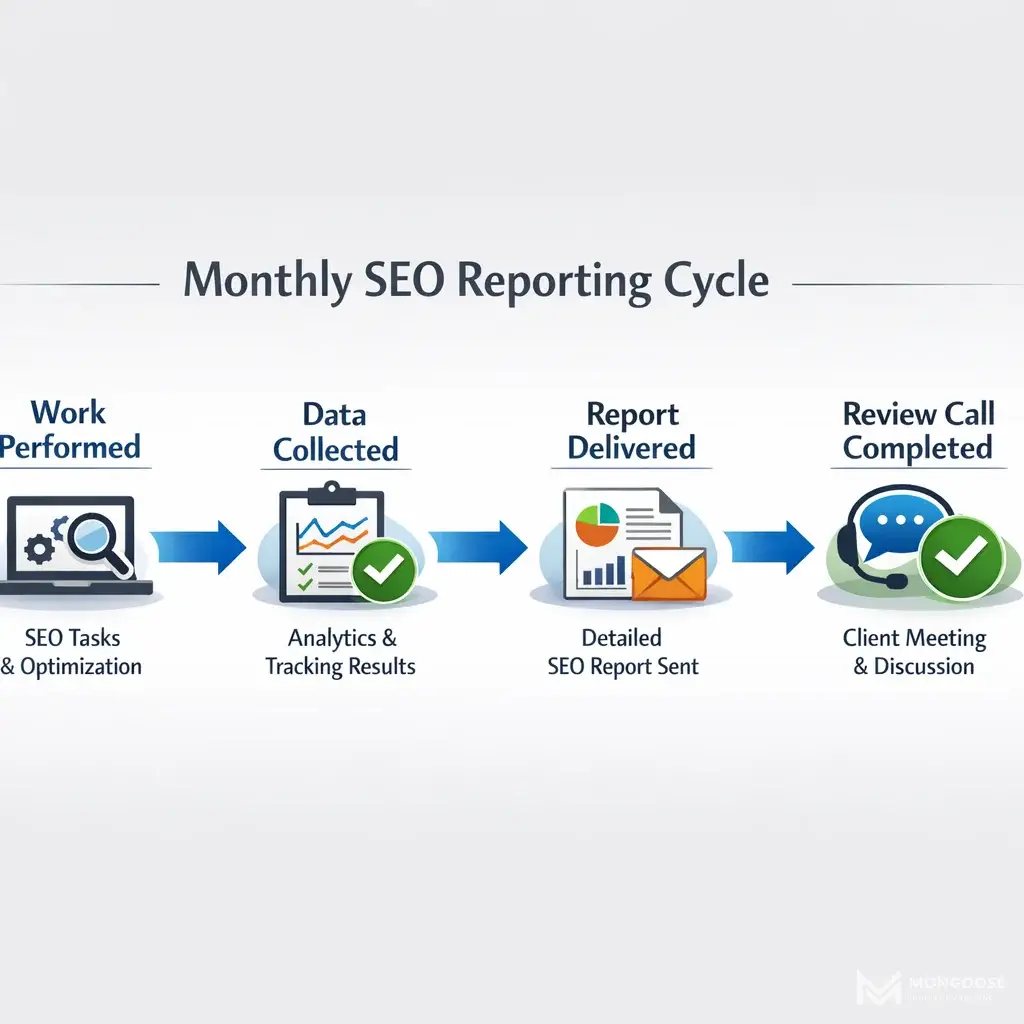
Illustration, not a photograph of a completed client project.
Choosing the Right Agreement for Your SEO Engagement
If you are a business owner in Dayton, Kettering, Beavercreek, Centerville, Huber Heights, Miamisburg, or Springboro evaluating SEO services, the agreement you sign is the first and clearest signal of how the provider operates. An agreement that defines deliverables in concrete terms, pairs the no-guarantee disclaimer with a real KPI framework, and assigns client responsibilities with specificity is not a red flag of complexity. It is evidence that the provider has done this before and intends to be accountable.
If you are ready to talk through what a structured SEO engagement looks like for your business, contact Mongoose Digital Marketing for a free consultation.
Frequently Asked Questions
What is the difference between an SEO services agreement and a standard marketing contract?
An SEO services agreement is structured around a set of problems specific to search engine optimization: the impossibility of guaranteeing rankings, the long timeline before results appear, the dependency on client-provided access, and the ongoing nature of the work. A standard marketing contract typically covers one-time or campaign-based deliverables with a defined end state. An SEO agreement, particularly in retainer form, governs a continuous relationship where scope, performance benchmarks, and reporting obligations all renew on a defined cycle. The clauses that matter most in an SEO agreement, the KPI framework, the client responsibilities section, and the termination conditions, are either absent or treated as secondary in most general marketing contracts.
Can a client be held accountable if they delay providing access or approvals?
Yes, provided the agreement assigns that accountability explicitly. A client responsibilities clause that names specific access requirements, sets a defined number of business days for content approvals, and requires advance notification before any site changes gives the provider documented grounds to pause timelines or adjust deliverable dates when client delays occur. Without that language, the provider has no contractual basis to separate their performance from the client’s non-compliance. This distinction matters most when a client attributes poor organic performance to the provider while having withheld CMS access or made unannounced structural changes to the site.
What happens to reports, keyword data, and content assets when an SEO engagement ends?
A complete termination clause should specify that the provider delivers a data handoff at the close of the engagement. This handoff typically includes all monthly reports produced during the contract term, the keyword research documentation, access credentials for any tools configured on the client’s behalf, and any content assets created during the engagement. The format and timeline for that handoff, for example, delivered within five business days of the final notice period, should be written into the agreement before work begins, not negotiated at the moment of exit when the relationship may already be strained.
Why do some SEO agreements use bilateral NDAs instead of protecting only client data?
A one-directional confidentiality clause protects the client’s business information but leaves the provider’s proprietary methods, reporting systems, and internal tools unprotected. If a provider has developed a differentiated research process or a proprietary audit framework, a one-directional NDA allows a client to share or replicate that methodology without recourse. A bilateral NDA creates mutual obligations: the provider protects client data, and the client protects provider methodology. For providers who have built a structured, repeatable process, the bilateral structure is not a formality, it is the mechanism that protects the intellectual work behind the service.
Conclusion
An SEO services agreement is not a formality that precedes the real work. It is a functional document that defines what will be done, what will be delivered, how performance will be measured, and who is accountable when something goes wrong. The clauses that most agreements get wrong, the KPI framework that should replace the ranking disclaimer, the client responsibilities section that prevents provider liability for client-caused delays, and the termination language that distinguishes who caused the exit and why, are also the clauses that determine whether an engagement produces results or generates disputes.
For business owners in Dayton and the broader Miami Valley region evaluating an SEO engagement, reviewing the agreement carefully before signing is one of the most concrete ways to assess whether a provider operates with the structure and transparency that produces durable results. If you have questions about what a well-structured SEO engagement looks like for your specific situation, contact Mongoose Digital Marketing to start a conversation.