

Key Takeaways
- An agency that cannot rank its own Google Business Profile in the local pack for “local SEO company [city]” is showing you their performance ceiling before you ever sign a contract.
- Service-area businesses (plumbers, HVAC, electricians) require fundamentally different local SEO configurations than brick-and-mortar storefronts — hiring an agency without experience in your specific business type can cause active harm, including Google Business Profile suspensions.
- Reporting that shows traffic increases without separating seasonal demand from actual SEO-driven growth is not accountability — it is a vanity metric disguised as a result.
- The most reliable client references you will ever get are unfiltered ones: find businesses ranking well in your local niche and ask them directly who manages their SEO.
- Contract structures tell you how confident an agency actually is in its own work — short performance-based arrangements signal confidence; long lock-ins with vague deliverables signal the opposite.
Selecting a local SEO company is one of the higher-stakes decisions a business owner in Dayton, Kettering, or Beavercreek will make for their digital growth. The market is crowded, the promises are uniform, and most of the guidance available online recycles the same checklist: ask for case studies, check for transparent reporting, avoid guaranteed rankings. That advice is not wrong — it is just radically incomplete.
What it leaves out is the practitioner-level reasoning that separates a genuinely capable local SEO partner from an agency that has mastered the art of looking capable. There is a meaningful difference between those two things, and that difference shows up in your Google Business Profile rankings, your inbound call volume, and your bottom line.
This guide is built for business owners in the Dayton metro area who are serious about growth and want to evaluate local SEO agencies the way an experienced operator would — not the way a first-time buyer would.
Why Most Advice on Selecting a Local SEO Company Falls Short
The standard buyer’s checklist for local SEO agencies has not meaningfully evolved in years. It tells you what to ask but never equips you to evaluate the answer. Here is where that conventional wisdom breaks down.
The “Case Study” Problem
Every guide says ask for case studies. What none of them explain is that case studies are curated artifacts. An agency controls which results it surfaces, which clients it highlights, and which time windows it reports within. A case study showing a 180% increase in organic traffic over six months tells you almost nothing without knowing:
- What the baseline traffic was (a jump from 15 to 42 visits is technically 180%)
- Whether that increase correlated with any increase in leads or revenue
- Whether the reporting window captured a seasonal demand spike that would have occurred regardless
- Whether the business is in the same category and business-type structure as yours
Case studies are a starting point, not a conclusion. Treat them as questions to ask, not answers to accept.
The Monolith Problem
Local SEO is not one discipline. It is three distinct disciplines that happen to share some tooling. The strategies required for a Kettering HVAC company with no public storefront are structurally different from those required for a Centerville medical practice or a Miamisburg retail storefront. Agencies that treat “local SEO” as a single service offering — with a single process — will inevitably apply the wrong framework to some portion of their clients. The question is whether your business is one of them.
The Reporting Problem
Reporting and accountability are not the same thing. An agency that sends you a monthly PDF showing keyword ranking movements and organic session counts is not demonstrating results — it is demonstrating activity. The question that matters is whether that activity is moving your pipeline. Traffic to a page that converts no one is not a business outcome. Ranking for keywords that your customers are not actually using is not a business outcome. A capable agency knows the difference, measures both, and reports them as connected data points.
The Self-Ranking Test: The Most Honest Signal You Will Ever Get
Before you schedule a single discovery call with any local SEO company serving Dayton or the surrounding area, run this test.
Open a private browsing window. Search for “local SEO company Dayton” or “local SEO Kettering” or whatever variant reflects the agency’s claimed market. Then look at two things:
1. Do they appear in the local 3-pack?
The local 3-pack is the map-and-listing block that appears above organic results for local searches. It is the most competitive real estate in local search. If an agency is selling you local 3-pack visibility for your business but cannot achieve it for their own business, that is a live demonstration of their output quality.
2. What does their own Google Business Profile look like?
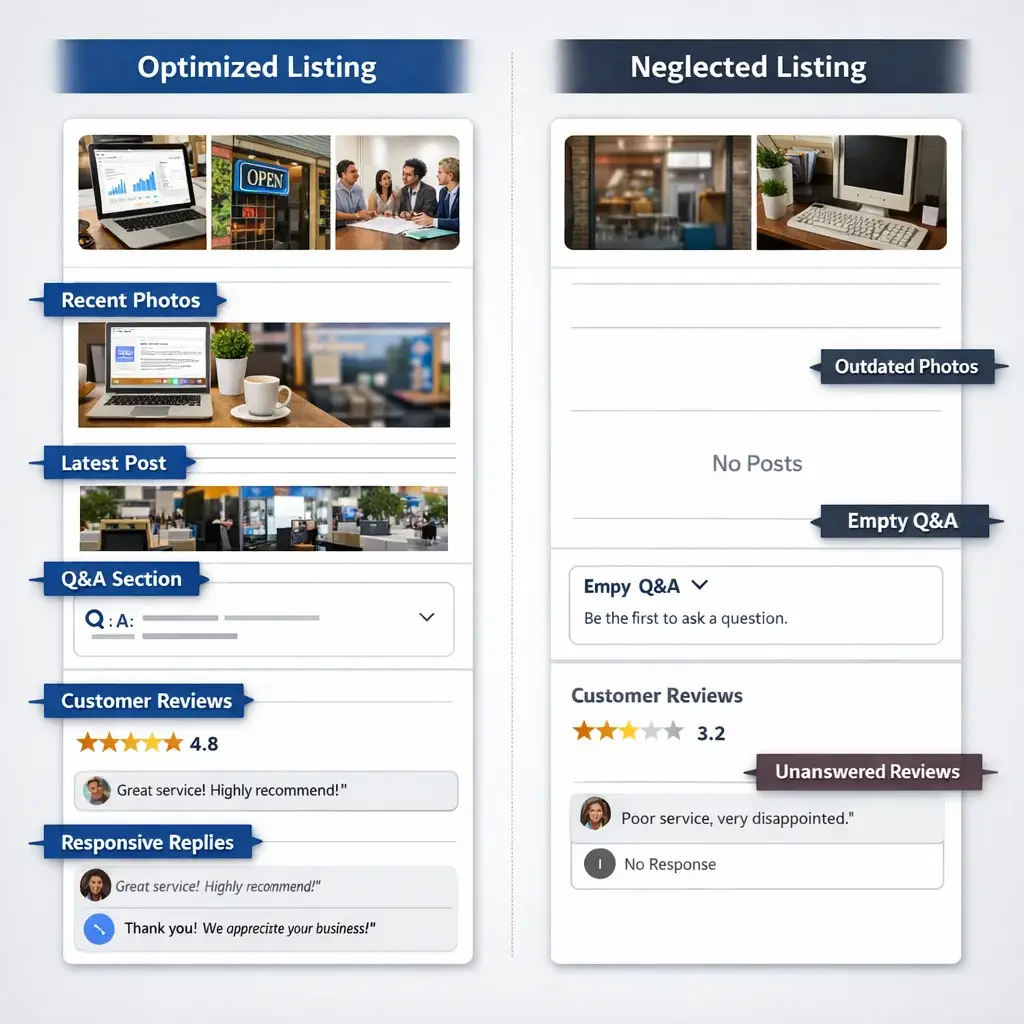
Pull up the agency’s GBP directly. Audit it the way they should be auditing yours:
- Are service areas configured and accurate?
- Are photos recent (within the last 90 days)?
- Is the Q&A section populated with substantive responses?
- Are reviews being responded to consistently, professionally, and with brand-appropriate language?
- Do the review responses contain natural geographic references — not keyword-stuffed, but contextually appropriate?
- Are they using posts actively, or is the profile static?
A Google Business Profile in 2025 is not a directory listing. It is a dynamic engagement platform that Google’s systems read continuously for signals of business activity, relevance, and trustworthiness. An agency that treats their own profile as a static listing is telling you exactly how they will treat yours.
This test requires no trust, no sales conversation, and no PDF. It is an unfiltered performance sample. For a deeper breakdown of what a fully optimized profile looks like in practice, the article Google Business Profile Optimization Tips That Actually Work walks through each element in detail.
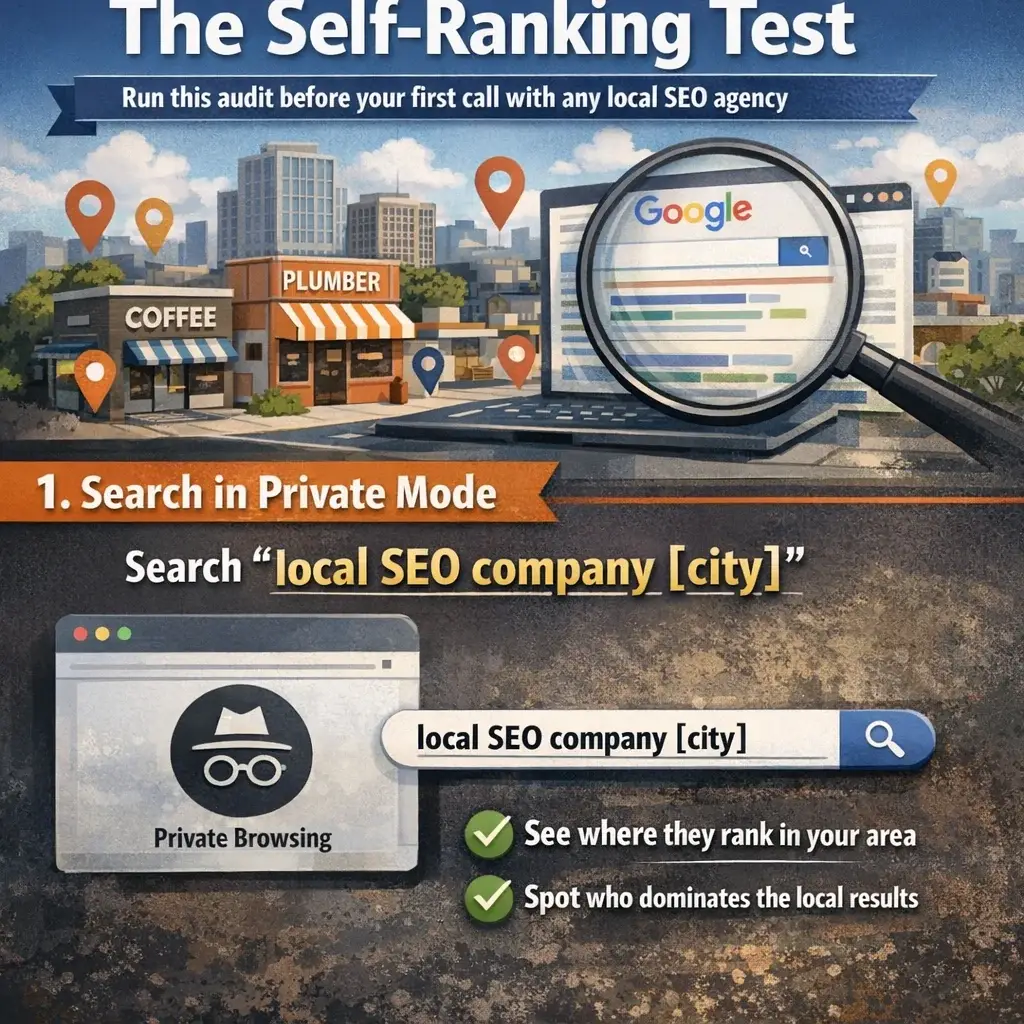
‘ in a private browser window. Note whether the agency appears in the local 3-pack.”; item2_title=”Audit Their GBP Photos”; item2_body=”Check whether profile photos have been updated within the last 90 days. Stale photos signal a static, unmanaged profile.”; item3_title=”Read the Q&A Section”; item3_body=”A well-managed profile has populated Q&A responses. An empty Q&A section means missed optimization opportunities.”; item4_title=”Review Response Quality”; item4_body=”Responses should be professional, brand-appropriate, and contextually specific — not templated copy-paste replies.”; item5_title=”Check Post Activity”; item5_body=”Active GBP posts signal an agency that understands GBP as a dynamic platform, not a static listing.”; footer=”Mongoose Digital Marketing — Dayton, OH”]
The Business-Type Mismatch: Why the Wrong Agency Can Actively Hurt You
This is the distinction that almost no published guidance on selecting a local SEO company addresses — and it is one of the most consequential factors in the evaluation process.
There are three structurally different categories of local business, and each requires a different local SEO architecture.
Service-Area Businesses (SABs)
This category includes plumbers, electricians, HVAC companies, pest control services, landscapers, and home cleaning services throughout Dayton and the surrounding suburbs. These businesses serve customers at the customer’s location and typically have either no public storefront or a back-office address they do not want displayed publicly.
The local SEO requirements for SABs are distinct:
- GBP must be configured with the address hidden and service areas properly defined
- Strategy relies on engagement signals, review velocity, and content relevance rather than physical proximity to the searcher
- City-specific landing pages are essential infrastructure for multi-suburb coverage across areas like Huber Heights, Springboro, and Centerville
- Citation building must never include a public address if one is not being displayed — mismatched NAP data across directories can trigger GBP suspensions
An agency that has primarily served brick-and-mortar businesses and attempts to apply the same framework to an SAB will make errors. The most damaging of these is accidentally publishing an address on directory listings that conflicts with a hidden-address GBP configuration — a mistake that can trigger a Google suspension and remove the business from the local pack entirely.
Brick-and-Mortar Single-Location Businesses
Restaurants, retail shops, medical and dental clinics, gyms, and salons in areas like Beavercreek and Kettering operate from a fixed, publicly visible address. Their local SEO strategy centers on different signals:
- Physical proximity to the searcher is a primary ranking factor
- In-store visit attribution through GBP insights
- Photo freshness and quality tied to the physical experience
- Review velocity correlated with transaction volume
- Peak hours optimization in the GBP listing
Multi-Location Businesses
Businesses operating across multiple Dayton-area locations require an infrastructure layer that single-location strategies do not address:
- Location-specific schema markup on each location page
- Separate GBP profiles per location, each individually optimized
- Local link building executed per market, not centralized
- A review strategy that balances volume across locations without cannibalizing brand consistency
The question to ask any prospective agency directly: “What percentage of your local SEO clients are service-area businesses versus storefront locations, and how does your workflow differ for each?”
If the answer is vague, that is your answer.
Evaluating Reporting: Separating Accountability from Activity
The reporting conversation is where business owners most commonly get misled — not through dishonesty, necessarily, but through a structural incentive problem. Agencies are measured on what they can easily report. Traffic and keyword rankings are easy to report. Revenue attribution is harder. So most agencies default to reporting what is easy and calling it performance.
Here is what genuine accountability-driven reporting looks like versus activity-based reporting:
| Reporting Type | What Gets Reported | What It Actually Tells You |
|---|---|---|
| Activity Reporting | Keyword rankings, organic sessions, impressions, DA/PA scores | That work is happening — not that it is working |
| Vanity Metric Reporting | Traffic increases, click-through rates, GBP views | Directional trends with no business context |
| Accountability Reporting | Lead volume by channel, conversion rate from organic, call tracking attribution, year-over-year comparisons against non-branded search growth | Whether the SEO investment is generating pipeline |
| Attribution-Aware Reporting | Organic growth benchmarked against seasonal demand curves, query-type segmentation in GSC, branded vs. non-branded traffic split | Whether the agency’s work — not the season — is driving results |
The Seasonality Attribution Test
One of the most common patterns in underperforming local SEO relationships is what experienced practitioners call seasonality capture. Here is how it works.
An agency onboards a roofing company, HVAC contractor, or landscaping business in the Dayton area in October or November. Work begins. Spring arrives. Call volume increases 40%. The agency’s reporting shows a 40% lift in organic traffic and leads. The client is pleased. The contract renews.
What often goes unexamined is whether that lift would have occurred regardless — because the demand for those services naturally spikes in the Dayton area every spring as homeowners address winter damage and start seasonal projects. The SEO work may have had minimal impact. The season did the work.
The counter-question to ask any prospective agency before signing: “How do you separate the impact of your SEO work from seasonal demand variation in your reporting?”
A sophisticated answer will reference year-over-year comparisons using the same time window, Google Search Console impression data segmented by query type, and organic traffic growth benchmarked against non-branded search terms specifically. An unsophisticated answer will redirect to the dashboard.
Finding References They Did Not Hand You
Every evaluation guide tells you to ask for client references. This is sound advice with one significant limitation: agencies control which clients they put in front of you. You will speak to the clients who are satisfied, communicative, and unlikely to surface complications.
There is a more reliable method.
Search for businesses that are currently ranking well in the local pack for competitive terms in your specific niche and market. A roofing company ranking in the Dayton 3-pack for “roof repair Dayton OH.” A dentist appearing consistently in the Kettering local pack. A landscaping company visible across multiple Springboro searches.
Contact those businesses directly. Ask who manages their SEO. Ask whether they would work with that agency again. Ask what the first 90 days looked like and whether reporting made sense to them.
These are unfiltered references. They reflect the agency’s actual performance distribution — not a curated sample of their best outcomes.
Contract Structure as a Confidence Signal
Most guidance on local SEO contracts stops at “avoid long-term lock-ins.” That is a starting point, not a strategy. The structure of a contract tells you something specific about how much confidence an agency has in its own work.
Consider what a long contract with vague deliverables actually communicates: the agency needs time before you can assess whether results are materializing. That time buffer protects the agency, not you. It is a hedge against accountability built into the agreement itself.
Contrast that with a contract structure that includes:
- Defined deliverables per month (specific tasks, not outcome promises)
- Clear reporting milestones tied to business metrics, not just activity metrics
- Reasonable notice periods that do not require a legal review to exit
- A performance review cadence at 90 days that both parties treat as a genuine evaluation point
None of this requires a guarantee of rankings — which no ethical agency should offer, because Google’s algorithm is not under anyone’s contractual control. What it does require is mutual accountability. An agency willing to be evaluated at 90 days against measurable criteria is an agency confident in its process.
An agency that needs 12 months of prepaid commitment before you can assess value is not expressing confidence. It is expressing the opposite.
What GBP Optimization Actually Looks Like in 2025
Several widely-circulated guides describe Google Business Profile management as though the platform has not changed since 2019. The advice reduces to: fill in your NAP, choose the right categories, get some reviews. That framing is materially incomplete for any business competing in Dayton’s local markets today.
GBP in 2025 operates as a dynamic engagement layer that Google’s systems actively read for freshness, relevance, and user interaction signals. The components that matter now:
Profile Completeness Beyond the Basics
- Service listings with individual descriptions and associated keywords
- Product listings where applicable, with updated imagery
- Booking integrations connected to live scheduling tools
- Business attribute selections that match your operational reality (women-led, veteran-owned, LGBTQ+ friendly, etc.)
Engagement Signal Architecture
- Photo updates on a consistent cadence — not a one-time upload
- Post activity that addresses seasonal, local, and service-specific topics relevant to the Dayton area
- Q&A responses that preemptively address the questions your customers actually ask
- Review response strategy that is consistent in tone, timely in cadence, and contextually specific
AI Summary Implications
Google’s AI-generated business summaries are now pulling from GBP content directly — including review text, post content, and business descriptions. An agency that does not understand how its content strategy feeds into those AI summaries is operating with an incomplete model of how local search works in the current environment.
Ask any prospective agency: “How does your GBP content strategy account for Google’s AI-generated summaries?” The quality of that answer tells you a great deal about how current their working knowledge actually is.
A Framework for Evaluating Local SEO Companies in the Dayton Area
Bring this framework to every discovery call. It is not a gotcha list — it is a structured way to assess whether an agency’s knowledge and process match what your business actually needs.
Questions That Reveal Real Expertise
- “What percentage of your clients are service-area businesses, and how does your process differ for them?” — Tests for business-type depth.
- “How do you separate seasonal demand from SEO-driven growth in your reporting?” — Tests for attribution sophistication.
- “Can you walk me through how your GBP content strategy accounts for AI search summaries?” — Tests for current knowledge.
- “What does your reporting look like at 90 days, and what metrics will we use to evaluate whether the engagement is working?” — Tests for accountability orientation.
- “How do you find independent references for your work beyond the clients you refer me to?” — Tests for transparency and confidence.
Red Flags That Should Change Your Decision
- Reporting that leads with rankings and traffic without connecting to leads or revenue
- An inability to differentiate their process for SABs versus storefronts
- Vague answers to the seasonality attribution question
- Contract structures requiring 12+ months with no defined review points
- A Google Business Profile for their own agency that is incomplete, outdated, or absent from the local pack in their own market
Positive Signals Worth Weighing
- They rank in the local 3-pack for their own services in their market
- They ask detailed questions about your business type before recommending anything
- Reporting samples show business outcome metrics alongside traffic data
- They reference year-over-year benchmarking as a standard practice
- Contract terms reflect mutual accountability, not just agency protection
The Local Advantage: Why Market-Specific Knowledge Matters in Dayton
There is a version of local SEO that treats every market identically — the same citation directories, the same GBP setup, the same content calendar template. That approach produces average results in average markets.
The Dayton metro area has its own competitive landscape. Beavercreek and Centerville carry different demographic profiles and search behavior patterns than Huber Heights or Miamisburg. A home services business in Springboro is competing in a different local pack than the same business category in Dayton proper. Seasonal patterns in this region — the winter freeze-thaw cycles that drive roofing and foundation calls, the spring demand for HVAC and landscaping services — create specific windows where local search visibility translates directly into revenue.
An agency with genuine familiarity with the Dayton area understands these patterns as operational context, not background information. That familiarity shows up in the content calendar, in the service-area configurations, and in the benchmarks they use to evaluate what counts as a meaningful result in this market. The article Local SEO for Ohio Service Businesses That Actually Works covers how these market-specific dynamics translate into strategy for businesses across the region.
Generic local SEO produces generic outcomes. Market-aware strategy produces the kind of results that show up in your call volume.
Selecting a local SEO company in the Dayton area is not a decision that rewards speed. The agencies that look the most polished in a sales conversation are not always the ones producing the most substantive results for clients. Run the self-ranking test before you make contact. Ask the attribution question before you sign anything. Match the agency’s experience profile to your specific business type. And evaluate the contract structure not as a legal formality but as a direct signal of how much confidence the agency has in what it is selling you.
If you want to see how Mongoose Digital Marketing performs against this framework — including in our own local search footprint — reach out for a free consultation. We will show you exactly where your business stands locally and what a results-driven strategy looks like for your specific market and business type.
Strategic Recommendations for 2026
The local search landscape continues to shift, and businesses that act on the right priorities now will be better positioned when the next algorithm update reshapes the local pack rankings. Three areas deserve your attention heading into 2026.
Audit your Google Business Profile with a dedicated GBP diagnostic tool. Free and low-cost tools like BrightLocal or Whitespark’s Citation Audit can surface inconsistencies in your NAP data, flag missing category selections, and benchmark your profile completeness against competitors ranking above you in the local pack. Before engaging any agency, run this audit yourself. The results will sharpen every conversation you have with a prospective partner.
Prioritize first-party data collection at the local level. As tracking restrictions tighten across browsers and devices, businesses that rely entirely on third-party attribution signals are flying with less and less visibility. Implementing simple call tracking with a tool like CallRail — properly configured to pass data into your analytics — gives you a direct line between local search activity and actual revenue-generating contacts. Any agency you work with in 2026 should be helping you build this infrastructure, not just reporting on impressions and clicks.
Conduct a local content gap analysis before committing to a content strategy. Tools like Semrush’s Keyword Gap or Ahrefs’ Content Explorer can show you what service-area and neighborhood-level topics your competitors are ranking for that you are not. In a metro area like Dayton — where search behavior in Centerville and search behavior in Huber Heights can diverge meaningfully — this kind of analysis prevents generic content investment and focuses production where organic opportunity is actually concentrated. For a broader look at how these tools fit into a complete approach, the article Local SEO Agency Comparison: What Actually Matters covers the evaluation criteria in detail.
Frequently Asked Questions
How long does it typically take to see results from local SEO in the Dayton area?
Most businesses working with a competent local SEO partner begin to see measurable movement in local pack rankings and organic visibility within three to six months, depending on how competitive the category is and how much foundational work needs to be done. Categories with high search volume and established competitors — home services, legal, medical — tend to require longer timelines to achieve and hold meaningful positions. Businesses in less saturated subcategories or specific suburban service areas around Dayton can sometimes see faster movement. Any agency promising significant results within thirty days should be pressed hard on how they define results and what data they are using to measure them.
What is the difference between a national SEO agency and a local SEO company for a Dayton business?
National agencies often apply standardized playbooks across clients regardless of market. A local SEO company with genuine familiarity with the Dayton metro understands the competitive differences between individual communities like Beavercreek, Kettering, and Miamisburg, and can configure service-area targeting, content strategy, and local citations in ways that reflect actual search behavior in this region. The distinction matters most in how an agency sets benchmarks and interprets results — a number that looks strong nationally may be underperformance in a specific local context, and vice versa.
What should I look for in a local SEO contract before signing?
Evaluate the contract length, the exit terms, and what deliverables are explicitly tied to what timeline. Month-to-month agreements with defined deliverables signal that an agency is willing to be held accountable on an ongoing basis rather than locking in revenue before performance has been demonstrated. Pay close attention to ownership clauses — confirm that any content, listing assets, or GBP access credentials remain yours if the relationship ends. Contracts that are vague about deliverables or that require extended commitments before any measurable benchmarks are established are worth scrutinizing carefully.
Can a small business in a Dayton suburb compete in local search against larger regional competitors?
Yes, and in many cases local search is where smaller businesses have the clearest path to visibility. The local pack algorithm weighs proximity, relevance, and profile completeness heavily — factors that a well-optimized small business can compete on effectively even against larger competitors with bigger overall marketing budgets. Hyper-local content that addresses specific neighborhoods and service areas, a fully optimized and actively managed Google Business Profile, and a consistent review generation strategy can position a small business above larger competitors for the searches that actually convert into customer calls in their geographic area.
The Right Partner for the Dayton Market
Local search in this region rewards specificity — the kind that only comes from working with a team that understands how Kettering and Beavercreek businesses compete differently and what it actually takes to move the needle in the Dayton metro. Mongoose Digital Marketing proudly serves businesses across Dayton, Kettering, Beavercreek, Centerville, and surrounding communities with strategies built around this market, not imported from somewhere else. If you are ready to see where your local search presence stands and what a focused, accountable strategy looks like for your business, Contact Mongoose Digital Marketing today.