
Most Businesses Are Managing Social Media Wrong — Here’s What Actually Works
There’s a version of social media management advice that gets recycled endlessly across the internet: post consistently, use hashtags, engage with your audience, and schedule everything in advance. It’s not wrong, exactly. It’s just incomplete in ways that cost businesses real money.
The gap between that advice and what actually drives leads, conversions, and customer retention is significant — and it’s the gap most businesses never know exists until they’ve spent months executing a social strategy that produces nothing but follower counts nobody can tie to revenue.
This guide is built for business owners who are past the basics. If you want a list of apps to download, this isn’t that. If you want to understand how to build the operational foundation, measurement systems, and platform strategy that makes social media a genuine growth channel for your business — keep reading.
Why Your Social Media Isn’t Performing: The Infrastructure Problem
Most underperforming business social media accounts share a common root cause: they were built on tactics without infrastructure. Someone started posting, maybe hired a freelancer, maybe handed it to a marketing-minded employee — and the whole effort runs on good intentions and improvisation rather than documented systems.
The result is predictable. Posting becomes inconsistent when that employee gets busy. The brand voice drifts depending on who wrote the caption that week. A negative comment sits unanswered for three days. The business has no idea whether any of it is generating pipeline or just producing likes from people who will never spend a dollar with you.
Before you optimize a single post, you need to build the infrastructure underneath it.
Account Governance: Who Actually Owns Your Social Presence?
Account governance is one of the most overlooked elements of social media management — and one of the most consequential. The question isn’t just “who posts?” It’s who has admin access, what happens when that person leaves, and how your business is protected if something goes wrong.
Every business managing social media accounts should have documented answers to the following:
- Primary ownership: Business accounts should be owned by a business email address, not a personal one. Facebook Business Manager, LinkedIn Company Pages, and similar platforms allow role-based access — use it.
- Permission tiers: Not everyone needs full admin access. Define who can publish, who can respond to messages, who can run ads, and who can change account settings. These should be separate roles.
- Offboarding protocol: When an employee or agency relationship ends, how quickly are their credentials revoked? This should be part of your standard HR and vendor offboarding checklist.
- Password management: Shared credentials stored in someone’s notes app is a security vulnerability. Use a business password manager with individual user access.
- Account recovery: Do you know the recovery email and phone number attached to each platform? Could you regain access to your Instagram account if you were locked out today?
These are not exciting questions. They are the difference between a recoverable situation and a business losing access to an account with years of community and brand equity.
Building a Social Media Policy That Protects the Business
If your employees are posting on your behalf — or even posting on their personal accounts in ways that reference your business — you need a documented social media policy. This doesn’t need to be a 30-page legal document. It does need to cover:
- What employees can and cannot say publicly about the business, clients, or competitors
- How to handle customer complaints or sensitive inquiries they encounter online
- What constitutes a brand crisis and who to contact immediately
- Standards for content approval before publishing
- Legal considerations around client confidentiality, testimonials, and regulated industries
A clear policy protects your business legally and operationally. It also gives your team the confidence to act quickly without second-guessing every response.
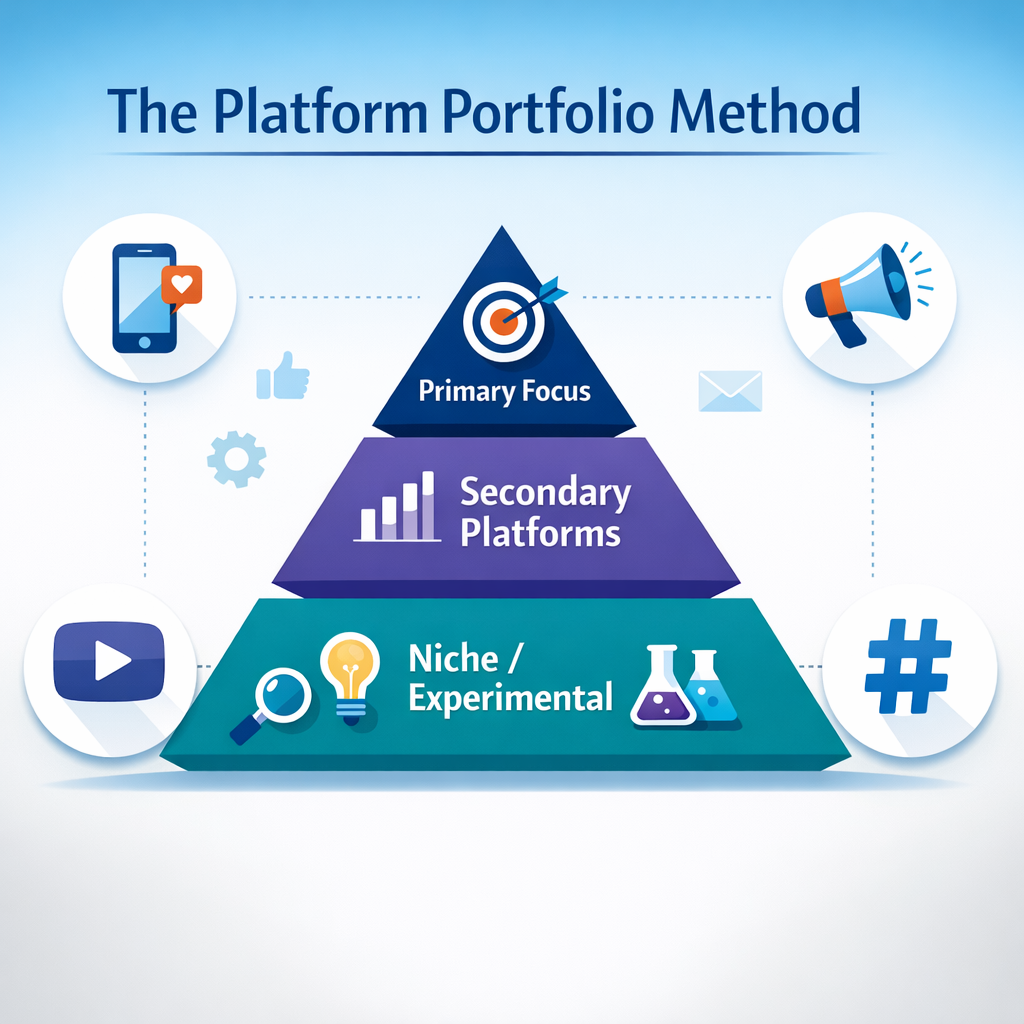
The Platform Portfolio Method: Stop Being Everywhere, Start Being Effective
Here is the advice that will save you the most time and budget: you do not need to be on every platform.
The dominant guidance — maintain a presence on Instagram, Facebook, LinkedIn, TikTok, X, Pinterest, and YouTube simultaneously — sounds comprehensive. In practice, it produces diluted, inconsistent content on every platform, none of which gains meaningful traction because no single platform receives the sustained, native-format engagement its algorithm requires to distribute content broadly.
Each major platform’s algorithm rewards a specific type of engagement signal:
| Platform | Primary Algorithm Signal | Content Format That Wins | Best-Fit Business Type |
|---|---|---|---|
| Saves, shares, Reel completion rate | Short video, carousel education, strong visual identity | B2C lifestyle, food, retail, services with visual output | |
| Dwell time, comment depth, content saves | Long-form professional narrative, industry perspective, data posts | B2B services, professional services, SaaS, consulting | |
| Group engagement, video watch time, link click behavior | Community content, local business updates, video | Local businesses, community-driven brands, events | |
| TikTok | Watch-through rate, replays, shares | Pattern-interrupting short video, trend participation, POV content | B2C brands targeting under-45 demographics, entertainment, education |
| YouTube | Click-through rate + audience retention curve | Long-form educational, product demos, brand storytelling | Any business with educational depth; strong for SEO value |
| Save rate, outbound click rate | Static imagery, infographics, step-by-step visual content | Home, design, fashion, food, DIY, wedding, lifestyle |
The strategic move is platform selection based on where your audience actually spends attention, combined with honest assessment of your content production capacity.
A professional services firm trying to maintain a TikTok presence while also running a LinkedIn content program is unlikely to do either well. A retail brand with strong visual product photography will outperform on Instagram and Pinterest and may see negligible returns from LinkedIn regardless of posting frequency.
How to Choose Your Platform Portfolio
Apply this decision framework before committing resources to any platform:
Step 1 — Audience behavior audit: Where do your existing customers report spending time? If you don’t know, ask. A simple post-purchase survey or email question produces more useful data than any demographic report.
Step 2 — Content capacity audit: What content formats can your team realistically produce to a consistent standard? If you don’t have video production capacity, TikTok and YouTube are not your platforms regardless of audience size. Start with what you can execute well.
Step 3 — Competitive signal check: Look at what competitors with similar audiences are doing on each platform. Strong competitor activity on a platform is a signal the audience is there. But also look at the quality — an undifferentiated competitor performing poorly is an opportunity.
Step 4 — Select two platforms and go deep: For most small and mid-sized businesses, two platforms executed with consistency and quality will outperform six platforms managed reactively. Expand only when you have the infrastructure, team capacity, and content systems to support it.
Building a Content Ecosystem (Not Just a Content Calendar)
A content calendar is a scheduling tool. It tells you when to post. It does not tell you why each piece of content exists, who it’s for, or how it connects to a business outcome. That’s the job of a content ecosystem.
The Hero-Hub-Hygiene framework — originally developed by media strategists and adopted widely by performance marketing teams — gives every piece of content a defined purpose and places it within the customer journey.
Hero Content
Hero content is your high-investment, brand-defining work. It’s not produced daily or even weekly. It’s the content that establishes authority, earns shares and backlinks, and positions your business as the definitive voice in your category.
Examples: an original research report, a comprehensive video series, a documented case study with real outcome data, a proprietary framework or methodology.
Hero content is expensive to produce and should be treated as a campaign asset — distributed, repurposed, and referenced repeatedly across other content types.
Hub Content
Hub content is your regular series — the content that builds audience habit and gives people a reason to follow you consistently. It runs on a predictable cadence (weekly, bi-weekly) and creates an expectation in your audience’s mind.
Examples: a weekly industry insight post, a recurring “client result” feature, a monthly Q&A series, a regular breakdown of industry news from your perspective.
Hub content is where brand voice becomes recognizable. It’s also the content type most businesses abandon first when capacity gets tight — which is exactly when it matters most.
Hygiene Content
Hygiene content is always-on, problem-solving, searchable content that addresses the specific questions your target customers are actively looking for answers to. It doesn’t need to be viral. It needs to be findable and useful.
Examples: how-to posts, FAQ responses, product comparisons, process explanations, local area content for location-based businesses.
Hygiene content does the heavy lifting for organic discovery. On platforms like YouTube and Pinterest, it continues generating impressions and traffic long after it’s published.
Mapping Content Types to the Customer Journey
| Content Type | Customer Journey Stage | Primary Goal | Success Metric |
|---|---|---|---|
| Hero | Awareness + Authority | Brand positioning, earned media | Shares, backlinks, press mentions, brand search volume |
| Hub | Consideration + Retention | Audience building, trust development | Follows, saves, return viewers, email opt-ins |
| Hygiene | Discovery + Decision | Organic reach, problem-solving | Impressions, profile visits, link clicks, DM inquiries |
When businesses produce only one type of content — typically hygiene posts mixed with promotional content — they wonder why their following grows slowly and their DMs stay quiet. The ecosystem approach ensures each stage of the customer journey has content serving it intentionally. For a deeper look at how this connects to broader campaign planning, the article on content marketing strategy for small businesses breaks down how to align content investment with business objectives at each stage.
Measuring What Actually Matters: Moving Beyond Vanity Metrics
Follower counts and likes are easy to report and nearly impossible to connect to revenue. They are not inherently useless — a growing, engaged audience has real business value — but they are leading indicators, not outcomes. Managing to them as primary KPIs is how social media budgets get cut when CFOs ask what the return is.
The measurement framework that earns budget justification connects social activity to business outcomes through a defined attribution chain.
Vanity Metrics vs. Business-Outcome Metrics
| Vanity Metric | Why It Feels Important | Business-Outcome Equivalent | What It Actually Measures |
|---|---|---|---|
| Follower count | Social proof signal | Email list growth rate | Owned audience building |
| Post likes | Content validation | Link clicks to site | Content driving action |
| Impressions | Reach perception | Branded search volume | Actual brand awareness |
| Engagement rate | Community signal | DM inquiry volume | Commercial interest |
| Comment count | Conversation signal | Booked consultations from social | Direct revenue attribution |
| Story views | Awareness metric | Profile visits → website traffic | Funnel movement |
The goal is not to stop tracking engagement — it’s to have a parallel set of metrics that connect social performance to pipeline. This requires setting up UTM parameters on every link you share, using platform analytics alongside Google Analytics (or equivalent), and defining what a “conversion” looks like from social for your specific business.
For a service business, a conversion from social might be a contact form submission, a phone call from a bio link, or a booked consultation. For an e-commerce business, it’s a transaction. Define it before you build your reporting structure.
Building a Social Response SLA
Social media is a customer service channel whether you treat it that way or not. Customers who receive no response to a complaint or inquiry on social media share that experience. Customers who receive a fast, helpful response frequently do the opposite.
Your social response SLA should define:
- Response windows by platform: Instagram and Facebook DMs typically have an expectation of same-day response. Twitter/X users often expect responses within hours. LinkedIn is more forgiving — 24 to 48 hours is generally acceptable.
- Public comment protocol: Not every comment requires a response, but negative comments, factual errors, and direct questions always do. Define which team member monitors comments and at what frequency.
- Escalation path: When a complaint or inquiry exceeds what a social media manager can handle, who does it go to? This should be documented before the moment arrives.
- Moving to DM: Public dispute resolution is rarely in a brand’s interest. Define when and how your team moves conversations to direct message, and what follow-up looks like.
- Crisis protocol: A coordinated negative campaign, a viral complaint, or a news story involving your business requires a different response protocol than a single unhappy customer. Know the difference and have a documented first response process.

The Organic Reach Reality: What No One Tells You
Any social media strategy built in the current environment needs to account for one structural reality: organic reach on most major platforms has been in sustained decline for years.
This is not a temporary algorithm update. It is the predictable consequence of platforms becoming advertising businesses. As ad inventory becomes more valuable, organic posts from business pages reach a smaller percentage of their own followers — because reach is now something platforms sell.
This doesn’t mean organic social is worthless. It means organic social strategy needs to be built with this constraint acknowledged, not ignored.
Practical implications for your strategy:
- Content quality over posting frequency: Algorithms on most platforms now preferentially distribute content that generates strong engagement signals quickly after posting. A single high-quality post that earns immediate saves and shares will outperform five mediocre posts scheduled across a week.
- Native format prioritization: Every major platform deprioritizes content that drives users off-platform. Posts with external links in the caption consistently underperform posts that keep users on the platform. Adjust your linking strategy accordingly — move links to bios, first comments, or Stories where platform behavior allows it.
- Owned audience building as a hedge: Social platforms are rented land. Building an email list, SMS subscriber base, or community platform (like a private group or newsletter) converts social followers into an audience you own and can reach regardless of algorithm changes. Every social strategy should include a mechanism for moving followers toward owned channels.
- Paid amplification for key content: For content tied directly to business outcomes — lead generation campaigns, product launches, event promotion — organic reach alone is an unreliable distribution mechanism. Paid amplification on key posts is not an admission that organic content failed. It’s how professional social media programs are structured.
Algorithm Literacy: What “Post More” Advice Gets Wrong
The instruction to “post consistently” is technically sound but strategically incomplete. Posting frequency matters less than posting with a clear understanding of how each platform’s algorithm evaluates and distributes content.
Here’s what’s actually happening on the platforms that matter most for business:
Instagram has moved significantly toward keyword-indexed captions and hashtag relevance for discovery, particularly on Reels. The Explore page and Reels feed distribute content based on topic clustering — which means your caption text functions more like SEO copy than it did three years ago. Completion rate on Reels is the primary performance signal. If viewers aren’t watching to the end, the content doesn’t distribute.
LinkedIn weighs dwell time heavily — how long someone pauses on your post before scrolling. This rewards content that stops the scroll with a strong opening line and holds attention through genuine depth. It also rewards native document posts (carousels and PDFs) because the format encourages interaction. Comments are heavily weighted, which is why posts that ask genuine questions or present a polarizing perspective outperform bland informational posts.
Facebook has deprioritized page content significantly in favor of group content and personal posts. For most businesses, Facebook Groups built around a community topic relevant to the business will generate more organic reach than page posts. Video watch time remains a strong signal. Understanding how Meta’s paid infrastructure works alongside its organic environment is also worth the time — the article on Facebook advertising management and how Meta’s algorithm works provides useful context for how organic and paid signals interact on the platform.
YouTube evaluates two metrics above almost all others: click-through rate from thumbnail and title, and audience retention curve (how long people watch before leaving). A technically excellent video that loses 70% of viewers in the first 30 seconds will not be recommended by YouTube’s algorithm regardless of its quality. The first 30 seconds of any YouTube video should be treated as the most important content you produce.
Understanding these signals doesn’t make content strategy more complicated — it makes it more efficient. You stop producing content that platforms are structurally unlikely to distribute and start producing content that works with how each platform actually functions.
Putting It Together: The Operating System for Social Media Management
Effective social media management for a business is not a collection of tactics. It’s an operating system — a set of documented systems, decision frameworks, and measurement structures that allow consistent execution regardless of who’s involved in the day-to-day work.
That operating system includes:
- Governance documentation: Account ownership, permission structure, offboarding protocol, social media policy
- Platform portfolio: Two to three platforms selected based on audience behavior and content production capacity, not industry convention
- Content ecosystem: Hero, Hub, and Hygiene content defined and mapped to customer journey stages
- Measurement framework: Business-outcome metrics defined alongside engagement metrics, with UTM tracking and defined conversion events
- Response SLA: Response windows, escalation paths, crisis protocol
- Organic reach strategy: Content quality prioritization, native format compliance, owned audience building mechanism
Businesses that build this infrastructure before worrying about posting frequency consistently outperform businesses that optimize posting cadence while running on improvisation underneath.
Social media managed this way stops being a cost center you’re never quite sure about and starts functioning as a measurable growth channel — one where you can draw a direct line between content investment and business outcomes.
If building that operating system from scratch sounds like a significant undertaking, that’s because it is. It’s also precisely the kind of work that separates social media programs that generate leads from ones that generate likes.
Final Recommendations for 2026
Building the operating system described in this article is the right goal. These three recommendations reflect where the tools, platforms, and strategic priorities are heading as you move into 2026.
1. Consolidate scheduling and analytics into a single platform.
Fragmented tools create fragmented data. Platforms like Buffer, Later, or Sprout Social have matured to the point where scheduling, performance reporting, and team collaboration can live in one place. If you’re evaluating your options, the article on how to choose social media management software walks through what to look for before committing to a platform. Pick one, configure it to track the metrics that tie to business outcomes, and stop pulling data from five different dashboards. The reduction in administrative overhead alone justifies the consolidation.
2. Invest in short-form video production capacity — not just content.
The algorithmic direction across every major platform in 2025 and into 2026 points toward native short-form video. That doesn’t mean hiring a full production team. It means having a repeatable process: a simple setup, a defined format, and a person who can execute consistently. Whether that’s internal or outsourced, the businesses winning organic reach in 2026 will be the ones who made short-form video operationally routine — not aspirational.
3. Build or audit your owned audience infrastructure before the next platform shift.
Email lists, SMS opt-ins, and direct customer data are the only social media assets a platform cannot take away from you. If you don’t have a mechanism for converting social followers into owned contacts, add one now. A lead magnet, a newsletter, a waitlist — the format matters less than the habit of capturing the relationship off-platform before the next algorithm update or platform disruption makes your follower count irrelevant.
Frequently Asked Questions
How many social media platforms should a business be active on?
Most small to mid-sized businesses are better served by managing two to three platforms well than spreading effort across five or six platforms inconsistently. Platform selection should be based on where your specific audience is already active and what content formats you can produce consistently — not on where your competitors happen to post or what platforms are currently generating the most general press coverage. Presence without consistent execution typically does more harm than no presence at all.
How long does it take to see results from social media management?
Organic social media growth operates on a longer timeline than paid advertising. Businesses that build the right content infrastructure and post consistently can typically begin to see meaningful engagement trends within three to six months, but attributable business outcomes — leads, traffic, conversions — usually become measurable closer to the six-to-twelve-month mark. Businesses that try to evaluate social media performance on a thirty-day window consistently underestimate the channel and abandon strategies before they compound.
What’s the difference between social media management and social media marketing?
Social media management refers to the operational work of maintaining accounts: content creation, scheduling, community response, governance, and performance tracking. Social media marketing is a broader term that often includes paid amplification, campaign strategy, and audience targeting through advertising. Many businesses need both, but the management layer — the operating system described throughout this article — has to exist and function before paid amplification produces reliable returns. Paying to promote a poorly managed presence accelerates its weaknesses, not its strengths.
Should a business hire someone in-house or work with an agency for social media management?
Both models can work. The more useful question is whether your business has the volume and consistency of content to justify a dedicated internal role, and whether you have the infrastructure to manage, direct, and measure that person’s work effectively. Agencies make more sense when you need a full team — strategy, content creation, analytics, and community management — without the overhead of building that capability internally. In-house hires make more sense when social is a core channel deeply integrated with sales or customer operations. Many businesses use a hybrid: an agency for strategy and content production, with an internal person handling day-to-day community engagement.
Work With a Team That Builds the Whole System
Social media management done right is an operational discipline — not a posting schedule. If you’re ready to move from improvised execution to a documented system that generates measurable results, Mongoose Digital Marketing builds exactly that. Our social media management and digital marketing strategy services are designed to connect your content investment to business outcomes you can actually track. Contact Mongoose Digital Marketing and let’s talk about what the right system looks like for your business.