
How to Choose an SEO Service Provider for Your Business
Most business owners approach hiring an SEO provider the way they’d buy a used car — they kick the tires, ask a few vague questions, and hope for the best. The result is predictable. They end up locked into a contract with an agency that delivers monthly rank reports full of keywords nobody is actually searching, while their competitors quietly capture all the organic traffic that should be theirs.
Choosing the right SEO partner is one of the highest-leverage decisions you can make for your business’s digital growth. Get it right, and you gain a compounding asset — organic traffic and qualified leads that build over time without paying for every click. Get it wrong, and you’ve lost months of momentum, handed over control of your data, and potentially inherited technical damage that takes a year to reverse.
This guide does not give you a generic checklist. It gives you a diagnostic framework — the same kind of thinking a seasoned marketing director uses before signing anything. By the end, you’ll know exactly what questions to ask, how to evaluate the answers, how to audit a provider’s own digital presence before the first call, and how to protect yourself if the relationship eventually ends.
Why Most SEO Provider Advice Fails Business Owners
Standard advice for choosing an SEO provider boils down to: check their reviews, ask for case studies, make sure they use white-hat techniques, and confirm they’ll report monthly. That’s not vetting. That’s hoping.
The real problem is that most guides treat SEO providers as interchangeable. They’re not. There are technical SEO specialists who excel at crawl architecture, site speed, and structured data. There are content-led agencies built around topical authority and editorial strategy. There are link acquisition firms focused almost entirely on building domain authority. And there are full-service providers who manage the entire ecosystem.
Conflating these creates catastrophic mismatches. A local service business hiring a provider whose strength is SaaS content marketing will burn through budget without moving a single local ranking. An e-commerce brand hiring a firm that specializes in one-location Google Business Profile optimization will watch their product pages stagnate while their technical infrastructure quietly deteriorates.
The starting point for every selection decision is understanding what kind of SEO your business actually needs.
Step One: Match Provider Specialization to Your Business Type
Before evaluating any specific provider, you need to know what category of SEO expertise your business requires. The table below maps business types to the specific competencies that actually move the needle for each.
| Business Type | Core SEO Competencies Required | Red Flag If Provider Can’t Demonstrate |
|---|---|---|
| Local Service Business | Google Business Profile optimization, local citation consistency, proximity signals, local link building, review strategy | No understanding of NAP consistency or local pack ranking factors |
| E-Commerce | Faceted navigation management, crawl budget optimization, product schema markup, category page architecture, duplicate content resolution | No e-commerce platform experience (Shopify, WooCommerce, Magento) |
| SaaS / B2B Tech | Topical authority cluster development, product-led content strategy, funnel-stage keyword mapping, technical documentation SEO | Inability to discuss intent mapping or content depth strategy |
| Professional Services (Legal, Medical, Finance) | E-E-A-T optimization, author authority signals, YMYL content standards, trust-building content frameworks | No familiarity with Google’s quality rater guidelines |
| Multi-Location Brands | Location page architecture, geo-targeting signals, scalable local SEO infrastructure | Only one approach for all locations; no scalable templating strategy |
| Publishers / Content Sites | Core Web Vitals, internal linking architecture, crawl efficiency, entity optimization | Focused only on link building with no technical depth |
When you sit down with a provider, your first real question is not “do you have experience in my industry?” Your question is: which specific technical and content capabilities does your team have direct, demonstrable experience executing for businesses structured like mine?
Ask them to describe the last three deliverables they produced for a business in your category. If they respond with vague answers about “strategy” and “content calendars,” you have your answer.
Step Two: Reverse-Engineer Their Own SEO Before the First Call
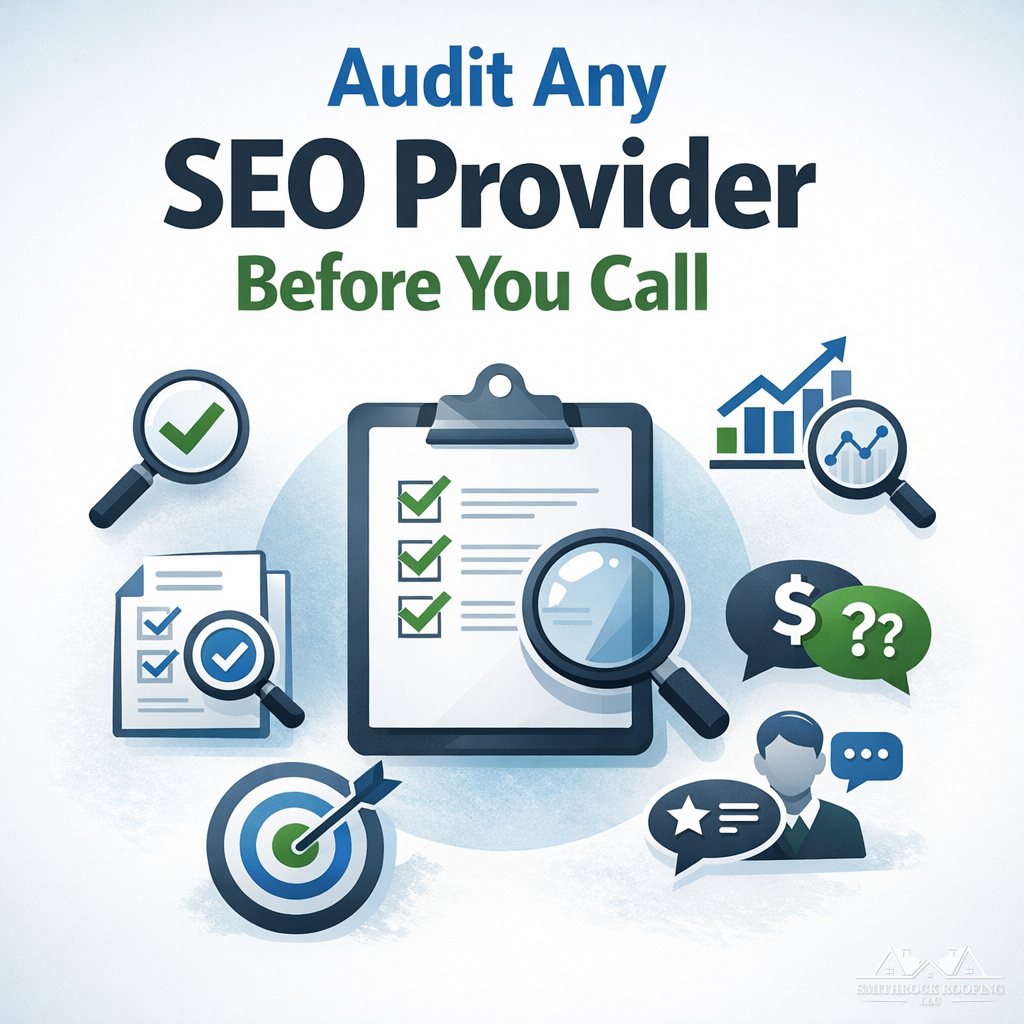
Here is something almost no selection guide ever tells you: the most powerful vetting tool available to you is the provider’s own website and digital footprint.
An SEO agency that cannot execute SEO for itself is the equivalent of a personal trainer who is visibly out of shape. It does not mean they have zero knowledge, but it is a significant diagnostic signal that deserves explanation.
Before you respond to a proposal or book a discovery call, run this audit:
Organic Presence Check
Search for competitive terms in their market — terms like “SEO agency [their city]” or “SEO services for [their target industry].” Are they ranking on page one for anything meaningful? If they operate in a competitive metro area and are nowhere to be found organically, that is worth noting.
Use a reputable SEO analysis tool to check their domain’s organic traffic trend over the last 12 to 24 months. A declining trajectory on their own site while they promise your business growth is a direct contradiction that warrants a frank conversation.
Content Quality Assessment
Read three to five of their recent blog posts or guides. Ask yourself: does this demonstrate genuine technical depth, or is it surface-level content that says very little in a lot of words? Are they citing real data? Are they making specific claims grounded in experience? Or is every article a variation of “SEO is important for your business, here are five reasons why”?
The quality of their owned content is the single best preview of the quality they’ll produce for you.
Backlink Profile Audit
Examine who is linking to them. Are their inbound links from reputable industry publications, regional business organizations, and relevant editorial sources? Or are they clustered around low-quality link directories, generic guest post farms, and sites that exist purely for link exchange?
A provider with a spammy backlink profile is either buying links they should not be buying, or they cannot earn real editorial links — either scenario tells you something important about how they’ll approach your campaign.
Step Three: Ask the Questions an Agency Cannot Bluff Through
Generic discovery calls let agencies control the narrative. They present polished decks, drop impressive-sounding metrics, and walk you through a proposal designed to sound thorough without committing to anything specific.
Flip that dynamic. Come with specific, technical questions that require real knowledge to answer well.
On Strategy and Vertical Fit
- “Walk me through how your approach for a business in my specific category differs from your approach for a different business type. What changes at the tactical level?”
- “What are the two or three most common technical SEO mistakes you see in businesses structured like mine, and how do you identify them during an initial audit?”
- “If I asked you to prioritize between a technical SEO issue and a content gap in the first 90 days, how would you make that decision and what would drive it?”
These questions reveal whether the provider thinks at a strategic level or whether they apply a universal template to every client regardless of context.
On Measurement and Reporting
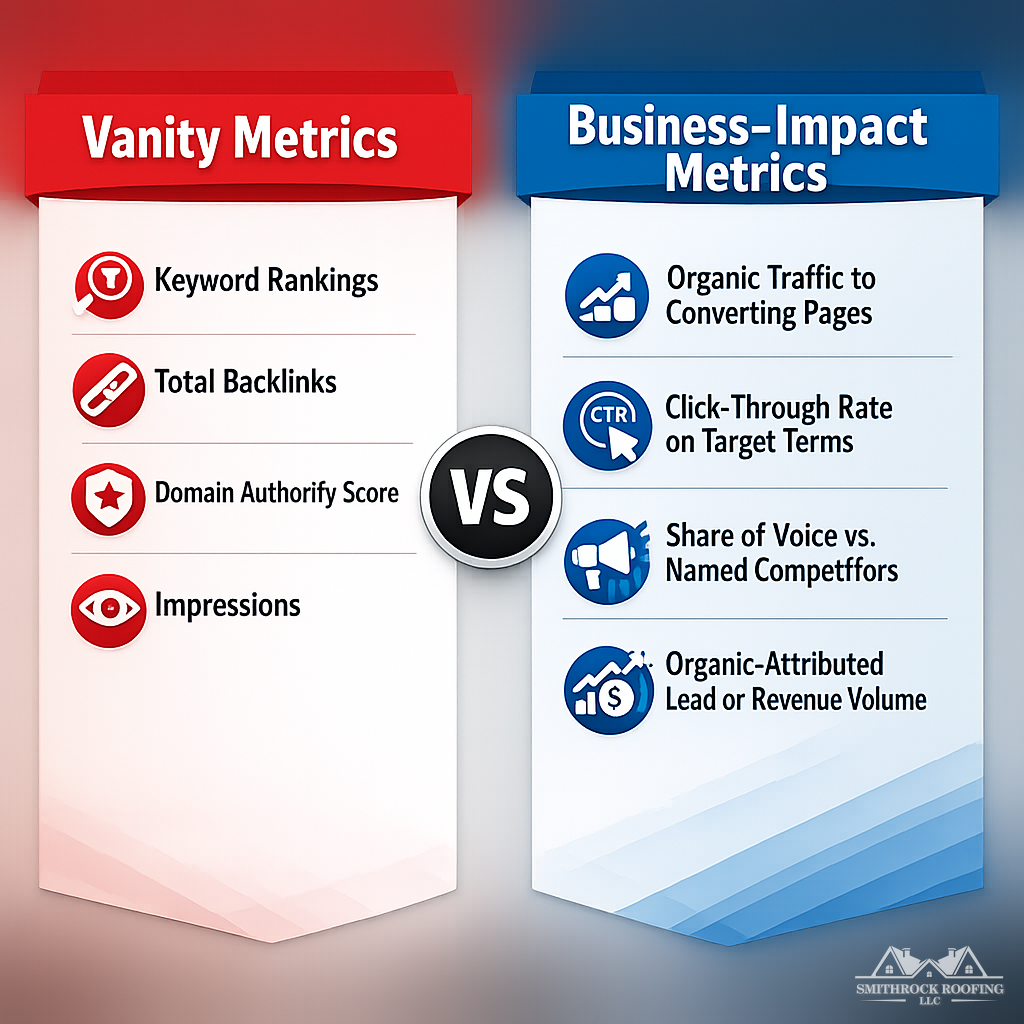
- “What metrics appear in your standard monthly report, and which of those do you consider vanity metrics versus business-impact metrics?”
- “How do you differentiate between an organic traffic increase driven by your work versus a seasonal trend or a Google core update?”
- “Can you show me an example report from a current client — anonymized — and walk me through how you use that data to make decisions?”
An agency that reports only on keyword rankings is giving you a lagging indicator that can be gamed. The metrics that matter for your business are organic traffic to pages that convert, click-through rates on target terms, share of voice against named competitors, and where possible, revenue or lead volume attributed to organic search. Any provider who cannot connect their work to these outcomes is operating at the wrong level.
On Execution and Team Structure
- “Who specifically will work on my account? Can I meet them before signing? What are their individual areas of expertise?”
- “Do you subcontract any element of the work — content writing, link outreach, technical audits? If so, to whom, and how is quality controlled?”
- “What does the first 30 days look like in concrete deliverables, not general phases?”
The strategy-execution gap is one of the most expensive problems in agency relationships. Agencies frequently sell with senior strategists in the room and deliver with junior coordinators running the account. You need to know who is actually doing the work before you commit.
Step Four: The Data Ownership Audit — Before You Sign Anything
This is the section of the vetting process that most business owners skip entirely — and it’s the one that causes the most damage when a relationship ends badly.
Before you sign a contract with any SEO provider, you need clear, written answers to the following questions. If a provider resists answering them, that resistance is its own answer.
Content Ownership
- Who owns the content produced during the engagement — blog posts, landing pages, meta descriptions, and supporting copy?
- If you end the contract, can you retain and continue using all published content, or does ownership revert to the agency?
Some agencies operate on a licensing model where content they’ve written technically belongs to them. Ending the relationship can mean losing months of published assets.
Tool and Data Access
- Do you maintain direct, admin-level access to your own Google Analytics and Google Search Console accounts at all times, or does the agency hold the primary access?
- If the agency uses proprietary reporting dashboards, what happens to your historical data if you leave?
- Do you retain access to keyword research, audit reports, and strategy documents produced during the engagement?
A rule of thumb: your data should live in accounts that belong to your business, with the agency added as a user — not the other way around.
Link Building Transparency
- Are the backlinks acquired through your campaign editorially placed on independent third-party sites you will retain access to after the engagement ends?
- Does the provider use any private blog network (PBN) links or link schemes that are contingent on maintaining the agency relationship?
PBN-based link building is one of the most common hidden risks in SEO contracts. If links are placed on sites controlled by the agency and those sites go offline or get deindexed when you leave, your domain authority can collapse overnight. Genuine editorial links — earned through outreach to independent publishers — are yours regardless of who manages the relationship. For a deeper look at what agencies routinely omit from these conversations, the article What Local SEO Companies Won’t Tell You covers the most common gaps worth knowing before you sign.
Step Five: Set Realistic Timeline Expectations Anchored to Real Data
Any provider who gives you a blanket timeline without reference to your specific competitive landscape is not operating from data. Timeline expectations for SEO results must account for three variables:
Your current domain authority and technical baseline. A brand-new domain with no existing content or backlinks faces a fundamentally different challenge than an established business domain with years of history. Early wins on long-tail, low-competition terms are realistic; competing with category leaders for primary head terms takes significantly longer.
Your competitor’s position and investment. If the top two results for your primary keyword are category-dominant brands that have invested in SEO for five or more years, matching their position requires a sustained, substantial commitment — not a sprint. A provider who has done a genuine competitive gap analysis can show you specifically where your opportunities exist and roughly how long each is likely to take.
Keyword difficulty relative to your current authority. A realistic provider maps your target keywords against your current authority scores and gives you a phased expectation: here’s what we expect in the first 90 days, here’s the six-month benchmark, and here’s what the 12-month picture should look like if execution stays on track. Any deviation from those benchmarks should trigger a transparent review of strategy, not a new set of promises.
Be appropriately skeptical of providers who promise specific ranking positions within specific timeframes. Ranking outcomes are influenced by factors no agency controls — Google algorithm updates, competitor behavior, and your own industry’s seasonal patterns. What a legitimate provider can commit to is a clear process, measurable intermediate progress indicators, and a willingness to adjust strategy based on what the data shows.
Step Six: Evaluate Their Reporting Against a Business-Impact Standard
Reporting is how you hold an agency accountable. But accountability only works if the report measures outcomes that connect to your actual business goals, not metrics that look impressive without meaning anything.
What a Strong SEO Report Includes
- Organic traffic trends to your highest-converting pages, not just overall traffic numbers
- Click-through rate performance on target keywords — are you showing up in results and are users clicking?
- Keyword movement with context — which terms moved, by how much, and what drove the change (their work, a competitor’s movement, or an algorithm update)
- Conversion data from organic — leads, form fills, calls, or transactions that originated from organic search
- Share of voice against your named competitors on the terms that matter to your business
- Technical health indicators — crawl errors, page speed trends, Core Web Vitals status, and indexation coverage
What a Weak SEO Report Looks Like
- A spreadsheet of keyword rankings with no explanation of what changed or why
- Metrics that are growing in the report but disconnected from any business outcome (traffic to irrelevant pages, rankings on terms with no search volume)
- No competitor context — rankings presented in isolation rather than relative to the competitive landscape
- No attribution — no clarity on which organic entries are actually driving leads or sales
Ask to see a sample report before you sign. If it’s a wall of keyword positions and a domain authority score, that’s a report designed to look like progress, not measure it.
The Full-Lifecycle View: Selection Is the Beginning, Not the End
The best SEO relationships are not transactions — they’re operational partnerships that evolve as your business grows and your digital landscape shifts. Selecting a provider is only the first decision. Equally important is establishing the ongoing accountability structures that ensure the relationship keeps delivering.
Set quarterly review checkpoints where strategy is reassessed against actual performance data. Define what underperformance looks like before the contract starts, and agree on what the response process looks like when benchmarks are missed. Maintain ownership of your own tools, data, and content throughout.
When those structures are in place, a strong SEO partner becomes one of the most powerful growth engines available to your business — building compounding visibility, qualified organic traffic, and lead volume that continues performing long after the work is done.
If you’re ready to work with a team that operates this way — transparent, data-driven, and accountable to real business outcomes — contact Mongoose Digital Marketing for a free consultation. We’ll start with an honest assessment of where you stand and what growth actually looks like for your specific business.
Final Strategic Recommendations for 2026
Choosing the right SEO service provider is only half the equation. Once you’ve made that decision, the tools and frameworks you put around the relationship determine whether it delivers. Here are three specific steps worth prioritizing as you move into 2026.
1. Implement an Independent Analytics Layer From Day One
Don’t rely exclusively on your SEO provider’s reporting dashboard. Set up Google Search Console and Google Analytics 4 under your own account ownership before any work begins. Add a secondary tool like Looker Studio configured to your own business KPIs — leads generated, pages driving conversions, and organic revenue attribution. This gives you a ground-truth view that exists entirely independent of your provider’s reporting, and makes performance conversations grounded in shared data rather than vendor-controlled metrics.
2. Conduct a Competitive Gap Audit at the Start of Each Year
Tools like Semrush, Ahrefs, or Screaming Frog give you the ability to benchmark your organic footprint against direct competitors at the keyword, page, and domain level. Before your provider builds a strategy for the year ahead, run or request this audit to identify where competitors have pulled ahead, which content categories are underdeveloped, and where technical gaps may be costing you indexation. A provider who welcomes this input — rather than working around it — is demonstrating exactly the kind of transparency worth investing in.
3. Establish a Content Governance Process That Outlasts Any Provider Relationship
One of the most overlooked risks in SEO partnerships is content dependency — where your organic growth is tied to a provider’s proprietary system, tools, or unpublished processes. In 2026, build internal documentation for every content type your SEO strategy produces: the brief format, the optimization framework, the internal linking logic, the update cadence. If the relationship ends for any reason, your content engine should be inheritable, not orphaned.
Frequently Asked Questions
How long does it typically take to see results from an SEO service provider?
SEO is a compounding channel, not an instant-return one. For most businesses, meaningful improvements in organic traffic and rankings begin to appear between three and six months after foundational work — technical fixes, on-page optimization, and initial content — is completed. However, competitive markets and newer domains may take longer. Any provider promising significant results within the first few weeks is almost certainly overstating what’s achievable, and that should be treated as a red flag during your evaluation process.
What questions should I ask an SEO provider before signing a contract?
The most important questions focus on accountability and transparency rather than tactics alone. Ask to see a sample performance report. Ask how they define success for a business like yours. Ask who specifically will be working on your account, whether that work is handled in-house or outsourced, and what happens if agreed benchmarks aren’t met. You should also ask for case studies from businesses in comparable industries or at a similar stage of growth. How a provider answers these questions tells you as much as the answers themselves.
Should I own my SEO tools, content, and website assets — or can my provider manage them?
You should own all of it. Your Google Search Console property, your analytics accounts, your content, your website, and any link-building or citation profiles built on your behalf should be held under credentials you control. Providers should have access to these assets — not ownership of them. If a contract or onboarding process asks you to transfer ownership, or if a provider hosts your site in a way that makes it difficult to migrate, treat that as a structural risk to your long-term independence.
What is the difference between local SEO and general SEO services?
General SEO focuses on improving organic visibility across broader search queries, typically through technical optimization, content strategy, and authority building. Local SEO is a specialized discipline aimed at improving visibility in geographically specific searches — including Google Business Profile optimization, local citation building, map pack rankings, and reviews management. For businesses that serve a defined geographic area — a city, region, or specific service territory — local SEO is not optional. It’s the mechanism through which nearby, high-intent customers find you. The article How to Select a Local SEO Company That Actually Works goes deeper on evaluating providers specifically for local search performance. A strong provider should be able to demonstrate competency in both, and should assess which emphasis is right for your specific business from the start.
Conclusion
Choosing an SEO partner is one of the most consequential marketing decisions a business can make, and it deserves the same rigor you’d apply to any major operational investment. Mongoose Digital Marketing builds relationships grounded in honest assessment, transparent reporting, and SEO services — from local SEO and technical optimization to long-term content strategy — that are measured against outcomes your business actually cares about. If you’re ready to have a direct conversation about where you stand and what growth realistically looks like for your market, Contact Mongoose Digital Marketing — no obligation, just a clear-eyed starting point.