Key Takeaways
- Google’s three roofing lead channels (Local Services Ads, Google Ads, and the Google Business Profile map pack) occupy different positions on the same search results page and require different optimization logic, so treating them as interchangeable wastes budget.
- LSA rankings are determined partly by your response rate and review count, meaning a slow response to an LSA lead does not just lose a sale, it actively lowers your visibility in future auctions.
- Mixing high-intent and generic keywords inside the same Google Ads campaign causes Smart Bidding to optimize toward an average, suppressing your best-converting search terms while continuing to spend on low-quality traffic.
- Conversion tracking that counts misdials and short calls as leads teaches Google’s algorithm to chase the wrong signals, degrading campaign performance over time regardless of budget.
- For roofers in the Dayton metro area including Kettering, Beavercreek, Centerville, Huber Heights, Miamisburg, and Springboro, a working Google lead system depends on building all three channels in the right sequence, not activating them simultaneously at random.
Roofers in the Dayton area who want leads from Google are choosing between three distinct channels, Local Services Ads, Google Ads (pay-per-click), and organic visibility through the Google Business Profile map pack. The channel you prioritize first, and why, depends on where your business currently stands: how many reviews you have, whether your website converts traffic into calls, and how quickly your team responds to inbound inquiries. Get those factors aligned before spending a dollar on ads and the system works. Ignore them and the budget disappears with little to show for it.
This article breaks down how each channel actually works, where most roofing companies lose money by misunderstanding the mechanics, and how to build a lead system on Google that compounds over time.
The Google SERP Structure Roofers Need to Understand First
When someone in Centerville or Huber Heights searches “roofing contractor near me,” they are looking at a search results page that can display up to three different types of Google-controlled real estate before a single organic website link appears. Understanding what occupies each position changes how you allocate effort and budget.
Position 1, Local Services Ads (LSAs): These appear at the very top of the page, above everything else. They display a “Google Guaranteed” badge, a star rating, and a phone number. You pay per lead, not per click.
Position 2, Google Ads (PPC): Standard pay-per-click text ads appear directly below LSAs. You pay every time someone clicks. These are triggered by keyword targeting and governed by auction mechanics that factor in your bid, your Quality Score, and your landing page relevance.
Position 3, The Map Pack: Three Google Business Profile listings appear with a map. These are organic, meaning you cannot pay your way in. Ranking here depends on proximity, review signals, and on-page GBP optimization.
A roofing company in Beavercreek or Miamisburg can theoretically appear in all three positions simultaneously for the same search query. That visibility dominance is the goal. But most roofing businesses treat these as separate, unrelated tactics. The practical reality is that they feed each other in ways that matter for your budget decisions.
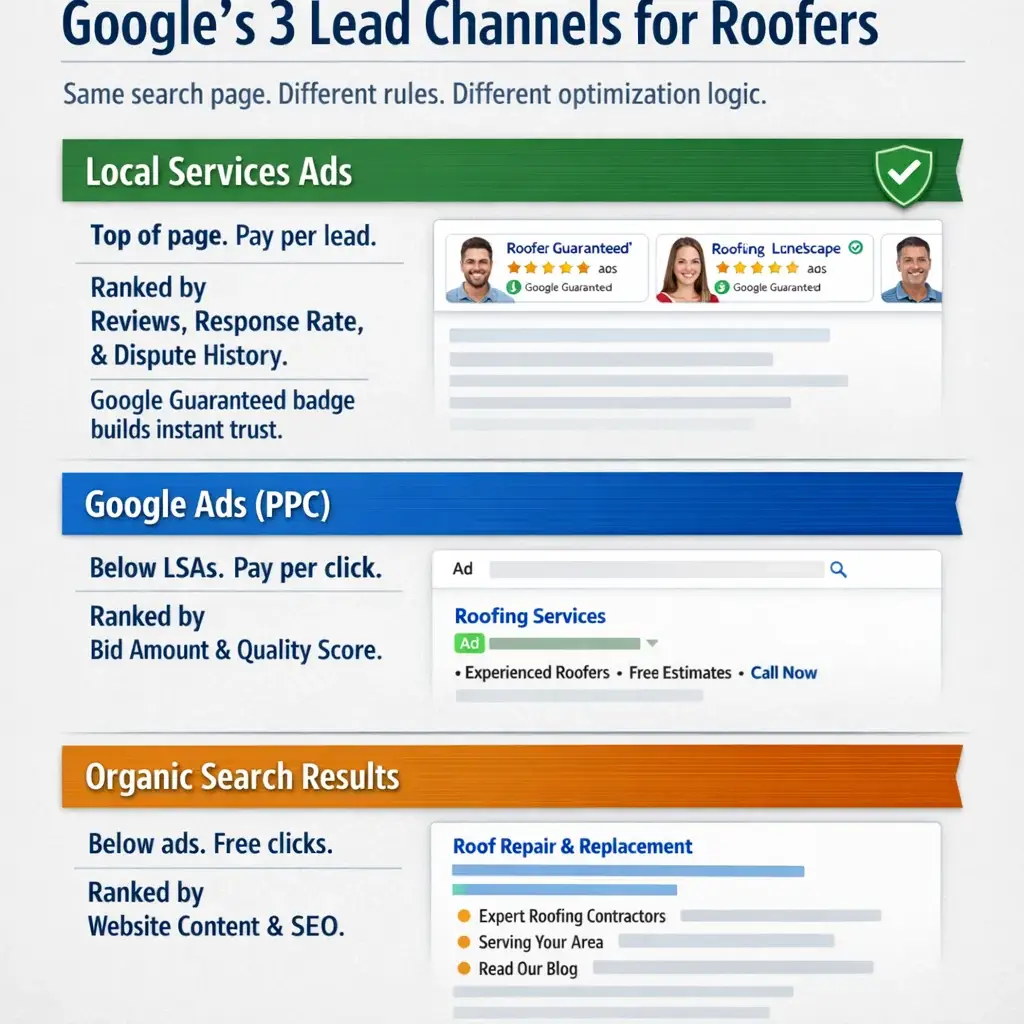
(https://support.google.com). Landing page relevance directly affects your cost per click.”; item3_title=”Map Pack (GBP)”; item3_body=”Organic, no ad spend required. Ranked by proximity, review volume, and Google Business Profile completeness.”; item4_title=”The Compounding Effect”; item4_body=”More GBP reviews improve LSA rankings. Better LSA response rates generate more reviews. These channels reinforce each other.”; item5_title=”The Right Sequence”; item5_body=”Build your GBP and review base first. Then activate LSAs. Layer in PPC for keywords LSAs don’t cover.”; footer=”Mongoose Digital Marketing”]
How Local Services Ads Actually Work, and Why Response Rate Is a Ranking Factor
LSAs are widely described as “ads at the top of Google where you pay per lead.” That description is accurate but incomplete in a way that costs roofers real money.
Google does not simply show the roofer with the highest budget at the top of the LSA results. The LSA auction factors in review count, average review score, response rate, and dispute rate. Two roofing companies in Springboro with identical monthly budgets will get completely different lead volumes if one has 85 reviews and a fast response time and the other has 12 reviews and takes four hours to pick up the phone.
This creates a mechanical link between your Google Business Profile review strategy and your LSA performance. They are not separate tactics listed on a checklist. They are connected at the algorithmic level. More reviews raise your LSA ranking, which generates more leads, which, when handled properly, generates more reviews. The loop is self-reinforcing in both directions.
What triggers a downrank in LSAs:
- Failing to respond to leads within a short window (Google tracks this)
- High dispute rates from marking too many leads as invalid
- Low or declining review scores
- Incomplete verification or lapsed Google Guaranteed status
For roofers in Dayton and surrounding areas, the practical implication is this: before activating LSAs, your Google Business Profile needs to be in good shape. If you have fewer than 25 reviews, the LSA auction is going to be difficult regardless of budget. Build the review foundation first, then turn on LSAs and protect your response rate as if it were a ranking signal, because it is.
Setting Up LSAs the Right Way
- Complete the background check and license verification Google requires; this is non-negotiable for the Google Guaranteed badge
- Connect your GBP to your LSA account so reviews count toward your LSA profile
- Set your service area to match the specific cities you want leads from: Kettering, Centerville, Huber Heights, and others in your target radius
- Designate one person or a system to respond to LSA leads within minutes, not hours
- Audit your dispute rate monthly; disputing more than a small fraction of leads damages your standing in the auction
Need a hand with this in Dayton, Kettering and the Triad? Call (937) 848-0086 or request a free estimate. Honest answers, no pressure.
Google Ads for Roofing: Keyword Intent Buckets and Why Campaign Structure Matters
Pay-per-click Google Ads give roofers precise control over which searches trigger their ads. The problem is that most roofing ad accounts are structured in a way that works against Google’s own algorithm. For a deeper look at how to build PPC lead generation campaigns that produce qualified results rather than just clicks, that article covers the mechanics that apply across service industries.
Here is the core mechanical issue: Google’s Smart Bidding strategies (Maximize Conversions, Target CPA) learn from the conversion data your campaign feeds back to them. When you mix high-intent keywords like “roofing contractor Dayton OH” with generic keywords like “roof repair” inside the same campaign, Smart Bidding averages the performance data across all of them. It cannot distinguish between a search that converts at a high rate and one that drains budget without producing qualified calls. The result is a campaign that performs mediocrely on everything instead of aggressively on your best opportunities.
The Four Keyword Intent Buckets for Roofing
Structuring campaigns around intent levels is not organizational tidiness. It directly affects what you pay per lead and how fast Google’s algorithm learns what a good conversion looks like for your business.
| Intent Bucket | Example Keywords | Buyer Stage | Recommended Structure |
|---|---|---|---|
| High-intent, service-specific | “roofing contractor near me,” “licensed roofer Dayton” | Ready to hire | Separate campaign, exact/phrase match, highest bid priority |
| Emergency / urgent | “roof leak repair emergency,” “storm damage roof repair” | Immediate need | Separate campaign or ad group, 24/7 ad scheduling |
| Service-specific, non-urgent | “roof replacement cost,” “metal roofing installation” | Researching options | Separate ad group, informational landing page with strong CTA |
| Generic / educational | “how long does a roof last,” “types of roofing materials” | Early awareness | Lower bids or excluded entirely from conversion campaigns |
Running all four buckets inside one campaign and trusting Smart Bidding to sort it out is how roofing companies in Beavercreek and Miamisburg exhaust their ad budget on low-quality traffic. Google’s algorithm will find the path of least resistance to spend your budget. Without structural guardrails, that path often runs straight through the generic queries.
Match Types and Negative Keywords
No discussion of roofing Google Ads is complete without addressing match types, because this is where budgets leak.
Broad match keywords on competitive roofing searches without a well-maintained negative keyword list is one of the fastest ways to spend money on irrelevant traffic. “Roof repair” on broad match can trigger ads for searches like “DIY roof repair tutorial” or “roof repair tools.” Neither of those searchers is going to call your Kettering or Huber Heights roofing business.
Build your negative keyword list before you launch, not after you notice the budget draining. Standard negatives for roofing campaigns include: DIY, how to, tutorial, materials, tools, supply, wholesale, training, certification, and any geographic terms outside your service area.
Conversion Tracking: What You’re Actually Measuring Matters More Than the Number
Competitor articles frequently note that roofers should “implement conversion tracking.” The advice is correct. The execution problem is almost universal.
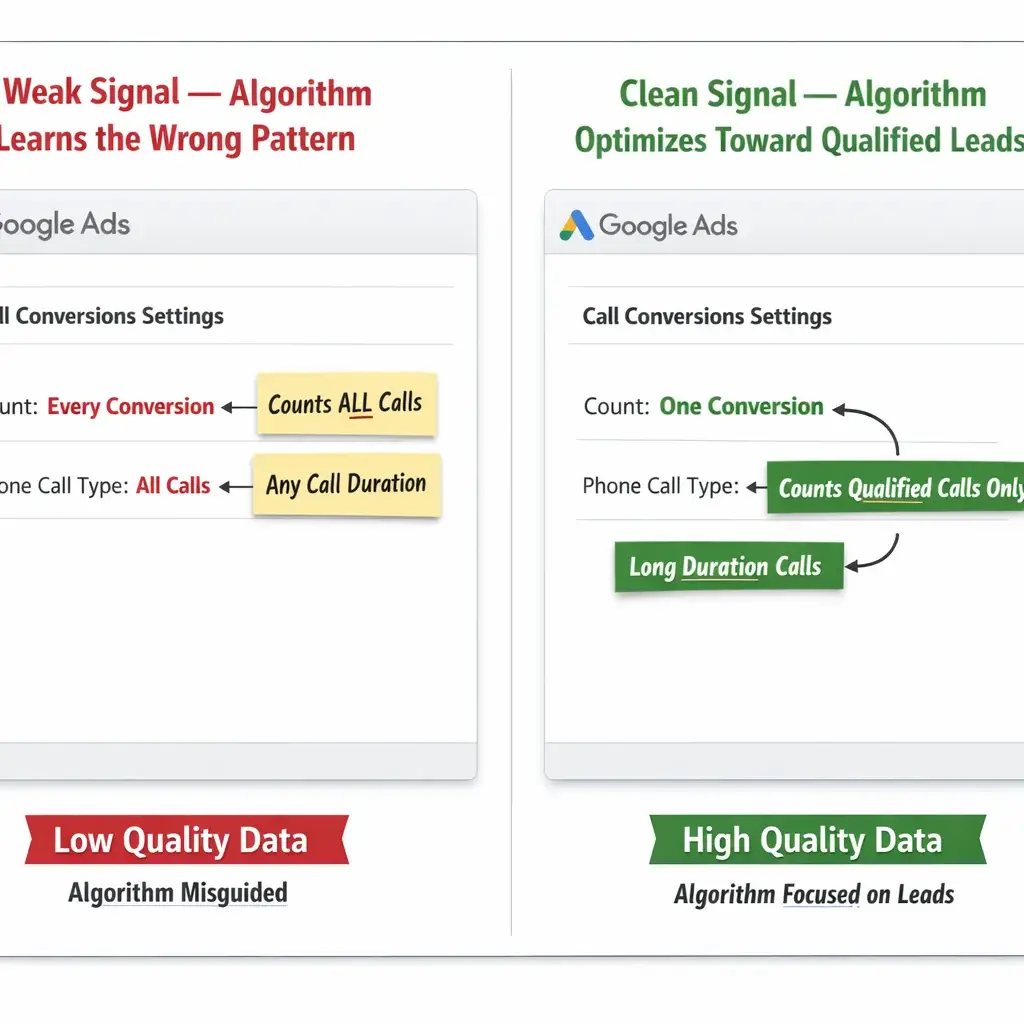
If your Google Ads account is counting every phone call that lasts longer than 30 seconds as a conversion, you are feeding Google’s algorithm data that includes misdials, spam calls, existing customer inquiries, and calls from people who hung up the moment they heard your voicemail. Smart Bidding is learning from all of it, optimizing your campaign toward generating more of the same mixed bag.
The distinction that matters is between micro-conversions and macro-conversions.
Micro-conversions, a page view, a call under 60 seconds, a form page visit, indicate engagement but not lead quality. Tracking them as primary conversions trains Smart Bidding on weak signals.
Macro-conversions, a qualified appointment booked, a call that results in an estimate scheduled, a form submission that matches your service area, represent actual business outcomes. These are the signals worth feeding back to Google.
The practical setup for a roofing company serving the Dayton metro:
- Track calls over 90 seconds as a primary conversion (adjust based on your average qualified call length)
- Track form submissions that include a valid local zip code as a primary conversion
- Import offline conversion data from your CRM when a lead becomes a booked estimate; this is the most powerful signal you can send Google
- Treat shorter calls and page views as secondary conversions for analysis only, not bidding optimization
The Google Business Profile: Your Organic Lead Channel
The map pack is the only Google lead channel that does not require ongoing ad spend. It is also the one most roofing companies in the Dayton area underinvest in because the results compound slowly rather than producing immediate phone calls like a new ad campaign.
GBP ranking is determined by three factors Google has consistently confirmed: proximity (how close your business is to the searcher), prominence (review count, review quality, citations), and relevance (how well your profile matches the search query).
Roofers cannot control proximity, but they can control prominence and relevance aggressively.
GBP optimization actions with direct ranking impact:
- Complete every section of your profile: business category (use “Roofing Contractor” as primary), service areas, services offered, business description with natural keyword inclusion
- Post to GBP weekly with project photos, before-and-after documentation, and short service updates; posts signal an active, maintained profile
- Respond to every review, positive and negative, within 24 hours; Google tracks engagement
- Add photos consistently; profiles with regular photo uploads outperform static ones in local rankings
- Use the Q&A section proactively, post and answer common questions yourself before customers ask them
For roofing companies in Centerville, Springboro, and the broader Dayton metro, GBP is the foundation that the other two channels (LSAs and PPC) rely on. The article on Google Business Profile optimization tips that actually work goes deeper on the specific actions that move the needle for local service businesses. Reviews generated through GBP directly improve LSA auction performance. The GBP profile linked to your PPC ads improves your ad’s seller ratings display, which raises click-through rates. These are not parallel tactics. They are a system.
Building the Lead System in the Right Sequence
The sequence in which you build these channels determines how efficiently your budget works. Activating all three simultaneously without the foundational elements in place is a common and expensive mistake.
Phase 1, Build the foundation: Optimize your GBP completely. Run a review generation campaign with past customers to reach a meaningful review count. Ensure your website has location-specific service pages for each city you serve, Dayton, Kettering, Beavercreek, Centerville, Huber Heights, Miamisburg, Springboro, with clear calls to action and fast load times on mobile. Understanding how to get more leads from your website is a critical prerequisite before driving paid traffic, since ads cannot compensate for a site that fails to convert visitors into calls.
Phase 2, Activate LSAs: Once your review count supports a competitive LSA ranking, activate Local Services Ads. Set up response protocols so no lead goes unanswered for more than a few minutes. Monitor your response rate and dispute rate weekly.
Phase 3, Layer in PPC: Build Google Ads campaigns structured by intent bucket. Install proper conversion tracking before the first dollar is spent. Build your negative keyword list in advance. Let the campaigns run long enough to accumulate statistically meaningful conversion data before making bid adjustments.
Phase 4, Optimize continuously: Use the conversion data from PPC to identify which services and locations generate the best leads. Feed that insight back into your GBP content and LSA service selections. The system becomes more efficient over time when the data from each channel informs the others.
Roofing companies that build this system correctly do not just generate leads from Google, they generate leads at a consistently lower cost per acquisition as the algorithm learns their actual conversion patterns. That is the difference between a campaign that runs and a campaign that compounds.
For roofing businesses in the Dayton area ready to build this system properly, Mongoose Digital Marketing offers a free consultation to assess where your current Google presence stands and what the highest-leverage starting point is for your specific situation. You can also explore how Google’s Local Services Ads work directly through Google’s platform to understand the verification requirements before getting started.
Frequently Asked Questions
How long does it take for a roofing company to start getting leads from Google?
It depends on which part of the system you are building. Google Business Profile optimizations can produce visibility improvements within a few weeks, especially for near-me searches in your immediate service area. Local Services Ads can generate calls relatively quickly once your profile is verified and your review count is competitive. Google Ads can drive traffic almost immediately after launch, though it typically takes several weeks of conversion data before the campaigns perform efficiently. The honest answer is that the full system takes months to mature, but individual channels can contribute leads well before everything is fully optimized.
Do roofing companies need all three channels, GBP, LSAs, and PPC, to be successful on Google?
Not necessarily all at once, but each channel fills a different role in the lead funnel. A well-optimized Google Business Profile is the non-negotiable foundation and should always come first. LSAs are highly effective for roofing because of the trust signals they carry and the pay-per-lead structure. Google Ads extend your reach into searches that organic and LSA listings do not capture. Companies that use all three in a coordinated way tend to generate more consistent lead volume than those relying on a single channel.
Why does review count matter so much for roofing lead generation on Google?
Reviews influence your ranking in both the Google Map Pack and Local Services Ads, and they directly affect whether a potential customer clicks your listing or a competitor’s. For roofing specifically, homeowners are making a significant decision about their home and they rely heavily on social proof before making contact. A roofing company with a strong review count and consistently positive ratings will outperform a competitor with better technical SEO but a thin review profile. Reviews are also one of the few ranking signals you can actively build through a simple follow-up process with past customers.
What is the biggest mistake roofing companies make with Google Ads?
The most common and costly mistake is running campaigns without proper conversion tracking in place. When you cannot see which clicks are turning into actual calls or form submissions, you are making bid and budget decisions based on incomplete information. The second most common mistake is targeting too broadly without a negative keyword list, which results in ad spend going toward searches that have no realistic chance of converting into a roofing job. Both problems are avoidable with correct setup before the campaign goes live.
Conclusion
Roofing companies in Dayton and Centerville that want consistent lead flow from Google need a system built on accurate data, proper verification, and content that matches how local homeowners actually search, and that is exactly the work Mongoose Digital Marketing does for contractors across the region every day. If you are ready to find out where your current Google presence has gaps and what the most efficient starting point is for your market, the team at Mongoose is happy to walk you through it at no cost. Call (937) 848-0086 or Contact Mongoose Digital Marketing to schedule your free consultation.