Key Takeaways
- Roofing companies that dominate local search do so by building a coordinated system of geographic signals across their website, Google Business Profile, and verified job activity, not by optimizing any single element in isolation.
- The keyword intent gap between “roof repair near me” and “standing seam metal roofing installation” is fundamental: each query reflects a different buyer stage, decision timeline, and required page architecture, and conflating them produces content that converts neither audience.
- Generic educational blog posts, “5 Signs You Need a New Roof”, represent the category of content Google has explicitly labeled commodity content and is actively devaluing in favor of unique, job-specific, location-verified documentation.
- Geographic diversity of verified service activity carries more local ranking authority than raw review volume; 80 reviews spread across 12 zip codes with documented job locations outperform 200 reviews concentrated in a single zip code.
- The 90-day indexing window most agencies cite as a waiting period can be compressed by generating corroborating signals across multiple surfaces simultaneously rather than publishing content and waiting passively.
Ranking on the first page of Google in the Dayton metro area is not primarily a content volume problem. It is a signal coherence problem. Roofing companies that generate consistent, geographically specific, service-verified signals across their website, their Google Business Profile, and their broader digital footprint tend to outrank competitors who publish more content but distribute it without strategic coordination. Understanding why that is true, and what it means at the tactical level, is the difference between an SEO investment that compounds and one that stagnates after six months.
This guide covers the mechanics of SEO for roofing companies in enough depth to give you a working mental model, not just a checklist. The goal is that you leave understanding the system, so you can evaluate any strategy, tool, or agency recommendation against first principles.
Why Roofing SEO Is a Local Ranking Problem First
Most roofing companies compete within a defined geographic service area. That means the primary ranking environment is not the traditional ten-blue-links search result, it is the Google Map Pack, the local three-result block that appears above organic results for queries like “roofing contractor Dayton OH” or “roof replacement Kettering.” Appearing in that block is driven by a different set of signals than ranking in traditional organic results, and the two systems interact in ways most guides never explain.
Google’s local ranking algorithm weighs three broad categories: relevance (does your business match what the searcher needs), distance (how close is your business to the searcher), and prominence (how well-known and trusted is your business based on signals across the web). The distance factor is partially outside your control. Relevance and prominence are not.
Prominence, specifically, is where most roofing companies leave ranking authority on the table. It is built through review consistency, geographic breadth of documented service activity, citation accuracy across directories, and the quality of your website’s supporting infrastructure. These are not independent levers you can optimize one at a time. They function as a system, and weakness in any one dimension creates a ceiling on the others.
The Map Pack and Organic Results Are Not the Same Race
A roofing company can rank well in the Map Pack and poorly in organic results, or vice versa. The signals that drive each are overlapping but not identical.
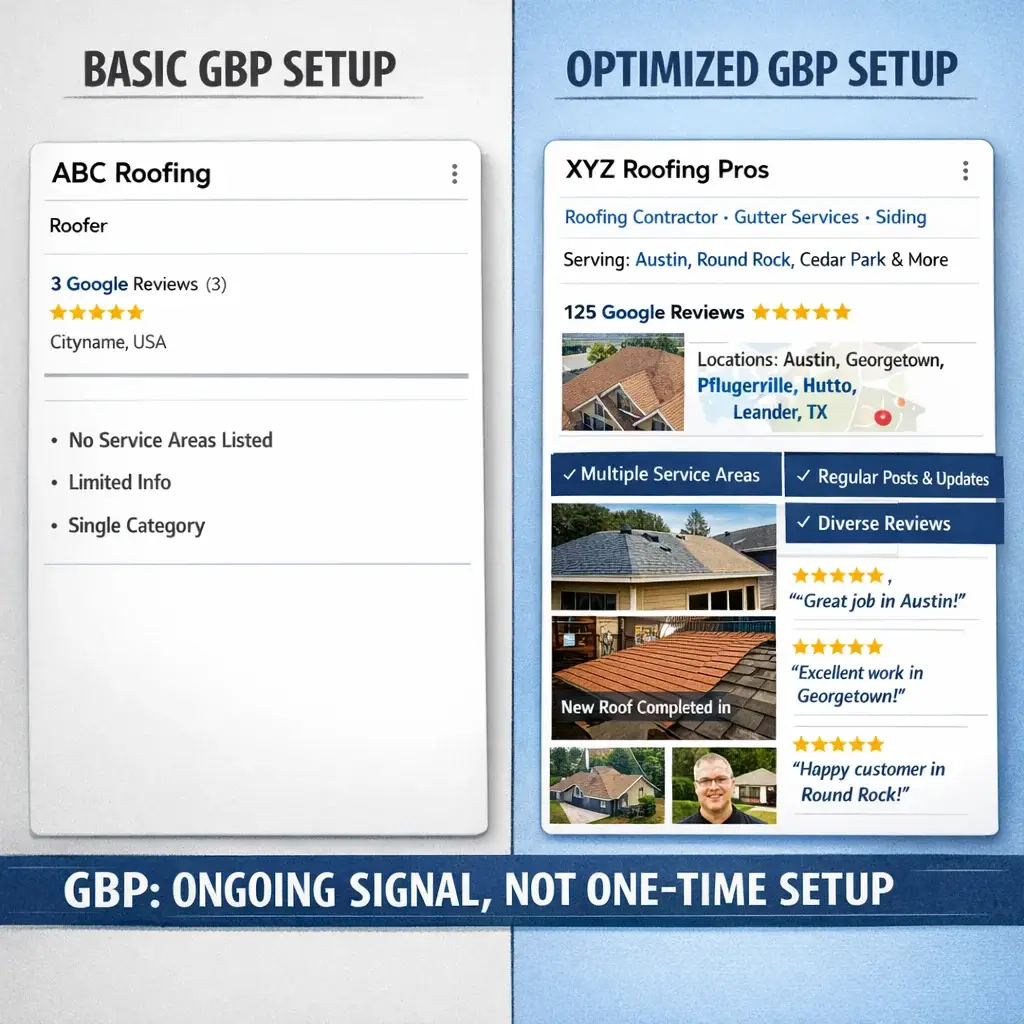
Map Pack rankings are heavily influenced by GBP activity, review signals, and proximity. Organic rankings are driven by on-page relevance, domain authority, backlink profile, and content depth. The companies that dominate both invest in both systems simultaneously, GBP is not a setup task you complete once, and organic content is not something you publish in batches and leave alone.
For roofing companies serving Dayton, Kettering, Beavercreek, Centerville, Huber Heights, Miamisburg, and Springboro, the practical implication is that your SEO infrastructure needs to address geographic coverage across your full service area, not just your headquarters location. A single optimized GBP listing in Dayton does not automatically produce strong rankings in Centerville or Springboro searches without supporting signals tied to those specific locations. Understanding the full scope of local SEO strategies that actually work for the Dayton market can help clarify exactly which signals matter most for your service area.
Keyword Intent Is Not a Spectrum, It Is a Set of Distinct Categories
Roofing companies often approach keyword research by generating a list of relevant queries and sorting them by search volume. That method misses the most important variable: intent stratification. Different queries represent fundamentally different buyers at different stages of a purchasing decision, and treating them as interchangeable produces pages that rank for nothing.
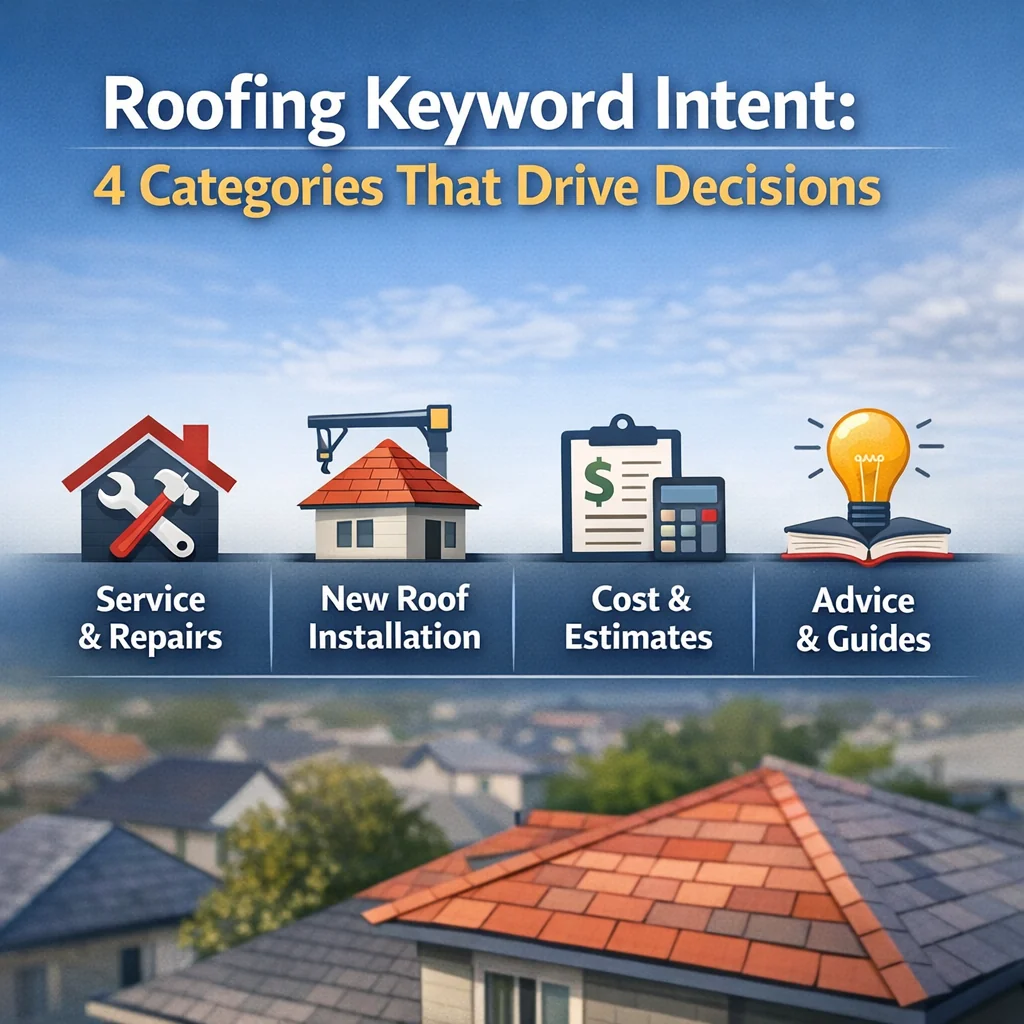
Four distinct intent categories matter for roofing SEO:
Emergency and high-urgency repair queries (“roof leak repair near me,” “emergency roofer Dayton OH”) come from buyers who have an active problem and need a response within hours, not days. These searches require pages built for immediate conversion: fast load times, phone number above the fold, trust signals front and center, and minimal friction between the search and the call.
Replacement and project-planning queries (“roof replacement cost Kettering,” “new roof Beavercreek”) come from buyers who are 2 to 8 weeks into a decision process. They are gathering information, comparing options, and building a shortlist. These pages need to deliver enough detail to establish credibility without burying the conversion path.
Material and specification queries (“standing seam metal roofing installation,” “GAF Timberline shingles contractor”) come from buyers who already know what they want and are looking for a qualified installer. These are high-conversion queries with lower search volume. A page that demonstrates genuine expertise in a specific material or system converts this buyer efficiently.
Informational and research queries (“how long does a roof last,” “signs of roof damage”) attract people who may be years away from a purchase decision. These have value for brand awareness and E-E-A-T signal building, but they should never share page architecture with transactional content. Mixing intent categories on a single page is a common roofing site failure mode.
The Cannibalization Risk Nobody Warns You About
Every guide recommends building city pages to extend your service area reach. What they rarely mention is that creating multiple city pages targeting near-identical intent with near-identical content structures creates keyword cannibalization. When Google sees ten pages on your site that all appear to target “roofing contractor [city] OH” with the same structural approach, the same headings, and the same body copy with city names swapped, it cannot determine which page should rank. The result is ranking suppression across all of them.
Effective city pages are not template pages with location variables inserted. They need unique service context, documented local job activity, and genuinely differentiated content that gives Google a reason to rank each page independently. For a roofing company serving the Dayton area, a Miamisburg page and a Springboro page should look substantively different, different jobs documented, different service mix emphasized, different community context woven in through verifiable service history.
Need a hand with this in Dayton, Kettering and the Triad? Call (937) 848-0086 or request a free estimate. Honest answers, no pressure.
The Content Error Most Roofing Companies Are Making Right Now
Google has stated publicly that it values content that is unique and authentic over content that reflects standard advice and general tips. The implication for roofing companies is uncomfortable: the majority of roofing blog content being published today falls squarely into the category Google is devaluing.
“5 Signs You Need a New Roof.” “How to Choose a Roofing Contractor.” “Asphalt Shingles vs. Metal Roofing: Which Is Right for You?” These are commodity content. They represent information that appears on thousands of roofing websites in nearly identical form. Publishing more of them does not build authority, at scale, it may signal to Google’s quality evaluation systems that your site produces undifferentiated output.
Non-commodity content for a roofing company looks different at the structural level. It documents specific jobs with specific outcomes. It shows before-and-after photo sequences tied to a verifiable address and service type. It captures the decision-making rationale for a material recommendation on a specific structure. It is content that could not have been written by any other roofing company because it reflects work that only your company did.
This is not an argument against educational content entirely. It is an argument for understanding the category difference between informational content that serves a research-stage buyer and authoritative content that builds domain credibility with Google’s evaluation systems. A roofing company that publishes 50 generic blog posts has not built authority. A roofing company that documents 50 completed jobs with geo-tagged photos, material specifications, and customer-verified outcomes has. Understanding how SEO blogs generate leads rather than just traffic makes clear why the structure and specificity of your content matters as much as the volume.
What Google’s E-E-A-T Framework Actually Means for Roofers
E-E-A-T stands for Experience, Expertise, Authoritativeness, and Trustworthiness. Google’s quality evaluators use this framework to assess whether content was produced by someone with real-world knowledge and demonstrated capability. For a roofing company, the Experience and Authoritativeness signals are the most actionable.
Experience signals come from demonstrated first-hand job documentation: photos with metadata, project descriptions that reflect genuine field knowledge, and customer accounts that describe specific outcomes rather than generic satisfaction. Authoritativeness signals come from your link profile, your GBP standing, your manufacturer certifications, and the consistency of your NAP (name, address, phone number) data across the web.
Trustworthiness signals come from review consistency, clear business information, and the absence of technical red flags on your site, missing SSL certificates, broken links, or crawl errors that suggest an unmanaged web presence.
Local SEO as a System, Not a Checklist
The most common local SEO mistake roofing companies make is treating GBP optimization, citation building, and review generation as separate tasks with independent value. They are not. They function as a reinforcing system, and the output of that system depends on how well the individual elements corroborate each other.
Here is how the signal interdependency works in practice:
| Signal Type | What It Tells Google | Common Mistake |
|---|---|---|
| GBP reviews (volume) | Service demand and customer satisfaction | Prioritizing volume without geographic diversity |
| GBP reviews (geography) | Service area reach and radius | Getting 200 reviews from one zip code vs. 80 from 12 |
| Geo-tagged job photos | Active service locations, recency of work | Uploading photos without location metadata |
| GBP posts | Topical relevance, business activity | Posting once at setup and never again |
| Citation consistency | Business identity verification | Inconsistent address formats across directories |
| City pages on website | Service area corroboration for GBP | Generic pages that don’t match GBP service area claims |
| Backlinks | Domain authority and topical trust | Chasing domain authority over geographic relevance |
The insight most guides miss is the geographic distribution of your review and job activity. A roofing company with 200 reviews all originating from customers in one zip code signals a narrow service radius to Google’s local ranking algorithm. A company with 80 reviews drawn from verified job locations across Dayton, Kettering, Huber Heights, Beavercreek, and Centerville, combined with geo-tagged job documentation from those locations, signals a legitimate multi-city service operation. The second company will outperform the first in searches originating outside its primary location, which for most roofing companies represents the majority of their growth opportunity.
Building a Link Profile That Actually Signals Local Authority
Backlinks are listed as a ranking factor in virtually every SEO guide, but the strategic hierarchy that determines which links matter for a local roofing company is almost never explained.
For a roofing company in the Dayton metro, the most authoritative link sources in descending order of local relevance are: manufacturer and supplier partnership pages (GAF, Owens Corning, CertainTeed contractor directories), local business directories and chambers of commerce, regional home improvement publications and news sites, and industry association memberships. General domain-authority links from unrelated sites carry less weight for local rankings than links from sources Google associates with geographic relevance or industry credibility.
Links from local organizations, a Dayton-area chamber, a regional business association, a community news outlet covering your participation in a local project, carry geographic corroboration value that a high-DA link from a national content farm does not. The goal is a link profile that tells a coherent story about your business’s presence and reputation in a specific market, not a portfolio of high-authority links that could belong to any business anywhere. This is one of the core factors covered in what local SEO companies won’t tell you about rankings, that link relevance to your geography and industry often outweighs raw domain authority.
The 90-Day Window Is Not a Waiting Period
Most agencies tell roofing companies to expect meaningful results in 90 to 120 days and frame that window as a period of indexing and trust-building that simply takes time. That framing is partially accurate and largely unhelpful, because it treats the ramp-up as passive when it can be actively managed.
Here is what actually happens during the first 90 days after a roofing site is launched or significantly optimized. Google’s crawler discovers the site and begins building an index model of what the site covers, who it serves, and how it relates to other sites and entities in the same topical space. The speed and accuracy of that model depends on how consistently the signals it encounters corroborate each other.
A roofing company that launches a new site, publishes city pages for Dayton, Kettering, and Miamisburg, and simultaneously begins generating geo-tagged job documentation, GBP posts, and new customer reviews from those locations is feeding Google corroborating signals across multiple surfaces at the same time. The indexing model it builds is more confident and more specific than the model it builds from a site that launched and then waited for organic signals to accumulate.
The practical actions that compress the 90-day window are not about gaming the algorithm. They are about removing ambiguity. The more clearly and consistently your website, GBP, backlink profile, and customer review activity all tell the same story about who you are, what you do, and where you work, the faster Google can build an accurate representation of your business and begin surfacing it for relevant queries.
For roofing companies serving the Dayton metro, that means the first 90 days should be an active period of signal generation across every available surface, not a period of publishing content and checking rankings weekly while waiting for something to happen.
Frequently Asked Questions
How long does it take for SEO to produce visible results for a roofing company?
Most roofing companies begin seeing measurable movement in local rankings within 60 to 90 days when the foundational work is done correctly from the start. That timeline shortens when your Google Business Profile, website content, and review activity are all generating consistent, corroborating signals simultaneously. Treating the early period as an active signal-building phase rather than a waiting period is what separates companies that see early traction from those still checking rankings at month six with nothing to show.
Does a roofing company need separate pages for each city it serves?
Yes, and the reason goes beyond simply having a page that mentions a city name. Google builds a model of where your business actually operates based on signals it can verify, job documentation, reviews that name specific neighborhoods, GBP posts tied to service locations, and structured content that speaks to the conditions and concerns relevant to each area. A single service area page that lists twelve cities is not the same as twelve pages that each demonstrate local relevance. For a company serving the Dayton metro, that distinction directly affects whether you appear in searches from Kettering, Beavercreek, or Centerville versus only ranking well in searches tied to your physical address.
What role do customer reviews play in local SEO for roofers?
Reviews function as a continuous signal system rather than a one-time trust badge. The recency, volume, keyword content, and geographic specificity of your reviews all influence how Google evaluates your relevance for local searches. A roofing company that consistently generates reviews mentioning specific services and service locations sends stronger signals than one with an older cluster of generic five-star ratings. Responding to reviews also contributes to this signal layer, particularly when responses reflect the same location and service language your site is built around.
Is Google Business Profile optimization really that important if my website is already ranking?
Your GBP and your website are evaluated as part of the same local entity, not as independent assets. A well-optimized website paired with a neglected GBP creates a gap in the signal picture Google is trying to build about your business. For roofing companies, the GBP is often the first thing a potential customer sees after a local search, and it is also a primary surface for photos, reviews, and service documentation that your website cannot replicate. Treating both as equally important parts of a unified local presence is what produces the compound effect that sustains rankings over time.
Conclusion
Roofing companies in the Dayton area, including those doing strong work in Beavercreek and Centerville, compete in a local search environment where the details of your digital presence determine whether customers find you or your competitor. Mongoose Digital Marketing proudly serves roofing businesses across Dayton, Kettering, Beavercreek, and Centerville with the kind of hands-on, locally grounded SEO strategy this market requires. If you’re ready to stop waiting and start building real search visibility, reach out at (937) 848-0086 or Contact Mongoose Digital Marketing to start the conversation.