

Key Takeaways
- Blog writing for Kettering, OH businesses performs best when content is calibrated to a pragmatic, evidence-respecting local audience shaped by proximity to Wright-Patterson AFB and the Kettering Health network — not copied from generic national templates.
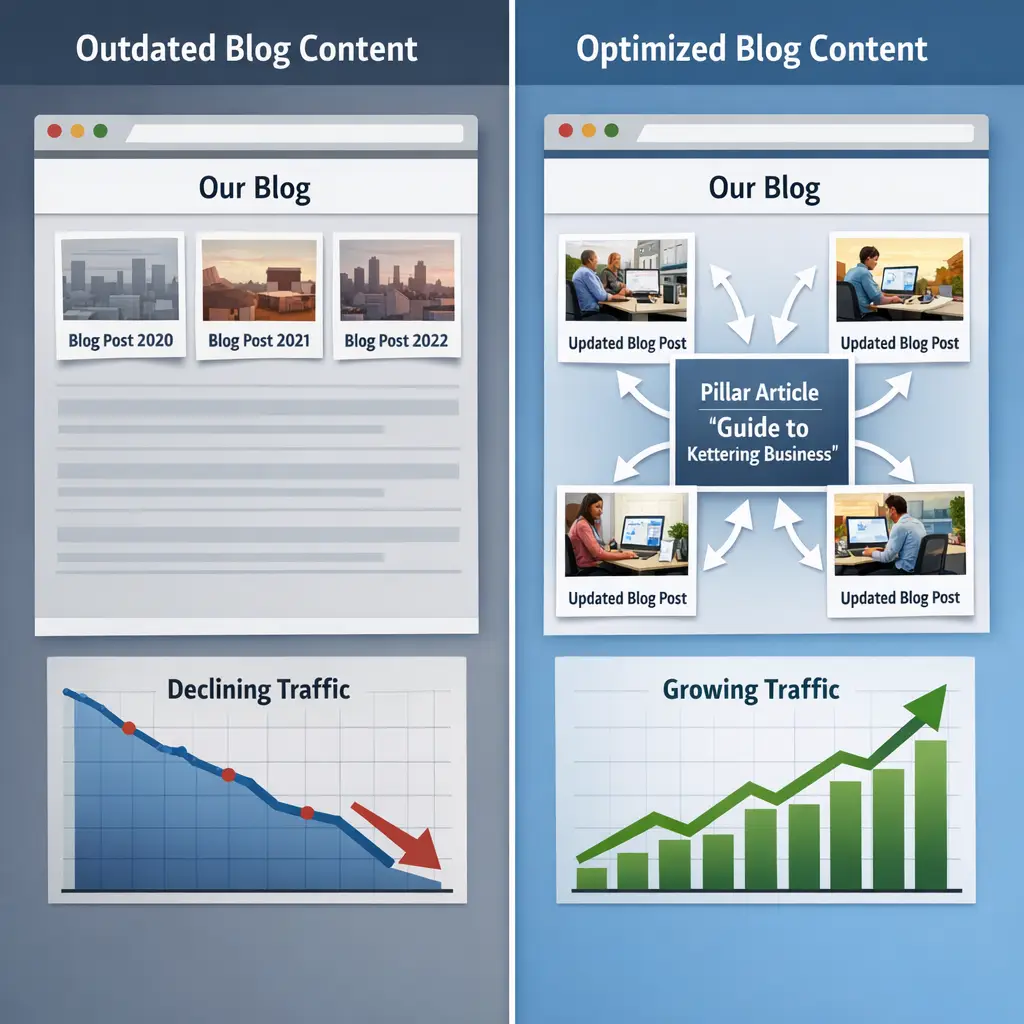
- Topic cluster architecture — a pillar page supported by semantically linked blog posts built over 90 to 180 days — delivers significantly stronger local SEO authority than publishing standalone posts in a mid-sized competitive market like Kettering.
- Professional blog writing for local service businesses functions primarily as an expert-to-reader translation service: converting deep technical knowledge into clear, action-driving content that first-time customers can trust.
- Blog posts experience content decay over time, and a Kettering business with unmaintained posts from 2021 or 2022 may be actively suppressing its own search rankings rather than building them.
- Measuring blog ROI requires explicit attribution tracking — phone call data, form submissions, and return visit behavior — not just traffic counts, which tell you nothing about revenue impact.
Why Most Blog Writing Services Fail Kettering Businesses Before the First Post Is Published
There is a version of blog writing that looks productive on paper: consistent publishing schedule, keyword-rich titles, articles that clock in at 800 words and hit a few SEO checkboxes. Agencies in Dayton, Cincinnati, and Columbus sell this version constantly. Business owners in Kettering buy it, watch their analytics for three months, and walk away wondering why nothing moved.
The failure is almost never about effort. It is about strategy — specifically, the absence of a strategy built around how Kettering’s market actually works.
Kettering is not a generic suburb. It is a community with a distinct professional workforce, a defined commercial geography running from Far Hills Avenue down through the SR-48 corridor, and a buyer psychology shaped by decades of engineering, healthcare, and precision-trades culture. Content that performs in a coastal market — fast, punchy, hype-forward — consistently underperforms here. Content that respects the reader’s intelligence, demonstrates genuine expertise, and earns trust through evidence regularly outperforms.
This guide exists to close the gap between what most blog writing services deliver and what Kettering businesses actually need to generate leads, build authority, and compete against both Dayton metro agencies and national brands showing up in local search results.
If you have tried blogging and been disappointed, this is the explanation you did not get the first time.
The Southwest Ohio Voice Problem Nobody Talks About
Every blog writing service will tell you they write “localized content.” What they typically mean is that they insert “Kettering, OH” into a template written for a national audience.
That is not localization. That is keyword placement.
Genuine localization means understanding the psychological profile of your reader — and in Kettering, that profile is specific.
Who Is Actually Reading Your Blog?
Kettering’s buyer base skews toward:
- Engineering and defense professionals connected to Wright-Patterson Air Force Base in neighboring Fairborn, who apply rigorous analytical thinking to purchasing decisions, including hiring local service businesses
- Healthcare workers and administrators in the orbit of the Kettering Health network, who are accustomed to evidence-based communication and have low tolerance for vague marketing language
- Established homeowners and business operators in Centerville, Springboro, and Miamisburg who are comparing multiple providers and using online content to vet credibility before making contact
This is not an audience that responds to “Transform Your Life with Our Amazing Service!” This is an audience that responds to specificity, demonstrated knowledge, and proof. They read the whole article. They notice when something is generic. They click away when content feels like it was written about them rather than for them.
Blog writing that converts in this market is:
- Direct, not breathless — it gets to the point without manufactured excitement
- Evidence-forward — it cites data, references real scenarios, and shows the reasoning behind claims
- Community-grounded — it references the actual landscape of Southwest Ohio, not a placeholder geography

Topic Clusters: Why Individual Blog Posts Rarely Win in a Competitive Local Market
Here is a structural truth that most blog writing services will not tell you because it makes the sale more complicated: one blog post almost never moves the needle by itself.
In a mid-sized market like Kettering — where you are competing against established Dayton metro businesses, national directories like Angi and Yelp, and legacy websites with years of domain authority — a single post targeting a competitive keyword has limited organic reach on its own.
What works is topic cluster architecture.
How Topic Clusters Work
A topic cluster consists of three components:
- A pillar page — a comprehensive, authoritative resource covering a broad topic your business owns (e.g., “Home Comfort Solutions for Ohio’s Four-Season Climate” for a Kettering HVAC company)
- Cluster blog posts — individual articles targeting specific subtopics, each internally linked back to the pillar page (e.g., “How to Prepare Your Kettering Home’s Furnace Before the First Freeze,” “Why Ohio Humidity Makes Air Quality Different from National Averages,” “Heat Pump vs. Gas Furnace: A Practical Guide for Dayton-Area Homeowners”)
- Internal linking architecture — deliberate, structured links between every cluster post and the pillar page, signaling to Google that your site has topical authority, not just a collection of loosely related articles
This approach builds what SEO practitioners call topical authority — a signal to search engines that your site is a reliable, in-depth resource on a given subject, not just a publisher of occasional keyword-targeted content. For a deeper look at how this fits into a broader growth plan, the article on content marketing strategy for small businesses breaks down how topic authority compounds over time.
The Timeline Reality
Topic cluster authority does not materialize overnight. For most Kettering businesses in moderately competitive service categories, meaningful ranking movement from a content strategy typically requires 90 to 180 days of consistent, well-structured publishing. That timeline is not a failure — it is how organic search authority is built. Any agency promising immediate results from blog content alone is selling you something that does not exist.
Comparing Content Approaches for Local Markets
| Approach | Setup | Time to Results | Authority Signal | Best For |
|---|---|---|---|---|
| Standalone posts (no strategy) | Low | Rarely delivers | Weak | Nothing — this is the common failure mode |
| Keyword-targeted single posts | Medium | 6–12 months per post | Moderate | High-volume, low-competition keywords only |
| Topic cluster architecture | High upfront | 90–180 days (cumulative) | Strong | Competitive local categories in mid-sized markets |
| Pillar + cluster + refresh cycle | High ongoing | Sustained long-term | Strongest | Businesses committed to content as a primary growth channel |
For Kettering businesses in healthcare services, professional services, home services along the SR-48 corridor, and specialty retail on Far Hills Avenue, topic cluster strategy is not a premium option — it is the minimum viable approach for content that actually competes.
The Expert-to-Reader Translation Function
The second most common failure mode in local blog writing — after strategic absence — is a content style mismatch.
Here is what happens frequently with Kettering service businesses: the owner or a senior staff member writes a first draft. They know their subject extremely well. The draft is technically accurate. It is also completely inaccessible to a first-time customer who has never thought about HVAC load calculations, periodontal staging, estate planning structures, or structural beam specifications.
Professional blog writing for local businesses is not primarily a writing service. It is a translation service.
What Expert-to-Reader Translation Actually Means
A skilled blog writer working with a Kettering business does the following:
- Extracts genuine expertise from the business owner or subject matter expert through structured interviews or detailed questionnaires — because authentic knowledge is what separates a useful blog post from generic content anyone can produce
- Identifies the reader’s entry point — what does a first-time customer actually know when they land on this page? What are they afraid of? What decision are they trying to make?
- Converts technical accuracy into readable clarity — precision does not require complexity; the best local service content is both accurate and immediately actionable
- Embeds trust signals throughout — not just in the bio or the about page, but in the body of the post itself: specific references, real scenarios, outcome examples, and the kind of detail that tells a skeptical reader “this person has actually done this work”
This last point connects directly to Google’s E-E-A-T framework — Experience, Expertise, Authoritativeness, and Trustworthiness. Google’s guidance is explicit: blog posts that contain first-person experience signals, cited expertise, and demonstrable knowledge within the body content — not just in an author bio — receive preferential treatment in quality evaluations. A post that reads like it could have been written by anyone about any business in any city is not just bad for readers; it is a liability in local organic search.
For Kettering’s trust-sensitive service industries — physical therapy, financial advising, legal services, home construction, pediatric care — the translation function of professional blog writing is where the real commercial value lives.
Content Decay: The Blog Problem Most Agencies Won’t Mention
Publishing is not a one-time transaction. A blog post exists in a competitive environment that changes continuously, and content that ranked well in 2021 may be actively hurting your site’s performance in 2025.
This is called content decay, and it is one of the most common silent revenue drains for Kettering businesses that invested in blog writing years ago and have not revisited it since.
What Causes Content to Decay
- Keyword landscape shifts — what users search for and how they phrase queries changes, particularly as voice search and AI-assisted search alter query patterns
- Competitive displacement — newer, more comprehensive competitor content earns the rankings your post once held
- Factual staleness — service details, pricing structures, staff references, regulations, or local market conditions referenced in old posts may now be inaccurate
- Lost link equity — inbound links pointing to old posts may decay or disappear, reducing the authority those pages pass through your site
- Changed E-E-A-T signals — a post that did not require author attribution or experience signals in 2020 may now underperform because it lacks them
A Basic Content Audit Framework for Local Businesses
Kettering businesses with an existing blog library should evaluate posts across four categories:
- Keep and update — posts that drive meaningful traffic but have outdated information or weak E-E-A-T signals; refresh these with current data, expanded depth, and author attribution
- Consolidate — multiple thin posts covering similar topics that are cannibalizing each other in search; merge these into a single authoritative resource
- Redirect — posts that have zero traffic, zero backlinks, and serve no strategic purpose; remove and redirect to the nearest relevant page
- Leave alone — high-performing, evergreen posts that are ranking well and converting visitors; do not touch these without a clear reason
Running this audit annually — or quarterly for businesses in competitive categories — is standard practice for content programs that sustain results rather than erode over time.
Measuring Blog ROI: What the Traffic Number Is Not Telling You
Traffic metrics are the most commonly reported — and most commonly misunderstood — measure of blog performance.
Pageviews tell you that someone loaded a URL. They tell you nothing about whether that person became a lead, called your business, booked a service, or returned to your site later with purchase intent. For Kettering business owners allocating real resources to content, traffic as a primary KPI is a distraction. The article on how SEO blogs generate leads — not just traffic explains in detail why the distinction between ranking and converting is where most local content programs break down.
What Meaningful Blog Attribution Looks Like
A properly instrumented blog content program tracks:
- Assisted conversions — blog posts that appear in a user’s session path before they complete a contact form or call, even if they are not the final touchpoint
- Return visit behavior — users who read a blog post, leave, and return directly to a service or contact page within a defined attribution window (typically 30 to 90 days)
- Phone call attribution — using call tracking numbers embedded in blog post CTAs to connect specific posts to inbound calls, particularly relevant for Kettering’s high-intent service categories like HVAC, plumbing, and legal services
- Scroll depth and time on page — engagement metrics that distinguish readers from bouncers; a post with high traffic but 15-second average session time is not performing, regardless of ranking position
- Keyword-to-conversion mapping — tracking which search queries are driving blog traffic and whether those queries align with buyer intent rather than casual information-seeking
This level of attribution is not optional for businesses serious about content as a revenue channel. It is the difference between knowing your blog works and being able to prove it — and between investing confidently in more content and cutting the program because “we can’t see the ROI.”
Blog Writing Strategy by Business Type: Kettering’s Industry-Specific Considerations
Because Kettering and the surrounding communities of Beavercreek, Centerville, Huber Heights, Miamisburg, and Springboro serve distinct industry sectors, a content strategy that works for one business type will not transfer directly to another.
Healthcare and Wellness Practices
Kettering’s healthcare businesses — medical practices, physical therapy clinics, mental health providers, dental offices — face unique content constraints and opportunities:
- Content must be accurate and must not make clinical claims that could create liability; this requires a writer who understands healthcare communication guardrails
- E-E-A-T signals are evaluated more rigorously by Google for health-related content (classified as “Your Money or Your Life” pages); author credentials, medical review disclosure, and cited sources are non-negotiable
- Patient-facing blog content performs best when it answers specific procedural or symptom questions and connects clearly to a next step (scheduling, consultation, referral)
Home Services and Trades
HVAC, plumbing, electrical, roofing, and landscaping businesses serving the Kettering and Dayton metro area benefit from:
- Seasonal topic clusters mapped to Ohio’s four-season climate — a natural and high-intent content calendar that aligns with when homeowners are actively searching
- Hyperlocal content referencing specific Kettering and Centerville neighborhoods, common housing stock (many mid-century ranch homes and split-levels), and regional utility providers
- Comparison and decision-guide content that helps homeowners choose between service options — this type of content ranks well and builds trust simultaneously
Professional and Financial Services
Law firms, accountants, financial advisors, and insurance providers in the Kettering area compete on trust above all other factors:
- Long-form, thorough content that demonstrates depth of knowledge outperforms short posts in these categories every time
- Educational content that explains processes, timelines, and what to expect — without making specific promises — positions firms as approachable experts rather than intimidating gatekeepers
- Local case studies and scenario-based examples (anonymized appropriately) convert readers who recognize their own situation in the content
What to Look For in a Blog Writing Partner for Your Kettering Business
Not all content agencies are equipped to serve a market like Kettering with the specificity and strategic depth the market demands. When evaluating a blog writing partner, the following questions separate capable agencies from template factories:
- Can they explain topic cluster strategy and show you a practical example relevant to your industry — not a generic diagram from a marketing textbook?
- How do they capture your expertise? A writer who does not interview you or your team before writing is producing generic content, not a reflection of your genuine knowledge.
- What does their content measurement framework look like? If the answer is “we send you a monthly traffic report,” that is not attribution — that is a vanity metric dashboard.
- Do they have experience writing for Southwest Ohio audiences? Local market familiarity is not a nice-to-have in a community as distinct as Kettering; it is a foundational requirement for content that resonates.
- How do they handle content decay and ongoing maintenance? A partner without a refresh and audit process is selling you content that will perform for a year and then quietly undermine your rankings.
The right blog writing partner for a Kettering business is not just a writer. They are a strategist, an audience analyst, a translator of expertise, and a measurement-oriented growth partner who can connect content activity to business outcomes with clear data.
That is a higher bar than most services clear — and it is precisely the bar your content program needs to meet if blogging is going to be a real growth channel rather than an expensive exercise in publishing. If you want to see how a structured local digital marketing approach fits together beyond content alone, the article on digital marketing strategy for service businesses is a useful next read.
Mongoose Digital Marketing works with businesses across Dayton, Kettering, Beavercreek, Centerville, Huber Heights, Miamisburg, and Springboro, OH. If your content program is not producing measurable leads and ranking gains, contact us for a free consultation to find out what a Southwest Ohio-specific content strategy actually looks like in practice. You can also review Google’s own E-E-A-T guidance at Google Search Central to understand the framework shaping how your blog content is evaluated today.
Strategic Recommendations for 2026
As blogging continues to evolve from a simple publishing exercise into a full-spectrum content intelligence function, Kettering businesses that want to stay ahead of the curve should be making three specific moves before the end of 2026.
1. Integrate a Search Intent Mapping Tool Into Your Content Planning Process
Tools like Semrush’s Keyword Magic Tool or Ahrefs’ Content Explorer allow you to move beyond basic keyword research and understand the why behind every search query your potential customers are making. For a Kettering-based service business, this means building content calendars around documented intent clusters — not guesses — so every blog post is aligned to a real moment in the buyer’s journey. In 2026, content built around intent mapping will outperform content built around keyword volume every time.
2. Establish a Formal Content Audit Cadence Using a Tool Like Screaming Frog or Surfer SEO
Content decay is one of the most overlooked threats to a business blog’s long-term performance. A quarterly audit using Screaming Frog for technical health and Surfer SEO for on-page optimization signals lets you identify which posts are underperforming, which need refreshing, and which are quietly cannibalizing each other’s rankings. This is not optional maintenance — it is a core growth function that separates blogs that compound in value from blogs that plateau and decline.
3. Build a Local Citation and Content Distribution Network Specific to the Greater Dayton Area
Publishing is only half the equation. In 2026, distribution — particularly through locally relevant channels like Dayton-area business directories, regional industry associations, and Southwest Ohio community platforms — will increasingly influence how Google’s local algorithm evaluates your content’s authority. Work with your content partner to develop a systematic distribution plan that extends every blog post’s reach beyond your own domain and into the local digital ecosystem where your customers are already spending time.
Frequently Asked Questions
What makes blog writing for a Kettering, OH business different from general content marketing?
Blog writing for a Kettering business requires a working understanding of the local market — the specific industries that drive the Dayton metro economy, the competitive landscape within Montgomery County, and the way Southwest Ohio residents search for and evaluate local service providers. Generic content written without that regional context tends to attract broad traffic that never converts, because it does not speak to the particular needs, references, and trust signals that resonate with a Kettering audience. A locally informed content strategy closes that gap.
How long does it take for business blog posts to start ranking in local search results?
Most well-optimized blog content targeting local and long-tail keywords in a mid-size market like Kettering begins to show measurable movement in search rankings within three to six months of consistent publishing. Highly competitive topics may take longer, while niche or hyperlocal subjects can surface more quickly. The key variable is consistency — sporadic publishing produces sporadic results, while a structured cadence of quality content compounds in authority over time and produces ranking gains that a single batch of posts cannot replicate.
What should a Kettering business look for when hiring a blog writing service?
The most important criteria are local market familiarity, a documented process for capturing your specific expertise before writing begins, and a clear framework for measuring content performance against actual business outcomes — not just traffic numbers. A credible blog writing partner should also be able to demonstrate experience producing content that aligns with Google’s E-E-A-T standards, meaning they can show you how your first-hand experience and professional authority will be reflected in the content they produce on your behalf.
How often should a small business in Kettering publish new blog content?
For most small to mid-size businesses in the Kettering and greater Dayton area, a publishing frequency of two to four substantive posts per month is a practical and effective starting point. Quality and strategic alignment matter far more than volume — a single well-researched, properly optimized post built around documented local search intent will outperform four generic posts written to fill a calendar. As your content library grows and your measurement data clarifies which topics are driving real leads, your publishing strategy can be refined to concentrate effort where the return is highest.
Conclusion
Kettering businesses deserve a content partner who understands the local market, speaks the language of Southwest Ohio buyers, and measures success in leads and revenue — not just page views. Mongoose Digital Marketing proudly serves Kettering, Dayton, Beavercreek, Centerville, and the surrounding communities with content strategies built around exactly that standard of accountability and local expertise. If you’re ready to turn your blog into a real growth channel, Contact Mongoose Digital Marketing and let’s build something that actually works for your business.
See also: SEO Services Dayton: Local Strategies That Actually Work
See also: Local SEO Agency Comparison: What Actually Matters
See also: Affordable SEO Management Dayton Ohio That Actually Works