
Why Most Small Businesses Get Web Design and SEO Backwards
There’s a pattern that plays out constantly in the small business world: a company invests in a new website, the design looks sharp, the owner is proud of it — and then nothing happens. No meaningful increase in traffic. No uptick in leads. Crickets.
The problem isn’t the design. The problem is the sequence.
Web design and SEO services for small businesses are frequently sold as a bundled offering, yet rarely integrated at the strategic level where it actually matters. Agencies list both services on the same page, use phrases like “seamlessly integrated” and “built with SEO in mind,” and then hand off a website that looks great but is architecturally wrong for organic growth from day one.
This article breaks down exactly what a properly integrated web design and SEO strategy looks like for a small business — not as a sales pitch, but as a technical framework you can use to evaluate any approach, including ours. We’ll cover the structural decisions that determine whether your site ranks or stagnates, why small businesses face a fundamentally different search landscape than enterprises, and what it takes to show up in the AI-powered search results that are rapidly reshaping how customers find local and service-based businesses.
If you’re a small business owner investing real money in your digital presence, you deserve to understand what you’re actually buying.
The Design-First Trap: How Redesigns Kill SEO Traction Before It Starts
One of the most common and least-discussed causes of organic traffic collapse for small businesses is a website redesign executed without an SEO migration plan.
Think about what a redesign typically involves: new URL structures, changed navigation hierarchies, consolidated or removed pages, updated page templates, new CMS platforms. Every one of those changes can strip away the organic authority your site has accumulated — sometimes years of it — in a matter of days.
This isn’t a rare edge case. It happens regularly, and it happens because the web design process and the SEO process are treated as sequential rather than integrated. Design first, optimize later. That sequencing is the problem.
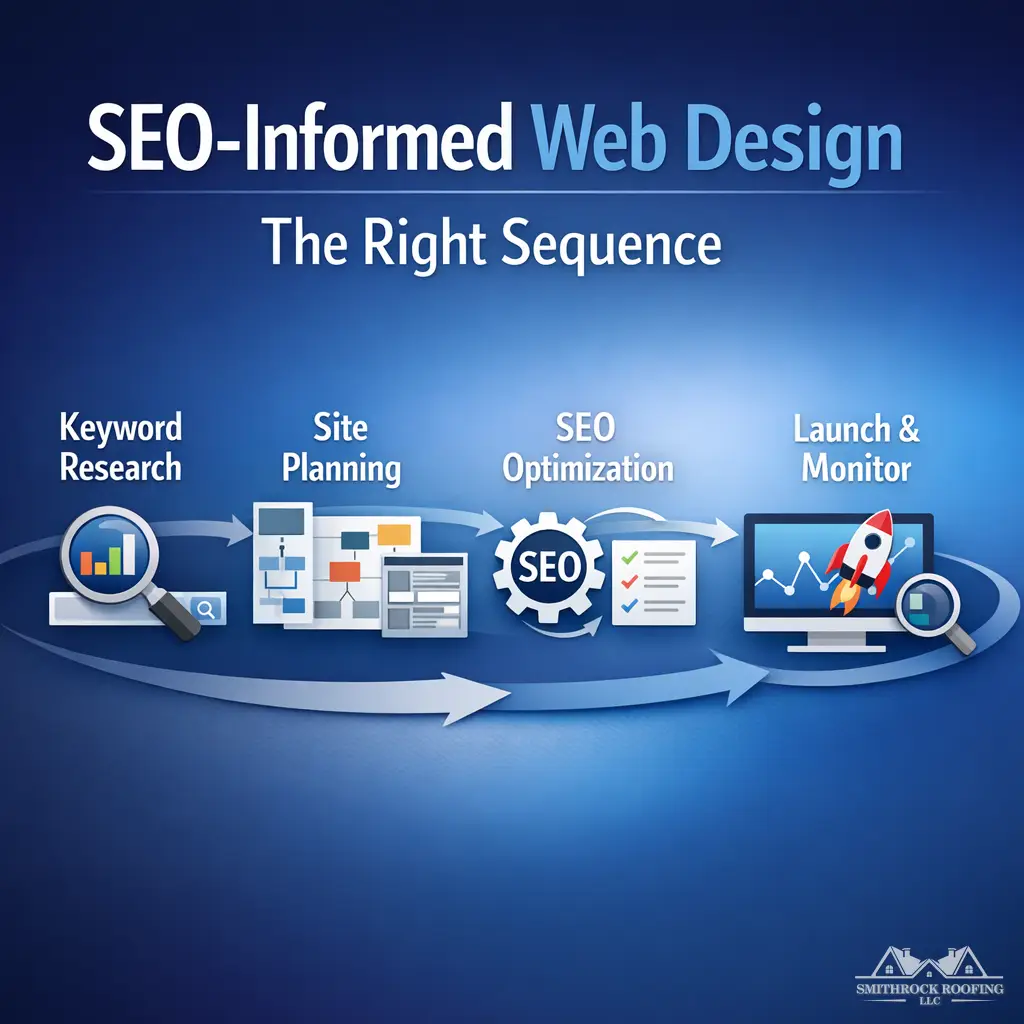
What SEO-Informed Design Sequencing Actually Looks Like
Before a single wireframe gets drawn, a strategically sound process requires that four things are established:
1. URL Structure Audit and Link Equity Mapping
Every existing URL that carries inbound links or ranking signals needs to be catalogued. If the redesign changes those URLs — even slightly — 301 redirects must be planned and implemented at launch, not discovered as an afterthought post-launch. Link equity that passes through a broken or missing redirect is link equity that evaporates.
2. Keyword-to-Page Mapping
Each page on the new site should have a defined primary keyword target before the content brief or design template is created. This determines heading hierarchy, content length requirements, and internal linking priorities. Without this map, you end up with beautiful pages that no one searches for and find.
3. Core Web Vitals Baselines Built Into the Design Brief
Google’s Core Web Vitals — Largest Contentful Paint (LCP), Interaction to Next Paint (INP), and Cumulative Layout Shift (CLS) — are direct ranking signals. These thresholds need to be embedded in the technical requirements given to the design and development team, not measured after the site goes live. A design that loads a full-screen hero video at 8MB is not an SEO-compatible design, regardless of how good it looks.
4. Internal Linking Architecture Planned at Sitemap Stage
Internal links distribute authority across your site and tell search engines which pages are most important. If internal linking is left to content editors after launch, you almost always get an inconsistent, shallow structure that fails to reinforce your most valuable pages. Planning it at the sitemap stage means the navigation, footer links, and in-content link placements are all deliberately aligned with your ranking priorities.
The Domain Authority Asymmetry Problem: Why Small Businesses Need a Different SEO Strategy
Here’s something most agencies won’t say plainly: a small business cannot compete with a national brand for broad, high-volume keywords in the first 12 to 18 months of an SEO campaign. Trying to do so is not ambitious — it’s a misallocation of budget that produces negligible results and frustrated clients.
This isn’t a commentary on effort or quality. It’s a structural reality driven by domain authority asymmetry.
National brands carry years of accumulated backlinks from high-authority sources, massive content libraries that signal topical depth to search engines, and the kind of brand-name search volume that Google treats as an implicit trust signal. A small business starting from a domain with minimal backlink history is not competing on a level field for those terms.
The right response to this reality is not to give up on SEO. It’s to compete where you can win.
Topical Authority: The Small Business Equalizer
Search engines increasingly evaluate websites not just on the strength of individual pages, but on topical authority — the depth and consistency of expertise a site demonstrates across a defined subject area.
A small business that systematically builds a tightly scoped content cluster around its core service area can establish genuine topical authority in that niche, even against competitors with larger domains. This requires a specific architectural approach:
- A central pillar page that provides comprehensive coverage of the primary topic (your main service or location-service combination)
- Supporting cluster pages that address specific subtopics, questions, and related services that link back to the pillar
- Consistent internal linking that reinforces the topical relationship between pages
This model is not how most small business websites are built. The typical small business site is a flat brochure: Home, About, Services, Contact. That structure signals nothing to search engines about topical depth. It competes for nothing specific and ranks for almost nothing as a result.
Long-Tail Keywords: A Strategic Necessity, Not a Fallback
For small businesses, targeting long-tail, intent-specific queries isn’t a second-best option — it’s the only mathematically viable path to organic visibility in competitive niches during the early months of an SEO campaign.
Consider the difference between targeting “web design” (estimated monthly search volume in the hundreds of thousands, dominated by massive platforms and national agencies) versus “web design services for HVAC companies in Charlotte” (far lower volume, dramatically lower competition, extremely high purchase intent). The second query is winnable. The first is not — not yet, and not without a long investment horizon.
Long-tail targeting also aligns naturally with conversion intent. A user searching a specific, detailed query is further along in their decision-making process than someone running a broad informational search. That specificity translates directly to higher conversion rates on the traffic that does arrive.
Crawl Budget: The Hidden Constraint on Small Business SEO
For high-authority domains, crawl budget — the number of pages search engine bots will crawl and index within a given period — is rarely a limiting factor. For small business websites, it can be a genuine constraint that slows down ranking timelines.
Poor internal linking, orphaned pages (pages with no internal links pointing to them), bloated navigation structures, and duplicate content all cause search engine crawlers to waste their allocation on low-value pages instead of discovering and indexing your priority content. The practical result: new pages take longer to appear in search results, and thin or redundant pages dilute your site’s overall quality signals.
The fix isn’t complicated, but it requires deliberate architecture: clean site structure, flat navigation hierarchies where possible, intentional internal linking, and regular crawl audits to identify and eliminate orphaned or duplicated pages. If you want to go deeper on the specific issues that commonly drag down small business rankings, the article The Small Business Technical SEO Audit: 10 Hidden Website Issues That Are Killing Your Google Rankings covers each one in detail.
Web Design Decisions That Actually Drive Conversions for Small Businesses
Competitors in this space consistently describe web design using aesthetic language: “beautiful,” “polished,” “compelling visuals.” These are not the decisions that drive business results.
For a small business website, the highest-ROI design decisions are functional and behavioral, not decorative.
The Four Functional Design Factors That Determine Performance
| Design Factor | What Most Agencies Focus On | What Actually Drives Results |
|---|---|---|
| Page Load Speed | Visual design quality | LCP under 2.5 seconds; image compression; deferred non-critical scripts |
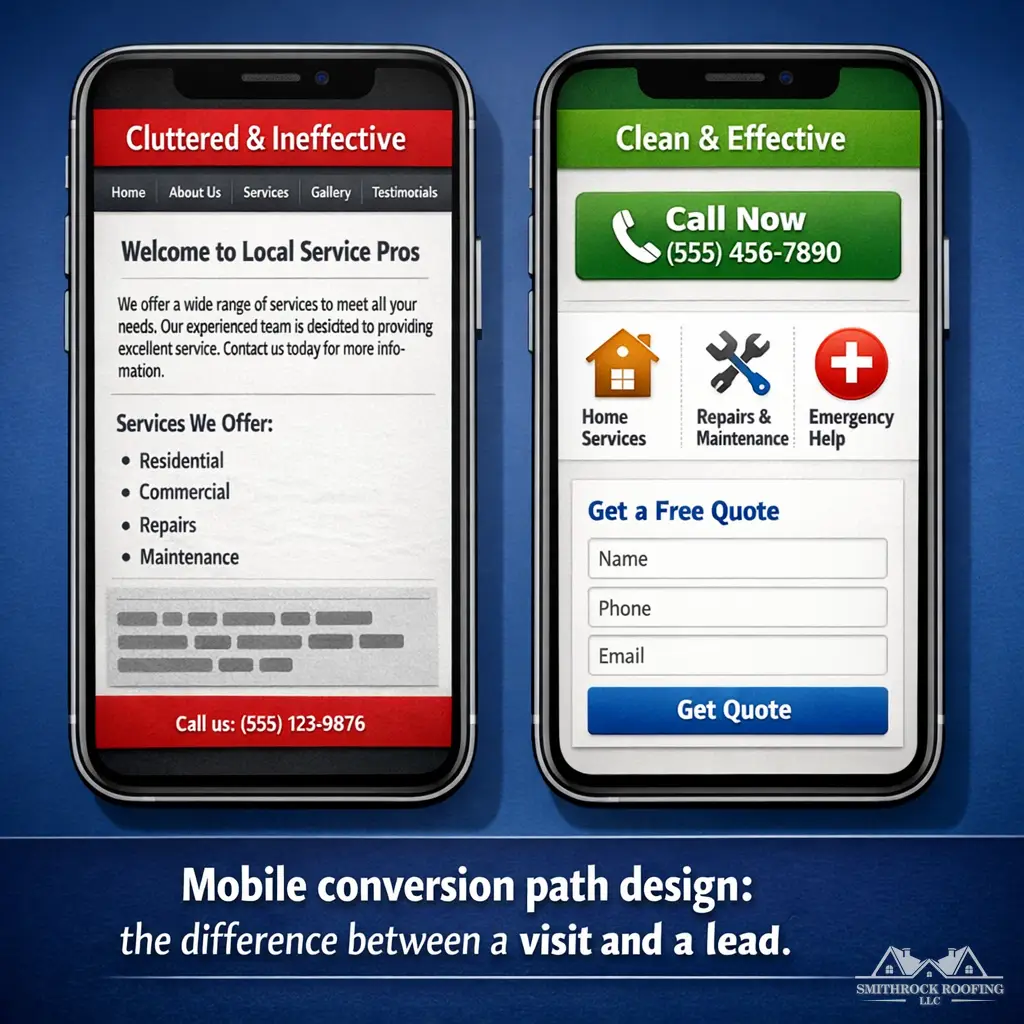
| Mobile Conversion Path | Responsive layout (does it fit the screen?) | Single-thumb navigation; tap target sizing; click-to-call above the fold |
| Form Friction | Form exists on the page | Field count reduction; inline validation; trust signals adjacent to submit button |
| CTA Placement | “We have a contact button” | Heat map-informed placement; above-fold primary CTA; contextual secondary CTAs on service pages |
| Heading Hierarchy | Visual sizing for aesthetics | H1–H3 structure aligned with keyword targets; scannable benefit statements |
| Trust Architecture | Logo placement | Reviews, certifications, and case study references positioned at decision points in the page flow |
Page load speed deserves specific emphasis for small businesses. Studies consistently show that each additional second of load time reduces conversion rates measurably. For a small business running paid traffic to a landing page or relying on organic rankings, a slow site is not just a technical problem — it’s a direct drain on revenue. Google also incorporates load speed into its ranking algorithms via Core Web Vitals, meaning a slow site underperforms in both organic rankings and user behavior simultaneously.
Mobile conversion path design matters enormously for service-based small businesses. A significant majority of local searches happen on mobile devices. If a potential customer searching “emergency plumber near me” lands on your site and can’t find your phone number within three seconds on a mobile screen, they’re back to the search results page. Your competitor’s phone is ringing instead of yours.
Local SEO Architecture: Beyond the Google Business Profile
Most conversations about local SEO for small businesses start and stop at the Google Business Profile. Optimize your profile, get reviews, post updates. That’s the full advice.
That advice isn’t wrong — it’s just incomplete. The relationship between your website architecture and your local search visibility is direct and significant, and it’s almost never discussed at the level of specificity that actually helps businesses make decisions.
The Three Technical Pillars of Local SEO for Small Business Websites
NAP Consistency and Citation Architecture
NAP stands for Name, Address, Phone Number. For local SEO, consistency of this data across every online mention of your business — your website, Google Business Profile, Yelp, industry directories, chamber of commerce listings, local news mentions — is a trust signal that search engines use to verify your business’s legitimacy and location relevance.
Inconsistencies in NAP data (different phone number formats, abbreviated vs. full street address, old addresses that haven’t been updated) dilute that trust signal. A citation audit — systematically identifying and correcting NAP inconsistencies across directories — is one of the highest-leverage, lowest-cost local SEO improvements a small business can make.
Local Schema Markup
Schema markup is structured data you add to your website’s code that explicitly tells search engines what your business is, where it operates, what it offers, and how customers can contact you. For local businesses, the most important schema types are:
- LocalBusiness schema — defines your business type, address, phone number, hours, geographic service area, and price range
- FAQPage schema — structures your FAQ content so search engines can surface specific answers directly in search results
- Review schema — enables star ratings to appear in search result listings, increasing click-through rates
None of this is visible to website visitors. All of it directly influences how search engines and AI systems interpret and represent your business. Yet the majority of small business websites are launched without any structured data in place.
The Website-to-Local-Pack Relationship
The Google Local Pack — the map-based results that appear at the top of local search queries — is influenced by more than just your Google Business Profile signals. Website authority, on-page optimization for local keywords, and the quality of your backlink profile from locally relevant sources all contribute to Local Pack rankings.
Specifically, backlinks from local organizations — regional news outlets, local chambers of commerce, industry associations with geographic chapters, local event sponsorships — carry disproportionate weight for local SEO. They signal to search engines that your business is genuinely embedded in its community, not just operating a website that mentions a city name. For a practical breakdown of how to fully leverage your Google Business Profile alongside these signals, see our article on Google Business Profile Optimization Tips That Actually Work.
AI Search Visibility: What Small Businesses Actually Need to Do
The emergence of AI-generated search results — Google’s AI Overviews, responses from Perplexity, and direct answers from conversational AI tools — represents a genuine shift in how customers find businesses. Multiple agencies have started using terms like “GEO” (Generative Engine Optimization) and “AEO” (Answer Engine Optimization) to describe optimization for these systems. Almost none of them explain what that optimization actually involves.
Here’s what it actually involves, specifically for small businesses.
Three Structural Requirements for AI Search Visibility
1. Entity Establishment
AI systems don’t just index web pages — they build models of real-world entities: businesses, people, places, concepts. For your business to surface in AI-generated answers, it needs to be recognizable as a distinct, well-defined entity across the web.
This means:
– Consistent business name, address, and contact information across all online properties
– A well-structured Google Business Profile that corroborates the information on your website
– Structured data (LocalBusiness schema, at minimum) that explicitly defines your business to machine readers
– Presence in authoritative directories and industry databases that AI systems treat as reliable reference sources
A business that exists only as a website with minimal external mentions is not yet an entity in the way AI systems understand entities. It’s just a page.
2. Citability of Content
AI-generated answers cite sources. For your business to be cited — for a potential customer asking an AI tool “who does commercial HVAC maintenance in Phoenix?” to see your business recommended — your content needs to meet a higher bar than a typical keyword-optimized service page.
Citable content is comprehensive, well-structured, and demonstrates genuine expertise on a specific, narrow topic. For a small business, this means having at least one cornerstone resource page per primary service that fully addresses the questions a decision-ready customer would ask: what the service involves, what problems it solves, what the process looks like, what factors affect outcomes, and why your business is qualified to deliver it.
A service page that contains two paragraphs and a list of bullet points will not be cited by an AI system. A page that genuinely and completely addresses a customer’s question will.
3. Trust Signal Density
AI systems, like traditional search algorithms, weight content from sites that have accumulated credible trust signals. For small businesses, the most accessible trust signals are:
- Backlinks from local news outlets (sponsorship coverage, press mentions, community involvement stories)
- Listings and links from industry associations and certification bodies
- Verified review signals from Google and industry-specific platforms
- Consistent structured data that corroborates business information across multiple authoritative sources
This is not a new concept — trust signals have always influenced search rankings. What’s changed is that AI systems appear to weight entity trustworthiness more heavily than traditional algorithms did, because the cost of citing an untrustworthy source in a direct recommendation is higher than the cost of ranking one among ten blue links.
Evaluating Web Design and SEO Services: What to Actually Ask
When assessing any agency offering combined web design and SEO services, the difference between a vendor and a genuine growth partner shows up in the specificity of their answers to direct questions.
Questions That Reveal Real Capability
“What is your process for protecting existing rankings during a redesign?” Any agency that doesn’t immediately reference URL mapping, 301 redirects, and pre-launch crawl testing hasn’t navigated a migration that went wrong — or they have and aren’t being transparent about it.
“How do you approach keyword targeting for a business in a competitive local market?” The answer should include explicit acknowledgment that broad, high-volume terms are not viable early targets for a site without established authority, and a clear explanation of how they identify winnable long-tail opportunities.
“What schema markup will be implemented on the site at launch?” If the answer is “we’ll handle SEO after the site is live,” that’s a red flag. Schema is a design and development deliverable, not a post-launch add-on.
“How do you measure success in the first 6 to 12 months, given the lag between SEO investment and organic results?” The honest answer acknowledges that timeline reality directly. Organic SEO does not produce overnight results, and an agency that implies otherwise is either overpromising or steering you toward paid channels without being transparent about why.
“Can you show me an example of a content architecture you’ve built for a small business, and explain why it’s structured that way?” This question separates agencies that write content from agencies that build topical authority. You want to see evidence of intentional structure: pillar pages, cluster content, internal link maps.
At Mongoose Digital Marketing, we work with small businesses across a range of industries and service areas, applying exactly the kind of integrated, architecture-first approach this article describes. Our process starts before the wireframe, covers the full technical stack from structured data to crawl optimization, and is measured against the metrics that actually reflect business growth — not vanity numbers that look good in a report but don’t connect to revenue.
If you want a direct conversation about what this looks like for your specific business, we offer a free consultation. No obligation, no hard pitch — just an honest assessment of where your current digital presence stands and what the highest-leverage next steps are.
Strategic Recommendations for 2026
Small businesses entering or refining their digital presence in 2026 face a landscape that continues to reward specificity, technical rigor, and genuine topical authority. Three recommendations stand out as particularly high-leverage for the coming year.
1. Prioritize AI-Overview Optimization Alongside Traditional SEO
Google’s AI Overviews now appear for a significant share of informational and local queries. To appear in these summaries, your content needs to answer questions with structured clarity — concise paragraphs, direct answers near the top of the page, and supporting detail below. This is not a separate tactic from SEO; it is an extension of the same principles. Businesses that structure content with genuine depth and clear hierarchy will benefit from both traditional ranking signals and AI-generated visibility.
2. Invest in a Local Content Cluster Before Expanding Broadly
Rather than producing general blog content, build a tightly linked set of pages around your specific service area and primary service categories. A local plumbing company in a mid-sized city, for example, is better served by ten well-structured pages targeting the neighborhoods and problem types they actually serve than by fifty generic how-to articles. Use tools like Google Search Console, Semrush, or Ahrefs to identify the specific long-tail queries your local competitors are ranking for and are not yet defending well. These are your entry points. For a deeper look at how this plays out in practice, the article SEO for Lead Generation 2026: What Actually Drives Pipeline walks through the pipeline mechanics behind content-driven organic growth.
3. Conduct a Technical SEO Audit Before Any Site Redesign
If a redesign is on your roadmap, commission a technical audit first. Businesses routinely destroy years of accumulated ranking signals by migrating to a new site without preserving URL structures, redirect chains, or structured data. A pre-redesign audit documents what is working so it can be intentionally carried forward, not accidentally discarded.
Frequently Asked Questions
How long does it take for SEO to show results for a small business?
Most small businesses begin to see measurable movement in organic rankings and traffic between four and nine months after a comprehensive SEO effort begins. The timeline depends on how competitive the local market is, how much content and authority already exists on the site, and how consistently the strategy is executed. Early months typically focus on technical corrections and content architecture that lay the foundation for ranking gains. Businesses that expect meaningful organic results within the first sixty days are usually working with unrealistic expectations set by an agency more interested in closing a deal than delivering an honest roadmap.
What is the difference between a website redesign and a website rebuild, and does it matter for SEO?
A redesign typically refers to visual and layout changes while preserving the underlying structure and content. A rebuild involves rebuilding the site from the ground up, often on a new platform or CMS. The distinction matters significantly for SEO because a full rebuild carries higher risk of losing existing ranking signals if not managed carefully. Redirect mapping, URL structure preservation, metadata migration, and structured data implementation all need to be handled deliberately during a rebuild. Working with a team that treats SEO as part of the development process — not a post-launch task — is the difference between a site that climbs in rankings and one that resets to zero.
Should a small business invest in paid search or organic SEO first?
These channels serve different purposes and different timelines. Paid search delivers visibility immediately but stops the moment you stop paying. Organic SEO compounds over time and builds an asset that continues generating traffic without a per-click cost. For most small businesses, the most effective approach is using paid search tactically in the short term — particularly for high-intent, transactional queries — while building the organic foundation that will eventually carry the majority of the load. Any agency that recommends paid search exclusively without a parallel organic strategy is optimizing for their own billing cycle, not your long-term growth.
What should be included in a professional small business website at launch?
A well-built small business website should launch with a clear service or product architecture, location and service-area pages optimized for local search, schema markup covering at minimum business type, location, reviews, and services, a technically clean crawl structure with no broken links or duplicate content issues, and a Core Web Vitals score that meets current Google thresholds on both mobile and desktop. These are not optional enhancements to add later — they are the baseline. A site that launches without them starts behind and spends months recovering ground that should never have been lost.
Conclusion
Choosing the right partner for web design and local SEO services is one of the highest-leverage decisions a small business can make, and it deserves the same rigor you’d apply to hiring a key employee. At Mongoose Digital Marketing, we build websites and SEO strategies as a single integrated system — because that is the only approach that consistently produces durable results in competitive local markets. If you are ready to have an honest conversation about where your current digital presence stands and what it would take to build something that actually grows your business, we are here for it.