

Key Takeaways
- Dayton’s geographic sprawl across the Miami Valley creates distinct Local Pack competitive zones — businesses in suburbs like Beavercreek, Centerville, and Kettering can dominate suburb-level search queries where competition is significantly thinner than broad “Dayton” keywords.
- Google’s Vicinity Update disproportionately affected businesses in dispersed metro areas like the Miami Valley corridor, meaning proximity signals now carry more weight than they did before November 2021 — a factor most Dayton businesses have never accounted for in their SEO strategy.
- Dayton’s three dominant economic sectors — defense/aerospace B2B, healthcare, and consumer services — each require a fundamentally different SEO approach; a single campaign structure applied across all three wastes resources and underperforms in each.
- Consistent structured data, citation accuracy, and Google Business Profile optimization are not just traditional SEO prerequisites — they are the same foundational assets that determine whether AI systems like Google Gemini and ChatGPT cite your Dayton business accurately in conversational search results.
- Topical authority — owning a subject area through interconnected, in-depth content — drives sustainable organic rankings for Dayton businesses far more reliably than isolated blog posts or keyword-stuffed service pages.
If you’ve spent any time researching SEO for your Dayton-area business, you’ve likely encountered a parade of agency websites making nearly identical promises. They list the same service categories, flash the same certification badges, and occasionally mention Wright-Patterson Air Force Base or the Oregon District to signal local credibility. Then the page ends, and you’re no closer to understanding what actually drives search rankings in the Miami Valley — or whether the agency in question has the strategic depth to move the needle for your specific business.
That gap between marketing language and genuine market expertise is exactly what this guide is designed to close.
Search engine optimization in Dayton, Ohio is not a generic service that transfers cleanly from Columbus or Cincinnati or any other regional market. Dayton has a specific economic composition, a distinct geographic structure, and a local search competitive landscape that rewards businesses who understand those dynamics — and quietly punishes those who apply template strategies built for somewhere else.
What follows is a practitioner-level breakdown of how SEO actually works in this market, where the real competitive opportunities are, and what a results-driven strategy looks like when it’s built around Dayton’s specific realities rather than a recycled playbook.
Why Dayton’s Geography Changes Your SEO Strategy
Most businesses think about SEO in terms of a single city. You’re in Dayton, you want to rank in Dayton, so you optimize for Dayton. That logic is understandable — and it’s costing you visibility.
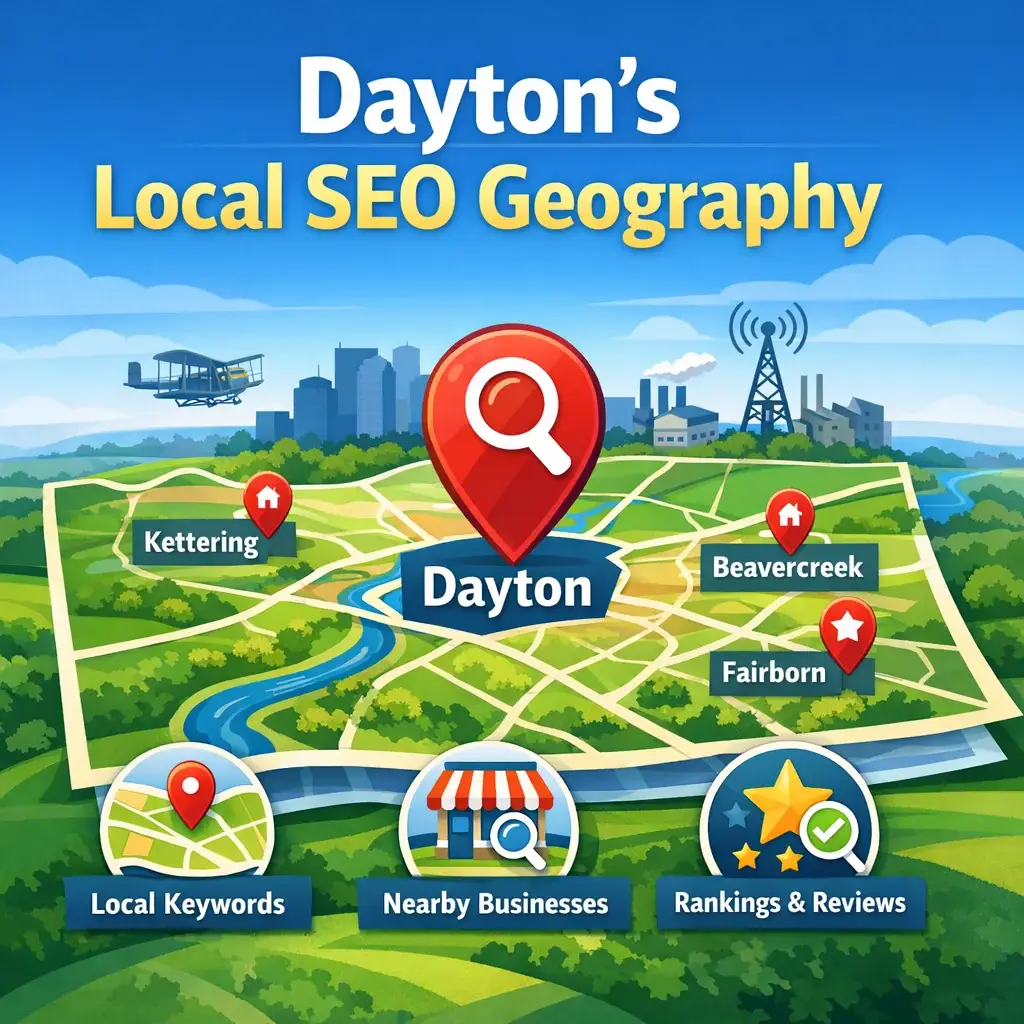
The Miami Valley is not a single search market. It’s a cluster of distinct communities — Kettering, Beavercreek, Centerville, Huber Heights, Miamisburg, Springboro — each functioning as its own search ecosystem with different competitive densities, different buyer demographics, and different Local Pack dynamics. Google does not treat “Dayton” as a monolithic market any more than a local resident would conflate Beavercreek with Trotwood.
The Suburb-Level Opportunity Most Businesses Ignore
The Google Local Pack — the map-based results that appear at the top of local searches — captures a disproportionate share of high-intent clicks. Studies consistently show the top Local Pack position earns between 30 and 44 percent of all clicks on local search results pages. For service businesses, that real estate is often more valuable than the first organic ranking below it.
Here’s what most Dayton businesses miss: the competitive density inside the Local Pack varies dramatically by suburb. A broad search for “HVAC company Dayton Ohio” puts you in direct competition with every established HVAC contractor in Montgomery County. The same search for “HVAC company Beavercreek” or “HVAC company Centerville Ohio” operates in a substantially thinner field. The search intent is identical — a homeowner needs a technician — but the number of businesses fighting for that three-pack position drops considerably.
This suburb-level asymmetry exists across virtually every consumer service category: attorneys, dentists, plumbers, electricians, landscapers, physical therapists, financial advisors. The businesses winning regional market share in the Miami Valley are not always out-ranking competitors on broad Dayton keywords. Many of them are methodically claiming Local Pack positions across five or six suburb-level queries where the competition never showed up.
Proximity vs. Prominence: Where You’re Located and What You Can Still Win
Google’s local ranking algorithm weighs three primary factors: relevance, distance (proximity), and prominence. Since the Vicinity Update rolled out in November 2021, proximity has carried significantly more weight. This update hurt businesses that had built strong prominence signals but were physically located further from the searcher — a dynamic that hit many Miami Valley businesses hard, particularly those in suburban locations trying to rank for searches centered on Dayton proper.
The practical implication: if your business is physically located in Miamisburg or Springboro, you should not be treating “Dayton Ohio” as your primary Local Pack target. You will almost always lose that proximity contest to businesses closer to the Dayton city center. Instead, your strategy should be structured around the geography you can realistically win — dominating Local Pack results in your immediate service area while building prominence signals robust enough to pull in adjacent suburb queries.
For businesses that serve multiple parts of the Miami Valley, this means a deliberate location page architecture on your website, strategic expansion of your Google Business Profile service area designations, and a citation network that consistently reflects your actual service geography — not just your physical address.
Dayton’s Three Search Markets — And Why One Strategy Fails All of Them
Dayton’s economy is not homogeneous, and its search behavior reflects that. The businesses that build sustainable search visibility in this market recognize that Dayton contains at least three functionally distinct search environments — each requiring a different optimization logic.
Defense and Aerospace B2B: Depth and Authority Over Local Signals
Wright-Patterson Air Force Base is the largest single-site employer in Ohio. The base’s presence anchors an ecosystem of defense contractors, engineering firms, advanced manufacturing suppliers, and specialized professional services that stretch across the I-675 corridor into Beavercreek, Fairborn, and beyond. Companies like L3Harris, Northrop Grumman, and SAIC maintain significant regional footprints, and their supply chains generate a dense network of B2B vendors competing for contract work and partnership visibility.
Search behavior in this vertical looks nothing like consumer service queries. Decision-makers are not typing “best defense contractor near me.” They’re using highly specific technical terminology, NAICS codes, capability descriptors, and sometimes RFP-adjacent search strings. The geographic component of the query often matters less than the specificity and authority of the content they find.
For B2B businesses serving this sector, effective SEO prioritizes:
- Domain authority and topical depth over local citation density
- Long-form technical content that demonstrates genuine subject matter expertise — engineering whitepapers, capability statements, case studies with verifiable outcomes
- Entity establishment through mentions in industry publications, government contractor registries, and authoritative third-party sources
- Structured data markup that clearly defines the organization’s capabilities, certifications, and service categories to Google’s Knowledge Graph
Local SEO signals (Google Business Profile optimization, NAP citations in local directories) are secondary in this context. A defense supplier in Beavercreek is not going to win or lose contracts based on their Yelp review count. They win or lose based on whether their website demonstrates the depth and credibility that sophisticated B2B buyers expect.
Healthcare and Medical Services: YMYL Competition With Non-Negotiable E-E-A-T Requirements
Premier Health and Kettering Health operate as dominant regional systems, and their affiliated practice networks create intense search competition across virtually every medical specialty. Layer in the independent practices, urgent care chains, specialty clinics, and ancillary healthcare services competing for the same patients, and you have one of the most competitive SERP environments in the entire market.
Google classifies medical, health, and financial content under “Your Money or Your Life” (YMYL) guidelines — categories where the quality and accuracy of information can directly affect user wellbeing. The ranking requirements in YMYL categories are materially stricter. Google’s algorithm looks for demonstrable Experience, Expertise, Authoritativeness, and Trustworthiness (E-E-A-T) signals before surfacing health-related content.
For Dayton healthcare providers and medical service businesses, this means:
- Physician and practitioner credential markup using structured schema that explicitly identifies the qualifications of the people behind the content
- Review velocity and quality management — consistent accumulation of high-quality Google reviews, with active responses, is a non-negotiable ranking factor in this category
- Medical and health schema implementation — including MedicalOrganization, MedicalWebPage, and Physician schema types — to ensure Google can accurately classify and surface your content
- Content accuracy and citation standards that match what a medical professional audience would recognize as credible — not general wellness blog writing
The practices that underestimate these requirements and apply standard SEO tactics to healthcare content consistently underperform against competitors who treat E-E-A-T compliance as a foundational investment rather than an optional enhancement.
Consumer Services and Retail: Hyper-Local Content and Community Signals
In the residential neighborhoods of Huber Heights, Trotwood, and similar communities across the Miami Valley, the ranking dynamics shift again. Broad domain authority matters less. What drives Local Pack and organic visibility in these markets is the combination of hyper-local content relevance and authentic community presence signals.
This is where businesses often make the mistake of applying the same content strategy they’d use for any mid-sized market — writing generic service pages and hoping broad keyword volume does the work. The Dayton consumer market, particularly in blue-collar and working-class residential communities, responds to trust signals that are rooted in demonstrable local presence: references to specific neighborhoods, service history in the community, connections to local organizations, and reviews from recognizably local customers.
An effective content strategy for consumer service businesses in these markets includes:
- Neighborhood-specific service pages with genuine content differentiation (not just swapped city names)
- Community event participation and local sponsorship mentions that generate authentic local citations
- Google Business Profile posts that reference seasonal and community-specific context
- Review generation strategies targeting specific geographic areas within the service radius
The Local Algorithm Mechanics Dayton Businesses Should Actually Understand
Beyond the geographic and industry-specific strategy, there are specific technical dynamics that determine where Dayton businesses appear in local search — and most businesses operating here have never been walked through them in concrete terms.
Google Business Profile Category Selection: The Decision Most Businesses Get Wrong
Your primary Google Business Profile category is one of the highest-weight local ranking signals available. It directly influences which search queries Google considers your business relevant for, and it shapes the competitive set you’re placed against in the Local Pack.
The error most Dayton businesses make is selecting the broadest applicable category rather than the most precise one. A personal injury law firm selecting “Law Firm” instead of “Personal Injury Attorney” is competing in a larger, more diluted pool. An HVAC company selecting “HVAC Contractor” when “Air Conditioning Contractor” or “Heating Contractor” would be more precise is leaving categorical relevance signals on the table.
Secondary category selection compounds this — most businesses either skip secondary categories entirely or select them without any keyword intent mapping. A complete category strategy involves:
- Mapping your primary category to the highest-value keyword intent you’re targeting
- Selecting secondary categories that reflect actual service lines (not aspirational ones)
- Cross-referencing your category selections against what Google is surfacing for your top target queries — not just what seems logical from the inside
For a deeper breakdown of how to structure and optimize your profile for maximum Local Pack visibility, the Google Business Profile optimization tips that actually work article walks through each element in detail.
NAP Consistency and the Dayton Citation Ecosystem
Name, Address, Phone (NAP) consistency across the web is table stakes for local SEO, but the specific citation sources that carry authority weight differ by market. In Dayton, the local citation ecosystem includes sources that national-template agencies frequently overlook:
| Citation Source | Category | Local Authority Value |
|---|---|---|
| Dayton Daily News business listings | Local Media | High |
| Dayton Area Chamber of Commerce | Regional Business | High |
| Better Business Bureau — Dayton Accreditation | Trust Signal | High |
| Ohio Secretary of State business registry | Government | High |
| Dayton Business Journal listings | Regional Business | Medium-High |
| Greater Dayton area neighborhood associations | Hyper-Local | Medium (varies) |
| Ohio-specific industry associations | Vertical-Specific | Medium-High |
| National aggregators (Data Axle, Neustar/Localeze) | Foundational | Medium |
Inconsistencies in NAP data — even minor variations like “St.” vs. “Street” or a suite number that appears on some listings but not others — create citation signals that partially cancel each other out. For businesses in competitive Dayton categories, a full citation audit and remediation process is not optional maintenance. It’s a ranking factor with direct measurable impact.
Schema Markup and Local Pack Eligibility
Structured data markup — schema — communicates directly with Google’s Knowledge Graph about who your business is, what you do, where you operate, and what attributes are associated with your brand. For local businesses in Dayton, LocalBusiness schema is the foundational layer, but the specificity of implementation separates businesses that benefit from it from those who deploy it as a checkbox.
Effective LocalBusiness schema implementation for Dayton businesses includes:
- Exact address matching to your Google Business Profile
- Service area markup that accurately reflects your operational geography (relevant for businesses serving multiple Miami Valley communities)
- Geo-coordinates embedded in schema
- Opening hours with special hours for holidays
- Aggregate rating markup pulling from verified review sources
- HasMap property linking to your Google Maps listing
- Service or Product schema nested within the LocalBusiness schema to communicate specific offerings
Businesses operating in Dayton’s healthcare vertical should layer in MedicalOrganization or Physician schema. Legal practices should implement LegalService and Attorney schema. These vertical-specific types communicate categorical authority signals that generic LocalBusiness markup alone cannot provide.
Topical Authority vs. Individual Keywords: The Architecture That Drives Sustainable Rankings
Most Dayton businesses approach content creation the same way: identify keywords, write a page for each one, publish, and wait. This approach produces modest results at best and fails entirely in competitive categories.
The reason is that Google does not rank pages in isolation. It ranks domains — evaluating whether a website comprehensively covers a subject area before deciding how much authority to extend to individual pages within it. This concept, often called topical authority, is the strategic difference between ranking sustainably and ranking temporarily.
Building Topical Authority in Dayton’s Competitive Categories
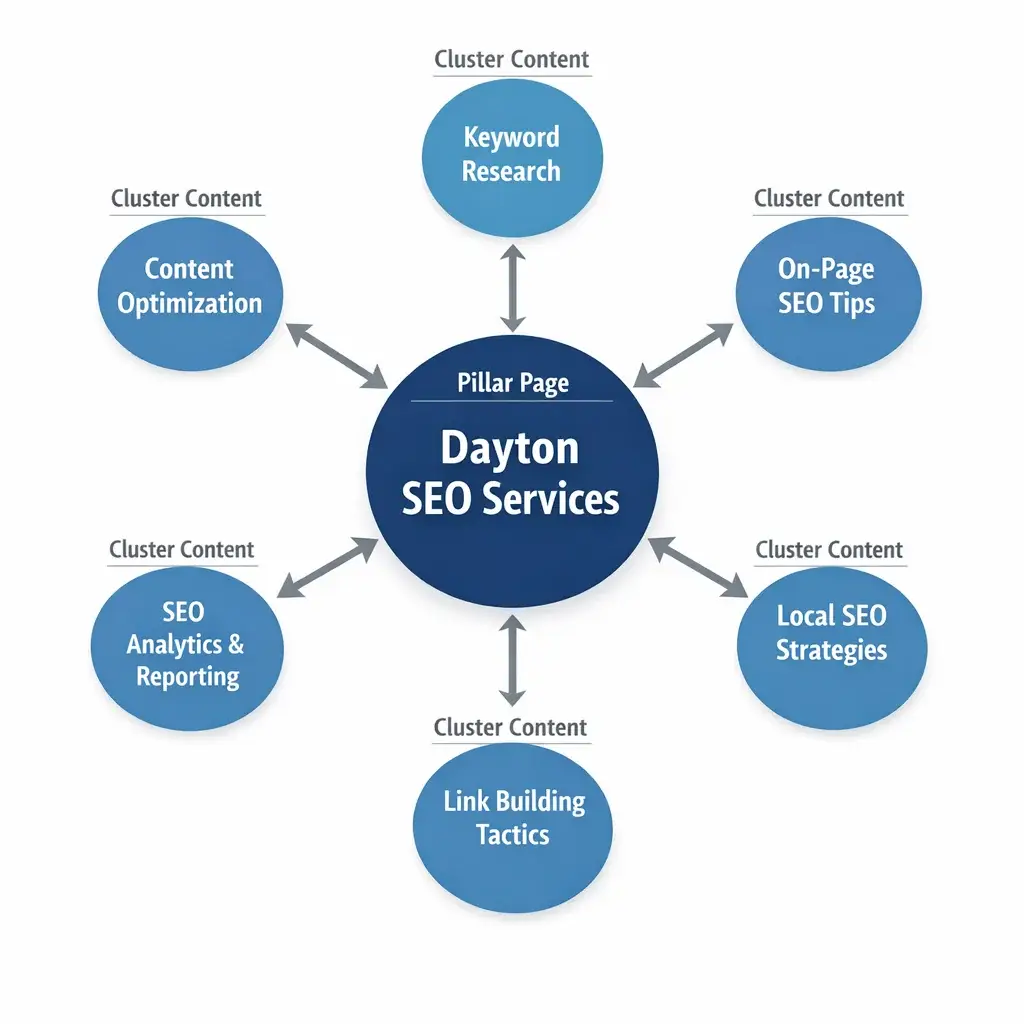
A topical authority architecture starts with a pillar page — a comprehensive, in-depth resource covering a broad subject area — and surrounds it with cluster content that covers specific subtopics in depth. The internal linking between cluster pages and the pillar page creates a semantic content structure that Google’s algorithm recognizes as evidence of subject matter expertise.
For a Dayton HVAC company, this might look like:
- Pillar: “HVAC Services in Dayton, Ohio” — a comprehensive overview page covering the full service suite
- Clusters: Separate in-depth pages covering furnace replacement, AC installation, heat pump efficiency, indoor air quality, emergency HVAC service, seasonal maintenance checklists, and specific suburb service pages for Kettering, Beavercreek, Centerville, and Miamisburg
Each cluster page answers a specific searcher question in full, links back to the pillar for broader context, and cross-links to adjacent cluster pages where topically relevant. The result is a content structure that signals comprehensive expertise in HVAC — not just keyword presence — and builds the domain authority that allows individual pages to rank for competitive terms.
This architecture approach applies regardless of industry vertical. The businesses that build it consistently out-rank competitors who publish isolated content pieces, because Google extends more ranking authority to sites that demonstrably own a subject area than to sites that merely mention relevant keywords. For a practical walkthrough of how this applies to local SEO in Dayton and how Google rankings work, that article covers the underlying algorithm mechanics in detail.
AI Search Visibility: Why Your Traditional SEO Foundation Determines Your AI Presence
The conversation about AI and search is generating significant noise in the marketing space, but most of that conversation lacks the technical specificity that would actually help Dayton business owners make informed decisions. Here is the mechanism that matters.
Google Gemini, ChatGPT, and other AI systems do not discover your business independently. They draw from the same structured data ecosystem — Google’s Knowledge Graph, citation networks, authoritative third-party mentions, and structured schema — that powers traditional local search. A business with weak local SEO foundations does not simply miss traditional organic rankings. It also lacks the data infrastructure that AI systems need to accurately describe, locate, and recommend that business in conversational search responses.
The Hallucination Risk for Dayton Businesses
When AI systems encounter a business with inconsistent NAP data, thin or absent schema markup, minimal authoritative citations, and sparse content, they face a data gap. To fill it, they sometimes generate plausible-sounding but inaccurate information — wrong service descriptions, outdated addresses, incorrect phone numbers, inaccurate service areas. This is the hallucination risk.
For a Dayton business that has spent years building a reputation, having an AI system confidently describe your company incorrectly to a prospective customer is a tangible business problem — not a theoretical future concern. The fix is the same foundational work that improves traditional local search rankings: citation auditing and remediation, schema implementation, consistent Google Business Profile maintenance, and authoritative content depth.
“Near Me” Queries in the AI Era
Traditional search handles location-intent queries through proximity detection and local index matching. Conversational AI handles them differently — drawing from business information that has been sufficiently structured and cited to be reliably associated with a specific location.
For Dayton businesses, the practical preparation for AI-driven local search is not a separate technical project. It is the outcome of doing traditional local SEO correctly: consistent NAP, accurate and complete Google Business Profile, structured schema, authoritative local citations, and content that clearly communicates your service geography.
The businesses that will maintain visibility as AI search becomes a larger share of the discovery channel are the ones who treat their foundational local SEO infrastructure as a long-term asset — not a one-time setup task.
Competitive Intelligence: What a Real Dayton SEO Strategy Starts With
Every effective Dayton SEO engagement begins with competitive analysis, and that analysis should go well beyond keyword research. The question is not only “what keywords should we target?” It’s “what is Google actually rewarding in this specific category right now, and what gap exists between what’s ranking and what our site currently offers?”
A rigorous competitive intelligence process for Dayton search looks at:
- Top-ranking page content depth: How comprehensively does each ranking page cover the topic? What questions does it answer that other competitors don’t?
- Backlink profile benchmarks by category: What does the link profile of a page ranking #1 for “attorney Dayton Ohio” look like versus the same position for “plumber Kettering Ohio”? The link authority thresholds are dramatically different.
- Google Business Profile optimization parity: Are the businesses in the Local Pack for your target queries using the same primary categories, have more reviews, or demonstrate stronger Q&A activity than your current profile?
- Technical performance gaps: Do the ranking competitors have faster Core Web Vitals scores, cleaner crawl architecture, or more complete schema implementations than your current site?
- Content gap mapping: What specific questions, subtopics, or search intents does your site fail to address that ranking competitors cover thoroughly?
This diagnostic approach — treating competitive analysis as a reverse-engineering exercise rather than a keyword list generator — is what separates campaigns that produce measurable ranking improvements from those that produce activity reports with no movement.
Dayton is a market where genuine expertise, strategic geographic thinking, and technical execution rigor create real, sustainable competitive advantages for businesses willing to invest in them. The generic approach produces generic results. The market-specific approach, built on the dynamics outlined above, produces rankings that compound over time and drive the leads, traffic, and revenue growth that make the investment worthwhile.
Strategic Recommendations for 2026
Dayton-area businesses ready to make meaningful progress in organic search over the next year should prioritize three specific moves that align with where Google’s local ranking signals are heading and where the competitive gaps in this market are most exploitable.
1. Invest in a Structured Local Content Architecture
Generic service pages no longer move the needle in competitive Dayton categories. The businesses gaining ground in 2026 are those building content ecosystems — a core service page supported by neighborhood-specific landing pages, FAQ-driven supporting content, and locally relevant blog content that addresses real questions Dayton residents are searching for. Tools like Screaming Frog (for crawl architecture auditing) and Surfer SEO (for content depth benchmarking against current ranking pages) give you the diagnostic data needed to build this architecture systematically rather than by guesswork.
2. Prioritize Google Business Profile as an Active Marketing Channel
The Local Pack for most Dayton queries is not won once and held passively. It requires ongoing Google Business Profile management — consistent posting, active Q&A management, photo updates tied to seasonal and local relevance, and a disciplined review acquisition strategy. Whitespark’s Local Citation Finder and Google Business Profile’s native Insights dashboard together give you the visibility needed to identify where your profile lags behind current Local Pack leaders in your specific category.
3. Commission a Technical SEO Audit with Core Web Vitals as a Filter
Many Dayton business websites carry years of accumulated technical debt — slow load times, crawl inefficiencies, duplicate content from location pages, and missing or broken schema implementations — that silently suppresses ranking potential regardless of how strong the content or link profile is. Running a full technical SEO audit using tools like Ahrefs Site Audit or Semrush’s Site Health tool, with PageSpeed Insights as a secondary Core Web Vitals validator, surfaces these issues with enough specificity to prioritize remediation in a logical sequence. In 2026, technical hygiene is table stakes, not a bonus.
Frequently Asked Questions
How long does it take to see SEO results for a Dayton business?
Most Dayton businesses begin to see measurable movement in rankings and organic traffic between three and six months after a well-executed SEO campaign launches, though the timeline varies significantly based on the competitiveness of the target keywords, the current state of the website, and how consistently the work is maintained. Highly competitive categories like legal services or HVAC in the Dayton metro may take longer to show top-position results, while less saturated niches or hyperlocal service areas like Centerville or Beavercreek often see movement more quickly.
Is local SEO different from general SEO for Dayton businesses?
Yes, in meaningful ways. Local SEO for Dayton businesses focuses heavily on Google Business Profile optimization, local citation consistency, and earning visibility in the Local Pack for geographically qualified searches — like “roof repair Kettering” or “dentist near Dayton Ohio.” General SEO focuses more broadly on organic ranking signals. Most Dayton small and mid-sized businesses need both working together, but local SEO is often the faster path to phone calls and leads for service-area businesses competing in specific Dayton-area neighborhoods and suburbs.
What makes SEO in the Dayton market unique compared to larger Ohio cities?
Dayton’s competitive landscape sits at a middle intensity that rewards specificity. It lacks the raw link-authority arms race of Columbus or Cleveland, which means well-structured local content, a clean technical foundation, and a strong Google Business Profile can outperform competitors who rely on domain age alone. At the same time, the market is mature enough that purely thin, templated approaches fail quickly. Dayton also has a fragmented geographic identity — with distinct communities like Kettering, Beavercreek, Huber Heights, and Centerville each carrying their own search behavior — which means effective SEO here requires genuine neighborhood-level thinking rather than one-size-fits-all city targeting.
How do I know if my current SEO provider is actually moving the needle?
The most reliable signal is a consistent improvement in rankings for keywords that match real buying intent — not just branded or low-competition terms — combined with measurable growth in organic sessions from the Dayton metro area and a trackable increase in leads or calls attributable to organic search. If your monthly reporting consists primarily of activity summaries (posts published, links built, pages updated) without corresponding movement in rankings or traffic from Dayton-area searchers, that is a meaningful warning sign. Trustworthy SEO reporting connects effort directly to outcome metrics that reflect business growth, not just campaign activity.
Conclusion
Mongoose Digital Marketing has spent years developing the kind of market-specific knowledge that produces real organic growth for businesses across Dayton, Kettering, Beavercreek, and Centerville — understanding not just how search engines work in general, but how Google’s local algorithms play out across the specific categories, neighborhoods, and competitive dynamics that define this region. If your business is ready to move past generic strategies and build search visibility that compounds into lasting revenue growth, our Dayton SEO and local search services are built for exactly that. Get a Free Estimate and let’s talk about what a market-specific approach can do for your business.