

Key Takeaways
- Specific service-page content acts as a lead-quality filter: pages written around a single roofing service attract visitors who need exactly that service and naturally repel mismatched inquiries.
- Portfolio content and testimonial content serve different trust functions and should be sequenced strategically rather than grouped together on one page.
- A growing share of homeowners now begin their roofing search on AI platforms such as ChatGPT and Google’s Gemini overviews, which reward conversational, FAQ-structured content rather than keyword-dense copy alone.
- Content architecture, meaning how your pages link to and reinforce each other, determines whether your site converts visitors into leads or simply informs them before they leave.
- Blogging for a roofing website produces measurably different results depending on whether the content is designed to capture early research demand or convert an already-decided buyer.
Roofing website content does one of two things: it builds a system that generates qualified leads on a consistent basis, or it sits on a server producing nothing measurable. The difference is almost never about quantity. It is about whether each page has a defined job, whether those pages work together, and whether the content is structured for the way people actually search for roofers today.
Most roofing companies serving the Miami Valley, including those in Dayton, Kettering, Beavercreek, Centerville, Huber Heights, Miamisburg, and Springboro, have a website. Far fewer have a website where every page is doing deliberate, trackable work. This guide breaks down what separates a passive site from a lead-generating one, and it covers the structural decisions that competitors in this space consistently avoid explaining.
The Job Each Page Has to Do
A roofing website is not a brochure. It is a collection of content assets, each targeting a specific type of visitor at a specific moment in their decision process. Before writing a single word, you need to map what those moments are.
Demand Capture vs. Demand Conversion
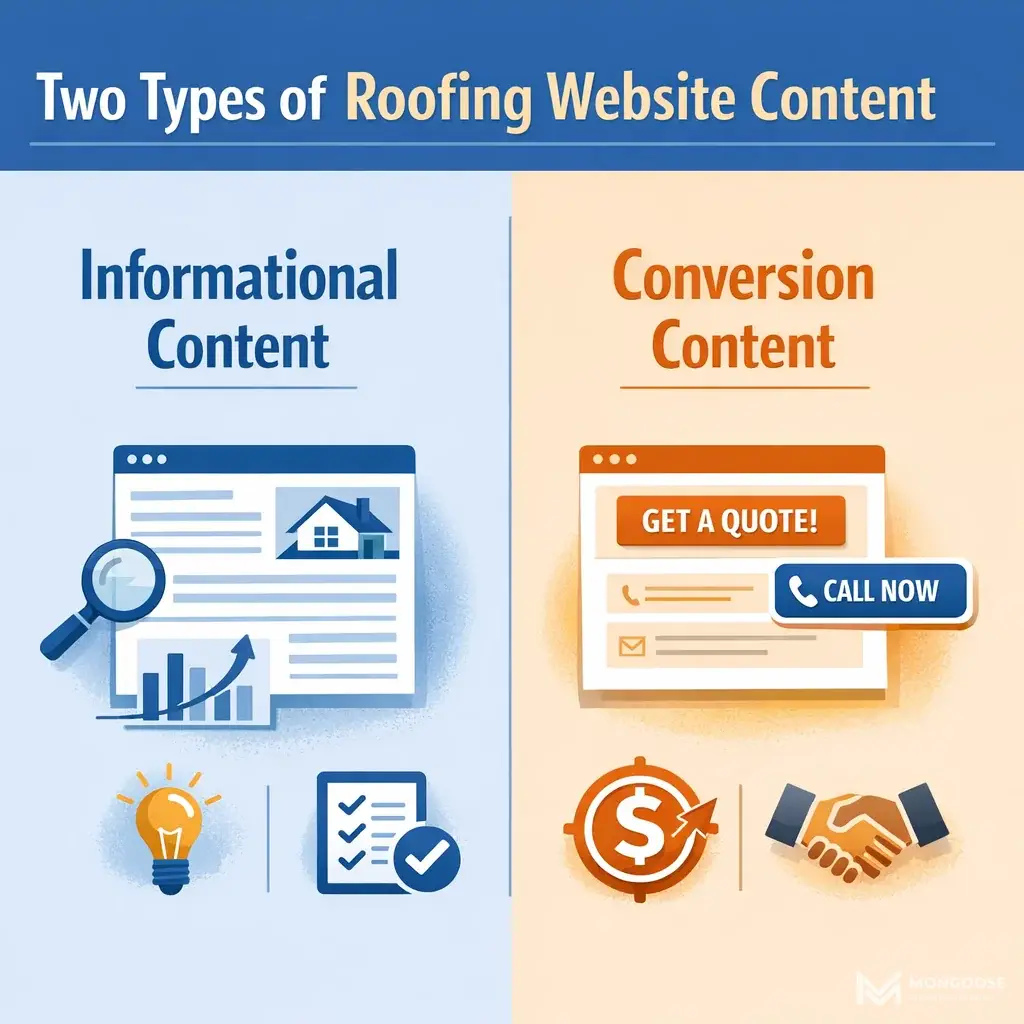
Content strategy for roofing sites splits into two fundamentally different content jobs:
Demand capture content reaches homeowners who are still in research mode. They are searching things like “how to tell if a roof is damaged” or “how long does a metal roof last.” They are not ready to call anyone. They need information, and your content has to deliver it clearly enough that they remember your company name when they are ready to act.
Demand conversion content reaches homeowners who have already decided to hire someone. They are searching “roof replacement in Kettering” or “commercial roofer Dayton Ohio.” They want to evaluate options and contact a shortlist. Every word on these pages has one function: move them toward a phone call or form submission.
Treating these two content types as interchangeable, which most roofing content guides do, is the single most common structural error in roofing websites. A blog post about shingle lifespan cannot do the same job as a location-specific service page, and a service page is not the right format for answering early-stage homeowner questions.
Illustration, not a photograph of a completed client project.
Have a question about roofing website content? Send a message with the situation you are working through and the decision you need help with. Ask for a written explanation of possible next steps.
Why Content Specificity Is a Lead-Quality Tool
One of the sharper insights buried in roofing marketing advice, and then immediately dropped, comes from Scorpion’s content guide. It points out that a roofer who only installs metal roofing will waste significant time if their website content is generic enough to attract asphalt shingle inquiries. The fix offered is “know your audience,” which is accurate but incomplete. (Source: scorpion.co)
The actual mechanism here is content specificity as a filter. A page written exclusively about metal roof installation, using the language a metal-roofing customer uses, will naturally repel visitors looking for shingle repair because those visitors self-select out. Generic “we handle all roofing needs” copy does the opposite: it casts a wide net and fills your pipeline with inquiries you cannot convert. Content specificity is not just an SEO tactic. It is a lead-quality control decision.
This applies at every level of your site architecture:
- Service pages should be written for one service, not a menu of offerings
- Location pages should address the specific geography you serve, not a general regional claim
- Blog content should address one question per post, answered completely
How Portfolio and Testimonial Content Serve Different Trust Functions
Roofr’s complete guide groups “Testimonials and portfolio” as a single website section. (Source: roofr.com) ContractorGorilla’s analysis of the best roofing websites discusses conversion and trust as related topics without clarifying which content type drives which outcome. (Source: contractorgorilla.com)
The distinction matters significantly for conversion performance:
Portfolio content, including before-and-after photos and project case studies, builds competence trust. It answers the question: “Can this company actually do the work?” A homeowner in early research mode needs this first. They are evaluating whether a roofer is capable before they will consider contacting them.
Testimonial content, including review quotes, star ratings, and linked review profiles, builds character trust. It answers the question: “Is this company honest and reliable?” This is the trust a visitor needs to convert from interested to committed. It is the final push that moves someone from browsing to calling.
Placing both types on a single combined page, or treating them as decorative additions to service pages, reduces the persuasive effectiveness of each. High-converting roofing websites sequence these deliberately. Competence trust content appears earlier in the user’s journey. Character trust content appears closer to the conversion point. The principles behind this sequencing connect directly to broader content marketing strategy for small businesses, where matching content type to buyer stage is a foundational performance decision.
Content Architecture: The Piece Most Roofing Guides Skip
Individual pages do not generate leads in isolation. The way those pages connect to each other, and guide a visitor through your site, determines your overall conversion rate. This is content architecture, and it is almost never addressed in roofing marketing content.
A well-built roofing site should function like this:
| Page Type | Primary Visitor Intent | Content Job | Conversion Action |
|---|---|---|---|
| Homepage | General awareness, brand check | Establish credibility, route to relevant content | Click to service or location page |
| Service Page | Specific service research | Explain the service, demonstrate expertise, filter unqualified leads | Request a quote or call |
| Location Page | “Best roofer in [city]” searches | Rank locally, demonstrate area-specific relevance | Phone call or form submission |
| Blog Post | Early-stage question | Answer one research question completely | Click to related service page |
| Portfolio / Project Page | Pre-hire due diligence | Demonstrate completed work quality | Click to testimonials or contact |
| Testimonials / Reviews Page | Final confidence check before contacting | Build character trust | Call, form, or direct contact |
The internal links between these pages matter as much as the content on each one. A blog post about “signs your roof needs replacement” should link directly to your roof replacement service page. A service page should link to relevant portfolio examples. Portfolio pages should link to reviews. Reviews should link to a contact form. Each step should reduce friction toward a conversation.
Writing for AI Search Alongside Traditional Search
This is the content decision most roofing websites are not making, because most roofing marketing advice has not caught up to the shift. As Mac Frederick’s roofing SEO guide documents, a meaningful and growing share of homeowners now search for roofers on AI platforms including ChatGPT, Perplexity, and Google’s Gemini AI overviews rather than traditional Google search. (Source: youtube.com)
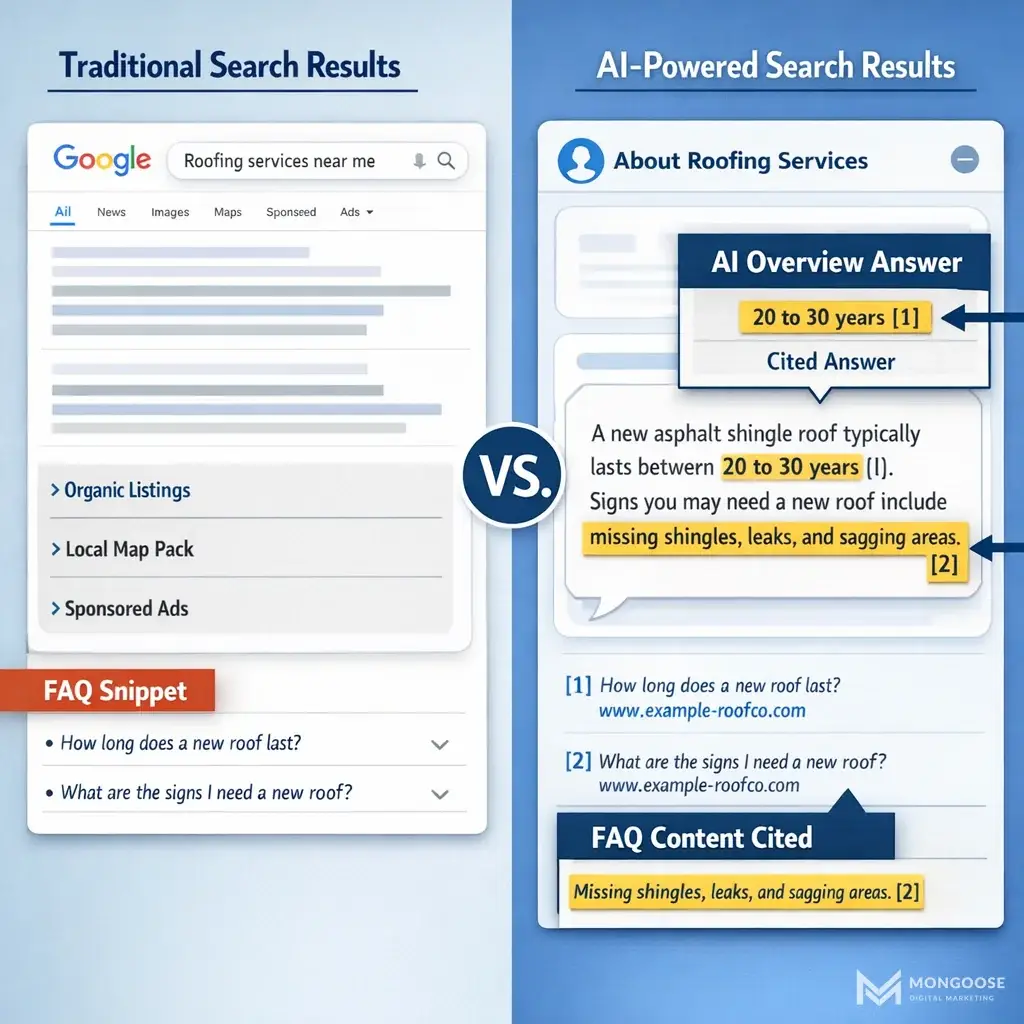
These platforms do not return a list of blue links. They generate a direct answer to the user’s question, pulling from websites that structure their content in specific ways. A page that ranks well in traditional search using keyword density may not be cited at all by an AI engine looking for clearly formatted, factually specific answers.
What AI search platforms favor:
- Direct question-and-answer formatting: An FAQ section on a service page that asks “How long does a roof replacement take in Ohio?” and answers it in plain language is far more retrievable by generative AI than a paragraph that mentions the same topic without structuring it as a question and answer.
- Schema markup: Local business schema and FAQ schema help AI systems identify and extract your content accurately. (Source: youtube.com)
- Factual specificity: Vague claims like “we provide quality roofing services” produce nothing useful for an AI engine trying to answer “who is the best roofer in Beavercreek?” Specific information, named services, real service areas, documented credentials, and clear explanations give AI something to cite.
- Consistent NAP data and citations: Name, address, and phone number consistency across your website and third-party platforms strengthens your retrievability in AI-generated local results.
Zero-click searches are also increasing. This means some homeowners will get enough information from an AI overview or a featured snippet that they never visit your website at all. Content that delivers genuine value within the search result, through structured snippets and AI-surfaced answers, builds brand recall even when no click occurs. Understanding how this intersects with local SEO for roofing companies is essential for competing in both traditional and AI-driven search environments.
Illustration, not a photograph of a completed client project.
The Blog Strategy That Actually Moves the Needle
Roofr, Company119, and Scorpion all recommend blogging. (Source: roofr.com) (Source: company119.com) None of them explain which types of blog content serve which stage of the buyer journey.
Blog content for a roofing website falls into three categories with distinct performance objectives:
Awareness posts answer questions homeowners ask before they are ready to hire anyone. Topics include “what causes roof leaks,” “asphalt vs. metal roofing: which is right for your home,” and “how to read a roofing contractor estimate.” These build your authority as a knowledgeable local resource and, over time, create a pipeline of visitors who will return when they are ready to act.
Comparison posts address the “evaluating options” stage. Topics include “what to look for in a roofing company,” “questions to ask before signing a roofing contract,” and “how roofing warranties differ between contractors.” These attract visitors who are close to a hiring decision and position your company as the credible choice.
Local authority posts combine geographic relevance with roofing expertise. Topics tied to the communities you serve, referencing local context without inventing facts, strengthen your relevance signal for local search. For a deeper look at which specific topics generate the most traction, the article on roofing company blog topics that drive real leads breaks down this selection process in detail.
Each post should end with a clear next step, typically a link to the relevant service page or a direct invitation to request a consultation. A blog post that educates but provides no path to conversion is a traffic asset that does not pay for itself.
If you want roofing website content that generates qualified leads across the Miami Valley, Mongoose Digital Marketing builds content strategies designed around the specific results your business needs to grow. Contact us to start a conversation.
Frequently Asked Questions
How many pages does a roofing website need to generate consistent leads?
There is no minimum page count that produces leads on its own. What determines results is whether each page has a defined job in the visitor’s journey. A site with eight pages, each written for a specific service, location, or buyer stage, will consistently outperform a thirty-page site where pages overlap in purpose or duplicate each other’s content. Before adding new pages, identify what job is missing from your current architecture and build to fill that gap.
Does blogging still matter for roofing websites, or has AI search replaced it?
Blogging remains effective, but the reason has shifted. Blog posts written around specific homeowner questions now serve two functions simultaneously: they rank in traditional search results and they supply the structured, question-and-answer formatted content that AI platforms pull from when generating responses. A blog post that answers one question completely, ends with a link to the relevant service page, and is formatted with clear headings is doing more work today than a keyword-dense post written for older search behavior alone.
What is the difference between a service page and a location page, and does a roofing company need both?
A service page is built around what you do. A location page is built around where you do it. They serve different search intents and attract different visitors. Someone searching “metal roof installation” is evaluating a service. Someone searching “roofer in Centerville Ohio” is evaluating geography. A roofing company serving multiple communities, such as those across the Miami Valley, benefits from having both: dedicated service pages that explain each offering in depth, and dedicated location pages that establish relevance within each specific city or township you serve.
Why does content architecture matter more than total word count?
Search engines and visitors both follow the paths your pages create between each other. A well-written service page that has no internal links pointing to portfolio examples, testimonials, or a contact form is a dead end. Visitors who arrive on it, find it useful, and then have nowhere obvious to go will leave without converting. Content architecture, meaning the deliberate linking structure between page types, determines whether your site moves visitors toward a phone call or simply educates them before they click away. Word count on any single page matters far less than whether that page connects logically to the next step in the visitor’s decision process.
Conclusion
The gap between a roofing website that generates qualified leads and one that simply exists is almost always structural. It is not about how much content you have. It is about whether your homepage routes visitors efficiently, whether your service pages are specific enough to pre-qualify inquiries, whether your portfolio and testimonial content are sequenced around how trust actually forms, and whether your blog posts are designed to either capture early research demand or move a ready buyer toward contact.
Roofing companies serving the Miami Valley, from Dayton and Kettering to Beavercreek, Centerville, Huber Heights, Miamisburg, and Springboro, are competing in a search environment that now includes AI platforms alongside traditional results. The content decisions you make today, in terms of format, specificity, internal linking, and question-and-answer structure, determine whether your site appears in both environments or neither.
A roofing website built on deliberate content architecture does not need to be large. It needs every page to have a job, every link to have a direction, and every piece of content to move the right visitor one step closer to calling you.