

Key Takeaways
- Google’s Vicinity Update (December 2021) dramatically compressed the effective ranking radius for competitive local categories, meaning a single Google Business Profile optimized for a broad city-level query often ranks only within a 1–3 mile radius in high-competition markets.
- Local pack rankings and local organic rankings are governed by different algorithmic signals — GBP optimization and proximity drive the map pack, while domain authority and on-page SEO drive local organic results, and each gap requires a distinct remediation strategy.
- Google has largely shifted from counting citations to understanding business entities through its Knowledge Graph, making structured data (LocalBusiness schema) and unstructured brand mentions on authoritative local domains more strategically valuable than directory submissions alone.
- Behavioral signals — including click-through rate from the local pack, direction requests, and call clicks on a Google Business Profile — are active ranking inputs that create a compounding visibility loop favoring already-visible businesses.
- For businesses serving the Dayton metro and surrounding communities like Kettering, Beavercreek, and Centerville, geographic segmentation strategy is not optional — proximity compression means ranking across the full service area requires a fundamentally different approach than ranking in a single neighborhood.
If you ask ten business owners in Dayton what local SEO means, nine of them will say something like “showing up on Google when someone nearby searches for what I do.” That’s not wrong. But it’s incomplete in ways that cost real businesses real customers every single day.
Local search engine optimization is the discipline of making your business visible — and competitive — in geographically relevant search results. That covers the local pack (the map results with the three listings and the pins), local organic results (standard blue links filtered for location), and increasingly, the AI-generated answer boxes that are starting to reshape both. Each of these surfaces has different ranking mechanics. Each responds to different inputs. And treating them as one unified thing is one of the most common and expensive strategic mistakes we see businesses make across the greater Dayton area.
This article is not a beginner’s checklist. It is a practitioner-level breakdown of how local search actually works in 2024 — including the dynamics that most guides won’t touch because they require honest engagement with complexity. If you’re a business owner in Springboro, Miamisburg, Huber Heights, or anywhere in the Dayton metro trying to understand why your rankings move without explanation, or why your competitor three blocks away outranks you despite having half your reviews, this is the article you’ve been looking for.
How Google Actually Decides Who Ranks Locally
The Three Factors — And What the Textbooks Miss
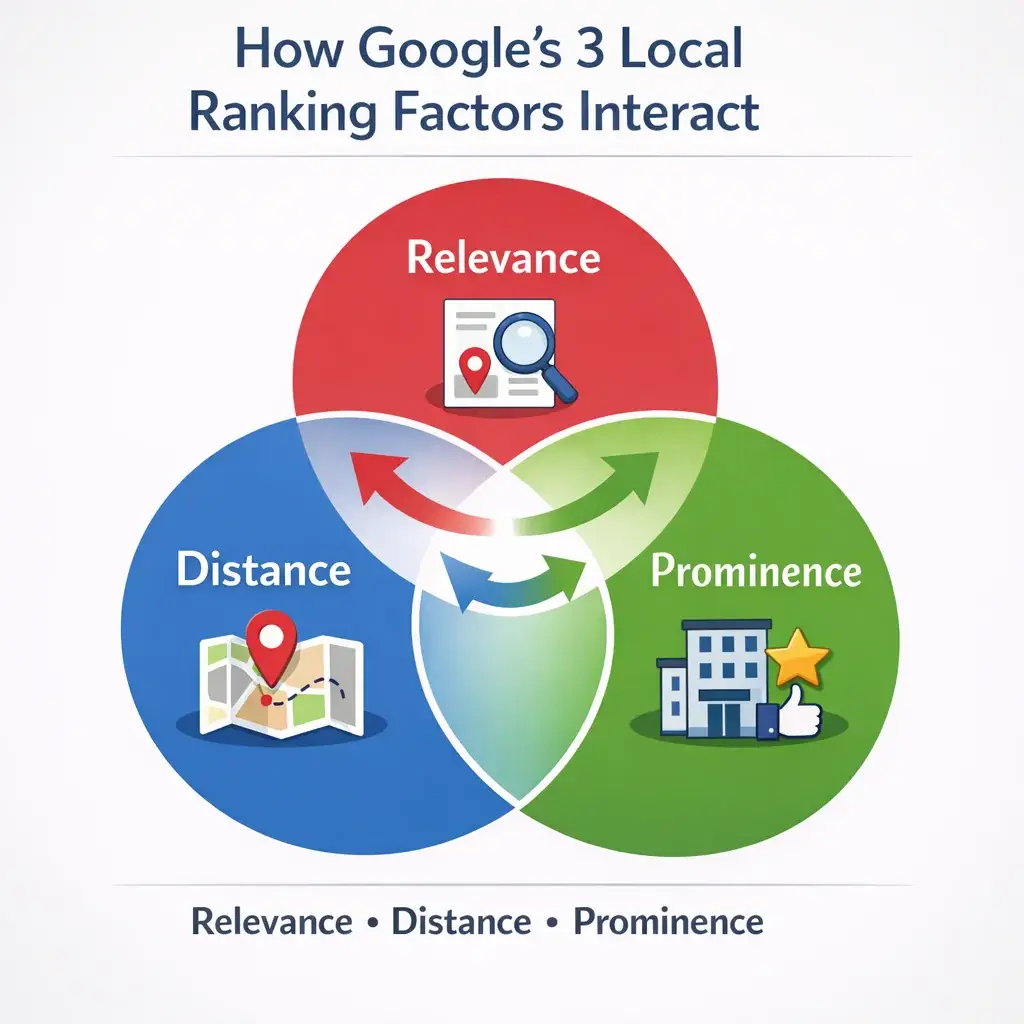
Google’s local algorithm publicly operates on three factors: relevance, distance, and prominence. You’ll see these repeated in virtually every article on the subject, almost word for word. What those articles don’t do is explain how the three factors interact — and interaction is where the real intelligence lives.
Relevance is how well your business profile and associated signals match the intent of the query. This isn’t limited to your business category. It includes the services you’ve listed on your Google Business Profile, the keywords that appear in your reviews, the content on your landing pages, and whether Google’s entity graph has confidently categorized what your business does.
Distance is proximity to the searcher’s real-time location — not to the city center, not to where you think your customers are, but to where the person physically is when they conduct the search. This distinction matters enormously for businesses serving spread-out areas like the Dayton metro.
Prominence is the aggregate of how well-known and trusted Google perceives your business to be — built from reviews, links, citations, behavioral data, and press mentions over time. It is the slowest factor to build and the hardest to fake.
Here’s what most guides leave out: these three factors are weighted dynamically, not equally. A business with exceptional proximity can outrank a more prominent business for a given search. A business with extremely high prominence can extend its ranking radius beyond what its proximity alone would justify. Understanding these tradeoffs is what separates informed local SEO strategy from checkbox optimization.
The Vicinity Update Changed the Rules — And Most Businesses Don’t Know It
In December 2021, Google rolled out what the SEO industry calls the Vicinity Update. The effect was immediate and significant: proximity weighting increased sharply, compressing the radius within which most businesses can realistically rank for competitive queries.
Before the update, a well-optimized business could rank across an entire metro area for competitive service terms. After the update, many of those same businesses found their visibility contracting to within a few miles of their physical address — sometimes dramatically less for high-competition categories.
For a business in Centerville, Ohio, this means your Google Business Profile might rank well for searches conducted in Centerville and parts of Kettering, but struggle to surface for searches in Beavercreek or Miamisburg — even if you serve those areas and have always served them. This is not a rankings failure you did anything to cause. It’s a structural algorithm shift that requires a structural strategic response.
The practical implication: optimizing a single GBP listing for an entire metro is no longer a reliable strategy in competitive categories. Geographic segmentation — whether through location-specific landing pages, service-area content, or in some cases additional verified locations — is now a necessary layer of local SEO architecture, not an advanced optional tactic.
Local Pack vs. Local Organic: Two Different Games
This is one of the most practically important distinctions in local SEO, and it’s routinely glossed over.
The local pack — the map-based results that appear at or near the top of a search results page — is driven primarily by your Google Business Profile signals, proximity, and behavioral data from Maps interactions. It responds relatively quickly to GBP optimizations and is heavily proximity-dependent.
Local organic results — the traditional link-based results that appear below the map pack — operate much more like conventional SEO. Domain authority, on-page optimization, quality backlinks, and content depth all play significant roles. These rankings are less proximity-sensitive and more responsive to long-term content and authority-building efforts.
A business can dominate the local pack and rank on page three in local organic results. A business can rank in the top three organically and barely appear in the map pack. Each scenario represents a different problem with a different solution.
| Signal Type | Local Pack Weight | Local Organic Weight |
|---|---|---|
| Google Business Profile completeness | Very High | Low |
| GBP category selection | Very High | Low |
| Proximity to searcher | Very High | Low-Moderate |
| Review quantity and velocity | High | Low |
| Behavioral signals (CTR, calls, directions) | High | Moderate |
| Domain authority | Low-Moderate | Very High |
| On-page keyword optimization | Moderate | Very High |
| Backlink profile | Low | Very High |
| LocalBusiness schema markup | Moderate | Moderate-High |
| Unstructured brand mentions | Moderate | Moderate |
| NAP consistency | Moderate | Low-Moderate |
Understanding which surface you’re underperforming in is the prerequisite to allocating resources correctly. Throwing content at a local pack problem wastes time. Throwing GBP effort at a local organic deficit produces similar frustration.
Google Business Profile: Behavioral Signals Are the Hidden Ranking Layer
Most local SEO advice treats Google Business Profile as a form to fill out. Category, description, hours, photos, done. This framing misses the more consequential dimension of GBP: it is an active behavioral data collection surface, and the interactions it generates feed directly back into your rankings. For a deeper look at how to put this into practice, the article Google Business Profile Optimization Tips That Actually Work walks through the specific optimizations that move the needle.
The Behavioral Signal Loop
When your listing appears in the local pack, Google observes what happens next. Users who see your listing may:
- Click through to your GBP profile
- Click to your website
- Request directions
- Tap to call
All of these actions generate engagement signals. Businesses that generate more engagement from the same level of exposure rank higher, which increases exposure, which generates more engagement. It is a compounding loop — and breaking into it as a new or under-optimized business requires deliberate strategic action, not just profile completion.
Click-through rate from the local pack is the entry point to this loop. This means your primary GBP photo, your business name display, your review snippet, and your category label are all conversion assets operating before a user has ever visited your profile. Optimizing these elements for CTR is GBP work that most businesses have never done.
Specific behavioral signals and their strategic implications:
- Direction requests are particularly strong ranking signals for businesses where physical visits are the conversion goal. A restaurant, a dental practice, or a retail location in Kettering benefits disproportionately from direction clicks.
- Call clicks signal to Google that your listing is generating real-world business transactions — high-quality behavioral confirmation of relevance and prominence.
- Photo views correlate with engagement depth. GBP listings with regularly updated, high-quality photos consistently show higher overall engagement rates.
- Q&A interactions — both questions and owner-provided answers — are indexed content that can match query terms and influence relevance scoring.
Service-Area Businesses vs. Brick-and-Mortar: Fundamentally Different Rules
This distinction is almost universally ignored in local SEO guides, and it’s operationally critical.
Brick-and-mortar businesses (a law firm on Brown Street in Dayton, a dental practice in Beavercreek) have a verified physical address displayed on their listing. This address anchors their proximity signals and gives Google a precise location to weight against searcher location.
Service-area businesses (SABs) — HVAC companies, plumbers, electricians, landscapers — hide their address and define a service radius or list specific service areas. Google treats these businesses differently in the local algorithm. Without a displayed address, the proximity signal behaves differently, and SABs consistently face a harder challenge ranking across broad geographic areas.
For SABs serving communities across the Dayton metro — from Springboro up through Huber Heights — this means local SEO strategy must compensate for weaker proximity anchoring through stronger relevance and prominence signals: more thorough service-area page development, stronger review velocity, and more deliberate entity establishment across the web.
Hybrid businesses (a contractor with a showroom but who primarily works on-site at client locations) need to decide whether operating as a brick-and-mortar listing or an SAB serves their geographic coverage goals better. This is not a one-size-fits-all decision. It depends on the service category, competitive density, and the geographic distribution of the target customer base.
Entity Establishment: What Has Replaced Pure Citation Building
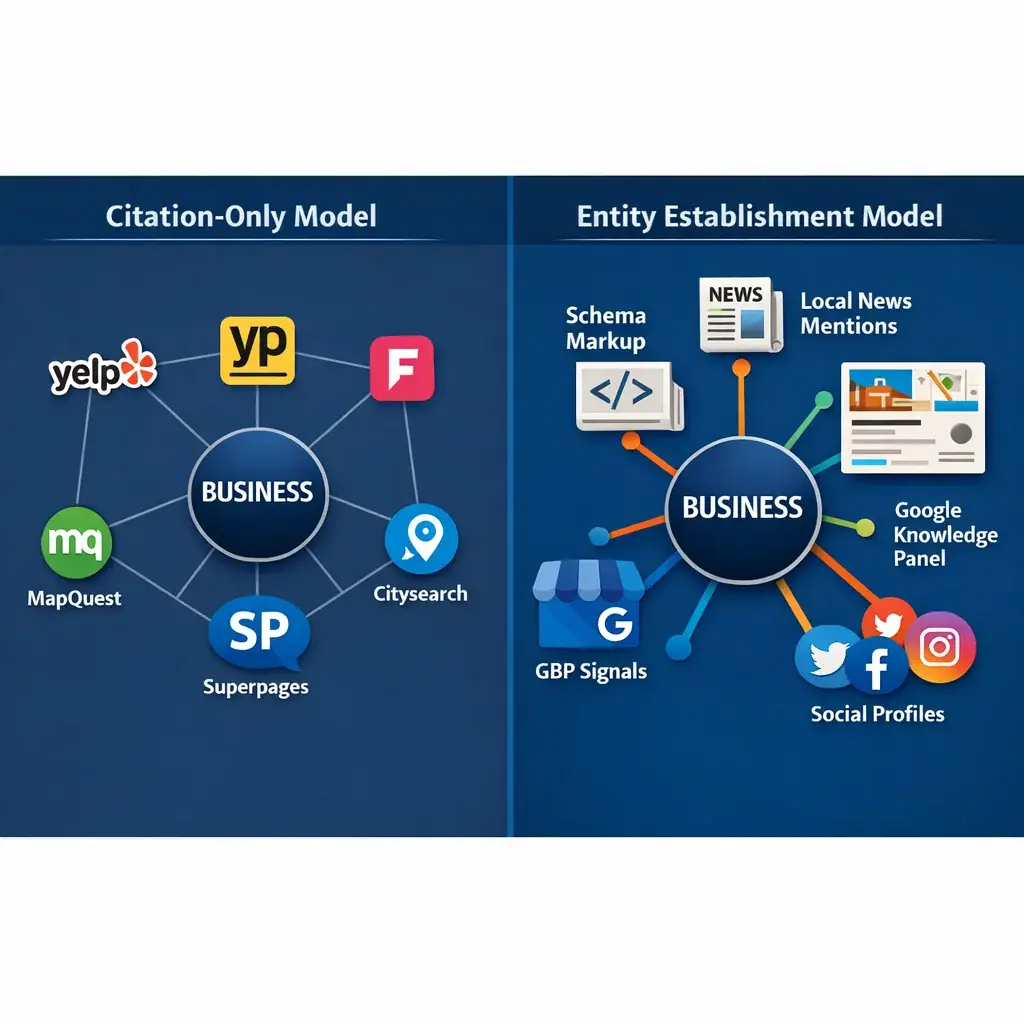
The local SEO industry spent years telling businesses to submit their name, address, and phone number to every directory on the internet. This wasn’t bad advice for its time — citation consistency was a meaningful ranking signal in early local search algorithms.
It is not 2014 anymore.
Google’s local algorithm has shifted substantially toward an entity-understanding model powered by the Knowledge Graph. The relevant question Google is now trying to answer is not “How many places on the internet list this business?” but rather “Have I confidently resolved this business as a distinct, well-understood entity — and do I understand what it does, where it operates, and who it serves?”
What Entity Establishment Actually Means
Entity establishment is the process of making Google’s knowledge about your business consistent, detailed, and confident across every surface where your business appears — structured and unstructured.
Structured signals:
– LocalBusiness schema markup on your website is a direct, machine-readable communication to Google’s entity graph. It specifies your business type, location, service areas, hours, and more in a format Google can parse without interpretation. This is not a “nice to have” — it is one of the most efficient uses of technical SEO effort available to a local business.
– Google Business Profile attributes — service lists, product catalogs, business attributes — all contribute structured signals that help Google categorize and understand your business at a granular level.
Unstructured signals:
– Brand mentions without links on authoritative local domains — local news coverage, chamber of commerce mentions, community event pages — contribute to entity confidence in ways that a Yelp or Yellow Pages submission does not. A mention in the Dayton Daily News carries more entity weight than fifty directory submissions.
– Social media profile consistency across platforms (consistent name, address, phone, description) reinforces entity clarity even though social links carry minimal direct link authority.
– Wikipedia and Wikidata entries, where applicable, directly feed Google’s Knowledge Panel data and are among the strongest entity signals available for any business large enough to qualify.
NAP Consistency: Still Necessary, No Longer Sufficient
NAP (name, address, phone) consistency across directories still matters — primarily as a hygiene factor. Inconsistent NAP data can create entity confusion that undermines Google’s confidence in your business listing, which is a real ranking liability. But correcting NAP inconsistencies is not a competitive advantage. It’s a prerequisite for being competitive at all.
The businesses winning in local search in competitive Dayton-area markets are not winning because they have 200 directory listings with matching phone numbers. They’re winning because Google has a rich, confident, multi-source understanding of their business as an entity — and that confidence is built through structured data, authoritative mentions, and behavioral confirmation.
Review Signals: Velocity, Recency, Sentiment, and Content Are Not the Same Thing
“Get more reviews” is technically accurate advice. It is also strategically incomplete in ways that matter.
Google processes review signals across at least four distinct dimensions, and conflating them leads to misaligned strategy:
Review Quantity is a prominence signal. More reviews indicate more customer interactions, which correlates with business activity and visibility. It is a meaningful baseline, but it has diminishing returns at scale.
Review Velocity — the rate at which new reviews arrive — is a separate signal. A business that has accumulated 200 reviews over five years and is currently receiving zero new reviews is algorithmically disadvantaged compared to a competitor with 80 reviews who is consistently receiving two or three new reviews per week. Recency of activity signals ongoing business health.
Review Recency compounds velocity. Reviews older than 12-18 months carry less algorithmic weight. A strong review profile requires active, continuous generation — not a one-time push.
Review Content — specifically, the presence of relevant keywords in review text — influences two downstream signals simultaneously. Keyword-rich review text surfaces in the GBP snippet visible in the local pack, which affects CTR. It also contributes to relevance scoring by reinforcing category and service signals. A plumber in Miamisburg whose reviews consistently mention “water heater installation” and “emergency pipe repair” has a meaningful relevance advantage over a competitor with similar star ratings whose reviews say only “great service, would recommend.”
Owner Response Patterns — the consistency and quality of how a business responds to reviews, both positive and negative — appear to function as an engagement signal confirming active business management. Businesses that respond to reviews show higher overall GBP engagement rates, and that engagement feeds the behavioral signal loop discussed earlier.
Query Classification: The Strategic Layer Most Businesses Ignore
Not all local searches are created equal, and Google’s algorithmic treatment varies based on how it classifies the query.
Implicit local queries — searches like “pizza delivery” or “emergency plumber” — don’t contain a geographic modifier, but Google infers local intent from context and returns local results. The ranking mechanics here weight real-time proximity very heavily because the user’s intent is clearly immediate and location-dependent.
Explicit local queries — “HVAC repair Dayton Ohio” or “dentist in Beavercreek” — contain a stated geographic modifier. Google treats the named location as a relevance input, but still weighs the searcher’s actual location. A business in Centerville can rank well for “dentist in Dayton” if it has sufficient prominence and relevance, even though it’s not located in the city proper.
Navigational local queries — “Kettering Health Network,” “Courthouse Square Dayton” — target a specific business or landmark. These are largely resolved through entity confidence and direct GBP matching.
This classification matters because your keyword strategy and content architecture should be built around query types, not just geographic modifiers. A business targeting implicit local queries needs to be competitive on proximity and behavioral signals. A business targeting explicit local queries can extend reach through landing page content and location-specific relevance signals. Treating all local keywords as structurally identical produces a keyword strategy that optimizes for none of them particularly well.
Vertical-Specific Considerations: Not All Local Industries Are Equal
Local SEO strategy for a Dayton-area restaurant is structurally different from local SEO strategy for a Dayton-area law firm. Google applies elevated scrutiny to YMYL categories (Your Money Your Life) — legal, medical, financial, and health-adjacent businesses — because errors in these verticals carry real-world harm potential.
For law firms, medical practices, and financial advisors across the Dayton metro, this means:
- Content quality and authoritativeness carry more algorithmic weight than in low-stakes verticals. Thin service pages will underperform regardless of local optimization.
- Domain authority requirements are effectively higher — pure GBP optimization cannot compensate for a weak website authority profile in competitive legal or medical categories.
- E-E-A-T signals (Experience, Expertise, Authoritativeness, Trustworthiness) function as ranking inputs through how Google assesses content quality and entity reputation.
For restaurants, retail, and lower-stakes service businesses, behavioral signals — reviews, direction requests, photo engagement — carry proportionally more weight, and the optimization priority stack shifts accordingly.
Understanding which vertical you’re operating in, and how Google weights signals differently within it, is prerequisite intelligence for building a prioritized local SEO action plan rather than a generic one.
Grid-Based Rank Tracking: Measuring What Actually Matters
One final point that separates practitioners from checkbox marketers: how you measure local rankings determines whether you understand your actual competitive position.
Single-point rank checking — checking your position for “plumber Dayton” from one location — tells you almost nothing actionable. Because local results are proximity-dependent and personalized, your ranking from a desktop in Centerville is a different data point than your ranking from a phone in Huber Heights. A single rank check gives you one pixel of a picture that requires hundreds of pixels to see clearly.
Grid-based rank tracking uses tools like Local Falcon or BrightLocal’s grid tracker to plot your rankings across a geographic grid — typically a 7×7 or 9×9 matrix of points spread across your target service area. The result is a heat map showing where you’re competitive, where you’re invisible, and exactly which geographic segments represent your highest-opportunity ranking gaps.
For a business serving the full Dayton metro — Kettering, Beavercreek, Centerville, Miamisburg, Springboro, Huber Heights — this kind of visualization is not a luxury. It’s the minimum viable measurement framework for understanding whether your local SEO investment is producing geographic coverage or just localized visibility in a small radius around your physical address.
Building a Local SEO Strategy That Matches How the Algorithm Actually Works
Bringing these elements together into a coherent strategy requires honest prioritization. The most common mistake is treating local SEO as a checklist rather than a system — completing individual items without understanding how they interact or which gaps are actually limiting growth.
Priority Framework for Dayton-Area Businesses
Foundation layer (prerequisite, not competitive):
– Verified, complete, and accurate Google Business Profile
– Consistent NAP across primary directories
– LocalBusiness schema on website
– Basic on-page optimization for location and service terms
Competitive layer (where rankings are actually won):
– Deliberate review velocity strategy — not one-time pushes, but continuous generation systems
– Behavioral signal optimization — GBP photo strategy, service listings, Q&A management
– Entity establishment through authoritative local mentions and structured data depth
– Location-specific landing pages for multi-city service areas
– Grid-based rank tracking to identify geographic performance gaps
Authority layer (long-term durability):
– Local link acquisition from genuinely authoritative Dayton-area domains
– Content depth on service pages that meets the bar for your vertical’s YMYL scrutiny
– Brand mentions in local media, community organizations, and industry associations
– Knowledge Panel development and entity consolidation
The businesses consistently visible across Kettering, Beavercreek, Centerville, and the broader Dayton metro aren’t winning on any single tactic. They’re winning because their local SEO functions as an integrated system — where GBP engagement feeds rankings, rankings feed visibility, visibility generates reviews, and reviews reinforce the entity confidence that makes the whole system more durable over time.
That system is buildable. It requires knowing where to start, what to measure, and how to sequence the work. That’s exactly where a tailored local SEO strategy makes the difference between scattered effort and compounding results.
Strategic Recommendations for 2026
The local search landscape continues to shift, and the businesses that gain ground are those that adapt their tools and processes ahead of the curve rather than in reaction to it. Three areas deserve deliberate attention heading into 2026.
1. Adopt Grid-Based Rank Tracking as a Standard Reporting Layer
Tools like Local Falcon or GeoGrid give you a spatial picture of where your Google Business Profile is actually ranking across a service area — not just one aggregate number. For businesses serving Beavercreek, Centerville, or multiple Dayton suburbs, this matters enormously. A profile that ranks well near your physical address may be invisible three miles away, and you won’t know that without geographic tracking. Build this into your monthly reporting so underperforming zones get targeted attention rather than generic effort.
2. Systematize Review Generation Through Operational Touchpoints
The businesses with the strongest review velocity in 2026 won’t be running periodic campaigns — they’ll have review requests embedded in their existing workflows. Whether that’s a post-service text sequence, a QR card handed to customers at point of completion, or a follow-up email triggered by a closed job, the mechanism matters less than the consistency. Identify two or three natural touchpoints in your current customer journey and attach a review request to each one. That compounding output is far more durable than any one-time push.
3. Invest in Topical Depth for Core Service Pages
Google’s evaluation of service pages — particularly in health, legal, financial, and home services verticals — continues to raise the bar on content quality and demonstrated expertise. In 2026, thin location pages with swapped city names will continue losing ground to pages that genuinely address what customers in a specific area need to know. Audit your highest-priority service pages and ask whether they would satisfy a skeptical reader who is comparing you to three competitors. If they wouldn’t, that’s where content investment will yield the clearest ranking impact. The article On-Page SEO for Small Businesses: 2025 Guide covers the specific on-page elements that have the clearest impact on service page performance.
Frequently Asked Questions
How long does local SEO take to show results in the Dayton area?
Most businesses begin to see measurable movement in local rankings within three to six months of consistent, well-structured effort. The foundation work — Google Business Profile optimization, NAP consistency, and on-page signals — tends to produce quicker gains, while authority-building through local links and review velocity compounds over a longer timeline. The specific pace varies by how competitive your vertical is in a given area and how much foundational work has already been done.
Does my business need a physical address in Dayton to rank in local search results there?
A verified physical address within or near the target area gives your Google Business Profile the strongest foundation for ranking in that market. Service-area businesses that operate without a storefront can still rank in local results, but the geographic proximity signals that come from a verified address carry meaningful weight. If you serve the broader Dayton metro from a single location, grid-based tracking can help you understand exactly where your visibility drops off and where additional optimization effort is needed.
What is the most important factor in local SEO for a small business?
There isn’t a single factor that overrides all others, but Google Business Profile health is consistently the highest-leverage starting point for most small businesses. A fully optimized, actively managed profile — with accurate information, regular photo updates, strong review velocity, and complete service listings — directly influences both map pack rankings and the behavioral signals Google uses to assess engagement. Once that foundation is solid, the next highest-impact lever is typically reviews, followed by the authority signals that come from local links and media mentions.
How do reviews affect local search rankings in competitive markets like Kettering or Beavercreek?
Reviews influence local rankings through multiple mechanisms simultaneously. The volume, recency, and rating of your reviews are direct signals that Google factors into map pack placement. Beyond the ranking signal, a strong review profile improves click-through rates from local results, which feeds the behavioral data that Google interprets as a signal of relevance. In competitive suburbs like Kettering and Beavercreek where several businesses may be well-optimized on the foundational elements, consistent review generation often becomes the clearest differentiating factor.
Conclusion
Local search visibility in the Dayton metro isn’t a mystery — it’s an achievable outcome when the strategy is built on the right foundation and executed with consistency. Mongoose Digital Marketing proudly serves Dayton, Kettering, Beavercreek, Centerville, and the surrounding communities, which means the recommendations we make are grounded in how this specific market actually behaves, not generic advice built for somewhere else. If you’re ready to stop guessing and start building a local SEO system that compounds over time, Contact Mongoose Digital Marketing — we’re glad to take a look at where you stand and map out what comes next.