

Key Takeaways
- Google’s local ranking algorithm weighs three distinct signals — Relevance, Distance, and Prominence — and a physically closer competitor can outrank a better-optimized business even when that business scores higher on the other two factors.
- Google Business Profile behavioral signals (click-to-call rates, direction requests, photo engagement) function as a real-time ranking feedback loop, meaning a technically optimized profile that users ignore will decline in rankings over time.
- Modern local SEO authority is built through semantic entity consolidation — a single brand mention in a respected Dayton-area news outlet or industry publication can carry more ranking weight than dozens of generic directory citations.
- Businesses in competitive Dayton-area markets including Kettering, Beavercreek, and Centerville face proximity override challenges that cannot be solved through on-page optimization alone and require geo-targeted content expansion strategies.
- The standard 3–6 month local SEO timeline reflects concrete mechanical processes — crawl and indexation cycles, domain trust accumulation, and GBP behavioral signal averaging — not arbitrary industry convention.
Hiring a local SEO company should be a straightforward decision backed by clear thinking. In practice, most business owners in Dayton and the surrounding communities — Kettering, Beavercreek, Centerville, Huber Heights, Miamisburg, Springboro — end up evaluating agencies on the wrong criteria entirely. They compare deliverable lists, count citations promised per month, and ask about reporting dashboards. These are reasonable starting points, but they sidestep the questions that actually determine whether a local SEO investment produces leads or just activity reports.
This article is written for business owners who want to understand the mechanics well enough to make a genuinely informed decision. Not a surface-level checklist. Not a buyer’s guide built around generic red flags. A real explanation of how local search rankings work, where most agencies fall short, and what separates the local SEO companies that move the needle from the ones that generate polished PDFs and flat traffic graphs.
The Dayton metro market has its own competitive dynamics. A law firm in Centerville competes differently than a HVAC contractor in Huber Heights or a dental practice in Miamisburg. Understanding those nuances — and demanding that your SEO partner understands them too — is where informed hiring starts.
How Google Actually Decides Who Ranks Locally
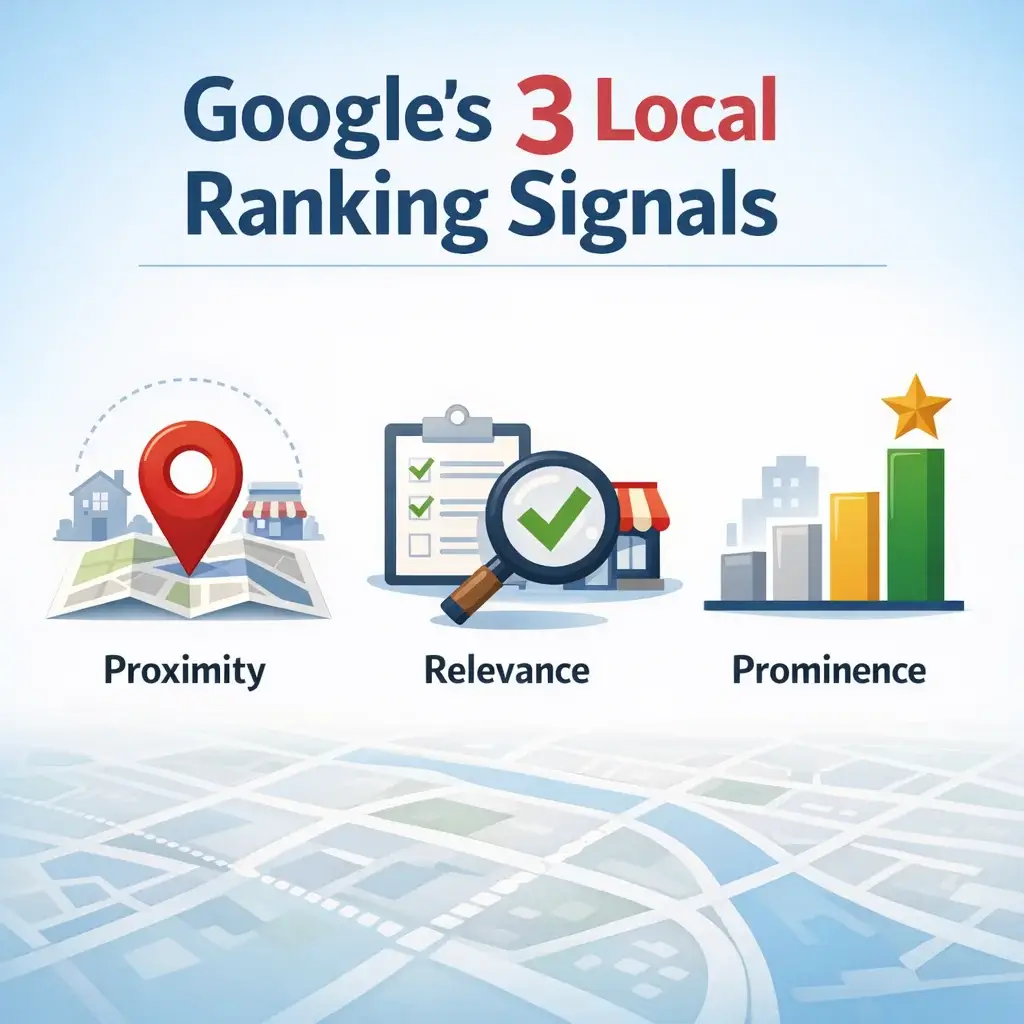
Before evaluating any local SEO company, you need to understand the system they are being hired to influence. Google’s local ranking algorithm operates on three core signals, and the relationship between them is more complicated than most agencies let on.
The Relevance-Distance-Prominence Triangle
Relevance measures how well your business profile and website match what a searcher is looking for. A plumber in Beavercreek with a fully optimized Google Business Profile, detailed service descriptions, and strong keyword alignment on their website scores high on Relevance for plumbing-related searches.
Distance measures the physical proximity between your business location (or the searcher’s location) and the search origin point. This is a hard geographic signal Google calculates in real time based on where the searcher actually is when they type a query.
Prominence reflects how well-known and authoritative your business is in Google’s understanding of the world — a composite signal drawn from reviews, backlinks, citation consistency, online brand mentions, and behavioral data.
Here is the part that most local SEO companies do not explain: these three signals compete with each other, and Distance can override both Relevance and Prominence in Map Pack results.
A dental practice in Centerville with 200 five-star reviews, a fully built-out website, and an impeccably managed GBP profile can still lose a Map Pack position to a less-optimized practice in Beavercreek simply because a searcher happens to be located closer to that competitor when they search. This is not a rare edge case. It is a structural feature of how the local algorithm functions.
The strategic implication is significant. If your business is not the physically closest option for a meaningful share of your target searches, then doubling down on traditional on-page optimization has a ceiling. A skilled local SEO company recognizes that ceiling and builds around it — rather than pretending it doesn’t exist.
The Proximity Override Problem and What to Do About It
When Distance overrides your Relevance and Prominence advantages, the strategic response is geographic signal expansion, not more citation building or another round of meta tag optimization.
Geo-targeted content expansion works by creating location-specific landing pages and service area signals that extend your effective proximity footprint across the Dayton metro. A roofing company headquartered in Miamisburg, for example, can build genuine topical authority and geographic relevance signals for Springboro, Centerville, and Kettering through well-constructed service area pages that speak directly to those communities — their neighborhoods, local permit requirements, and specific search patterns — rather than thin placeholder pages that swap out a city name and call it done.
The goal is not to trick Google into thinking your business is located somewhere it isn’t. The goal is to establish genuine, documentable relevance signals for the service areas you actually serve, so that Distance becomes less of a determining factor when searchers in those areas are looking for what you offer.
This is expert-level local SEO thinking. It requires understanding how GBP service area designations interact with on-site geographic signals, how internal linking architecture reinforces topical authority for specific locations, and how content must be structured to satisfy both user intent and entity recognition. Most agencies skip this level of analysis entirely.
Google Business Profile: Signal System, Not Static Listing
Ask most business owners what GBP optimization looks like and they will describe filling out the profile completely — business name, address, phone number, categories, hours, and a few photos. That is table stakes. It is also nowhere near sufficient for competitive local markets in the Dayton area.
Behavioral Signals Are a Real-Time Ranking Input
Google measures what happens after a searcher sees your GBP listing. Specifically, it tracks:
- Click-to-call rate — how often searchers call directly from the search results page
- Direction requests — how often searchers navigate to your location from Maps
- Website click-through rate — how often searchers click through to your site from the profile
- Photo engagement — how often searchers view your photos and for how long
- Review engagement — how often searchers read and interact with your reviews
- Q&A interaction — whether the Q&A section generates meaningful user engagement
These behavioral metrics feed back into Google’s ranking model as real-time signals of business relevance and legitimacy. The practical implication: a GBP profile that is technically complete but generates weak engagement will drift downward in rankings over time, regardless of what’s happening on the website behind it.
This is why a genuinely skilled local SEO company manages GBP as an active engagement product, not a one-time setup task. That means testing primary photos for click-through performance, writing service descriptions with conversion psychology in mind, maintaining an active Q&A section that addresses real searcher concerns, and monitoring GBP Insights data to identify engagement drops before they translate into ranking losses. For a deeper look at how to approach this systematically, the article on Google Business Profile optimization tips that actually work covers the tactical execution in detail.
What a High-Performance GBP Management Approach Looks Like
The table below contrasts standard GBP management — the approach most agencies deliver — with the engagement-focused model that expert local SEO companies execute.
| Management Element | Standard Agency Approach | Expert Engagement-Focused Approach |
|---|---|---|
| Primary Photo Selection | Upload business photos, set a cover image | Test multiple primary images, monitor click-through performance via Insights, rotate based on engagement data |
| Service Descriptions | List services with basic keyword inclusion | Write descriptions targeting click-through psychology, addressing searcher intent and objections |
| Review Management | Solicit reviews, respond to negatives | Monitor review velocity, flag sentiment trends, use review content to identify Relevance signal gaps |
| Q&A Section | Populate with basic FAQs | Actively seed and maintain questions that align with high-intent search queries, monitor for new user questions |
| Posts | Publish promotional updates on a schedule | Use posts to reinforce seasonal service relevance, test CTA formats, align post content with query intent |
| GBP Insights Monitoring | Monthly report summary | Weekly trend analysis, behavioral signal tracking, engagement anomaly detection |
| Category Optimization | Set primary and secondary categories at setup | Audit categories quarterly against competitor category structures and search behavior shifts |
The gap between these two approaches is not cosmetic. In a market like Kettering or Beavercreek where multiple competitors are fighting for the same three Map Pack positions, behavioral signal management is often the differentiating variable.
Citation Building in 2025: What’s Changed and Why It Matters
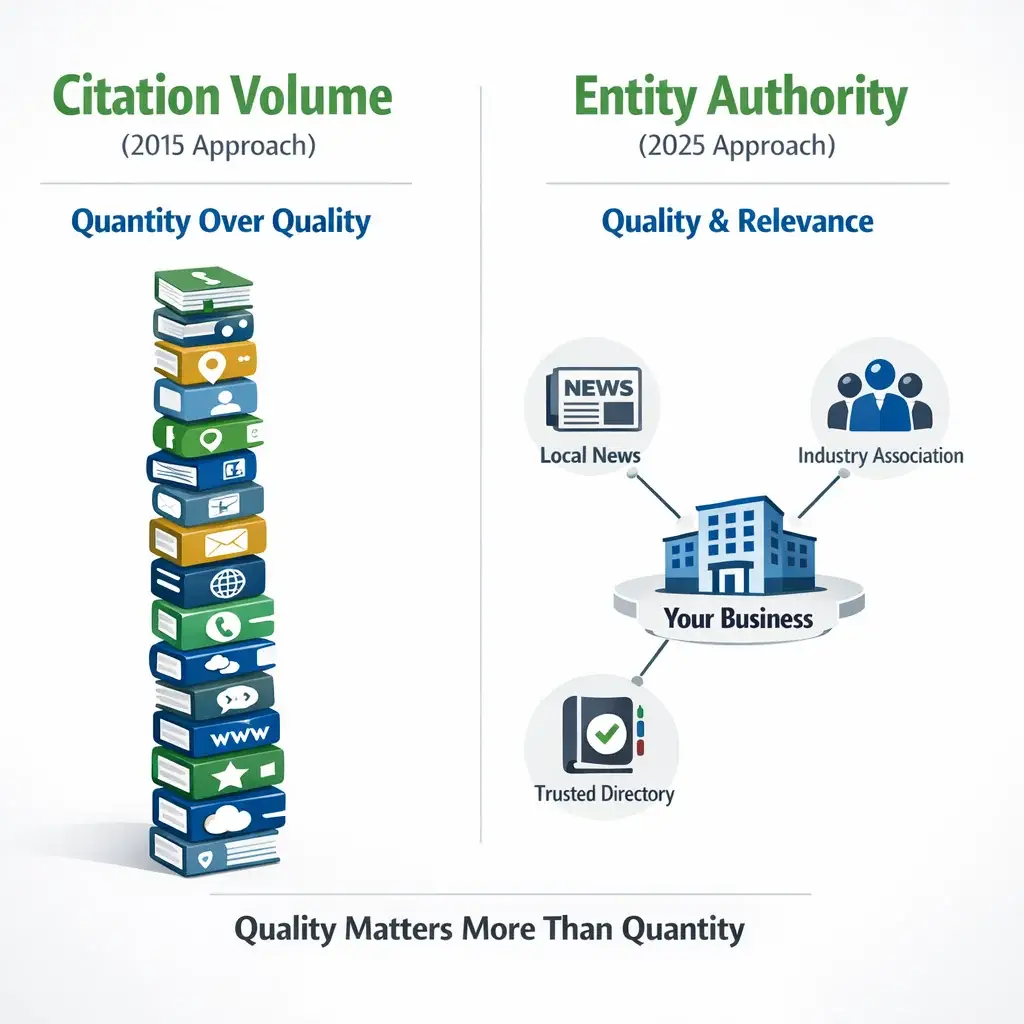
The traditional citation-building narrative — build NAP (Name, Address, Phone) consistency across major directories, submit to data aggregators, accumulate listings — was accurate and effective a decade ago. It is not wrong today, but it is significantly incomplete, and relying on it as a primary authority-building strategy reflects outdated thinking.
Entity-Based Search and Why Citation Volume Is No Longer the Goal
Google’s Knowledge Graph understands local businesses as semantic entities — structured objects with defined attributes, category relationships, and geographic associations — not simply as website URLs with matching contact information. When Google evaluates a Dayton-area HVAC contractor’s authority and legitimacy, it is asking: does the entity model we have built for this business match the category, location, and attributes the website and GBP profile claim?
This shift has meaningful practical consequences. Citation signals now function primarily as entity confirmation inputs — they help Google verify that your business entity is consistently represented across the web. The threshold for that confirmation is relatively low once you have solid coverage across the foundational directories (Google, Yelp, Facebook, Bing Places, Apple Maps, and the major data aggregators like Data Axle and Neustar Localeze).
Beyond that baseline, the marginal ranking value of adding a 47th or 63rd generic directory citation is minimal. What carries genuine weight in the entity model is brand mention quality and source authority — specifically, whether trusted, topically relevant sources are referencing and confirming your business’s existence, location, and category.
Entity Authority: What Actually Moves Rankings Now
For a business in the Dayton metro, this means the following types of signals carry disproportionate entity authority weight:
- A feature in the Dayton Business Journal or Dayton Daily News
- A listing or mention in a recognized regional or industry association (Dayton Area Chamber of Commerce, relevant trade associations)
- A backlink or brand mention from a locally authoritative website (a Dayton-based university, hospital network, or established media outlet)
- Consistent brand mentions in locally relevant context — event sponsorships, community involvement coverage, local award recognitions
A single well-placed brand mention in a genuinely authoritative local source can do more for your entity footprint than 50 additional generic directory submissions. The best local SEO companies build editorial strategies around earning these mentions rather than automating citation submission and calling it an authority-building program.
What “Competitive Analysis” Actually Means at an Expert Level
Most local SEO companies list competitive analysis as a service component in their proposals. Very few execute it with any real methodological rigor. If you ask an agency how they analyze your competitors and the answer involves a general traffic estimate tool and a list of keywords your competitors rank for, you are looking at surface-level intelligence, not strategic analysis.
The Signals a Rigorous Competitor Analysis Examines
A genuinely expert competitive analysis for a Dayton-area business looks at the following layers:
GBP Competitive Profile
– Competitor review velocity (how fast they are accumulating new reviews)
– Engagement patterns visible through Insights-equivalent data
– Category structures and secondary category selections
– Photo volume, recency, and type distribution
– Q&A content and whether competitors are actively seeding high-intent questions
Referring Domain Profile
– Domain authority distribution of competitor backlink sources
– Topical relevance of referring domains (industry-specific vs. generic)
– Local source authority (are competitors earning mentions from recognized Dayton-area publications and organizations?)
– Link acquisition velocity and pattern (steady accumulation vs. spike-and-stall patterns that suggest link schemes)
Content Topical Authority
– Which topic clusters competitors have built depth in vs. thin coverage
– Content gaps that represent ranking opportunities your business could realistically capture
– Whether competitors are targeting informational, navigational, or transactional intent — and how well their content actually satisfies that intent
Entity Signal Ecosystem
– Where competitor brand mentions are appearing and in what context
– Whether competitors have established Knowledge Panel presence and how robust it is
– Schema markup implementation and structured data signal quality
This level of analysis produces actionable intelligence — it tells you where the real competitive gaps are, which ranking positions are achievable with focused effort, and where you are facing entrenched authority that would require disproportionate resources to displace. That last insight is particularly valuable and connects to a strategic reality that almost no agency discusses openly.
Diminishing Returns and Competitive Ceilings: What Honest Agencies Acknowledge
In highly competitive local markets — and certain service categories in the Dayton metro are extremely competitive — SEO effort reaches diminishing return thresholds where incremental ranking improvements require exponentially more resources. A business fighting for position one in a saturated category with multiple well-established competitors is playing a different game than a business entering a moderately competitive niche with clear gaps to exploit.
An expert local SEO company acknowledges this honestly, because the honest answer often changes the strategic recommendation. At a certain competitive ceiling, the highest-ROI move is not to spend more on SEO — it is to diversify the channel mix, layer in targeted pay-per-click for high-intent terms where ranking organically is impractical in a reasonable timeframe, or refocus SEO resources on adjacent keyword clusters where the competitive landscape is more accessible. Understanding how PPC and SEO work together to grow your business is worth reviewing if you are approaching that ceiling in your market.
This kind of strategic honesty is not a weakness in an agency’s positioning. It is the mark of a genuine growth partner rather than a vendor trying to protect a retainer.
The Real Mechanics Behind the 3–6 Month Timeline
Every local SEO company in the industry quotes a 3–6 month timeline for results. Almost none explain what is actually happening during that period at a mechanical level. Understanding the underlying processes helps you set realistic expectations and evaluate whether your agency is executing correctly.
What Is Actually Happening Month by Month
Crawl and Indexation Cycles
When new content is published or technical changes are implemented, Google must crawl and reindex the affected pages before any ranking signal is processed. Depending on your site’s crawl budget and the frequency with which Googlebot visits your domain, this can take days to several weeks per change. Accumulating these changes across multiple pages takes time by its mechanical nature.
Domain Trust Accumulation
Backlinks and brand mentions earn ranking weight gradually as Google processes and validates the source signals. A link from a newly acquired source does not immediately transfer its full authority value — Google evaluates the consistency and longevity of linking patterns before weighting them heavily.
GBP Behavioral Signal Averaging
Google’s behavioral engagement signals for GBP listings are averaged over rolling time periods. A newly optimized profile needs to accumulate enough behavioral data — clicks, calls, direction requests — for Google to update its understanding of the listing’s engagement quality. This averaging process takes weeks to months depending on your search impression volume.
Review Velocity and Sentiment Processing
Google incorporates new review data into ranking signals, but the system applies smoothing to prevent sudden spikes from gaming results. Consistent review accumulation over several months carries more weight than the same number of reviews generated in a single push.
Together, these mechanical processes explain why results compound over time rather than appearing immediately. They also explain why agencies that front-load activity in month one and coast afterward produce flat results after an initial uptick — consistent execution across all signal types is required for sustained ranking improvement.
Local SEO Across Multiple Search Surfaces in 2025
A dimension of local search that almost every agency ignores: modern local search intent is resolved across multiple surfaces simultaneously, and managing visibility on each requires distinct but coordinated strategies.
Where Local Search Now Happens
Google Search (Organic Results)
Traditional blue-link results remain relevant, particularly for informational and research-phase queries. Content strategy, technical SEO, and topical authority building are the primary levers here.
Google Maps and Map Pack
The three-business Map Pack that appears for most local service queries is driven by the Relevance-Distance-Prominence model described earlier. GBP optimization, review management, and behavioral signal management are the primary levers.
AI Overviews
Google’s AI-generated summaries now appear for a growing share of local queries. Businesses appear in AI Overviews when their content is structured clearly enough for Google’s language models to extract and attribute factual, useful information. Schema markup, clear FAQ structure, and entity-confirmed business information are increasingly important for this surface.
Voice Search
Voice queries tend to be longer, more conversational, and often framed as questions (“Who is the best electrician near Kettering?”). Conversational content structure and FAQ schema improve voice search visibility.
Third-Party AI Assistants
ChatGPT, Gemini, and similar tools are increasingly answering local business queries by drawing on web content, GBP data, and review signals. Building a strong, consistent entity footprint across the web makes it more likely that your business appears in these AI-generated recommendations.
A local SEO company worth hiring in 2025 is thinking about visibility across all of these surfaces as a unified strategy — not treating each as a separate deliverable tier. The businesses in Dayton and surrounding communities that build this kind of cross-surface presence now will hold a significant competitive advantage as AI-driven search behavior continues to accelerate.
Evaluating a Local SEO Company: The Questions That Reveal Real Expertise
When you are speaking with local SEO companies for your Dayton-area business, the right questions cut through polished sales presentations and reveal whether you are dealing with genuine expertise or activity-focused service packaging.
Questions That Expose Depth of Knowledge
“How do you address the proximity override problem in competitive local markets?”
A knowledgeable agency will explain the Relevance-Distance-Prominence interaction and describe geo-targeted content expansion as a countermeasure. An agency without this depth will pivot to talking about citation building or on-page optimization.
“How do you manage GBP behavioral signals, and what metrics do you monitor through GBP Insights?”
A strong answer references click-to-call rates, direction requests, photo engagement, and review velocity. It describes a monitoring cadence and explains how they respond to engagement drops. A weak answer describes posting schedules and review solicitation.
“What is your methodology for competitive analysis beyond keyword gap tools?”
Look for answers that include referring domain quality analysis, entity signal ecosystem evaluation, and GBP competitive profiling. Vague references to “checking what your competitors rank for” signal surface-level execution.
“At what point would you recommend supplementing SEO with other channels, and how do you determine that threshold?”
This question surfaces whether the agency thinks strategically about your overall growth or is primarily protecting its own service scope. A growth-focused agency answers this honestly with a framework. A vendor-minded agency deflects.
“How are you thinking about AI Overview and cross-surface visibility for local businesses in 2025?”
This question distinguishes agencies keeping pace with the evolving local search landscape from those still operating on a 2020 playbook.
The right local SEO partner for a business in the Dayton metro — whether you are in Springboro, Miamisburg, or Huber Heights — answers these questions with specificity, acknowledges limitations honestly, and frames every recommendation around your actual growth outcomes rather than their deliverable list.
Strategic Recommendations for 2026
The local search landscape is accelerating faster than most agencies are adjusting their playbooks. Businesses that position themselves now for the infrastructure shifts coming in 2026 will hold significant advantages over competitors still optimizing for yesterday’s ranking signals. Three specific areas deserve focused investment.
1. Entity Authority Development Through Structured Knowledge Ecosystem Building
Move beyond citation consistency as the primary trust signal and invest in building a coherent entity ecosystem — structured relationships between your brand, your service areas, your staff credentials, and your community involvement that machine learning models can interpret with confidence. Tools like Semrush’s Entity Tracker combined with deliberate PR-driven mention acquisition from locally authoritative domains will define which businesses appear in AI-generated answer surfaces and which do not. This is not optional infrastructure for 2026; it is the foundation of local visibility in an AI-mediated search environment.
2. Behavioral Signal Optimization Through GBP Experience Auditing
Google Business Profile engagement signals — direction requests, click-to-call actions, photo views, menu interactions — are functioning as relevance proxies in ways that most businesses have not systematically addressed. In 2026, invest in quarterly GBP experience audits that treat your profile as a conversion surface rather than a directory listing. Platforms like Local Falcon for rank tracking combined with GBP Insights trend monitoring will surface the behavioral gaps costing you visibility in the map pack before they compound into ranking losses.
3. Cross-Surface Content Architecture for AI Overview Eligibility
AI Overviews are appearing for local service queries with increasing frequency, and the businesses cited within them share a common characteristic: structured, authoritative content that directly answers the specific questions their market is asking. Invest in a content architecture audit using tools like Surfer SEO or Clearscope alongside a local question-mapping framework — surfacing the actual queries Dayton-area residents are typing into search — and build content assets that position your business as the credible, cited source within generative results. This approach compounds across traditional organic, map pack, and AI-generated answer placements simultaneously.
Frequently Asked Questions
What does a local SEO company actually do differently from a general SEO agency?
A local SEO company focuses specifically on the signals that influence visibility within a geographic area — Google Business Profile optimization, local citation consistency, proximity and prominence signals, and review velocity — rather than treating every search as a national ranking competition. General SEO agencies often apply broad strategies that miss the map pack entirely, which is where most local service businesses generate their highest-converting traffic. The methodology is different, the tools are different, and the performance benchmarks are different. For businesses serving specific communities like Kettering or Beavercreek, that geographic specificity in execution is what moves the needle.
How long does local SEO take to produce measurable results?
Most local SEO campaigns begin producing measurable directional movement — improved map pack positioning, increased GBP engagement, growing organic impressions — within the first sixty to ninety days, assuming foundational issues are addressed early. Competitive markets with established incumbents may require a longer runway to overcome accumulated authority gaps. The more important framing is that local SEO builds compounding returns over time, meaning early investment creates an asset that grows in value rather than disappearing when you stop paying for it, which is the fundamental difference between SEO and paid advertising.
How do I know if a local SEO company is actually performing work or just sending reports?
The clearest signal is whether the agency can connect specific activities to specific outcome changes. A legitimate local SEO partner will walk you through what changed on your GBP, what content was published and why, which citations were built or corrected, and how those actions correlate with ranking or engagement movement. If the reporting you receive describes activity volume — posts published, citations submitted — without connecting those activities to business outcomes like direction requests, call volume, or website visits from local searches, you are receiving a reporting experience rather than a performance partnership.
Should a local business invest in local SEO even if they already rank in some positions?
Existing rankings represent a starting point, not a ceiling, and they are rarely as stable as they appear. Competitors are actively building authority, Google is continuously adjusting its ranking infrastructure, and the introduction of AI Overviews is creating new visibility surfaces that current rankings do not capture. Businesses that treat existing positioning as sufficient typically find themselves defending eroding ground rather than expanding their market share. The right question is not whether to invest in local SEO, but whether current positioning is capturing the full addressable search demand in your service area — and in most cases, a structured audit reveals significant gaps even for businesses with visible presence. The article on local SEO optimization and what actually drives rankings provides a useful framework for evaluating where those gaps typically appear.
Conclusion
For businesses across the Dayton region — whether you are growing a service company in Centerville or building a client base in Beavercreek — the difference between a local SEO vendor and a genuine growth partner comes down to accountability, local knowledge, and strategic honesty. Mongoose Digital Marketing proudly serving Dayton, Kettering, Beavercreek, Centerville brings all three to every engagement, combining deep familiarity with the regional market with execution standards that hold up to the interview questions this article outlined. If you are ready to move from uncertainty about your local visibility to a clear, outcome-focused strategy, the next step is a direct conversation. Get a Free Estimate and find out exactly where your local presence stands and what it would take to make it work harder for your business.