

Why Most Social Media Monitoring Strategies Fail Before They Start
Most businesses launch a social media monitoring program the same way they hang a smoke detector — they set it up once, assume it’s working, and forget about it until something catches fire. The result is predictable: dashboards full of irrelevant data, alert fatigue inside of 60 days, and a quiet organizational consensus that “monitoring doesn’t really work for us.”
It does work. But only when the strategy is built around how your business actually operates — not around what a tool’s default settings happen to track.
This guide is written for business owners and marketing teams who want to build a monitoring program that generates real, actionable intelligence rather than a stream of noise nobody reads. We’ll cover the strategic frameworks that most articles skip entirely: how to match your monitoring approach to your organizational maturity, how to build a keyword architecture that filters signal from clutter, and — critically — how to solve the organizational “last mile” problem that causes most monitoring programs to quietly collapse long before they deliver any measurable value.
If you’re looking for a list of tools with screenshots, there are plenty of those online. This isn’t that article.
The Foundation: Understanding What Social Media Monitoring Actually Is
Before designing a strategy, it helps to be precise about what monitoring actually means — because the term gets used loosely in ways that lead teams to build the wrong infrastructure for their actual goals.
Social media monitoring is the systematic tracking of specific keywords, brand mentions, hashtags, and conversations across social platforms, with the intent to capture and respond to relevant activity as it occurs or shortly after. It is inherently backward-looking in its base form — you’re capturing what has already been said.
Social media listening operates at a higher altitude. Rather than capturing individual mentions, listening aggregates data at scale to identify patterns, sentiment trends, and emerging narratives across a topic or industry. Listening informs strategy. Monitoring informs response.
Social media intelligence goes further still — it applies analytical judgment to listening data to produce forward-looking strategic recommendations, competitive positioning insights, and predictive signals about market behavior.
Most small-to-midsize businesses need monitoring. Many benefit from selective listening. Very few have the infrastructure to extract genuine intelligence — but building toward that capacity is exactly what a well-designed strategy makes possible over time.
Getting clear on which capability your business actually needs right now is the first decision your strategy must answer.
The Monitoring Strategy Maturity Model
The most persistent mistake in how monitoring strategy gets taught is treating it as binary — you either have a monitoring program or you don’t. In practice, there are four distinct operational stages, and each one demands a fundamentally different approach to what you track, who acts on it, and what success looks like.
Attempting to run a Stage 3 program with Stage 1 infrastructure — which is what most businesses unknowingly do — is the single most common reason monitoring programs fail.
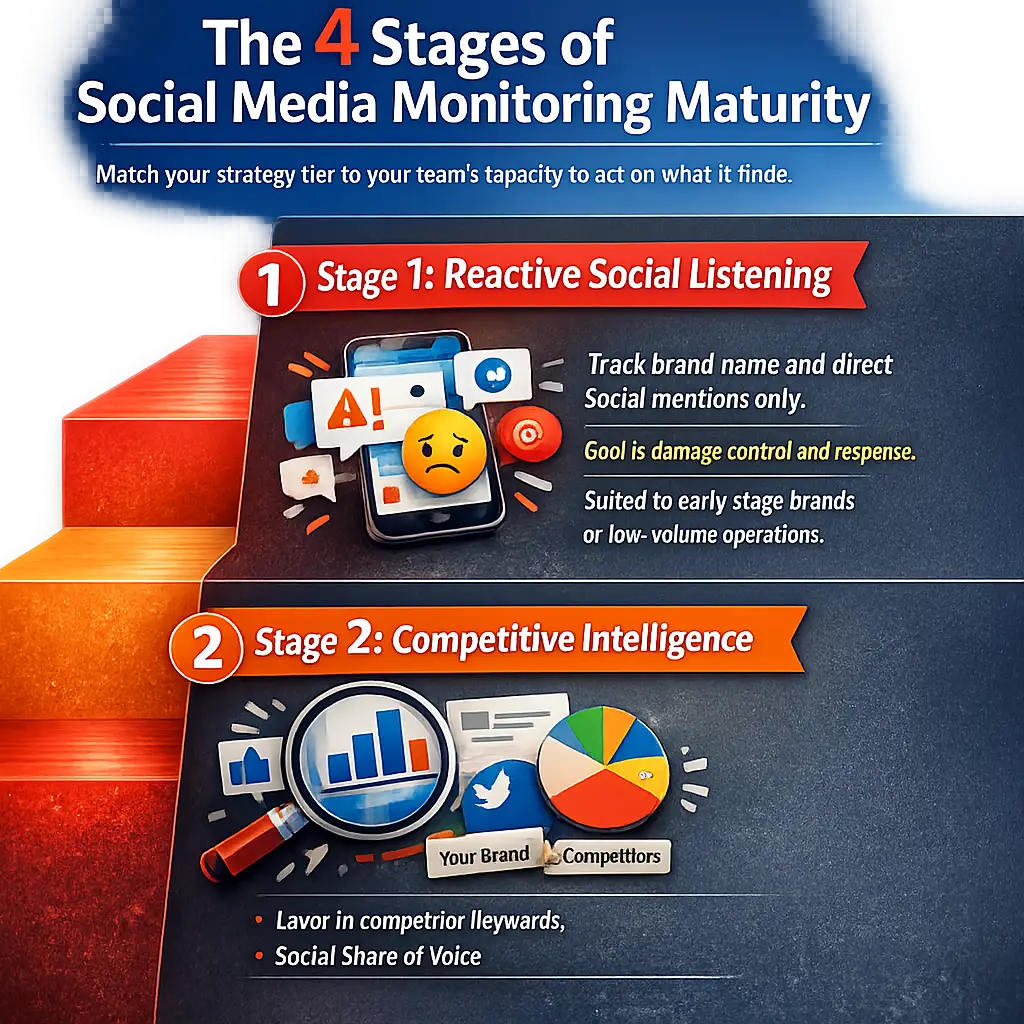
(https://www.semrush.com/blog/tracking-social-media-kpis/) tracking, and campaign-adjacent terms. Goal is market positioning and differentiation.”; item3_title=”Stage 3: Audience Insight”; item3_body=”Monitor industry topics, adjacent communities, and unbranded conversations. Goal is content strategy and product feedback.”; item4_title=”Stage 4: Predictive Signal”; item4_body=”Track trend velocity, sentiment trajectory, and emerging hashtag clusters to anticipate market shifts before they appear in traditional research.”; item5_title=”The Critical Rule”; item5_body=”Your strategy tier must match your team’s capacity to act on findings — not just collect them. Mismatched tiers are where programs fail.”; footer=”Mongoose Digital Marketing”]
Stage 1 — Reactive Monitoring
This is the entry point for most businesses, and there is nothing wrong with starting here. The scope is narrow by design: your brand name, common misspellings, your key product names, and your executives’ names if they carry public profiles. The operational goal is awareness and response — knowing when someone mentions you so you can reply, resolve, or escalate.
Reactive monitoring requires minimal tooling, a small time commitment, and a single owner. Its limitation is that it tells you only what people are saying about you directly — and only when they tag you or use exact match terms. It produces no competitive insight and no proactive intelligence.
Stage 2 — Competitive Intelligence Monitoring
At Stage 2, the monitoring scope expands to include your direct competitors’ brand names, their product names, and terms associated with major campaigns they’re running. You begin tracking share of voice — the relative volume of conversation your brand captures compared to competitors within your category.
This stage is where monitoring begins to directly influence business decisions: messaging adjustments, positioning shifts, and identifying gaps competitors are failing to address in their customer conversations.
Stage 3 — Audience Insight Monitoring
Stage 3 moves beyond branded and competitive tracking into the unbranded conversations your target audience is having. You’re monitoring industry pain points, product category discussions, and community conversations that have nothing to do with your brand — but everything to do with the problems you solve.
This stage requires significantly more sophisticated keyword architecture (covered in the next section) and a team structure that can route insights to content strategy, product development, and sales — not just the social media manager.
Stage 4 — Predictive Signal Monitoring
Stage 4 is practiced by larger organizations with dedicated brand intelligence functions. The focus shifts from capturing current conversations to identifying emerging patterns — tracking velocity of topic growth, sentiment trajectory shifts, and hashtag cluster behavior to anticipate where conversations are heading before they peak.
This level requires either advanced tooling, a dedicated analyst, or both. For most growing businesses, Stage 4 is a future-state goal, not an immediate priority.
Building a Keyword Architecture That Actually Works
Here is the single most important operational truth about social media monitoring that virtually no mainstream guide discusses: the difference between a monitoring program that generates 500 irrelevant alerts per day and one that surfaces 12 genuinely actionable insights lies almost entirely in query architecture — not in which tool you use.
Most monitoring guides tell you to “add your brand name, product names, and relevant hashtags.” That advice is not wrong. It’s just so incomplete that following it and nothing else almost guarantees a noisy, low-value feed.
A functional keyword architecture organizes queries into five distinct layers.
The Five Query Layers
Layer 1 — Core Identity Queries
These are your non-negotiables: exact brand name variants, common misspellings, product names, taglines, and any abbreviations your audience uses in the wild. These queries must run at all times, on every platform where your audience exists.
Layer 2 — Context Modifier Queries
Pairing your brand terms with sentiment-loaded or intent-loaded modifiers surfaces specific signal clusters that are far more actionable than raw mention counts. Examples include your brand name combined with terms like “broken,” “love,” “problem,” “alternative,” “vs,” or “disappointed.” Each modifier cluster represents a distinct customer intent that warrants a distinct response protocol.
Layer 3 — Competitive Displacement Queries
These are queries that capture users who are actively considering switching away from a competitor — a category your business competes in. Phrases structured around “looking for alternative to [competitor],” “better than [competitor],” or “[competitor] let me down” are lead generation signals that most brands miss entirely because they’re only monitoring their own name.
Layer 4 — Industry Pain Point Queries
Unbranded searches around the problems your product or service solves. These conversations happen continuously at high volume, completely disconnected from your brand name. Monitoring them at Stage 3 informs content strategy, reveals objections your sales team should be addressing, and surfaces emerging needs your product roadmap should consider.
Layer 5 — Exclusion Logic (Boolean NOT)
This layer is where most programs break down. If your brand name or a key product term shares vocabulary with an unrelated industry, you need Boolean NOT operators to exclude that noise from your feed. A legal services firm named “Summit” that doesn’t exclude mountaineering content will find its monitoring feed buried under hiking discussions. Exclusion logic isn’t optional — it’s foundational.
Keyword Architecture Reference Framework
| Query Layer | Purpose | Example Structure | Priority Level |
|---|---|---|---|
| Core Identity | Catch all direct brand mentions | “[Brand name]” + all spelling variants | Non-negotiable — always on |
| Context Modifiers | Surface intent-specific signals | “[Brand] + broken / love / vs / alternative” | High — refine monthly |
| Competitive Displacement | Identify switching-intent leads | “looking for alternative to [Competitor]” | High — tied to sales pipeline |
| Industry Pain Points | Drive content and product insight | “[Problem category] + [symptom terms]” | Medium — review quarterly |
| Exclusion Logic | Reduce irrelevant noise | NOT [unrelated industry term] | Non-negotiable — refine ongoing |
Platform Prioritization: The Case Against Monitoring Everything
Several widely-read guides recommend monitoring “all platforms” as a matter of completeness. For a team with a dedicated brand intelligence function and enterprise tooling, this may be operationally feasible. For virtually every other business, it is the second fastest path to program abandonment — right after poor keyword architecture.
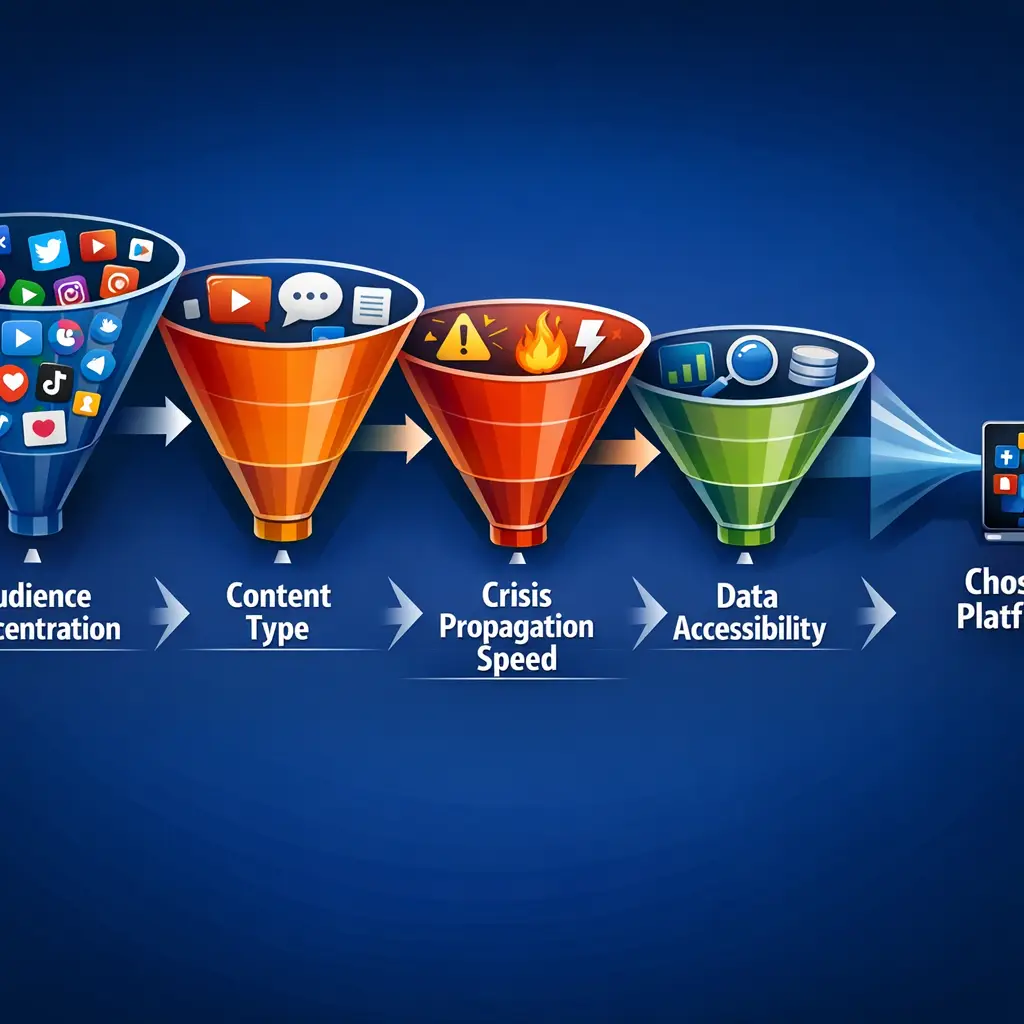
Platform prioritization should be a deliberate strategic decision driven by four factors:
1. Audience Concentration
Where does your specific target audience actually spend time in meaningful volume? B2B audiences tend to concentrate on LinkedIn and niche industry forums. Consumer audiences may concentrate on Instagram, TikTok, or Facebook depending on demographics. Monitor where your audience is densest first.
2. Content Type and Conversation Format
Different platforms produce different types of monitoring signal. Long-form discussions on Reddit and industry forums yield deeper qualitative insight into pain points and objections. Twitter/X produces faster-moving, higher-volume brand mentions that are better suited to real-time response. Instagram and TikTok comments tend to be sentiment-heavy but context-light. Your platform prioritization should reflect what type of intelligence you actually need.
3. Crisis Propagation Speed
Some platforms amplify negative content far faster than others. A critical review thread on Reddit may surface on Google within hours. A negative video on TikTok can reach millions within a day. Understanding which platforms in your category generate the fastest negative amplification should inform your real-time alert configuration — even if those platforms aren’t your primary audience concentration points.
4. Data Accessibility Constraints
This is a factor most guides ignore entirely, but it directly affects what any monitoring tool can actually deliver. Following significant API restriction changes on major platforms — including X/Twitter’s 2023 restructuring of data access — the social data landscape shifted considerably. Real-time full-coverage monitoring across all platforms is not uniformly available across all tools. Understanding where your chosen tool has complete data access versus estimated or sampled data is a requirement for interpreting your results accurately, not a footnote. For a deeper look at how platform API changes affect what tools can actually surface, the Social Media API Integration for Business Marketing article covers the practical implications in detail.
The Honest Truth About Sentiment Analysis
Every monitoring tool sells sentiment analysis as a marquee feature. The capability is genuinely useful — but not in the way most guides describe it.
AI-powered sentiment analysis achieves roughly 70–80% accuracy on clear, straightforward English-language text. That accuracy drops significantly under several conditions practitioners encounter constantly:
- Sarcasm and irony — “Oh great, another outage. Love this product.” reads as positive to most sentiment engines.
- Industry-specific terminology — Technical language, trade jargon, and category-specific vocabulary frequently confuse models trained on general language datasets.
- Multi-language content — Sentiment model accuracy varies substantially across languages, and code-switching (mixing languages in a single post) compounds the problem further.
- Culturally specific references — Humor, idioms, and cultural context that shifts the meaning of otherwise neutral language often produces incorrect sentiment classifications.
This does not mean sentiment analysis should be dismissed. Aggregate sentiment trends across large data sets remain genuinely informative — a 15-point shift in positive sentiment over a month is meaningful even if individual classifications are imperfect. The problem arises when teams treat individual sentiment scores as reliable enough to route automated responses or make high-stakes decisions without human review.
The practical protocol: use sentiment scoring as a triage and prioritization mechanism, not as a definitive judgment. Configure your monitoring workflow so that any mention tagged as strongly negative by the sentiment engine routes to a human reviewer before any response action is taken — not after.
Solving the Organizational “Last Mile” Problem
This is where most monitoring programs silently die.
The technical infrastructure is in place. Alerts are firing. Dashboards are populated. And then — nothing changes. Reports get generated. Nobody reads them. The program gets described internally as “not really useful” and eventually deprioritized.
The problem is almost never the data. It is the organizational routing of insights.
The Ownership Problem
Social media monitoring outputs typically live inside a marketing tool. But the actions those outputs require span customer service, product development, public relations, and sales. Without a clearly defined ownership model — specifically, a documented RACI that assigns who is responsible, accountable, consulted, and informed for each category of monitoring output — insights stall at the point of discovery.
A mention that indicates a product defect should route to product and customer service. A mention that indicates a competitor’s vulnerability should route to sales and marketing. A mention that indicates a PR risk should route to communications leadership. These are three different owners. Without a routing structure, everything lands on whoever manages the monitoring tool — who is usually a social media manager without the authority or context to act on most of it.
The Escalation Protocol Gap
Real-time alerts are operationally valuable only when there is a documented decision tree behind them. The essential questions every monitoring program needs answered in advance:
- Who reviews an alert when it fires outside business hours?
- What volume or sentiment threshold constitutes a crisis-level escalation?
- Who has authority to approve a public response, and within what timeframe?
- What is the process if the designated reviewer is unavailable?
Most businesses lack formal answers to these questions until a crisis forces them to improvise — which is precisely the worst moment to be improvising.
The Insight Translation Layer
Raw monitoring outputs — mention counts, sentiment scores, trending hashtags — do not translate naturally into decisions that stakeholders in product, finance, or operations can act on. High-performing monitoring programs build a structured weekly insight brief format rather than sharing dashboard screenshots.
An effective weekly insight brief frames social data in terms of business implications, not platform metrics. The difference looks like this:
- Dashboard dump version: “Reddit mentions up 47% this week. Net sentiment: negative.”
- Insight brief version: “Support-related Reddit conversation around our checkout flow has increased 47% week-over-week and is trending negative ahead of our quarterly product review. The primary complaints cluster around mobile payment failures. Recommend proactive support messaging and escalation to the product team before this surfaces in helpdesk volume.”
The second version requires a human analyst to write it — but it is the version that gets read, shared, and acted upon.
Closing the Feedback Loop
Monitoring insights should feed back into the program itself on a documented cycle. Keyword lists should be reviewed and refined monthly based on what’s generating signal versus noise. Platform prioritization should be revisited quarterly as audience behavior shifts. Insight brief formats should be adjusted based on stakeholder feedback about what’s actually useful versus what gets ignored.
A monitoring program without a feedback loop calcifies within a year. The teams that extract sustained, measurable value from monitoring treat it as a living operational system — not a set-and-forget configuration.
Matching Strategy to Business Size and Life Stage
One final dimension that most monitoring guides treat as irrelevant deserves direct attention: your monitoring strategy should reflect where your business actually is, not some idealized version of a mature enterprise program.
A 15-person business with a two-person marketing function does not need a Stage 3 monitoring infrastructure. What it needs is a tight Stage 1 or Stage 2 configuration with a clear owner, a functional escalation protocol, and a weekly review habit. That program, run consistently, produces real value. A more ambitious program built without the organizational capacity to act on its outputs produces nothing but overhead.
As your team scales, your monitoring strategy should scale with it — moving through the maturity stages deliberately, adding complexity only when you have the organizational structure to absorb it productively.
The businesses that grow their monitoring capability most effectively treat each stage as a proof of concept: demonstrate that you can consistently act on Stage 1 insights before expanding to Stage 2. Demonstrate Stage 2 value before committing to the broader keyword architecture and cross-functional routing that Stage 3 demands.
This is not a limitation. It is how durable, high-performing monitoring programs are actually built. For context on how monitoring fits within a broader approach, the Social Media Strategy for Small Businesses That Actually Works article covers the wider strategic framework that monitoring programs should plug into.
Final Strategic Recommendations for 2026
Choosing the right tools and habits now positions your monitoring program to scale cleanly as platform behaviors and audience expectations continue to shift. Three specific moves are worth prioritizing heading into 2026.
1. Consolidate around a mid-tier unified monitoring platform before expanding coverage.
Tools like Brandwatch, Sprout Social Listening, or Mention offer the keyword management, source breadth, and alert infrastructure that support both Stage 1 and Stage 2 programs without requiring enterprise-level organizational overhead. Whichever platform you evaluate, prioritize Boolean query support and exportable reporting — those two capabilities determine whether the tool grows with your program or constrains it. The How to Choose Social Media Management Software article walks through the evaluation criteria that matter most when comparing platforms at this tier.
2. Build an AI-assisted triage layer into your workflow.
In 2026, volume management is the practical problem. Native AI summarization features inside monitoring platforms — and lightweight integrations with tools like ChatGPT or Claude for insight synthesis — reduce the manual time required to move from raw mention data to actionable briefs. This is not a replacement for human judgment on escalations; it is a filter that makes human judgment faster and better-targeted.
3. Establish a quarterly competitive listening audit as a standing deliverable.
Competitive monitoring tends to drift into background noise unless it produces a concrete output on a fixed schedule. A quarterly audit — reviewing share of conversation, sentiment differentials, and emerging competitor messaging themes — gives your team a structured moment to translate monitoring data into strategic decisions about positioning, content, and response priorities.
Frequently Asked Questions
What is the most important first step when building a social media monitoring strategy from scratch?
The single most important first step is defining what you are actually monitoring for — and being specific about it. Before selecting tools or configuring dashboards, document the two or three business questions your monitoring program needs to answer. Brand reputation? Competitive positioning? Customer service escalations? The answer to that question determines everything downstream: which keywords matter, which platforms to prioritize, and how frequently insights need to be reviewed. Teams that skip this step build programs that generate data without generating decisions.
How many platforms should a small business monitor at launch?
Start with the one or two platforms where your audience is most active and where your brand is most likely to be mentioned without being tagged. For most small businesses, that means starting with the platform where your existing organic presence is strongest, then adding a secondary source — often Google reviews or a relevant industry forum — based on where your customers actually discuss products or services in your category. Broad platform coverage sounds comprehensive but dilutes the attention required to act on what you find. Depth on the right platforms outperforms breadth across all of them.
How often should you review and update your monitoring keyword list?
A monthly review cycle is the practical standard for most programs. Each review should ask two questions: which keywords are generating actionable signal, and which are generating noise that requires manual filtering to discard. Terms that consistently surface irrelevant mentions should be refined with exclusion logic. New product names, campaign terms, and emerging competitor activity should be added as they become relevant. A keyword list that is never updated within six months of launch is almost certainly underperforming — audience language shifts, and your configuration should shift with it.
When does it make sense to move from a basic to an advanced monitoring setup?
The right trigger for expanding monitoring maturity is demonstrated capacity to act on what your current setup is already surfacing — not a specific team size or platform count. If your team is consistently reviewing insights, escalating issues through a defined process, and making documented decisions based on monitoring outputs, that is the signal that a more sophisticated configuration will add value rather than overhead. Expanding keyword architecture, adding cross-functional routing, or integrating monitoring data into broader reporting frameworks before those operational habits are in place produces complexity without proportional return.
Conclusion
A well-designed social media monitoring strategy is one of the highest-leverage operational investments a business can make — and getting the foundation right matters far more than scaling fast. If you are working through which stage fits your current team, how to structure your keyword architecture, or how monitoring connects to a broader digital marketing strategy, Mongoose Digital Marketing is the kind of local partner that makes that process straightforward. Our work in social media management and digital strategy is built around programs that produce real business outcomes, not dashboards that look impressive and go unread. When you are ready to talk through what the right monitoring setup looks like for your specific situation, Contact Mongoose Digital Marketing and we will figure it out together.