
Key Takeaways
- Service businesses that audit their content library by buying stage — problem-awareness, solution-awareness, and vendor-selection — consistently identify that 80% or more of their existing content targets only the final stage, leaving cold prospects with no pathway to engagement.
- The feast-or-famine cycle in service business marketing is a structural problem caused by the same people delivering the work also being responsible for generating new business — solving it requires a pre-built, capacity-tiered content system, not simply better time management.
- Referral likelihood peaks within 7 to 21 days after a client’s highest positive experience, meaning most service businesses either ask too early or too late to capture referrals at their most motivated moment.
- High-stakes, low-frequency services such as legal, financial, and consulting require “category creation” content that first convinces prospects they have a problem worth solving — before any vendor comparison content becomes effective.
- Standard last-click attribution models consistently under-report the contribution of SEO and content marketing to service business revenue because they cannot track the multi-month, multi-touchpoint journeys that precede most service purchases.
When a service business in Dayton or Centerville puts up a website, runs a few Facebook ads, and wonders why the phone isn’t ringing — the problem is almost never execution. It’s architecture. The digital marketing playbook that works for an e-commerce store selling physical products does not map cleanly onto a business where the product is expertise, time, and trust. The buying journey is longer, the attribution is murkier, and the competitive differentiators are harder to see on a screen.
This guide is written for service business owners and operators in the greater Dayton metro area who are done with generic advice. What follows is a practitioner-level breakdown of how digital marketing actually functions differently for service businesses — not the version that lumps a Beavercreek accountant in with a Miamisburg hair salon and calls them the same problem.
Why “Service Business” Is Not a Single Marketing Category
The most persistent strategic error in service business marketing is treating the category as uniform. A Springboro wedding photographer and a Kettering IT managed services firm are both “service businesses.” They share essentially zero marketing physics.
The variable that matters most is not industry — it is the purchase frequency and decision stakes combination. These two axes determine your entire channel mix, content architecture, trust-building timeline, and conversion strategy.
The Four Service Business Marketing Archetypes
Understanding which archetype your business occupies is the prerequisite to every other decision in your digital marketing strategy.
| Archetype | Examples (Dayton Area) | Purchase Frequency | Decision Stakes | Primary Marketing Challenge |
|---|---|---|---|---|
| High-Frequency / Low-Commitment | Massage therapy, hair salons, auto detailing | Weekly to monthly | Low — easy to switch | Reduce friction at decision point; win on availability and convenience signals |
| Low-Frequency / High-Stakes | Estate attorneys, financial advisors, surgical specialists | Once or rarely | High — consequences of a wrong choice are significant | Build category urgency first; demonstrate domain authority before vendor comparison begins |
| Subscription / Retainer | IT managed services, marketing agencies, bookkeeping firms | Ongoing — contract-based | Medium to high — switching costs are real | Demonstrate long-term ROI; compete on trust, integration depth, and accountability |
| Project-Based / Episodic | Wedding photographers, home renovation contractors, graphic designers | Occasional — tied to life events | Medium to high — project failure is costly | Win the research phase; be visible precisely when the trigger event occurs |
Each of these archetypes demands a different lead time before conversion, a different content strategy, and a different definition of what “marketing success” looks like. A high-frequency service business that invests heavily in long-form thought leadership content is burning resources on the wrong tool. A high-stakes professional service firm running urgency-based social ads is working against its own trust requirements.
Get the archetype right first. Everything else follows from it.
The Buying Stage Coverage Problem Most Service Businesses Don’t Know They Have
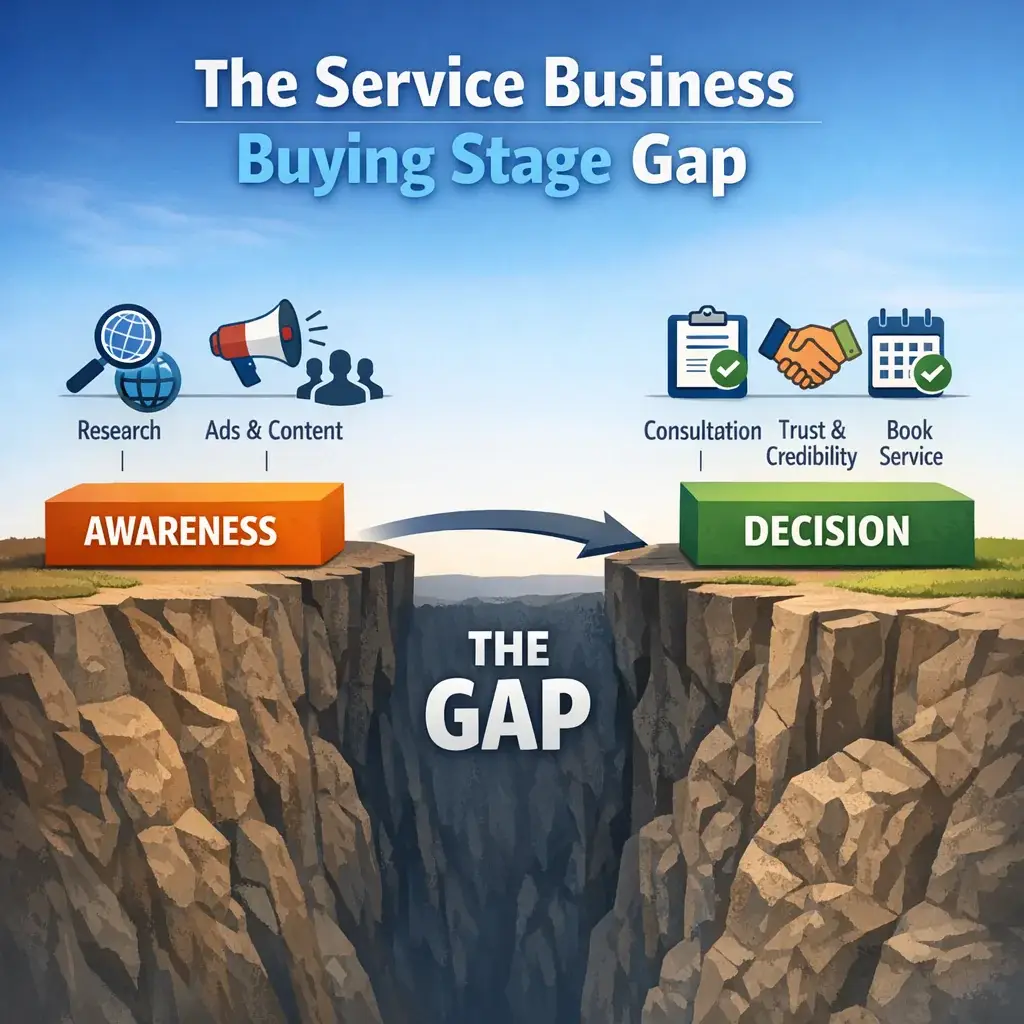
Here is a diagnostic exercise worth doing before you spend another dollar on marketing: categorize every piece of content your business has produced in the last 12 months — every blog post, every social caption, every landing page, every video — into one of three buckets.
Bucket 1 — Problem Awareness: Content that helps a prospect recognize they have a problem, quantify its cost, or understand why it requires professional help. Example: “Signs Your Huber Heights Business Is Losing Customers to Competitor Websites Without Knowing It.”
Bucket 2 — Solution Awareness: Content that explains the category of solution, how it works, and what outcomes it produces. Example: “How Local SEO Works and What It Can Realistically Do for a Dayton-Area Service Business.”
Bucket 3 — Vendor Selection: Content that makes the case for hiring you specifically. Testimonials, case studies, “About Us” pages, “Why Choose Us” sections, service pages.
Most service businesses find that 75 to 90 percent of everything they have ever produced sits in Bucket 3. This is the correct content for prospects who are already ready to hire someone — it just fails completely for the much larger population of prospects who haven’t yet decided they need to hire anyone at all.
This is not a minor gap. For high-stakes service categories especially, the majority of your eventual clients will spend weeks or months in the problem-awareness and solution-awareness stages before they ever evaluate a vendor. If you have no presence in those stages, you are invisible during the period when preferences and brand associations are actually forming.
What Buying Stage Coverage Should Look Like
For most professional service businesses in the Dayton metro, a healthy content distribution target looks something like this:
- Problem Awareness content: 30 to 40 percent of total content production
- Solution Awareness content: 30 to 35 percent
- Vendor Selection content: 25 to 35 percent
This does not mean producing less vendor-selection content. It means producing proportionally more early-stage content that meets prospects where they actually are when they first begin their journey. A well-structured content marketing strategy for small businesses maps content production deliberately across all three stages rather than defaulting to promotional material.
The Invisible Pipeline Problem and Why Standard Advice Makes It Worse
Every piece of generic digital marketing advice tells service businesses to “stay consistent.” Post three times a week. Send a monthly newsletter. Publish one blog article per month. The advice is not wrong in isolation — the problem is that it completely ignores the structural reality of how service businesses operate.
When you are fully booked serving clients in Beavercreek, Centerville, and Springboro, the newsletter does not get written. The blog post gets pushed to next month. The social media queue runs dry. Marketing output collapses precisely at the moment revenue is highest — and six weeks later, when those projects close, the pipeline is empty and the business is scrambling.
This is the feast-or-famine cycle. It is not a discipline problem. It is a structural problem created by the fact that in a service business, the people delivering the work are often the same people responsible for finding the next work.
The Capacity-Tiered Marketing System
The practical solution is to architect your marketing operation across three operational states rather than one flat “consistent” standard.
State 1 — Low Capacity (Production Mode)
When client load is light, this is the window for bulk content production. Write three months of blog posts in two weeks. Record video content. Build out email sequences. Develop downloadable frameworks or guides. The goal is to fill an asset library that will run on its own during the next busy period.
State 2 — Optimal Capacity (Maintenance Mode)
When business is running at a healthy pace, the focus shifts to scheduling and deploying pre-produced assets. Social posts go out from the queue. Email sequences run automatically. The blog publishes on schedule from the draft backlog. Marketing continues without requiring active creation hours.
State 3 — Full Capacity (Minimum Viable Signal Mode)
When the business is fully booked, marketing does not stop — it drops to its minimum viable configuration. This means the evergreen email sequence continues, the Google Business Profile stays current, and one or two pre-produced content pieces publish. The pipeline never fully goes dark.
The key architectural principle is decoupling content creation from content distribution. These two activities do not have to happen simultaneously. Most service businesses treat them as the same task, which is why marketing stops when work starts.
The Evergreen Asset Priority
Certain content formats generate pipeline continuously after a single production investment. For service businesses in the Dayton area, these formats represent the highest-leverage marketing investments available:
- Pillar service pages with embedded FAQ content that captures long-tail search queries from Dayton and surrounding suburbs
- Email nurture sequences (5 to 8 emails) that run automatically from first contact to consultation request without manual effort
- Video explainers that answer the three to five most common questions your prospects ask before hiring, hosted on YouTube and embedded on service pages
- Downloadable frameworks or checklists that provide genuine value, capture email addresses, and automatically trigger a nurture sequence
Each of these formats continues working at 3 a.m. on a Friday when the team is finishing a project for a Kettering client and nobody has time to post on Instagram.
Building Authority, Not Just Awareness: The Distinction That Wins Professional Service Markets
There is a meaningful difference between a Dayton-area business knowing your name and a prospect trusting you as the recognized expert in their specific problem. Generic marketing advice confuses these two outcomes and recommends the same tactics for both.
Brand awareness asks: Have I heard of them?
Domain authority asks: Are they the acknowledged expert in exactly what I need?
For professional service businesses — attorneys, financial planners, consultants, engineers, medical practitioners — the second question is the one that actually drives the hire. A prospect who has vaguely seen your ads is not meaningfully closer to hiring you than someone who has never heard of you. A prospect who has read your detailed analysis of a problem they are actively experiencing, who has watched you explain the nuances of a decision they are about to make, and who has seen you cited or referenced by others in their network — that prospect is ready to call.
The Authority Ladder vs. the Awareness Ladder
Awareness-building tactics — display ads, broad social reach, brand mentions — are horizontal. They spread your name across a large population, most of whom are not currently in your buying window.
Authority-building tactics are vertical. They go deep with the specific population that is actively in a problem-solving mode right now.
Authority-building content formats that work for Dayton-area professional services:
- In-depth guides that address the specific regulatory, geographic, or market considerations relevant to Southwest Ohio businesses and residents
- Detailed case studies written from a problem-solving narrative perspective, not a promotional one — what was the situation, what were the real considerations, what was decided, and what happened
- Webinars or recorded presentations on niche topics where you can demonstrate live reasoning, not just curated talking points
- Guest contributions to local publications, Dayton Business Journal features, or regional association newsletters that put your analysis in front of audiences who already trust the publication
- Podcast appearances or hosting — audio content builds a particularly strong parasocial authority relationship because listeners spend extended time in your voice
The authority ladder takes longer to climb than an awareness campaign. It also produces a fundamentally different type of prospect: one who arrives already convinced of your competence, with objections pre-answered, and with a much shorter sales conversation required.
Engineering Referrals as a Predictable Acquisition Channel
Referrals are the dominant acquisition channel for most established service businesses in the Dayton metro. Ask most owners where their best clients come from and the answer is almost always some version of “word of mouth.” Then ask how they systematically generate referrals and the answer is almost always “we just do great work and people mention us.”
That is a passive referral posture. It produces referrals at whatever rate the universe decides, which is inconsistent and unmeasurable.
A referral system produces referrals at a measurable rate that can be improved, tested, and scaled.
The Three Components of a Referral Operating System
1. Referral Trigger Mapping
Clients do not refer with equal probability throughout your relationship. Referral motivation peaks at specific emotional moments — typically within the first few weeks after they experience a clear, tangible win from your work. Behavioral research on the peak-end rule demonstrates that people’s memory of an experience is disproportionately shaped by its most intense positive moment and its final impression.
For a Dayton marketing agency, that peak moment might be the first month where a client’s Google rankings visibly move. For a Centerville bookkeeper, it might be the moment a client sees their first clean financial report after months of disorganized books. For a Beavercreek contractor, it might be the moment a homeowner sees the finished space for the first time.
Map these moments in your client journey explicitly. Then build a referral prompt — a conversation, an email, a handwritten note — that arrives within two weeks of that moment, not six months later when the emotional salience has faded.
2. Referral Language Scaffolding
Most clients who want to refer you cannot do it effectively because they do not know how to describe what you do in terms that will resonate with someone who has never worked with you. They know the result they got. They don’t have the vocabulary to explain how you got there.
Give them the words. A short, plain-language description of the specific problem you solve and the type of client you serve best — delivered in a thank-you card, a client onboarding packet, or a follow-up email — dramatically increases referral conversion because it equips advocates with a script they can actually use.
3. Reciprocity Architecture
The most durable referral relationships are built on genuine reciprocity, not transactional incentives. For B2B service businesses especially, actively referring business to your clients and strategic partners creates the relational conditions where referring business back to you feels natural rather than obligated.
This means building a deliberate referral network — identifying complementary service businesses in the Dayton area whose clients overlap with yours but whose services don’t compete. A commercial real estate attorney and a business banking relationship manager serve many of the same clients. A web design firm and a brand photography studio operate in adjacent spaces. These relationships, actively cultivated, create a referral ecosystem rather than a series of one-off asks.

Measuring What Actually Drives Service Business Revenue
Standard digital marketing measurement was built for e-commerce. A customer sees an ad, clicks, and buys within minutes. Attribution is clean. The last click gets the credit.
Service businesses do not work this way. A prospect searching “Dayton financial advisor” in January might read your blog post, not contact you, find you again on LinkedIn in March, attend your webinar in April, get a referral from a mutual contact in June, and finally call your office in July. Last-click attribution gives 100 percent of the credit to the search that prompted the July call — and zero credit to the five months of content and relationship-building that made the call possible.
This broken measurement model causes service businesses to systematically cut the channels that build authority and pipeline (content marketing, SEO, email, webinars) because they appear not to generate leads, while over-investing in the channels that close prospects who were already going to convert regardless (branded search campaigns, direct mail to warm lists).
The Metrics That Actually Matter for Service Businesses
Rather than a single conversion metric, service business marketing measurement should be structured across three time horizons:
Leading Indicators (Signal Today, Revenue in 60-90 Days)
– Organic search visibility for problem-awareness and solution-awareness queries — not just branded terms
– Email list growth rate and sequence engagement (open rate, click rate, reply rate)
– Content consumption depth — are visitors reading full articles or bouncing immediately
– Google Business Profile interaction volume in target markets (Dayton, Kettering, Beavercreek, Centerville, Huber Heights, Miamisburg, Springboro)
Pipeline Indicators (Signal Today, Revenue in 30-60 Days)
– Consultation or discovery call request volume
– Referral lead volume and source
– Inbound inquiry quality score — are leads matching your ideal client profile
– Proposal or quote request rate
Revenue Indicators (Signal Now)
– Closed-won revenue by acquisition source
– Client lifetime value by acquisition channel — referral clients and organic search clients typically have significantly higher retention rates than paid acquisition clients
– Revenue per marketing channel over a trailing 90-day window
Building this three-layer measurement system requires more setup than installing a conversion pixel. It also produces a fundamentally more accurate picture of how your marketing investment is actually performing — and that accuracy is what makes every subsequent budget and strategy decision better.
Local Digital Presence for the Dayton Metro: The Non-Negotiable Foundation
Before any sophisticated content strategy, referral system, or authority-building program can function at full effectiveness, the local digital foundation must be solid. For service businesses operating across Dayton, Kettering, Beavercreek, Centerville, Huber Heights, Miamisburg, and Springboro, this foundation consists of three elements that work together.
Google Business Profile Optimization
Your Google Business Profile is frequently the first interaction a local prospect has with your business — and for high-frequency, lower-stakes services, it may be the only thing they evaluate before calling. A fully optimized profile for each service area includes accurate category selection, complete service listings, regular photo updates, an active Q&A section, and a consistent cadence of responses to all reviews (positive and negative).
Review velocity matters as much as review volume. A business with 40 reviews received over three years is treated differently by Google’s local algorithm than a business that received 30 of those reviews in the last six months. Building a system to generate reviews at a consistent pace — tied to the same post-delivery trigger moments used in referral mapping — compounds local search visibility over time. For a detailed walkthrough of what actually moves the needle, the article on Google Business Profile optimization tips that actually work covers the specific settings and signals that local businesses in this market consistently overlook.
Location-Specific Service Pages
A single “Services” page optimized for “Dayton” does not capture the full geographic demand across the metro area. Prospects in Springboro search differently than prospects in Huber Heights, and Google’s local search algorithm differentiates between them. Individual service-area pages — built around genuine location-specific content rather than template copy with the city name swapped — expand your organic footprint across the entire service territory without paid amplification.
Citation Consistency
Your business name, address, and phone number must appear identically across every directory, platform, and data aggregator where your business is listed. Inconsistencies create fractured local authority signals that suppress ranking performance across all target markets. An audit of existing citations, followed by a systematic correction process, is one of the highest-return foundational investments a Dayton-area service business can make.
Putting the Strategy Together: A Sequenced Build Approach
Attempting to implement every element of a sophisticated digital marketing strategy simultaneously is a reliable path to half-finished systems that generate nothing. The sequenced build approach structures implementation in a logical order where each layer supports the next.
Phase 1 — Foundation (Months 1 to 2)
Establish your local digital presence: Google Business Profile optimization, citation audit and cleanup, location-specific service pages. These elements generate returns continuously with no ongoing maintenance cost once properly built.
Phase 2 — Content Architecture (Months 2 to 4)
Conduct the buying stage coverage audit. Identify the specific problem-awareness and solution-awareness gaps in your current content library. Begin producing content that fills those gaps, prioritizing evergreen formats that will continue generating pipeline independent of ongoing production effort.
Phase 3 — Pipeline Systems (Months 3 to 5)
Build the email nurture sequence, the referral trigger map, and the referral language toolkit. These systems run automatically once built and represent the backbone of a consistent pipeline that functions even during full-capacity periods.
Phase 4 — Authority Amplification (Months 4 and Ongoing)
With the foundation and pipeline systems in place, begin the longer-term work of authority-building: guest publications, speaking opportunities, webinar content, strategic partnership development with complementary businesses in the Dayton metro.
Phase 5 — Measurement and Optimization (Ongoing from Month 2)
Implement the three-layer measurement system from the beginning. Use it to identify which channels and content types are producing leading indicators first, then follow those signals to optimize distribution and production priorities quarter over quarter.
This is not a one-time project. It is an operating system for sustainable business development — one that gets more effective over time as each layer compounds the performance of the others.
If your service business in the Dayton area is ready to move beyond generic marketing advice and build a strategy that matches how your specific clients actually make decisions, Mongoose Digital Marketing offers a no-obligation consultation to assess exactly where your current digital presence stands and where the highest-leverage opportunities are. The starting point is always an honest audit, not a sales pitch.
Strategic Recommendations for 2026
As the digital landscape continues to shift toward more personalized, intent-driven experiences, service businesses in the Dayton metro have a clear opportunity to get ahead by moving early on three specific priorities.
1. Invest in Conversation Intelligence Tools
Platforms like CallRail or Gong allow service businesses to capture and analyze what prospects are actually saying during discovery calls and consultations. This data directly informs content strategy, objection handling, and the language used across your website and email sequences. In 2026, businesses that understand the exact words their clients use will outperform those guessing at messaging.
2. Build a Systematic Video Presence on YouTube
YouTube remains the second-largest search engine and is significantly underutilized by local service businesses. A library of process explanation videos, FAQ responses, and client education content creates compounding search visibility that reinforces your written content strategy. Pair short-form clips with longer educational content to capture both discovery and decision-stage searchers.
3. Develop a Structured Client Onboarding Content Experience
The period between signed agreement and first service delivery is one of the highest-anxiety moments in the client relationship. Businesses that build structured digital onboarding sequences — welcome emails, expectation-setting videos, process guides — reduce early churn, dramatically increase referral rates, and generate testimonials more consistently. This is a largely untapped competitive advantage for service businesses operating in regional markets like Dayton. Understanding how to get more leads from your website starts with the experience a visitor has from their very first touchpoint through to becoming an active client.
Frequently Asked Questions
How long does it take to see results from a digital marketing strategy for a service business?
The timeline depends heavily on which channels you prioritize and the current state of your digital foundation. Technical SEO improvements and Google Business Profile optimizations typically begin showing measurable movement within sixty to ninety days. Content-driven organic traffic builds over three to six months as new pages earn authority and ranking positions. Referral systems and email nurture sequences can produce results more quickly once launched, often within the first sixty days, because they activate relationships that already exist. A realistic expectation for a well-executed full-strategy buildout is meaningful pipeline improvement within the first quarter, with compounding results extending through the first twelve months and beyond.
Do service businesses in smaller metro areas like Dayton benefit from the same digital strategies as large-city competitors?
Yes, and in some cases regional markets offer a structural advantage. Competition for local search visibility, authoritative content, and strategic partnerships is meaningfully lower in markets like Dayton, Kettering, Beavercreek, and Centerville than in major metros. A service business that builds a thorough digital presence in a regional market can achieve top positioning with less effort than the same business would require in a primary market. The strategies are identical — the opportunity to execute them before saturation occurs is simply greater here.
What is the most common digital marketing mistake service businesses make?
The most common and costly mistake is prioritizing content volume over strategic coverage. Many service businesses produce blog posts, social content, and videos without mapping that content to the specific stages their prospects move through before making a buying decision. The result is a large library of material that generates traffic from people who are nowhere near ready to hire, while prospects in the active evaluation stage find nothing that speaks to their specific concerns. A buying-stage content audit almost always reveals significant gaps at the solution-awareness and provider-comparison stages — which are the most valuable stages to serve.
How does Mongoose Digital Marketing approach strategy differently than a generalist agency?
Mongoose Digital Marketing focuses specifically on service-based businesses in the Dayton metro, which means every recommendation is grounded in how local buyers in this market actually research, evaluate, and choose service providers. Rather than applying a channel-first approach — leading with social ads or SEO as a default — the process begins with an honest audit of your current digital presence, your pipeline gaps, and the decision-making behavior of your specific client profile. Strategy follows the data, not a pre-packaged template.
Service businesses throughout the Dayton region — from Kettering to Beavercreek — deserve a marketing partner who understands local market dynamics and builds strategy around how real clients in this community make decisions, not around what happens to be trending nationally. Mongoose Digital Marketing proudly serving Dayton, Kettering, Beavercreek, Centerville specializes in SEO strategy and content marketing built specifically for service businesses ready to grow with intention. If you’re ready to find out exactly where your digital presence stands and what it would take to build a pipeline that works consistently, Contact Mongoose Digital Marketing to schedule your no-obligation audit today.