

What Is Viewpoint in Digital Marketing Strategy? (And Why Most Brands Don’t Actually Have One)
Most businesses approach digital marketing the same way: pick your channels, build your personas, produce content, run ads, measure results. Repeat. It’s a rational process — and it produces rational, forgettable results.
What separates brands that dominate their digital channels from those that blend into the background isn’t a better tactic. It isn’t a bigger budget or a more sophisticated tech stack. It’s something that sits above all of that — a clearly defined marketing viewpoint.
Here’s the problem: ask a hundred marketing teams to define their brand’s viewpoint, and the majority will hand you their tone of voice guidelines or their brand positioning statement. Those are real assets, but they’re not a viewpoint. Conflating the three is one of the most common strategic errors in digital marketing today — and it’s costing brands traffic, trust, and conversions they’ll never be able to attribute to the real cause.
This article defines what a marketing viewpoint actually is, where it sits in your strategic hierarchy, and why getting it right is one of the few genuinely defensible advantages available in modern digital channels.
The Strategic Hierarchy Most Digital Marketers Skip Entirely
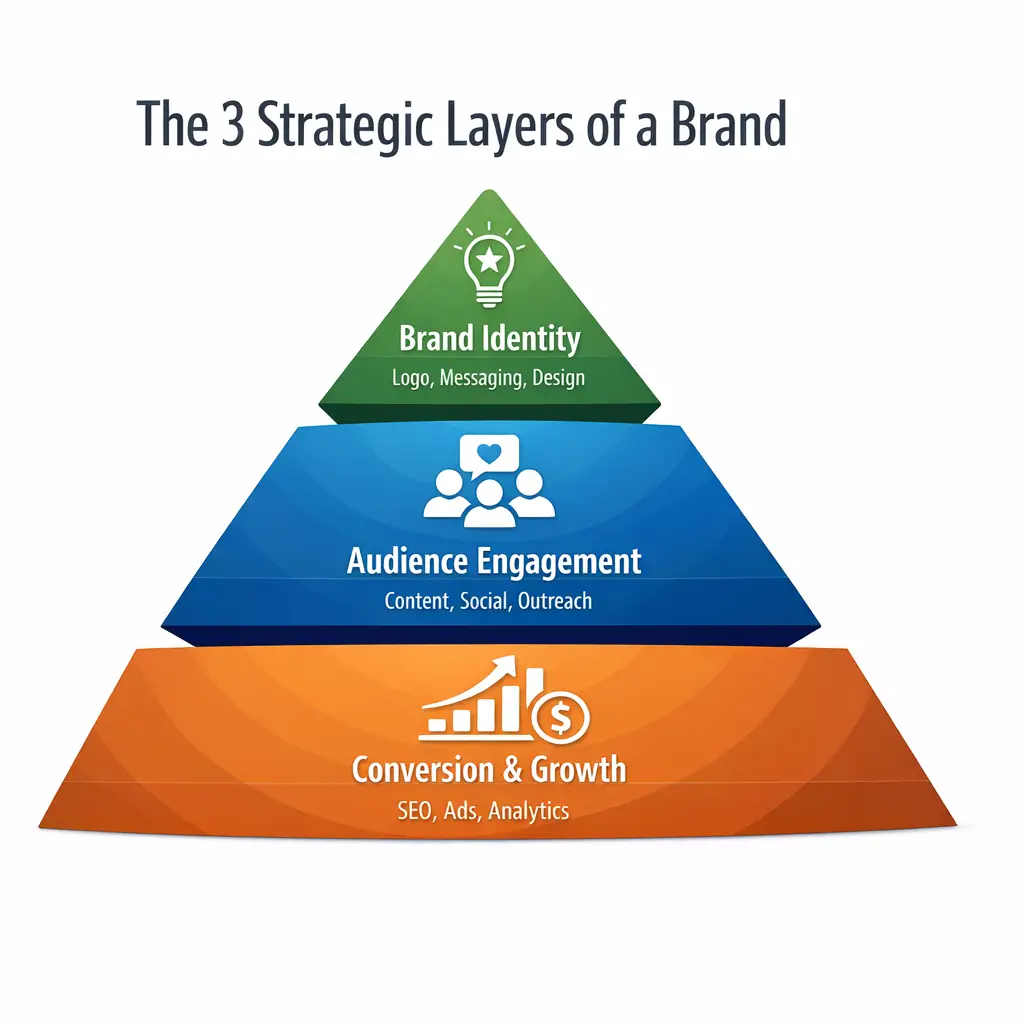
Before defining viewpoint, it helps to see clearly where it lives relative to the other strategic assets most teams are already working with. These three elements are routinely conflated — and the confusion is expensive.
Brand Voice
Brand voice describes how your brand communicates. It covers tone, vocabulary preferences, sentence structure, and personality markers. A brand voice might be “direct and no-nonsense” or “warm and conversational.” Voice is an execution-layer asset. It governs how content is written, not what the brand fundamentally believes.
Brand Positioning
Brand positioning describes where your brand sits in the competitive landscape. It defines your category, your differentiation from direct competitors, and the specific audience segment you’re targeting. Positioning answers the question: “Why should someone choose us over them?” It’s a market-orientation tool.
Brand Viewpoint
Brand viewpoint is the layer above both of these. It describes what your brand believes about your customer’s world — specifically, what you believe about their problem, their industry, or their situation that most others in your category haven’t said clearly, or have gotten wrong entirely.
A viewpoint isn’t a tagline. It isn’t a mission statement. It’s a declared perspective on how things actually work in your market — a perspective that is informed by genuine observation, experience, and conviction. Your voice carries that viewpoint. Your positioning reflects it. But neither one is the viewpoint.
| Strategic Asset | Core Question It Answers | Where It Lives |
|---|---|---|
| Brand Voice | How do we say things? | Execution layer — content, copy, creative |
| Brand Positioning | Where do we sit in the market? | Competitive layer — audience targeting, differentiation |
| Brand Viewpoint | What do we believe about our customer’s world? | Meta-strategic layer — shapes all decisions above and below |
| Tactics | What specific activities do we run? | Output layer — SEO, PPC, social, email, web design |
| Metrics | How do we measure success? | Accountability layer — conversions, traffic, ROI |
The strategic error most brands make is building from the bottom up — choosing tactics first, then worrying about positioning, and never getting to viewpoint at all. The result is marketing activity that is technically proficient but strategically incoherent.
Defining Marketing Viewpoint: A Precise Definition
A marketing viewpoint is the interpretive framework through which a brand understands, communicates about, and acts within its market. It is the brand’s declared stance on what is true about the problem it solves — a stance specific enough that it implies which solutions work, which approaches are flawed, and why the brand’s perspective has been earned rather than assumed.
Put more plainly: your marketing viewpoint is the answer to the question, “What do you believe about your customers’ world that most people in your industry haven’t had the courage or clarity to say?”
This draws from a concept in classical rhetoric called stasis — the identification of the precise point of genuine disagreement in any argument. A brand with a real viewpoint has identified the stasis point in its category: the belief about the customer’s problem that, once stated clearly, organizes everything else the brand says and does.
Why Viewpoint Is Not the Same as Having an Opinion
A common misreading of this concept is to treat viewpoint as a license to be contrarian or provocative for its own sake. That’s not what this is.
A strategic marketing viewpoint has three specific properties that separate it from a branded opinion or a content marketing “hot take”:
1. It is grounded in observed reality. A real viewpoint comes from accumulated experience in serving a specific audience — patterns noticed, assumptions tested, results tracked. It isn’t manufactured to sound interesting. It reflects what the brand has genuinely seen to be true in its market.
2. It is consequential. A viewpoint that doesn’t change what you do isn’t a viewpoint — it’s a talking point. A real marketing viewpoint actively filters decisions: which audience segments to prioritize, which channels to invest in, which content formats serve the brand’s perspective, and which tactics to walk away from because they contradict what the brand believes.
3. It passes the “Only We Could Have Written This” test. If your competitor could publish your content without changing a single word, your viewpoint is absent. Content that could have come from anyone — regardless of how technically accurate or well-produced — is interchangeable, which makes it strategically inert and algorithmically vulnerable.
This third criterion deserves serious attention. Google’s E-E-A-T framework — the quality standard underlying how content is evaluated for search ranking — specifically elevates Experience as a ranking signal. Experience, in this context, is Google’s algorithmic proxy for authentic viewpoint: demonstrated evidence that the content reflects direct, lived knowledge rather than assembled information. Brands that operate without a defined viewpoint struggle to satisfy this signal because their content, by definition, could have been written by anyone.
The “Epistemic Stance” Problem in Digital Content
Every piece of content a brand publishes communicates an implicit signal about what kind of knowledge the brand has and how it came to have that knowledge. This is what philosophers and communication theorists call an epistemic stance — and in digital marketing, it determines whether your content earns genuine authority or merely performs it.
Most brands default to what could be called assumed authority: they broadcast advice, instructions, or recommendations as if expertise is self-evident. The content says “here’s what you should do” but offers no signal of why this brand specifically knows this — no evidence of observation, no reference to what was tested, no acknowledgment of what was found to be false before the truth became clear.
Earned viewpoint operates differently. It signals knowledge that has a traceable origin — experience with a specific type of client, patterns observed across a particular industry, conclusions drawn from testing a hypothesis and tracking the outcomes. Content built from earned viewpoint doesn’t just tell audiences what to do. It tells them what the brand has seen to be true — which is a categorically different and more trustworthy kind of communication.
This distinction matters practically for digital marketing performance:
- SEO: Content built from earned viewpoint naturally satisfies E-E-A-T signals, generates more specific long-tail search queries, and earns more contextually relevant backlinks from peers who recognize genuine insight.
- Paid channels: Ad copy rooted in a clear viewpoint cuts through pattern recognition faster because it says something specific rather than something familiar. Specificity drives click-through. Familiarity produces scroll-past.
- Social media: Viewpoint-driven content generates substantive engagement — comments that engage with the idea — rather than passive likes. Algorithmic reach on most social platforms is driven disproportionately by comment activity.
- Email: Subscribers who connect with a brand’s viewpoint exhibit significantly different retention behavior than those who simply find the content useful. Viewpoint creates relational loyalty. Useful content creates transactional loyalty — and transactional loyalty migrates when a better offer appears.
Viewpoint Coherence: The Signal Architecture Problem No One Is Talking About
Assume a business has done the foundational work: they’ve documented their marketing viewpoint. Now the real strategic challenge begins.
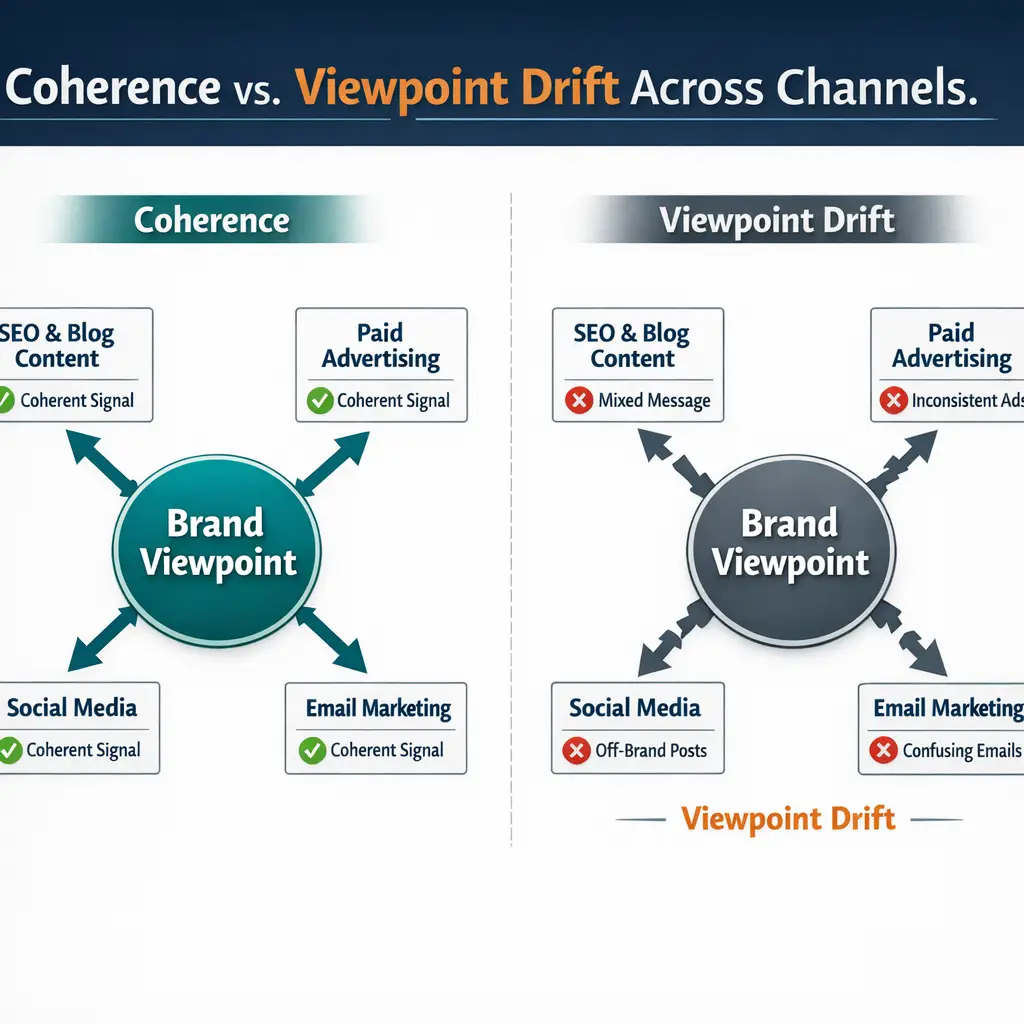
In a multi-channel digital environment — which describes virtually every serious business marketing effort today — the battle is not for presence. Most businesses already have presence across websites, social media, email, and paid channels. The battle is for coherence: ensuring that every touchpoint reflects the same underlying belief system, so that audiences and algorithms alike receive a consistent signal about what this brand fundamentally stands for.
When a brand’s LinkedIn content, blog posts, paid ad copy, and email sequences each reflect a subtly different set of implicit beliefs, the result is what strategists might call Viewpoint Drift — a gradual erosion of the brand’s original strategic perspective as more contributors (team members, agencies, AI tools) add to the content ecosystem without a documented viewpoint architecture to guide their decisions.
Viewpoint Drift is rarely dramatic. It happens incrementally:
- A blog post is written to capture a trending keyword and takes a position that the brand’s core content would never explicitly endorse.
- A paid ad is optimized for click-through rate without reference to whether the offer aligns with the brand’s stated perspective on its audience’s problem.
- A social media post adopts a tone that contradicts the authority the brand claims in its long-form content.
- An email sequence written by an outside agency uses messaging that is technically accurate but carries a different implicit belief about how the audience’s problem should be solved.
None of these errors is fatal in isolation. Collectively, they produce a brand that audiences experience as subtly inconsistent — and while most audiences cannot articulate the dissonance they feel, the behavioral evidence is measurable: lower return visit rates, declining email open rates, shorter time-on-page, and reduced conversion rates from returning visitors who should, by all conventional logic, be warmer leads.
Why Viewpoint Is a Defensible Asset — and Tactics Are Not
This is the argument that sophisticated marketers need to hear clearly, because it reframes how digital marketing investment should be evaluated.
Tactics are replicable. If a competitor sees that you’re generating leads through a specific content format, paid channel, or SEO approach, they can reverse-engineer and replicate the tactic within weeks. The average lifespan of any tactical advantage in digital marketing is contracting — AI tools, competitive analysis platforms, and the general acceleration of information sharing mean that the window between “we’re doing something others aren’t” and “everyone is doing this now” is shorter than it has ever been.
Viewpoint is not replicable at the same speed — because authentic viewpoint cannot be copied without also copying the accumulated experience, internal conviction, and organizational commitment that produced it.
A competitor can duplicate your blog structure. They cannot duplicate your brand’s specific interpretation of why your customers’ problems are being systematically mishandled by your industry — especially when that interpretation is documented, consistently expressed, and reinforced by years of client results.
This is why the most durable brands in any digital category tend to be the ones with the clearest point of view — not the ones with the biggest content libraries, the largest ad budgets, or the most sophisticated marketing technology. The content library, the ad performance, and the technology are all outputs of a clear viewpoint, consistently applied. Remove the viewpoint and the outputs lose their cohesive identity.
The Internal Alignment Function of a Documented Viewpoint
One of the most underrated benefits of defining a marketing viewpoint explicitly — in writing, in a document that every team member, agency partner, and content contributor can reference — is what it does to internal decision-making.
Without a documented viewpoint, every content decision becomes a negotiation: is this topic on-brand? Does this ad copy sound like us? Should we publish this perspective or is it too strong a position to take? These negotiations cost time, introduce inconsistency, and frequently resolve in favor of the safest, least distinctive option.
A documented viewpoint functions as a strategic filter that answers these questions before they become debates. When a team member asks “should we write about this topic?”, the answer isn’t a subjective judgment call — it’s a question of whether the proposed topic can be addressed through the lens of the brand’s documented perspective. If it can, it belongs. If it requires the brand to adopt a contradictory stance or take no position at all, it doesn’t.
This governance function is especially important as AI tools play an increasing role in content production. AI-generated content, by default, reflects consensus — the most statistically common perspective on any given topic. A brand without a documented viewpoint that it actively applies to AI-assisted content production will find its content gradually converging toward the generic center of its category. A documented viewpoint gives AI tools the specific interpretive frame they need to generate content that is distinctive, not just technically accurate.
Building a Marketing Viewpoint: The Foundational Questions
Defining a marketing viewpoint is not a branding exercise or a creative brief. It is a strategic inquiry that requires honest reflection on what the brand has genuinely observed and believes. The following questions are the starting framework:
What is the most common misunderstanding your ideal customers have about their own problem? Not a superficial misconception — the deep assumption that leads them toward solutions that don’t fully serve them.
What does your industry tend to get wrong about how to serve this audience? Where are conventional approaches producing results that are technically acceptable but not actually what clients need?
What have you seen to be true — through direct experience — that contradicts the standard advice in your category? This is the experiential core of a genuine viewpoint.
If you were completely honest with a prospective client on day one, what would you tell them that most competitors in your space would avoid saying? The answer to this question is often the most powerful viewpoint statement a brand can make.
What does success actually look like for your clients — beyond the vanity metrics most marketing conversations default to? A viewpoint includes a perspective on what outcomes genuinely matter and why.
The answers to these questions, refined and articulated clearly, become the foundation from which all downstream marketing decisions flow: which audiences to prioritize, which channels to invest in, which content to produce, and how to frame every offer and every conversation.
That is what a marketing viewpoint does. And it is why most brands — operating without one — are working significantly harder than they need to for results that are less durable than they could be.
Strategic Recommendations for 2026
Brands that take viewpoint development seriously in the coming year will need the right tools and disciplines to operationalize it — not just articulate it. Three specific next steps are worth prioritizing:
1. Conduct a Formal Viewpoint Audit Before Any Channel Investment
Before adjusting media spend, publishing calendars, or campaign strategies, complete a structured internal audit that documents what your brand genuinely believes about your category, your client’s real problem, and the gaps in conventional industry thinking. This audit becomes the strategic brief that informs everything else — including AI-assisted content workflows, sales enablement materials, and brand messaging. Without it, channel investment is essentially renting attention without a reason to hold it.
2. Invest in Interview-Based Customer Research Focused on Belief Mapping
Survey data tells you what customers do. Conversation tells you what they believe. In 2026, brands that commission qualitative research specifically designed to surface the assumptions, frustrations, and mental models of their ideal clients will have a significant advantage in shaping a viewpoint that resonates rather than one that merely sounds plausible. Tools like Otter.ai for interview transcription, combined with structured thematic analysis, make this process more accessible than it has ever been for organizations of any size.
3. Build a Viewpoint Document That Functions as Your AI Content Governance Layer
As generative AI becomes a standard part of content production, the differentiating factor will not be access to the tools — everyone has that — but the quality of the interpretive framework the tools are given to work from. Develop a living viewpoint document of meaningful length that articulates your brand’s core beliefs, named contrarian positions, audience insight, and definitions of genuine success for your clients. Feed this document into every AI-assisted content workflow as a governance layer. The output will be categorically more distinctive than content produced without it. For a deeper look at how content strategy and execution connect in practice, the article Blog Writing Services: What You’re Missing is worth reviewing alongside this framework.
Frequently Asked Questions
What is a viewpoint in digital marketing strategy, and how is it different from a brand voice or positioning statement?
A viewpoint is a documented set of beliefs a brand holds about its category, its clients’ real problems, and where conventional industry thinking falls short. Brand voice describes how a brand communicates. Positioning describes where a brand sits relative to competitors. A viewpoint explains why the brand sees the world the way it does — and that underlying conviction is what makes both voice and positioning feel genuine rather than constructed. Most brands have the latter two without the first, which is why their messaging feels technically competent but not particularly compelling.
Can a small business or local company realistically develop a meaningful marketing viewpoint?
Yes — and in many cases, small and local businesses have a distinct advantage here. A business with direct, ongoing relationships with its clients accumulates genuine observational knowledge about what actually works, what clients misunderstand, and where industry-standard approaches fail real people. That kind of ground-level experience is exactly what a strong viewpoint is built from. The challenge for smaller organizations is usually not having the insight — it is having the time and framework to extract, articulate, and deploy that insight systematically. The article Digital Marketing Services for Small Businesses outlines how this type of strategic clarity translates into channel-level execution for smaller organizations.
How long does it take to develop a marketing viewpoint that is actually usable?
The initial extraction process — working through the foundational questions honestly and with enough depth — typically takes several focused working sessions. Refining the language so that it is clear and usable as a strategic document takes additional iteration. What most organizations underestimate is that this is not a one-time exercise. A genuine viewpoint evolves as the brand’s experience deepens, as the market shifts, and as the brand’s understanding of its clients becomes more precise. The goal is a living document, not a finished artifact.
How does having a documented viewpoint affect content marketing and SEO performance specifically?
A documented viewpoint affects content marketing at the level of editorial judgment — which topics to address, what angle to take, which conclusions to draw, and which conventional narratives to challenge. This produces content that is meaningfully differentiated from the category average, which matters both to human readers evaluating whether a brand understands them and to search engines increasingly focused on genuine expertise and original perspective. Viewpoint-driven content tends to generate stronger engagement signals, more relevant inbound links, and clearer topical authority — the underlying factors that translate into durable search performance over time. The article SEO for Lead Generation 2026: What Actually Drives Pipeline explores how these authority signals connect directly to measurable business outcomes.
Conclusion
A clearly defined marketing viewpoint is not a luxury for well-resourced brands — it is the strategic foundation that makes every other investment in digital marketing work harder and last longer. Mongoose Digital Marketing works with businesses at exactly this level, helping organizations develop the strategic clarity that makes their content marketing and SEO not just visible, but genuinely worth finding. If you’re ready to build marketing that reflects what you actually know and believe about your clients and your category, Contact Mongoose Digital Marketing to start the conversation.