

Key Takeaways
- Beavercreek businesses frequently lose local search visibility because Google’s algorithm treats Dayton and Beavercreek addresses as competing signals, creating citation inconsistencies that suppress map pack rankings without any obvious warning signs.
- The Wright-Patterson AFB demographic — heavily populated by STEM professionals, defense contractors, and military families — requires trust-building content architecture before paid campaigns will convert efficiently, unlike consumer audiences in comparable suburban markets.
- The Greene Town Center’s national and regional chain tenants bring corporate-level marketing budgets to Beavercreek’s local search landscape, forcing independent businesses to compete against enterprise SEO infrastructure on unequal footing.
- In the Dayton DMA, local search competition for high-intent keywords is often decided by review velocity and Google Business Profile completeness, not just website quality or ad spend.
- A channel selection framework based on business maturity, industry type, and competitive density will consistently outperform a generic full-service retainer in a market as structurally specific as Beavercreek.
If you’ve tried digital marketing for your Beavercreek business and walked away with underwhelming results, the problem almost certainly isn’t effort — it’s that the strategy wasn’t built for this market. Beavercreek, OH has a genuinely unusual local economy. You have one of the largest air force bases in the country three miles from a premium outdoor lifestyle center, surrounded by one of the most educated and highest-earning suburban workforces in the Dayton region. That combination creates a search environment, a consumer psychology, and a competitive landscape that requires a fundamentally different approach than what works in neighboring suburbs or generic Ohio markets.
Most agencies operating in this space don’t acknowledge that complexity. They list services — SEO, Google Ads, social media, web design — and claim local expertise because they’re within a reasonable drive of Fairborn Road. That’s not a strategy. That’s a service menu.
This guide breaks down what digital marketing in Beavercreek actually requires: the structural SEO challenges specific to this market, the demographic realities that shape how consumers here research and buy, and a framework for deciding which channels deserve your attention first based on your industry and where your business currently sits.
The Beavercreek Local Search Problem Nobody Is Talking About
Why Your Address May Be Quietly Killing Your Rankings
Here’s something most Beavercreek business owners don’t know: the city you think you’re in and the city Google thinks you’re in may not match. This isn’t a technicality — it’s a structural ranking problem with measurable consequences.
Beavercreek is a city in Greene County, but a meaningful portion of its businesses operate with Dayton mailing addresses. This happens for legitimate reasons — legacy postal routing, commercial developments straddling municipal lines, and decades of informal address conventions. The result is a citation inconsistency problem that affects a disproportionate share of local businesses.
Google’s local search algorithm weighs NAP consistency — Name, Address, Phone — across every online directory, data aggregator, and business listing it can crawl. When your Google Business Profile says Beavercreek and your Yelp listing says Dayton and your Chamber of Commerce listing says something slightly different, the algorithm interprets that as ambiguity. Ambiguous businesses rank lower. It’s that direct.
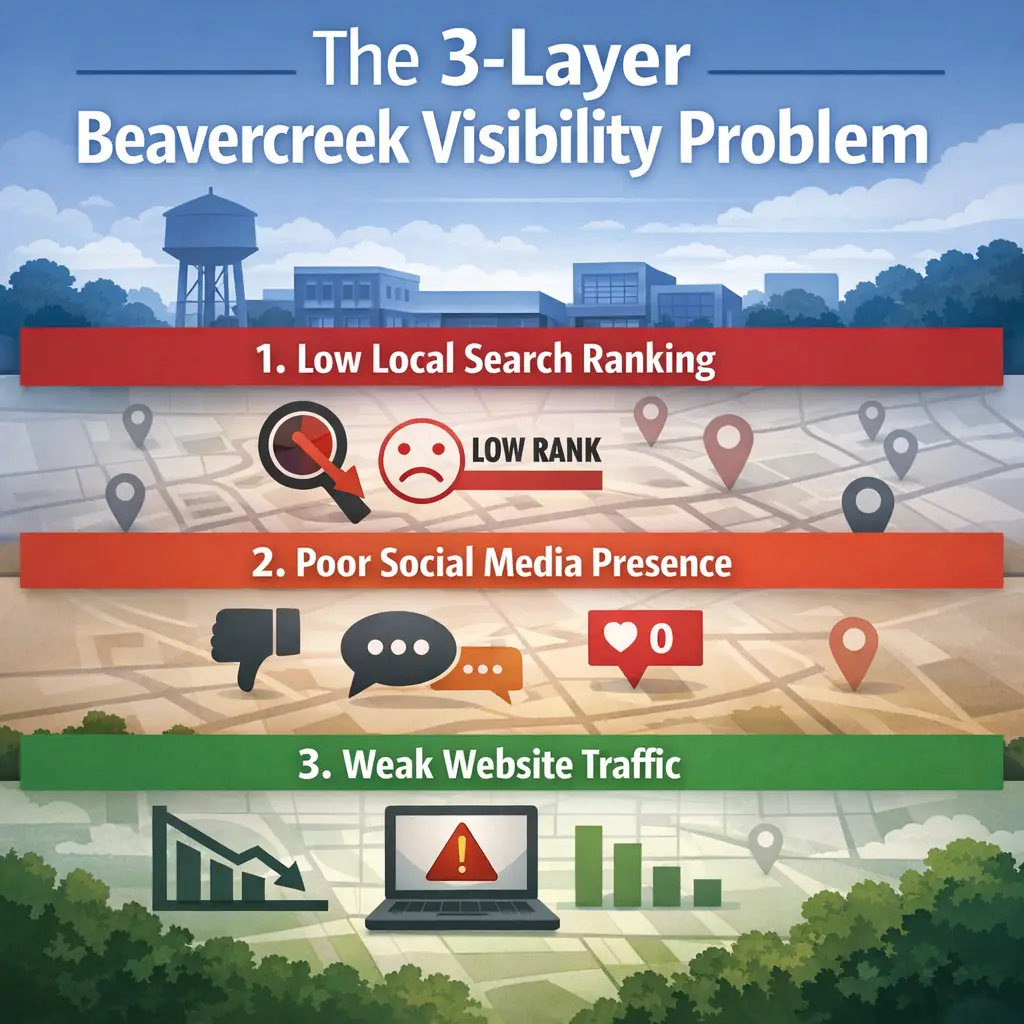
The three-layer local visibility problem in Beavercreek breaks down like this:
Layer 1: Address Signal Fragmentation
Businesses with Dayton-designated addresses competing for Beavercreek search terms face an inherent geographic mismatch. Google’s proximity weighting system favors businesses whose confirmed location aligns with the searcher’s detected location and the geographic modifier in the query. A business physically located in Beavercreek but listed with a Dayton postal designation sends conflicting signals about where it actually serves.
Layer 2: Review Volume Gap Against Dayton Incumbents
Map pack placement in competitive categories is heavily influenced by review count and recency. Established Dayton-based businesses — particularly in home services, legal, medical, and financial categories — have been accumulating reviews for years longer than many Beavercreek-incorporated competitors. Newer Beavercreek entrants start behind in a metric that compounds over time.
Layer 3: Domain Authority Asymmetry
For organic results sitting below the map pack, domain authority determines rank position more than any other single factor. Dayton-area businesses with longer operating histories, more inbound links, and more indexed content consistently outrank Beavercreek businesses for the same high-intent keywords — even when the Beavercreek business is more locally relevant to the searcher.
What Actually Fixes It
The correction strategy isn’t complicated, but it is methodical. It requires a full citation audit across the primary data aggregators — Neustar Localeze, Data Axle, Foursquare, and Apple Maps — combined with a Google Business Profile optimization pass that confirms your primary category, service area designations, and geographic coordinates. Then you build review velocity through a systematic post-transaction outreach process, because the review gap is a real problem that only consistent outreach closes over time.
None of this is passive. Beavercreek’s search landscape penalizes inaction. A business that audits its citations once and never revisits them will gradually slide in rankings as competitors build authority and new directory sources introduce new inconsistencies.
The Wright-Patterson Effect: Marketing to One of Ohio’s Most Distinctive Consumer Bases
Why the Standard Funnel Architecture Underperforms Here
Beavercreek’s proximity to Wright-Patterson Air Force Base isn’t just a local point of pride — it is the single most defining factor in the area’s consumer demographics, and it has direct implications for how digital marketing campaigns should be structured.
WPAFB is the largest single-site employer in Ohio. It brings roughly 30,000 military and civilian personnel to the Beavercreek-Fairborn area, the majority of them with advanced education, above-average household income, and a decision-making profile that diverges sharply from the national consumer average. Defense contractors, aerospace engineers, program managers, and active-duty officers are the dominant consumer archetype in this market.
What does that mean for your digital marketing funnel? More than most agencies will tell you.
This demographic over-indexes on research. Before converting on any high-consideration purchase — home services, financial advising, medical practices, legal services — they gather information systematically. They read reviews carefully, examine credentials, compare service pages, and look for evidence of expertise rather than persuasion. Campaigns built entirely around offer-driven creative — “Call Now for a Free Quote,” “Limited Time Savings” — significantly underperform with this audience compared to national benchmarks.
The funnel architecture that works in Beavercreek is heavier at the top and middle:
| Funnel Stage | Standard Suburban Approach | WPAFB-Adjacent Beavercreek Approach |
|---|---|---|
| Awareness | Broad reach ads, social media impressions | Authority content, search visibility for informational queries |
| Consideration | Service description pages, pricing signals | Detailed service pages, credentials, case studies, FAQ depth |
| Trust | General testimonials | Specific outcome-based reviews, industry certifications visible |
| Conversion | Strong CTA, offer-led | Low-friction consultation request, emphasis on process transparency |
| Retention | Periodic promotions | Consistent value communication, educational content |
The practical implication: businesses in Beavercreek that serve this demographic need to invest in content depth before they chase conversion volume. A paid search campaign driving traffic to a thin, generic landing page will produce poor conversion rates not because the traffic is wrong but because the trust architecture isn’t there to support the decision.
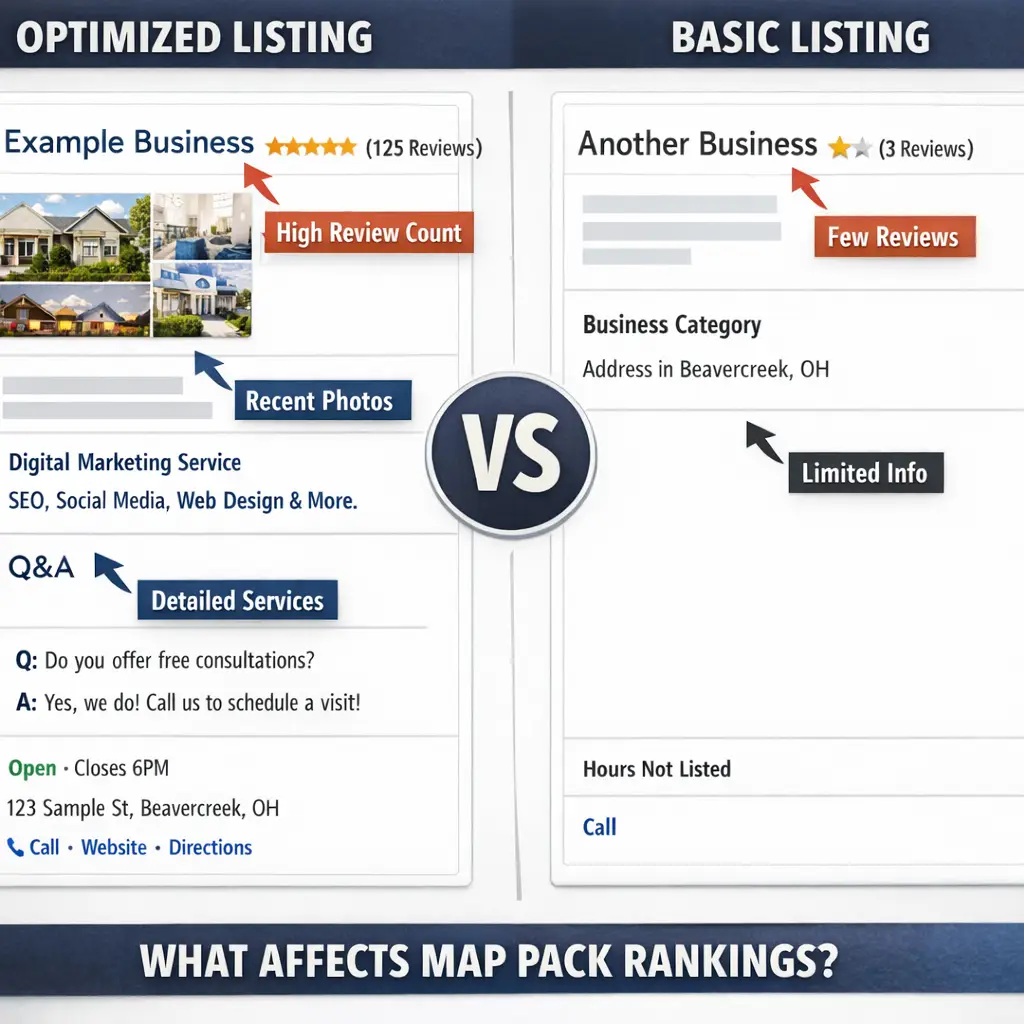
Google Business Profile completeness becomes especially significant in this context. A fully built-out GBP with complete service descriptions, posted photos, answered questions, and a pattern of detailed owner responses to reviews signals the kind of operational credibility this consumer group actively looks for. It’s one of the highest-leverage actions a Beavercreek business can take, and it costs nothing but time.
The Military Transience Factor
One demographic reality that gets almost no attention in local marketing strategy: military families rotate. WPAFB personnel typically serve assignments of two to four years before transferring. This creates a perpetual population of new Beavercreek residents actively searching for local service providers across every category — from dentists to landscapers to contractors — who have zero existing brand familiarity with local businesses.
For a business that can win this segment’s trust quickly, it represents a consistent source of new customer acquisition that doesn’t depend on beating an established competitor. For businesses that rely on reputation and word-of-mouth built over years, this segment is frequently invisible because they’re not yet plugged into local referral networks.
Digital marketing — specifically local SEO for Ohio service businesses and Google Business Profile visibility — is how you reach this audience before a local referral network does. New residents searching “HVAC service Beavercreek OH” or “family dentist near Wright-Patterson” are high-intent buyers with immediate needs and no incumbent loyalty. Ranking for those searches isn’t a nice-to-have; it’s a customer acquisition channel competitors are leaving uncaptured.
The Greene Town Center Dynamic: Competing Without a Corporate Marketing Budget
The Asymmetric Competition Problem
The Greene Town Center is genuinely valuable for Beavercreek’s economic identity — it draws traffic, creates a retail environment that benefits the surrounding area, and puts Beavercreek on the regional map as a destination. What it also does, from a competitive marketing standpoint, is seed the local search landscape with national and regional chain businesses backed by enterprise-level digital marketing operations.
When a national retailer, restaurant group, or service franchise opens at The Greene, they don’t just bring their brand — they bring centralized SEO teams, agency relationships, corporate Google Ads accounts optimized across hundreds of locations, and review generation infrastructure. An independent Beavercreek business in the same category is competing against that.
This is an asymmetric fight if you try to win it on the same terms. The counter-strategy requires playing a different game entirely.
What Independent Beavercreek Businesses Should Do Instead
Hyper-local content targeting neighborhood-level intent. National chains optimize broadly. Their content targets category-level searches — “restaurant Beavercreek” or “fitness center Beavercreek.” Independent businesses can dominate the more specific, longer-tail searches that corporate content teams don’t bother with: content addressing specific Beavercreek neighborhoods, references to local landmarks, and service-specific combinations that reflect how local residents actually search.
Google Business Profile category precision. One of the most common and damaging mistakes a local business can make is selecting overly broad primary categories on their GBP. Broad categories group you algorithmically with national chains that have far more reviews and authority. A more specific category designation — one that accurately reflects your niche and that fewer competitors have claimed — can dramatically improve your map pack visibility for the exact searches your best customers are running.
Review velocity as a competitive moat. Corporate locations are often slow to build authentic local review volume because their review solicitation processes are centralized and generic. A locally-owned Beavercreek business can implement a systematic, personal post-transaction review request process that outpaces a national chain’s local review accumulation within months. In local search, a business with 180 recent, detailed reviews consistently outperforms a competitor with 400 older reviews and a lower recency signal.
Building a Channel Selection Framework for Beavercreek Businesses
Why Service Lists Don’t Help You Decide Anything
Every agency in this market will tell you they do SEO, Google Ads, social media, and web design. That’s not useful information. The question every Beavercreek business owner actually needs answered is: given my industry, my current online presence, my competitive environment, and where I want to be in 18 months — where should my marketing dollars go first?
The answer is never the same for two different businesses. Here is a practical framework for thinking through it:
Channel Priority by Business Type and Maturity
Home Services (HVAC, Plumbing, Roofing, Electrical)
These businesses operate in high-intent, immediate-need categories where local SEO and Google Business Profile optimization deliver the highest near-term return. Searchers in these categories convert fast — they have a broken furnace or a leaking roof and they’re calling the first credible result they find. Google Local Services Ads (LSAs) are worth prioritizing alongside GBP optimization. Social media plays a secondary awareness role but rarely drives direct service calls in the short term.
Primary focus: Local SEO + GBP + LSAs
Secondary: Paid search for high-value service terms
Lower priority initially: Social media, content marketing
Professional Services (Legal, Financial, Medical, Accounting)
This category aligns most directly with the WPAFB demographic profile. Long consideration cycles, credential sensitivity, and high average lifetime client value make content depth and trust architecture the foundation. SEO for informational and comparison-intent keywords builds the pipeline. Paid search should target high-commercial-intent terms once the trust infrastructure is in place. Social media can support credibility but rarely drives direct conversions.
Primary focus: Content-led SEO + GBP completeness + reviews
Secondary: Paid search on conversion-intent terms
Lower priority initially: Broad social media advertising
Retail and Restaurant (especially near The Greene corridor)
This is where paid social and visual content earn their place in the strategy. Retail and dining decisions are driven by discovery, social proof, and recency. Instagram and Facebook ads targeted at Beavercreek and adjacent zip codes can build awareness efficiently. Google Ads for branded and category searches protects against competitors bidding on your brand name. Local SEO matters but plays a supporting role to the awareness and retention work happening on social channels.
Primary focus: Paid social + Google Ads brand protection
Secondary: Local SEO + review accumulation
Lower priority initially: Long-form content marketing
B2B and Defense Subcontractors
This is the most differentiated category in the Beavercreek market and the one most poorly served by standard agency playbooks. Decision cycles are long, stakeholders are multiple, and the buying environment is relationship-driven. LinkedIn becomes the highest-value paid channel. Content marketing — specifically thought leadership, technical documentation, and capability statements translated into accessible web content — builds credibility with procurement-adjacent audiences. SEO targets branded and niche-specific searches. Google Ads broad match is often wasted spend in this category.
Primary focus: LinkedIn + content/SEO for niche terms
Secondary: Website as a credibility asset with deep service documentation
Lower priority initially: Facebook/Instagram advertising, broad paid search
Measurement and Attribution: What Beavercreek Business Owners Should Actually Track
The Metrics That Tell You Whether It’s Working
One of the most consistent failures in local digital marketing is a measurement gap — campaigns run, reports get delivered, but business owners can’t connect the marketing activity to revenue outcomes. Here is what a properly instrumented Beavercreek campaign should be tracking:
Local Search Visibility Metrics
– Google Business Profile impressions (search and maps separately)
– GBP direction requests and website clicks (these are high-intent signals)
– Keyword rank position for primary service + location terms
– Map pack appearance rate for target search queries
Conversion Metrics
– Phone call conversions tracked to source (Google Ads call extensions, organic, GBP)
– Form submission completions with UTM attribution
– For retail: in-store visit attribution from Google Ads campaigns where applicable
Competitive Benchmarks
– Review count and average rating vs. top three map pack competitors (tracked monthly)
– Share of voice for primary keyword set vs. identified competitors
Business Outcome Metrics
– New customer acquisition by source (requires consistent intake data collection)
– Lead-to-close rate by channel (identifies which traffic source brings the best-fit customers)
The attribution challenge in local markets is real — phone calls from organic search are hard to track without call tracking software, and walk-in traffic from social media ads is nearly impossible to attribute precisely. The practical answer is to instrument every trackable touchpoint, use call tracking numbers for each major channel, and supplement the data with consistent intake questioning (“How did you hear about us?”). Imperfect attribution with systematic tracking beats confident reports built on incomplete data.
What a Realistic Beavercreek Digital Marketing Timeline Looks Like
Setting Accurate Expectations in a Competitive Suburb
One piece of information competitors consistently withhold is a realistic timeline. Beavercreek is not a low-competition environment where a few optimized blog posts and a clean GBP produce first-page rankings in sixty days. It is a competitive Dayton-area suburb with established local businesses, regional operators, and national chains all competing for the same map pack positions.
Here is what a well-executed local digital marketing campaign in Beavercreek realistically produces across a 12-month horizon:
Months 1–3: Foundation
Citation audit and correction, GBP optimization, website technical audit and corrections, baseline tracking installation. Visible ranking movement is limited at this stage. This is infrastructure work that determines how quickly everything else compounds.
Months 3–6: Early Signal
Review velocity improvements become visible. GBP engagement metrics (impressions, calls, website clicks) begin climbing. Organic ranking movement for lower-competition terms. Paid campaigns, if running, producing improving efficiency as landing pages and quality scores mature.
Months 6–12: Compounding Returns
Measurable rank improvement for target terms. Consistent map pack appearances for primary service categories. Paid search campaigns operating at improved conversion efficiency. Social campaigns building audience data and remarketing pools. New customer attribution through digital channels becoming trackable and significant.
A business that enters this process expecting 90-day transformation will be disappointed regardless of execution quality. A business that commits to a 12-month process with proper measurement will have competitive advantages in local search that are genuinely difficult for new entrants to displace quickly — because time, review accumulation, and domain authority don’t compress.
Working With a Digital Marketing Partner in Beavercreek: What to Look For
Proximity claims are not expertise. An agency that mentions The Greene Town Center and Wright-Patterson AFB in their pitch but can’t explain the structural SEO challenges specific to Beavercreek’s address environment, the demographic implications of the WPAFB workforce, or the competitive dynamics created by national chains in local search is demonstrating surface familiarity, not strategic depth.
The questions worth asking any agency you evaluate:
- What is your specific process for auditing and correcting citation inconsistencies for businesses with Beavercreek vs. Dayton address designations?
- How do you approach channel prioritization for a business in my industry at my current stage?
- What measurement infrastructure do you set up, and how do you connect marketing activity to revenue outcomes?
- What does a realistic 12-month outcome look like for a business with my competitive profile?
- What are the conditions under which a campaign strategy needs to change, and how do you identify them?
Answers to those questions will reveal whether you’re talking to an agency with genuine strategic command of this market or one that excels at service-listing content and proximity claims.
At Mongoose Digital Marketing, our work in the Dayton metro — including Beavercreek, Kettering, Centerville, Huber Heights, Miamisburg, and Springboro — is built on exactly this kind of market-specific analysis. We don’t sell retainers. We build growth systems calibrated to the actual conditions your business operates in. If you’re ready to understand what a real strategy looks like for your specific situation, start with a free consultation. We’ll tell you what’s actually worth doing, in what order, and why.
Strategic Recommendations for Beavercreek Businesses Heading Into 2026
The local search and digital marketing landscape continues to shift, but three priorities stand out for Beavercreek businesses looking to build durable competitive positioning over the next year.
1. Invest in AI-Assisted Local Content Infrastructure
Generative AI tools are changing how search engines surface local information, and businesses that build structured, factual content about their specific service areas — Beavercreek, Fairborn, the WPAFB corridor, Xenia — will be better positioned as AI-powered search results increasingly pull from clearly organized, location-specific sources. This isn’t about producing volume. It’s about producing the kind of precise, credible local content that both search algorithms and prospective customers find genuinely useful. Tools like Surfer SEO combined with a disciplined local content calendar are worth building into your 2026 strategy.
2. Prioritize First-Party Data Collection Before Dependency Becomes a Liability
Third-party data signals continue to erode. Businesses that build direct communication channels with their customer base — email lists, SMS opt-ins, loyalty frameworks — own something that algorithm changes, platform policy shifts, and competitive paid advertising cannot take away. For service businesses in Beavercreek’s competitive verticals, a well-maintained email list built around genuine customer value is a long-term moat that compounds quietly and reliably.
3. Build a Review Velocity System That Actually Operates
Review accumulation discussed throughout this piece isn’t a passive outcome — it requires an operational system. In 2026, the businesses that pull away in local search rankings will be those that have automated, friction-reduced review request workflows embedded in their post-transaction process. Tools like Birdeye, Podium, or GatherUp make this achievable for most small and mid-sized businesses, but the tool is only useful if the system around it is working. Build the workflow, assign ownership, and measure it monthly. For a deeper look at how PPC and SEO work together to accelerate this kind of compounding visibility, that article breaks down the mechanics in detail.
Frequently Asked Questions
What makes digital marketing in Beavercreek different from other Dayton suburbs?
Beavercreek has a specific combination of factors that affect how local marketing performs: a significant portion of residents are affiliated with Wright-Patterson Air Force Base, which influences household income levels, tenure patterns, and the types of purchasing decisions that respond to different channels. The address designation issue — where some Beavercreek businesses carry Dayton addresses in parts of their citation profile — creates structural SEO problems that require deliberate auditing and correction. The presence of national retail and service chains at The Greene Town Center also raises the competitive baseline in local search, particularly for categories like dining, fitness, and home services. These aren’t abstract differences — they have direct implications for strategy, channel prioritization, and the timeline required to see results.
How long does it take to see results from local SEO in Beavercreek?
Realistic timelines depend on your starting point, your competitive category, and the consistency of execution. For businesses with citation problems, an incomplete or inconsistent Google Business Profile, or thin review counts, the first phase of work is corrective — and improvement in local pack visibility often begins within sixty to ninety days as foundational fixes take effect. For businesses competing in more saturated categories, meaningful ranking movement typically requires sustained effort over six to twelve months. The honest answer is that local SEO rewards consistency and punishes shortcuts — and agencies that promise rapid dominant rankings in competitive markets are usually overstating what’s achievable in a short window.
Should Beavercreek businesses use paid advertising or focus on organic search first?
The right answer depends on your business model, your competitive environment, and your current stage. Paid search provides immediate visibility and is appropriate when you have a proven offer and need to generate leads while organic authority builds. Organic local SEO builds an asset that compounds over time without requiring ongoing spend to maintain. For most small and mid-sized Beavercreek businesses, the practical approach is sequenced: stabilize your local presence and citation environment first, then layer paid traffic in channels where your margins support it. Treating paid and organic as an either/or decision usually results in underperforming both.
How do I evaluate whether a digital marketing agency actually understands the Beavercreek market?
Ask specific questions that require market-specific answers. Can they explain the citation challenges related to Beavercreek’s address environment? Do they understand the demographic profile of the WPAFB workforce and how it affects consumer behavior in the area? Can they describe the competitive dynamics in your specific category — not generically, but with reference to who your actual local and national competitors are and how they currently rank? An agency with genuine strategic depth will answer those questions with specificity. An agency that excels at proximity claims and service listings will give you generalities that could apply to any market.
Conclusion
Beavercreek’s market has real complexity — from citation infrastructure to a competitive local search environment shaped by national brands and a distinctive resident demographic — and navigating it effectively requires more than a standard agency playbook. Mongoose Digital Marketing proudly serves Dayton, Kettering, Beavercreek, Centerville, and the surrounding metro with local SEO and content strategy built around the actual conditions each market presents, not templated assumptions. If you’re ready to understand what’s genuinely worth doing for your business and in what order, Contact Mongoose Digital Marketing and let’s start with a real conversation.